1997 CHEVROLET CAMARO reset
[x] Cancel search: resetPage 159 of 404

Downloaded from www.Manualslib.com manuals search engine PREV (1): Press this button or the left SEEK arrow to
go back to the start of a current track.
If you hold the
button or press it more than once, the player will
continue moving back through the disc. The sound will
mute while seeking.
RDM (2): Press this button to hear the tracks in random,
rather than sequential, order.
RANDOM will show on
the display. Press RDM again
to turn off random play.
RDM is reset to off when the disc is ejected.
NEXT (3): Press this button or the right SEEK arrow to
go
to the next track. If you hold the button or press it
more than once, the player will continue moving
forward through the disc. The sound will mute
while seeking.
REV (4): Press and hold this button to quickly reverse
within
a track. Release it to play the passage. You can
use the counter reading on the display to locate a
passage more easily.
FWD (6): Press and hold this button to advance quickly
within a track. Release it to resume playing. You can
use the counter reading on the display to locate a
passage easily.
RECALL: Press this button to see which track is
playing. Press it again within five seconds to see how
long it has been playing (elapsed time). The track
number also appears when you change the volume or
when a new track starts to play.
AM-FM: Press this button to play the radio when a disc
is in the player. The letters
CD will go off the display.
CD AUX: Press this button to change to the disc
function when the radio
is on. A CD icon will appear on
the display when the disc is in the player, whether it
is
active or not.
E JECR Press this button to remove the disc. The radio
will play. The disc will start at the first track when
you
reinsert it.
If you turn
off the ignition or radio with a disc in the
player, it will stay in the player. When you turn on the
ignition
or system, the disc will start playing where it
was stopped.
If you press EJECT but don’t remove the
disc, the player will pull the disc back in to protect it
after about one minute.
3-19
Page 163 of 404

Downloaded from www.Manualslib.com manuals search engine Care of Your Cassette Tape Player
A tape player that is not cleaned regularly can cause
reduced sound quality, ruined cassettes or a damaged
mechanism. Cassette tapes should be stored in their
cases away from contaminants, direct sunlight and
extreme heat. If they aren’t, they may not operate
properly or may cause failure of the tape player.
Your tape player should be cleaned regularly after every
50 hours of use. Your radio may display CLN to indicate
that you have used your tape player for
50 hours without
resetting the tape clean timer.
If this message appears on
the display, your cassette tape player needs to be
cleaned. It will still play tapes, but you should clean it as
soon as possible
to prevent damage to your tapes and
player. If you notice a reduction
in sound quality, try a
known good cassette to see if
it is the tape or the tape
player at fault. If this other cassette has
no improvement
in sound quality, clean the tape player. Cleaning
may be done with a scrubbing action,
non-abrasive cleaning cassette with pads which scrub
the tape head as the hubs
of the cleaner cassette turn. It
is normal for the cassette to eject while cleaning. Insert
the cassette at least three times to ensure thorough
cleaning.
A scrubbing action cleaning cassette is
available through your Chevrolet dealership.
You may also choose a non-scrubbing action, wet-type
cleaner which
uses a cassette with a fabric belt to clean
the tape head. This type
of cleaning cassette will not
eject and, it may
not clean as thoroughly as the
scrubbing type cleaner.
After you clean the player, press and hold
EJECT for
five seconds to reset the
CLN indicator. The radio will
display
--- to show the indicator was reset.
Cassettes are subject to wear and the sound quality may
degrade over time. Always make sure the cassette tape
is in good condition before you have your tape
player serviced.
3-23
Page 277 of 404
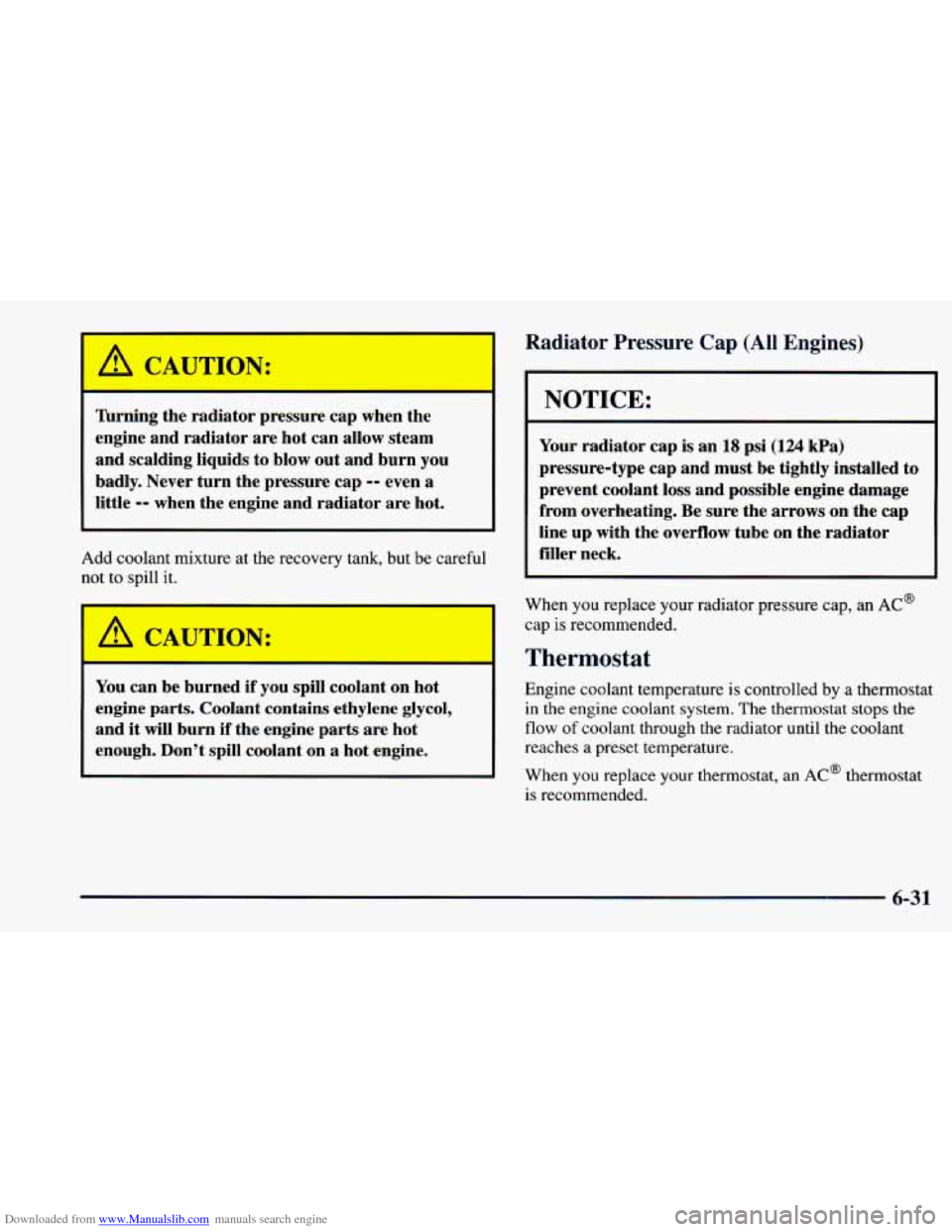
Downloaded from www.Manualslib.com manuals search engine A CAUTION:
Turning the radiator pressure cap when the
engine and radiator are hot can allow steam
and scalding liquids
to blow out and burn you
badly. Never turn the pressure cap
-- even a
little -- when the engine and radiator are hot.
Add coolant mixture at the recovery tank, but be careful
not to spill it.
'
A CAUTION:
You can be burned if you spill coolant on hot
engine parts. Coolant contains ethylene glycol,
and
it will burn if the engine parts are hot
enough. Don't spill coolant on a hot engine.
Radiator Pressure Cap (All Engines)
NOTICE:
Your radiator cap is an 18 psi (124 kPa)
~ pressure-type cap and must be tightly installed to
~ prevent coolant loss and possible engine damage
from overheating. Be sure the arrows on the cap
line up with the overflow tube on the radiator
filler neck.
When you replace your radiator pressure cap, an AC@
cap
is recommended.
Thermostat
Engine coolant temperature is controlled by a thermostat
in the engine coolant system. The thermostat stops the
flow of coolant through the radiator until the coolant
reaches a preset temperature.
When you replace your thermostat, an AC@ thermostat
is recommended.
6-31
Page 302 of 404

Downloaded from www.Manualslib.com manuals search engine Traction -- A, B, C
The traction grades, from highest to lowest, are A, B,
and C, and they represent the tire’s ability to stop on
wet pavement as measured under controlled conditions
on specified government test surfaces of asphalt
and concrete. A tire marked C may have poor
traction performance.
Warning: The traction grade assigned to this tire is based
on braking (straightahead) traction tests and does not
include cornering (turning) traction.
Temper ’ ----, -- A, B, C
The temperature grades are A (the highest), B, and C,
representing the tire’s resistance to the generation of
heat and its ability to dissipate heat when tested under
controlled conditions on a specified indoor laboratory
test wheel. Sustained high temperature can cause the
material of the tire to degenerate and reduce tire life, and
excessive temperature can lead to sudden tire failure.
The grade
C corresponds to a level of performance
which all passenger car tires must meet under the
Federal Motor Vehicle Safety Standard
No. 109. Grades
B and A represent higher levels of performance on the
laboratory test wheel than the minimum required by law.
Warning: The temperature grade for this tire is
established for a tire that is properly inflated and not overloaded. Excessive speed,
underinflation,
or
excessive loading, either separately or in combination,
can cause heat buildup and possible tire failure.
Wheel Alignment and Tire Balance
The wheels on your vehicle were aligned and balanced
carefully at the factory to give you the longest tire life
and best overall performance.
Scheduled wheel alignment and wheel balancing are not
needed. However, if
you notice unusual tire wear or
your vehicle pulling one way
or the other, the alipnment
may need
to be reset. If you notice your vehicle
vibrating when driving on a smooth road, your wheels may need to be rebalanced.
Wheel Replacement
Replace any wheel that is bent, cracked, or badly rusted
or corroded.
If wheel nuts keep coming loose, the wheel,
wheel bolts and wheel nuts should be replaced. If the
wheel leaks air, replace it (except some aluminum
wheels, which can sometimes be repaired).
See your
Chevrolet dealer if any of these conditions exist.
Your dealer will know the kind of wheel you need.
Each new wheel should have the same load-carrying
capacity, diameter, width, offset and be mounted the
same way as the one it replaces.
6-56