Page 268 of 402
Downloaded from www.Manualslib.com manuals search engine What to Do with Used Oil
Did you know that used engine oil contains certain
elements that may be unhealthy for your skin and could
even cause cancer? Don't let used oil stay on your
skin
for very long. Clean your skin and nails with soap and
water, or
a good hand cleaner. Wash or properly throw
away clothing or rags containing used engine oil. (See
the manufacturer's warnings about the use and disposal
of oil products.)
Used oil can be a real threat
to the environment. If you
change
your own oil. be sure to drain all free-flowing oil
from the filter before disposal. Don't ever dispose of oil
by putting
it in the trash. pouring it on the ground, into
sewers, or into streams or bodies of water. Instead,
recycle it by taking
it to a place that collects used oil. If
you have a problem properly disposing of your used oil,
ask your dealer, a service station or a local recycling
center
for help.
Air Cleaner
cr
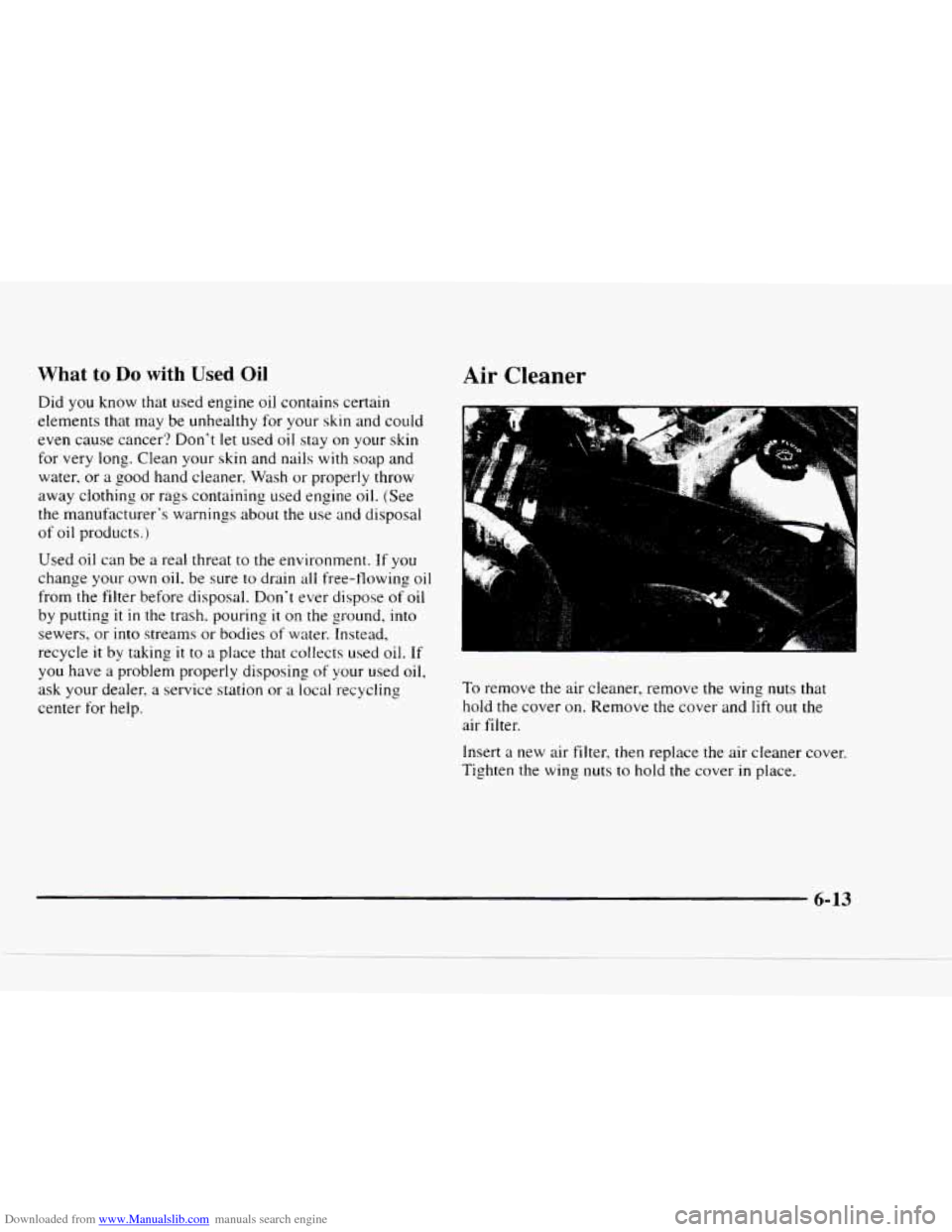
To remove the air cleaner, remove the wing nuts that
hold
the cover on. Remove the cover and lift out the
air filter.
Insert
a new air filter, then replace the air cleaner cover.
Tighten the wing
nuts to hold the cover in place.
- .. 6-13
Page 269 of 402
Downloaded from www.Manualslib.com manuals search engine A CAUTION:
Operating the engine with the air cleaner off can
cause you or others to be burned. The air cleaner
not only cleans the
air, it stops flame if the engine
backfires.
If it isn’t there, and the engine
backfires, you could be burned. Don’t drive with
it
off, and be careful working on the engine with
the air cleaner
off.
NOTICE:
If the air cleaner is off, a backfire can cause a
damaging engine fire. And, dirt can easily get
into your engine, which will damage
it. Always
have the air cleaner in place when you’re driving.
Automatic Transmission Fluid
When to Check and Change
A good time to check your automatic transmission fluid
level is when the engine oil is changed.
Change both the fluid and filter every
50,000 miles
(53 000 km) if the vehicle is mainly driven under one or
more
of these conditions:
In heavy city traffic where the outside temperature
regularly reaches
90°F (32°C) or higher.
In hilly or mountainous terrain.
When doing frequent trailer towing.
Uses such as found in taxi. police or delivery service.
If you do not use your vehicle under any of these
conditions, the fluid and filter
do not require changing.
See “Scheduled Maintenance Services”
in the Index.
6-14
Page 270 of 402
Downloaded from www.Manualslib.com manuals search engine How to Check
Because this operation can be a little difficult, you may
choose
to have this done at your GM dealership
Service Department.
If
you do it yourself, be sure to follow all the
instructions here, or
you could get a false reading
on
the dipstick.
NOTICE:
Too much or too little fluid can damage your
transmission.
Too much can mean that some of
~ the fluid could come out and fall on hot engine
parts
or exhaust system parts, starting a fire. Be
' sure to get an accurate reading if you check your
transmission fluid.
Wait at least 30 minutes before checking the
transmission
fluid level if you have been driving:
0 When outside temperatures are above 90°F (32°C).
At high speed for quite a while.
In heavy traffic -- especially in hot weather.
0 While pulling a trailer.
To get the right reading, the fluid should be at normal
operating temperature, which is
180°F to 200°F (83OC
to 93°C).
Checking Transmission Fluid Hot
Get the vehicle warmed up by driving about 15 miles
(24 km) when outside temperatures are above 50°F
(IOOC). If it's colder than 50°F (IOOC), drive the
vehicle
in DRIVE (D) until the engine temperature gage
moves and then remains steady for
10 minutes. Then
follow the hot check procedures.
6-15
Page 273 of 402
Downloaded from www.Manualslib.com manuals search engine Manual Transmission Fluid
When to Check
A good time to have it checked is when the engine oil is
changed. However, the fluid in your manual
transmission doesn't require changing.
How to Check
Because this operation can be a little difficult. you
rnay choose to have this done at your GM dealership
Service Department.
If you do it yourself. be sure to follow all the
instructions here, or
you could get a false reading.
I NOTICE:
i Too much or too little fluid can damage your
1 transmission. Too much can mean that some of
the fluid could come out and fall on hot engine
parts or exhaust system parts, starting a fire. Be
sure
to get an accurate reading if you check your
transmission fluid.
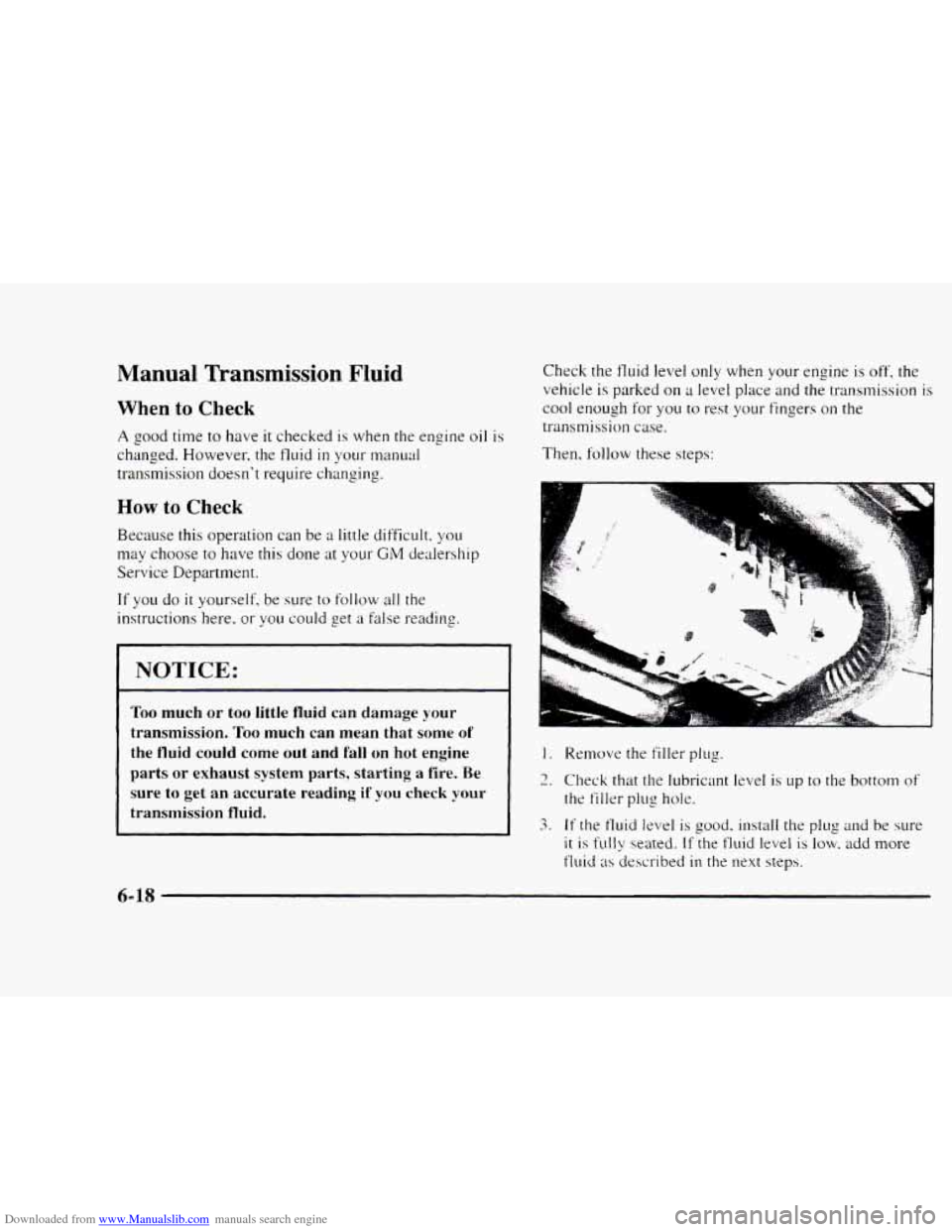
Check the fluid level only when your engine is off, the
vehicle
is parked on a level place and the transmission is
cool enough for
you to rest your fingers on the
transmission case.
Then. follow these steps:
1. Remove the filler plug.
2. Check that the lubricant level is LIP to the bottom of
the filler plug hole.
3. If the fluid level is good. install the pl~~g md be sure
it is f~llly seated. If the fluid level is low. add more
fluid as described in the next steps.
6-18
Page 274 of 402
Downloaded from www.Manualslib.com manuals search engine How to Add Fluid
Here’s how to add fluid. Refer to the Maintenance
Schedule to determine what kind
of fluid to use. See
“Recommended Fluids and Lubricants” in the Index.
I. Remove the filler plug.
2. Add fluid at the filler plug hole. Add only enough
fluid to bring the fluid level
up to the bottom of the
filler plug hole.
3. Install the filler plug. Be sure the plug is fully seated.
Hydraulic Clutch
The hydraulic clutch system in your vehicle is
self-adjusting.
A slight amount of play (1/4 inch to
112 inch or 6 mm to 12 mm) in the pedal is normal.
It isn’t a good idea
to “top off’ your clutch fluid. Adding
fluid won’t correct a leak.
A fluid loss in this system
could indicate a problem. Have the system inspected
and repaired.
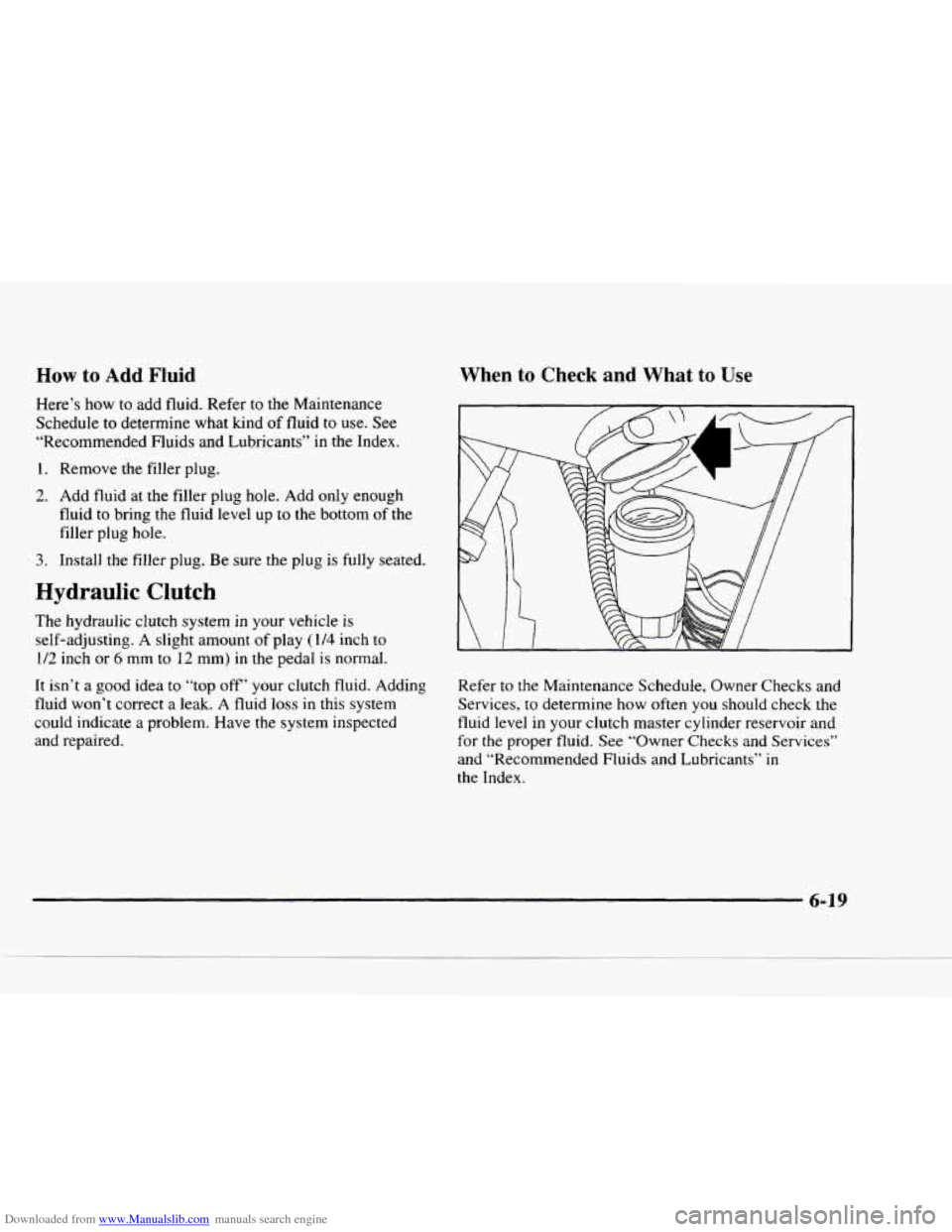
When to Check and What to Use
Refer to the Maintenance Schedule, Owner Checks and
Services, to determine how often you should check the
fluid level in your clutch master cylinder reservoir and
for the proper fluid. See “Owner Checks and Services”
and “Recommended Fluids and Lubricants” in
the Index.
6-19
Page 275 of 402
Downloaded from www.Manualslib.com manuals search engine How to Check How to Check Lubricant
The proper fluid should be added if the level does not
reach the bottom of the diaphragm when it's in place in
the reservoir. See the instructions on the reservoir cap.
Rear Axle
When to Check and Change Lubricant
Refer to the Maintenance Schedule to determine how
often
to check the lubricant and when to change it. See
"Scheduled Maintenance Services"
in the Index.
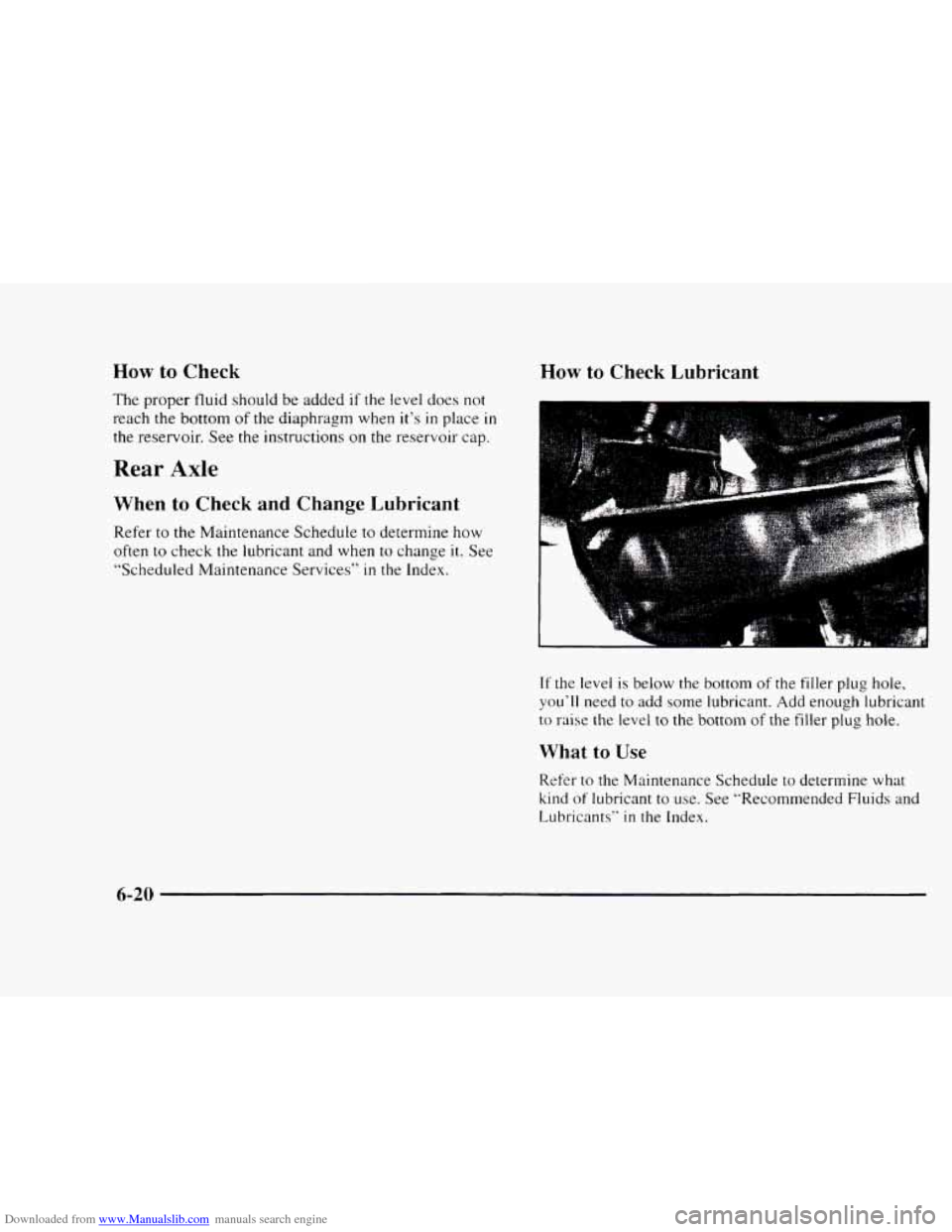
If the level is below the bottom of the fiIler plug hole,
you'll need to add some lubricant. Add enough lubricant
to raise the
level to the bottom of the filler plug hole.
What to Use
Refer to the Maintenance Schedule to determine what
kind of lubricant to use. See "Recommended Fluids and
Lubricants"
in the Index.
6-20
Page 277 of 402
Downloaded from www.Manualslib.com manuals search engine Front Axle
When to Check and Change Lubricant
Refer to the Maintenance Schedule to determine how
often to check the lubricant and when
to change it. See
“Scheduled Maintenance Services” in the Index.
How to Check Lubricant
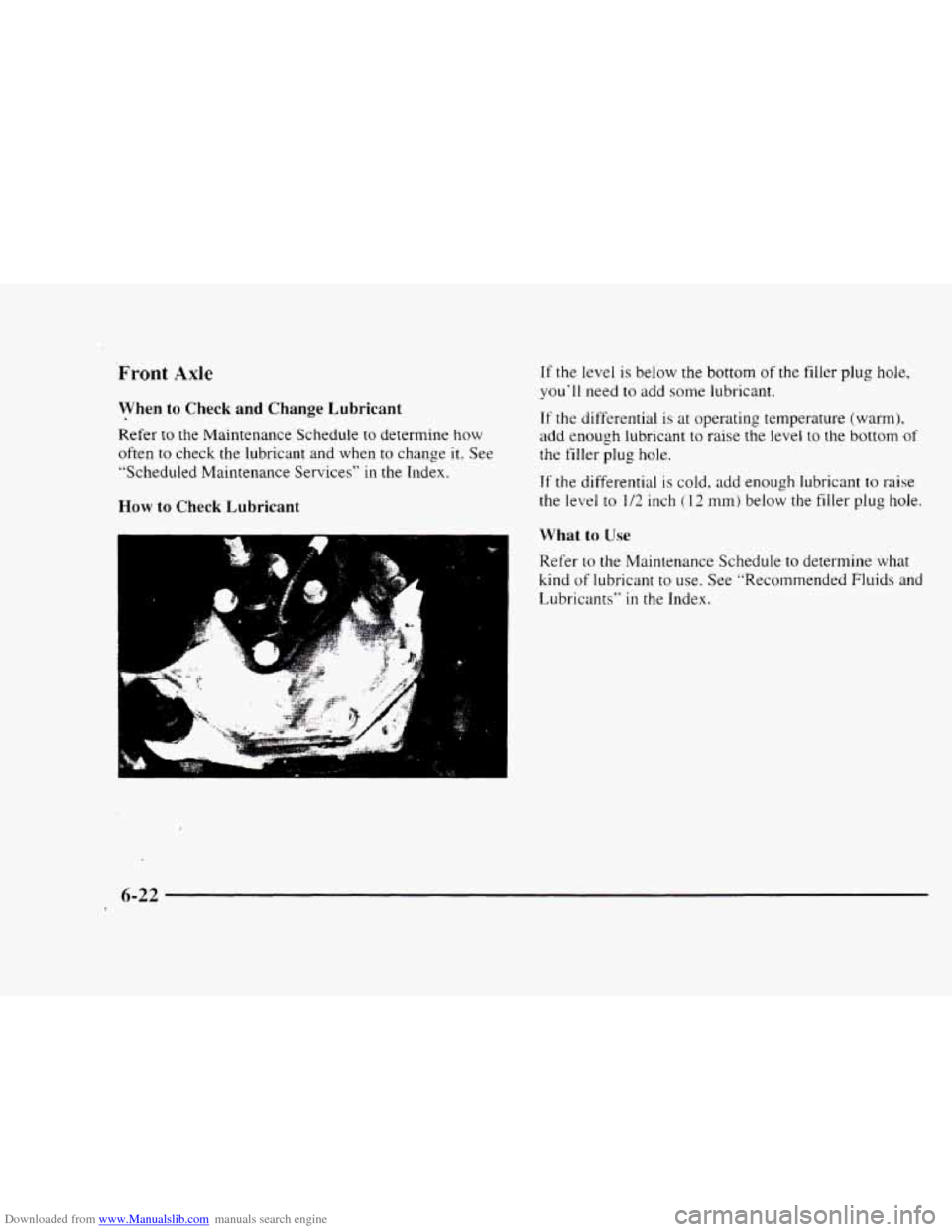
If the level is below the bottom of the filler plug hole,
you‘ll need to add some lubricant.
If the differential is at operating temperature (warm),
add enough lubricant to raise the level
to the bottom of
the filler plug
hole.
If the differential is cold, add enough lubricant to raise
the level to 1/2 inch (: 12 mm) below the filler plug hole.
What to Use
Refer to the Maintenance Schedule to determine what
kind
of lubricant to use. See ”Recommended Fluids and
Lubricants” in the Index.
6-22
Page 295 of 402
Downloaded from www.Manualslib.com manuals search engine B C
-~
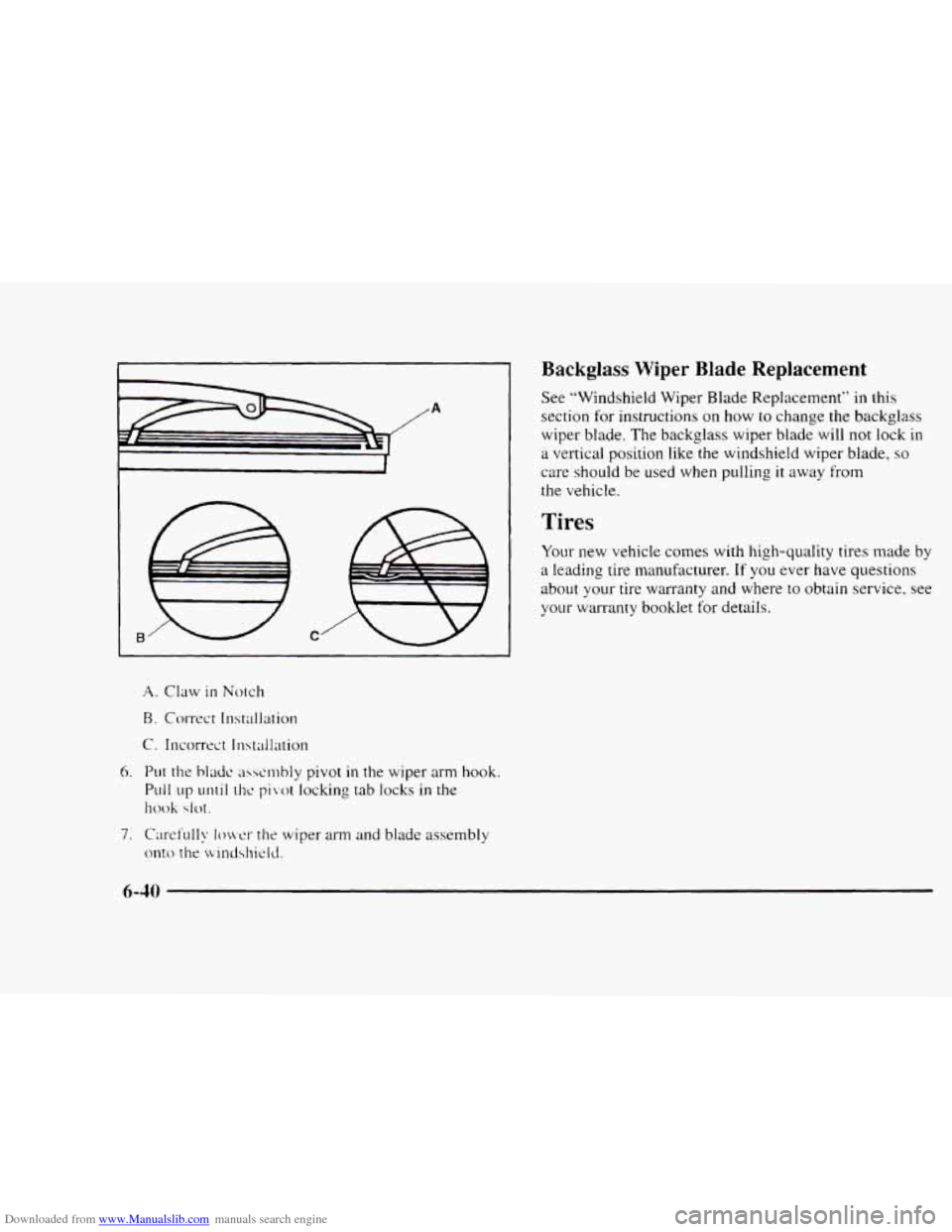
A. Claw in IVotch
B. Correct Installation
C. Incorrect Installation
6.
Put the hlxit. a~st.mbly pivot in the wiper arm hook.
Pull up until fhc pi\.ot locking tab locks in the
hook slot.
7. Caref’uIIv Io .cr the wiper arm and blade assembly
onto the \vindshiclci.
Backglass Wiper Blade Replacement
See “Windshield Wiper Blade Replacement’‘ in this
section
for instructions on how to change the backglass
wiper blade. The backglass wiper blade will
not lock in
a vertical position like the windshield wiper blade, so
care should be used when pulling it away from
the vehicle.
Tires
Your new ve.hicle comes with high-quality tires made by
a leading tire manufacturer. If you ever have questions
about your tire warranty and where
to obtain service. see
your warranty booklet for details.