1997 CHEVROLET BLAZER check engine
[x] Cancel search: check enginePage 134 of 402
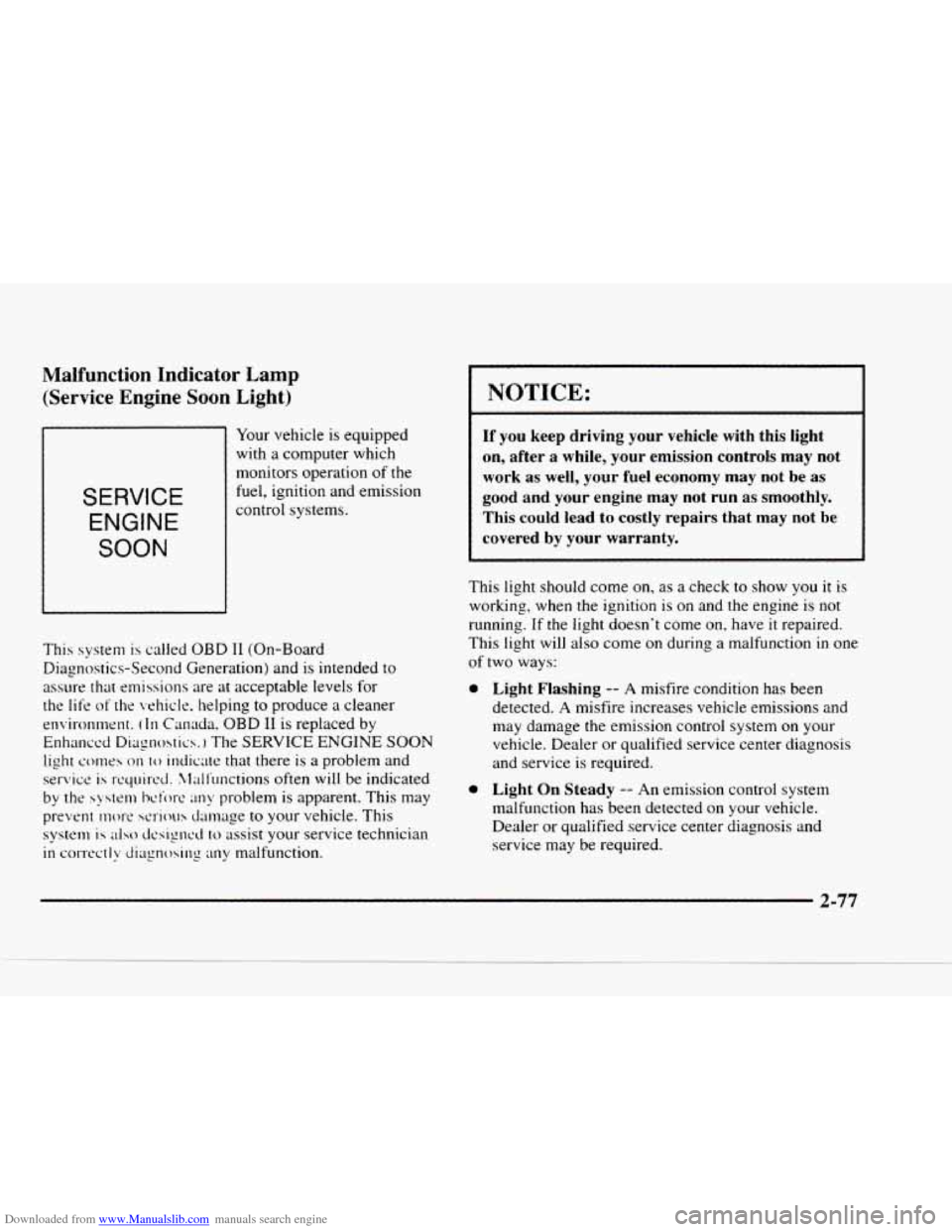
Downloaded from www.Manualslib.com manuals search engine Malfunction Indicator Lamp (Service Engine Soon
Light)
1
Your vehicle is equipped
with a computer which
monitors operation
of the
fuel, ignition and emission
SERVICE
ENGINE
SOON
control systems.
This system
is called OBD I1 (On-Board
Diagnostics-Second Generation) and
is intended to
assure that emissions are at acceptable levels for
the life of
the vehicle. helping to produce a cleaner
environment.
(In Canada. OBD 11 is replaced by
Enhanced
Diqnohtics. The SERVICE ENGINE SOON
light co111es
on to indicate that there is a problem and
service
is rquired. X,l;df'unctions often will be indicated
by the
system bciore any problem is apparent. This may
prevent
mort' serious damage to your vehicle. This
system is also t1csignt.d to assist your service technician
in correctly diagnosing any malfunction.
NOTICE:
If you keep driving your vehicle with this light
on, after a while, your emission controls may not
work as well, your fuel economy may not be as
good and your engine may not run
as smoothly.
This could
lead to costly repairs that may not be
covered by your warranty.
This light should come on, as a check to show you it is
working, when
the ignition is on and the engine is not
running. If the light doesn't come on, have it repaired.
This light will also come
on during a malfunction in one
of two ways:
0 Light Flashing -- A misfire condition has been
detected.
A misfire increases vehicle emissions and
may damage
the emission control system on your
vehicle. Dealer or qualified service center diagnosis
and service
is required.
0 Light On Steady -- An emission control system
malfunction has been detected on
your vehicle.
Dealer or qualified service center diagnosis and
service may be required.
2-77
Page 135 of 402
Downloaded from www.Manualslib.com manuals search engine If the Light Is Flashing
The following may prevent more serious damage to
your vehicle:
0 Reducing vehicle speed.
0 Avoiding hard accelerations.
Avoiding steep uphill grades.
If you are towing a trailer. reduce the amount of
cargo being hauled as soon as it is possible.
If the light stops trashing and remains on steady. see "If
the Light Is On Steady" following.
If the light continues to flash, when it is safe to do so.
stop the lyehiclc. Find a safe place to park your vehicle.
Turn the key off, wait at least
10 seconds and restart the
engine.
If the light remains on steady. see "If the Light
Is On Steady" following. If the light is still flashing,
follow the previous steps. and drive the vehicle
to your
dealer
or qualified service center for service.
If the Light Is On Steady
You may be able to correct the emission system
malfunction by considering the following:
Did you recently
put fuel into your vehicle'?
If so, reinstall the fuel cap. making sure to fully install
the cap. The diagnostic system can determine
if the fuel cap
has been left off
or improperly installed. A loose or
missing fuel cap will allow fuel to evaporate into the
atmosphere.
A few driving trips with the cap properly
installed should turn the light off.
Did you just drive through a deep puddle of water'?
If so. your electrical system may be wet. The condition
will usually be corrected when the electrical system
dries out.
A few driving trips should turn the light off.
Have you recently changed brands of fuel?
If so. be sure to fuel your vehicle with quality fuel (see
"Fuel"
in the Index). Poor fuel quality will cause your
engine not
to run as efficiently as designed. You may
notice
this as stalling after start-up. stalling when you put
the vehicle into gear, misfiring, hesitation on acceleration
or stumbling
on acceleration. (These conditions may go
away once the engine is warmed up.) This will be detected
by the system and cause the light to turn on.
If you experience one or more of these conditions.
change the fuel brand
you use. It will require at least one
full tank of the proper fuel to turn the light off.
tr none of the above steps have made the light turn off,
have your ciealer or qualified service center check the
vehicle. Your dealer has the proper test equipment and
diagnostic
tools to fix any mechanical or electrical
problems
that may have developed.
2-78
Page 136 of 402
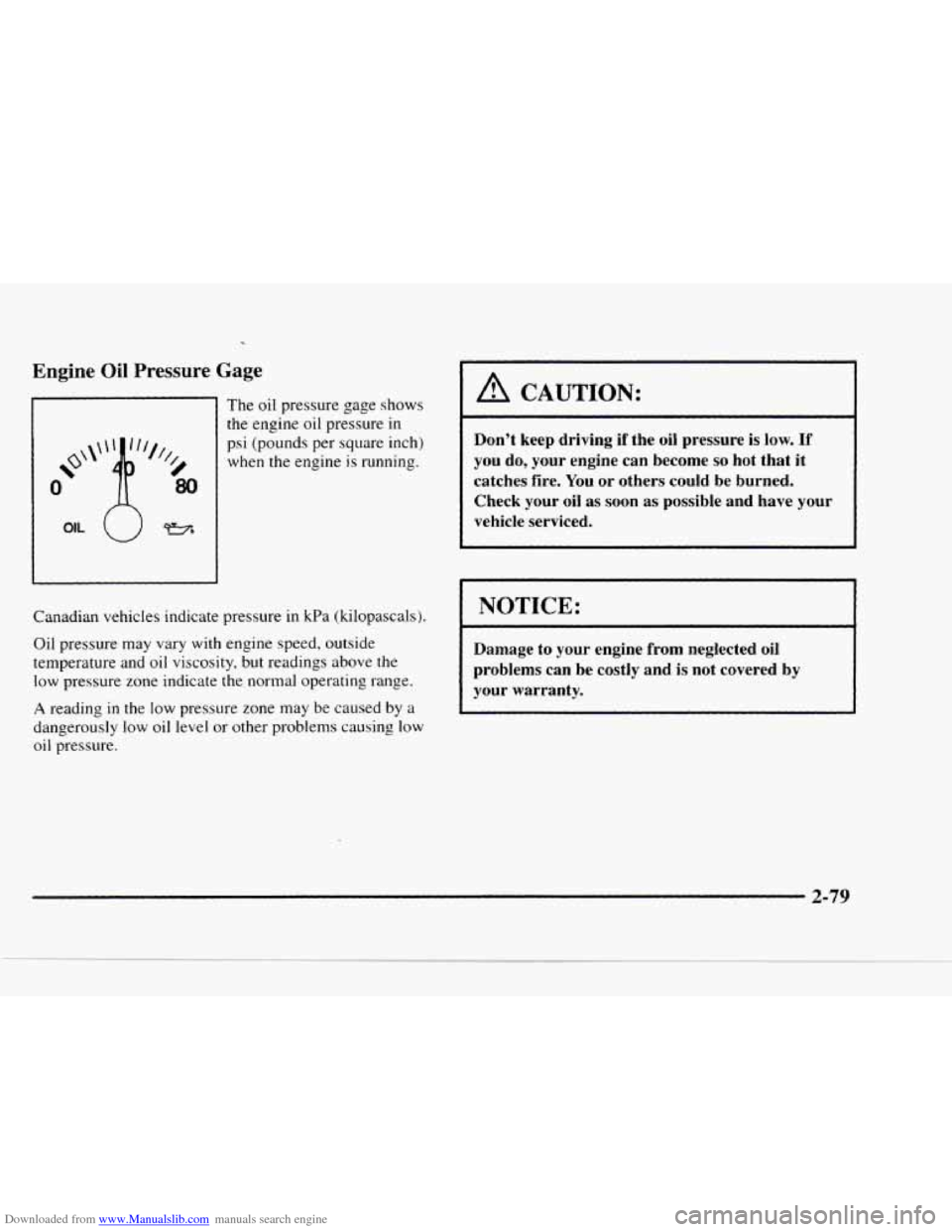
Downloaded from www.Manualslib.com manuals search engine Engine Oil Pressure Gage
011 0-
The oil pressure gage shows
the engine oil pressure in
psi (pounds per square inch)
when the engine
is running.
Canadian vehicles indicate pressure in kPa (kilopascals).
Oil pressure may vary with engine speed, outside
temperature and oil viscosity, but readings above the
low pressure zone indicate
the normal operating range.
A reading in the low pressure zone may be caused by a
dangerously low oil level or other ~roblems causing low
oil pressure.
A CAUTION:
Don't keep driving if the oil pressure is low. If
you do, your engine can become
so hot that it
catches fire.
You or others could be burned.
Check your oil
as soon as possible and have your
vehicle serviced.
NOTICE:
Damage to your engine from neglected oil
problems can be costly and is not covered by
your warranty.
2-79
Page 137 of 402
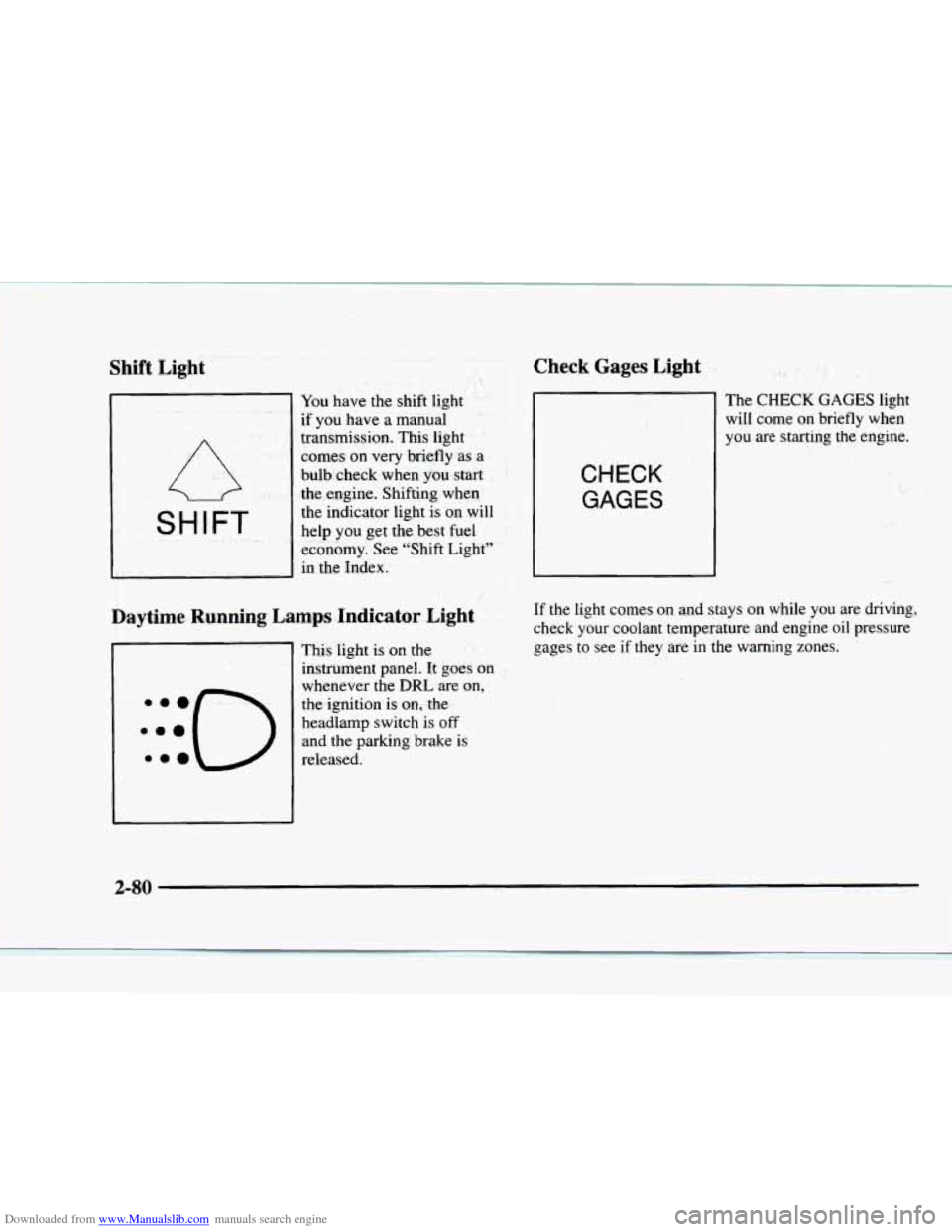
Downloaded from www.Manualslib.com manuals search engine Shift Light
-w
/fls 1
You have the shift light
if you have a manual
transmission. This light
comes
on very briefly as a
bulb check when
you start
the engine. Shifting when
the indicator light is on will
help you get
the best fuel
economy. See "Shift Light"
in the Index.
1 'd 8.
Daytime Running Lamps Indicator Light
This light is on the
instrument panel. It goes on
whenever the
DRL are on,
the ignition is on,.the
headlamp switch is
off
and the parking brake is
released.
Check Gages Light
CHECK GAGES
The CHECK GAGES light
will come on briefly when
you are starting the engine.
:
.. * ,. ,. , i ..3
I I.. -_. .
If the light comes on and stays on while you are driving,
check your coolant temperature and engine oil pressure
gages to see if they are in the warning zones.
1;
.I. ..
' , .;i ,- ..
"j
.. . .
2-80
Page 159 of 402
Downloaded from www.Manualslib.com manuals search engine To help avoid hearing loss or damage:
Adjust the volume control to the lowest setting.
Increase volume slowly until you hear comfortably
and clearly.
1 NOTICE:
Before you add any sound equipment to your
vehicle
-- like a tape player, CB radio, mobile
telephone or two-way radio
-- be sure you can add
what you want.
If you can, it’s very important to do
it properly. Added
sound equipment may interfere
with the operation
of your vehicle’s engine, Delco
radio or other systems, and even damage them.
Your vehicle’s systems may interfere with the
operation
of sound equipment that has been
added improperly
So, hefore adding sound equipment, check with
your dealer and
tw sure to check Federal rules
covering
mobile radio and telephone units.
Care of Your Cassette Tape Player
A tape player that is not cleaned regularly can cause
reduced sound quality, ruined cassettes or
a damaged
mechanism. Cassette tapes should be stored
in their
cases away from contaminants, direct sunlight and
extreme heat.
If they aren’t, they may not operate
properly or may cause failure
of the tape player.
Your tape player
should be cleaned regularly after every
50 hours of use. If you notice a reduction in sound
quality, try a known good cassette to see if
it is the tape
or the tape player
at fault. If this other cassette has no
improvement
in sound quality, clean the tape player.
Cleaning may be done with a scrubbing action,
non-abrasive cleaning cassette
with pads which scrub
the tape head
as the hubs of the cleaner cassette turn. It
is normal for the cassette to eject while cleaning. Insert
the cassette at least three times to ensure thorough
cleaning.
A scrubbing action cleaning cassette is
available through your GM dealership.
3-20
Page 160 of 402
Downloaded from www.Manualslib.com manuals search engine You may also choose a non-scrubbing action, wet-type
cleaner which uses
a cassette with a fabric belt to clean
the tape head. This type
of cleaning cassette will not
eject and,
it may not clean as thoroughly as the
scrubbing type cleaner.
Cassettes
are subject to wear and the sound quality
may degrade over
time. Always make sure the cassette
tape is
in good condition before you have your tape
player serviced.
Care of Your Compact Discs
Handle discs carefully. Store them in their original cases
or other protective cases and away from direct sunlight
and dust.
If the surface of a disc is soiled, dampen a
clean, soft cloth in a mild, neutral detergent solution and
clean it, wiping from the center
to the edge.
Be sure never to touch the signal surface when handling
discs. Pick
up discs by grasping the outer edges or the
edge
of the hole and the outer edge.
Fixed Mast Antenna
The fixed mast antenna can withstand most car washes
without being damaged. If
the mast should ever become
slightly bent, you can straighten
it out by hand. If the
mast is badly bent, as
it might be by vandals, you should
replace it.
Check
every once in a while to be sure the mast is still
tightened
to the fender.
3-2 1
Page 168 of 402
Downloaded from www.Manualslib.com manuals search engine Avoid needless heavy braking. Some people drive in
spurts
-- heavy acceleration followed by heavy
braking
-- rather than keeping pace with traffic. This is a
mistake. Your brakes may not have time to cool between
hard stops. Your brakes
will wear out much faster if you
do a lot of heavy braking. If you keep pace with the
traffic and allow realistic following distances,
you will
eliminate a
lot of unnecessary braking. That means
better braking and longer brake
life.
If your engine ever stops while you‘re driving, brake
normally but don’t
pump your brakes. If you do, the
pedal may get harder
to push down. If your engine
stops,
you will still have some power brake assist. But
you will
use it when you brake. Once the power assist is
used up, it may take longer to stop and the brake pedal
will be harder
to push.
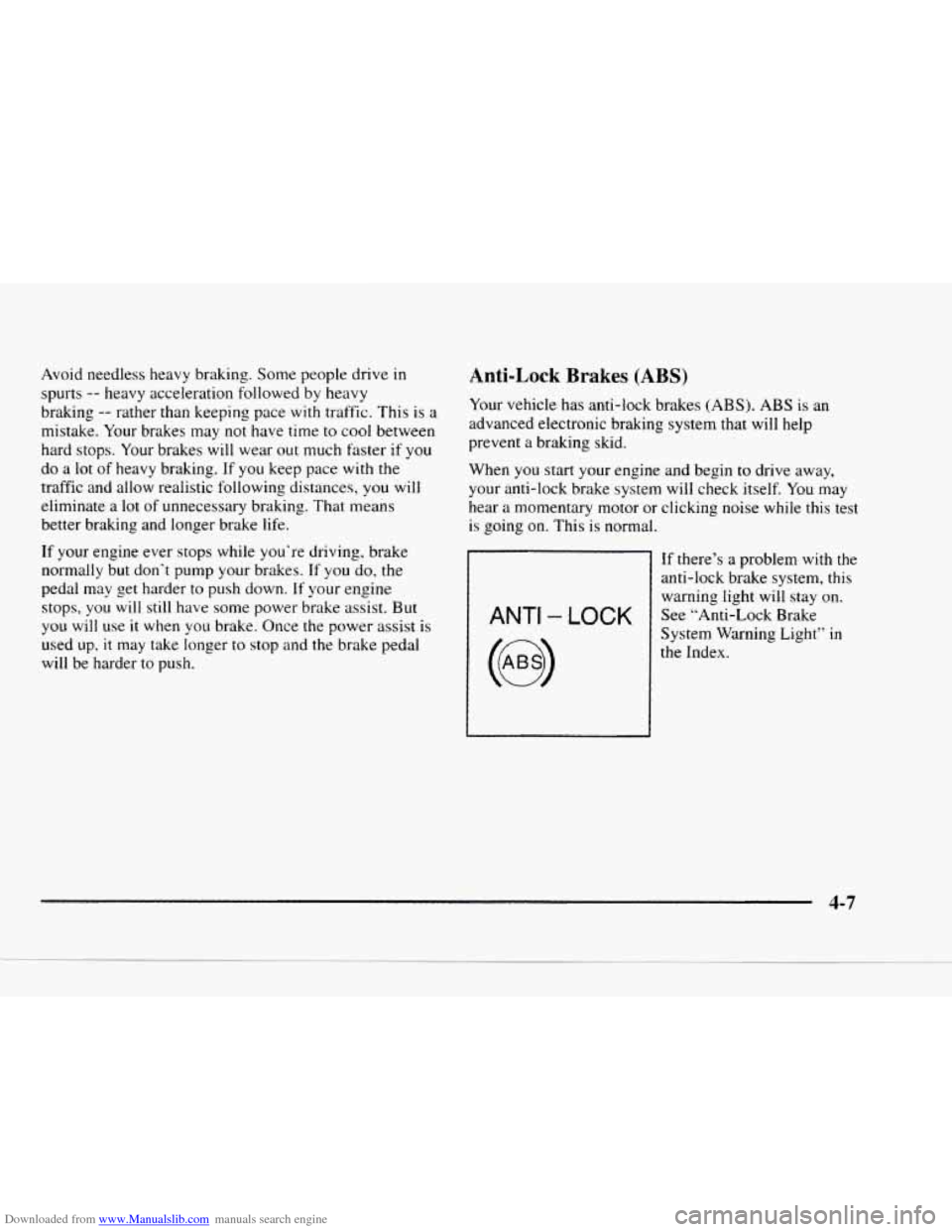
Anti-Lock Brakes (ABS)
Your vehicle has anti-lock brakes (ABS). ABS is an
advanced electronic braking system that will help
prevent a braking skid.
When
you start your engine and begin to drive away,
your anti-lock brake system will check itself.
You may
hear a momentary motor or clicking noise while this test
is going on. This is normal.
ANTI - LOCK
If there’s a problem with the
anti-lock brake system, this
warning light will stay
on.
See “Anti-Lock Brake
System Warning Light”
in
the Index.
-. 4-7
Page 173 of 402
Downloaded from www.Manualslib.com manuals search engine Passing
The driver of a vehicle about to pass another on a
two-lane highway waits
for just the right moment.
accelerates, moves around
the vehicle ahead. then goes
back into the right lane again.
A simple maneuver?
Not necessarily! Passing another vehicle on
a two-lane
highway is
a potentially dangerous move, since the
passing vehicle occupies the same lane as oncoming
traffic for several seconds.
A miscalculation. an error in
judgment. or a brief surrender to frustration or anger can
suddenly
put the passing driver face to face with the
worst of all traffic accidents
-- the head-on collision.
So here are some tips for passing:
"Drive ahead." Look down the road. to the sides and to
crossroads for situations that might affect your passing
patterns.
If you have any doubt whatsoever about
malung
a successful pass. wait for a better time.
Watch for traffic signs, pavement markings and lines.
If you can see a sign up ahead that might indicate a
turn or an intersection. delay your pass. A broken
center line usually indicates it's
all right to pass
(providing the road ahead is clexj. Never cross a solid
line
on your side of the lane or a double solid line.
even
if the road seems empty of approaching traffic.
Do not get too close to the vehicle you want to pass
while you're awaiting an opportunity. For one thing,
following too closely reduces your area
of vision.
especially
if you're following a larger vehicle.
Also, you won't have adequate space if the vehicle
ahead suddenly slows or stops. Keep back
a
reasonable distance.
When it looks like a chance to pass is coming up,
start to accelerate but stay in the right lane and don't
get too close. Time your move
so you will be
increasing speed as the time comes to move into the
other lane.
If the way is clear to pass. you will have a
"running start" that more than makes up for the
distance you would lose
by dropping back. And if
something happens to cause you to cancel your pass.
you need only slow down
and drop back again and
wait for another opportunity.
If other cars are lined up to pass a slow vehicle, wait
your turn.
But take care that someone isn't trying to
pass you
as you pull out to pass the slow vehicle.
Remember
to glance over your shoulder and check
the blind spot.
4-12