1997 CHEVROLET BLAZER stop start
[x] Cancel search: stop startPage 122 of 402
Downloaded from www.Manualslib.com manuals search engine This device complies with Part 15 of the FCC Rules.
Operation
is subject to the following two conditions:
(1) This device may not cause harmful interference, and
(2) This device must accept any interference received,
including interference
that may cause undesired operation.
Programming the Transmitter
Do not use the transmitter with any garage door opener
that does
not have the “stop and reverse’’ feature. This
includes any garage door opener model manufactured
before April
1, 1982.
Be sure that people crnd objects are clear of the garage
door j~ur are progrmnming!
Your vehicle’s engine should be turned off while
programming
the transmitter. Follow these steps to
program up to three channels:
1. If you have not previously programmed a universal
channel. proceed to Step
2. Otherwise, hold down the
two outside buttons on the universal transmitter until
the
red light begins IO !lash rapidly (approximately
20 seconds). Then release the buttons. This procedure
initialiLes
thc memory and erases any previous
settings tor all three channels.
2. Hold the end of the hand-held transmitter against the
bottom surface of the universal transmitter so that
you can still see the red light.
3. Decide which one of the three channels you want to
program. Using both hands, press
the hand-held
transmitter button and
the desired button on the
universal transmitter. Continue
to hold both buttons
through Step
4.
4. Hold down both buttons until you see the red light
on
the universal transmitter flash rapidly. The rapid
flashing, which could take up
to 90 seconds,
indicates that
the universal transmitter has been
programmed. Release both buttons once
the light
starts to flash rapidly.
11 you have trouble programming the universal
transmitter, make sure that you have followed
the
directions exactly as described and that the battery in the
hand-held transmitter is
not dead. If you still cannot
program
it, rotate the hand-held transmitter end over end
and try again. The universal transmitter may not work
with older garage door openers that
do not meet current
Federal Consumer Safety Standards. If you cannot
program the transmitter after repeated attempLs, consult
your
GM dealer.
Be sure to keep the original hand-held transmitter
in case
you need to erase and reprogram
the universal transmitter.
2-65
Page 133 of 402
Downloaded from www.Manualslib.com manuals search engine Anti-Lock Brake System Warning Light
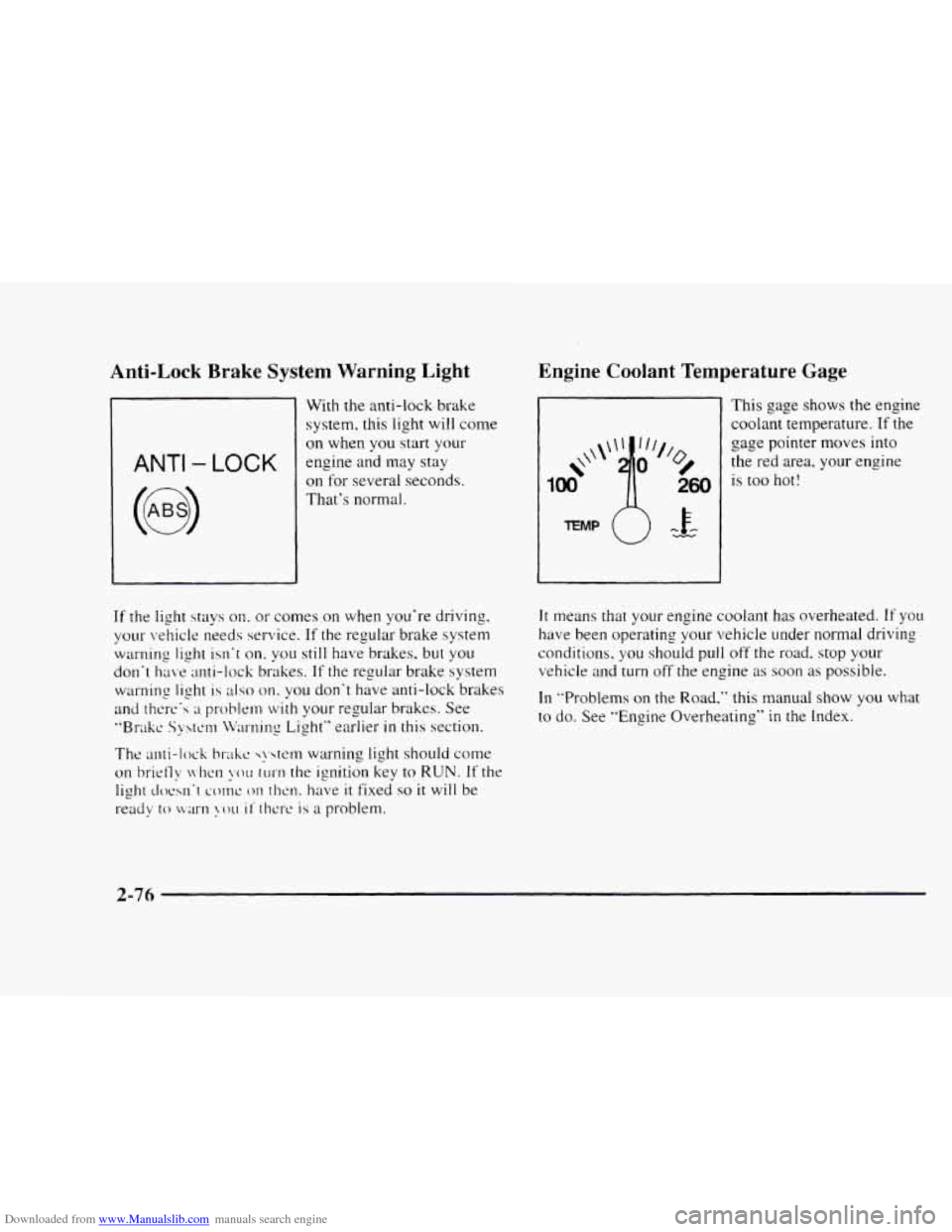
ANTI - LOCK
With the anti-lock brake
system, this light will come
on when you start your
engine and may stay
on for several seconds.
That's normal.
Engine Coolant Temperature Gage
This gage shows the engine
coolant temperature.
If the
gage pointer moves
into
is too hot!
the
red area, your engine 260
If the light stays on. or comes on when you're driving,
your irehick needs service.
If the regular brake system
warning
light isn't on. you still have brakes. but you
don't
have anti-lock brakes. If the regular brake system
warning light
is also on. you don't have anti-lock brakes
and there's
;I problern with your regular brakes. See
"B1-akc. Svstcm LVmling Light" earlier in this section.
The anti-lock brakc. s>.4tem warning light should come
on briet'ly n.hct1
~.ou turn the ignition key to RUN. If the
light doesn't co1nc3 011 111cn. have it fixed so it will be
ready
to w;m U)LI it' thew is a problem. lt means
that your engine coolant
have been operating your vehicle has
overheated.
If you
under normal driving
conditions. you should pull off the road.
stop your
vehicle and
turn off the engine as soon as possible.
In "Problems on the Road." this manual show you what
to
do. See "Engine Overheating" in the Index.
2-76
Page 135 of 402
Downloaded from www.Manualslib.com manuals search engine If the Light Is Flashing
The following may prevent more serious damage to
your vehicle:
0 Reducing vehicle speed.
0 Avoiding hard accelerations.
Avoiding steep uphill grades.
If you are towing a trailer. reduce the amount of
cargo being hauled as soon as it is possible.
If the light stops trashing and remains on steady. see "If
the Light Is On Steady" following.
If the light continues to flash, when it is safe to do so.
stop the lyehiclc. Find a safe place to park your vehicle.
Turn the key off, wait at least
10 seconds and restart the
engine.
If the light remains on steady. see "If the Light
Is On Steady" following. If the light is still flashing,
follow the previous steps. and drive the vehicle
to your
dealer
or qualified service center for service.
If the Light Is On Steady
You may be able to correct the emission system
malfunction by considering the following:
Did you recently
put fuel into your vehicle'?
If so, reinstall the fuel cap. making sure to fully install
the cap. The diagnostic system can determine
if the fuel cap
has been left off
or improperly installed. A loose or
missing fuel cap will allow fuel to evaporate into the
atmosphere.
A few driving trips with the cap properly
installed should turn the light off.
Did you just drive through a deep puddle of water'?
If so. your electrical system may be wet. The condition
will usually be corrected when the electrical system
dries out.
A few driving trips should turn the light off.
Have you recently changed brands of fuel?
If so. be sure to fuel your vehicle with quality fuel (see
"Fuel"
in the Index). Poor fuel quality will cause your
engine not
to run as efficiently as designed. You may
notice
this as stalling after start-up. stalling when you put
the vehicle into gear, misfiring, hesitation on acceleration
or stumbling
on acceleration. (These conditions may go
away once the engine is warmed up.) This will be detected
by the system and cause the light to turn on.
If you experience one or more of these conditions.
change the fuel brand
you use. It will require at least one
full tank of the proper fuel to turn the light off.
tr none of the above steps have made the light turn off,
have your ciealer or qualified service center check the
vehicle. Your dealer has the proper test equipment and
diagnostic
tools to fix any mechanical or electrical
problems
that may have developed.
2-78
Page 156 of 402
Downloaded from www.Manualslib.com manuals search engine CD AUX: To switch between the player and the radio
when
a disc is playing, press the AM-FM button. To
return
to the player, press CD AUX. When a disc is
playing,
the letters CD and the CD symbol will appear
on the display. (If the radio is turned off, the disc stays
in the player and will resume playing at the point where
it stopped.)
EJECT: Press this button to eject the disc from the
player and play the radio.
When the same or
a new disc is inserted, the disc wilI
start playing on track one. If
a compact disc is left
sitting
in the opening for more than a few seconds, the
player will pull the
CD back in. The radio will continue
playing. When the ignition is off, press this button to
load a CD. If you leave a compact disc in the player
while listening
to the radio. it may become warm.
Theft-Deterrent Feature
THEFTLOCK” is designed to discourage theft of your
radio. It works by using a secret code to disable all radio
functions whenever battery power
is removed.
The THEFTLOCK feature
for the radio may be used or
ignored.
If ignored, the system plays normally and the
radio is not protected by the feature. If THEFTLOCK is
activated, your radio will not operate if stolen.
When THEFTLOCK
is activated, the radio will display
LOC
to indicate a locked condition anytime battery
power
is removed. If your battery loses power for any
reason, you must unlock the radio with the secret code
before it will operate.
Activating the Theft-Deterrent Feature
The instructions which follow explain how to enter your
secret code to activate
the THEFTLOCK system. It is
recommended that you read through all nine steps
before starting the procedure.
NOTE: If you allow more than 15 seconds to elapse
between any steps, the radio automatically reverts
to
time and you must start the procedure over at Step 4.
3-17
Page 168 of 402
Downloaded from www.Manualslib.com manuals search engine Avoid needless heavy braking. Some people drive in
spurts
-- heavy acceleration followed by heavy
braking
-- rather than keeping pace with traffic. This is a
mistake. Your brakes may not have time to cool between
hard stops. Your brakes
will wear out much faster if you
do a lot of heavy braking. If you keep pace with the
traffic and allow realistic following distances,
you will
eliminate a
lot of unnecessary braking. That means
better braking and longer brake
life.
If your engine ever stops while you‘re driving, brake
normally but don’t
pump your brakes. If you do, the
pedal may get harder
to push down. If your engine
stops,
you will still have some power brake assist. But
you will
use it when you brake. Once the power assist is
used up, it may take longer to stop and the brake pedal
will be harder
to push.
Anti-Lock Brakes (ABS)
Your vehicle has anti-lock brakes (ABS). ABS is an
advanced electronic braking system that will help
prevent a braking skid.
When
you start your engine and begin to drive away,
your anti-lock brake system will check itself.
You may
hear a momentary motor or clicking noise while this test
is going on. This is normal.
ANTI - LOCK
If there’s a problem with the
anti-lock brake system, this
warning light will stay
on.
See “Anti-Lock Brake
System Warning Light”
in
the Index.
-. 4-7
Page 173 of 402
Downloaded from www.Manualslib.com manuals search engine Passing
The driver of a vehicle about to pass another on a
two-lane highway waits
for just the right moment.
accelerates, moves around
the vehicle ahead. then goes
back into the right lane again.
A simple maneuver?
Not necessarily! Passing another vehicle on
a two-lane
highway is
a potentially dangerous move, since the
passing vehicle occupies the same lane as oncoming
traffic for several seconds.
A miscalculation. an error in
judgment. or a brief surrender to frustration or anger can
suddenly
put the passing driver face to face with the
worst of all traffic accidents
-- the head-on collision.
So here are some tips for passing:
"Drive ahead." Look down the road. to the sides and to
crossroads for situations that might affect your passing
patterns.
If you have any doubt whatsoever about
malung
a successful pass. wait for a better time.
Watch for traffic signs, pavement markings and lines.
If you can see a sign up ahead that might indicate a
turn or an intersection. delay your pass. A broken
center line usually indicates it's
all right to pass
(providing the road ahead is clexj. Never cross a solid
line
on your side of the lane or a double solid line.
even
if the road seems empty of approaching traffic.
Do not get too close to the vehicle you want to pass
while you're awaiting an opportunity. For one thing,
following too closely reduces your area
of vision.
especially
if you're following a larger vehicle.
Also, you won't have adequate space if the vehicle
ahead suddenly slows or stops. Keep back
a
reasonable distance.
When it looks like a chance to pass is coming up,
start to accelerate but stay in the right lane and don't
get too close. Time your move
so you will be
increasing speed as the time comes to move into the
other lane.
If the way is clear to pass. you will have a
"running start" that more than makes up for the
distance you would lose
by dropping back. And if
something happens to cause you to cancel your pass.
you need only slow down
and drop back again and
wait for another opportunity.
If other cars are lined up to pass a slow vehicle, wait
your turn.
But take care that someone isn't trying to
pass you
as you pull out to pass the slow vehicle.
Remember
to glance over your shoulder and check
the blind spot.
4-12
Page 175 of 402
Downloaded from www.Manualslib.com manuals search engine If your vehicle starts to slide. ease your foot off the
accelerator pedal and quickly steer the way
you want the
vehicle to
go. If you start steering quickly enough. your
vehicle may straighten
out. Always be ready for a
second skid
if it occurs.
Of course, traction is reduced when water, snow. ice.
gravel or other material is on the road. For safety. you’ll
want to
slow down and adjust your driving to these
conditions.
It is important to slow down on slippery
surfaces because stopping distance will be longer and
vehicle control more limited.
While driving on a surface with reduced traction.
try
your best to avoid sudden steering, acceleration or
braking (including engine braking by shifting to a lower
You may not realize the surface
is slippery until your
vehicle is skidding. Learn to recognize warning
clues
-- such as enough water. ice or packed snow on
the road to make a “mirrored surface“
-- and slow down
when you have any doubt.
t oear). Any sudden changes could cause the tires to slide.
Remember: Any anti-lock brake system
(ABS) helps
avoid only the braking skid.
Driving Guidelines
This multipurpose passenger vehicle is defined as a utility
vehicle
in Consumer Information Regulations issued by
the National Highway Traffic Safety Administration
(NHTSA) of the United States Department of
Transportation. Utility vehicles have higher ground
clearance and a nmower track to make them capable
of
perfolming in a wide variety of off-road applications.
Specific design characteristics give them a higher center of
gravity than ordinary cars.
An advantage of the higher
to anticipate problems. They are
not designed for
cornering at the same speeds as conventional
two-wheel-drive vehicles any more than low-slung
sports
cars are designed to perform satisfactorily under off-road
conditions.
If at all possible, avoid sharp turns or abrupt
maneuvers.
As with other vehicles of this type, failure to
operate this vehicle correctly may result
in loss of control
or vehicle rollover.
2 oround clearance is a better view of the road allowing you
4-14
Page 179 of 402
Downloaded from www.Manualslib.com manuals search engine Scanning the Terrain
Off-road driving can take you over mLmy different kinds
of terrain.
You need to be fatniliar with the terrain and its
many different features.
Here are some things to consider.
Surface Cmditiom. Off-roading can take you over
hard-packed dirt, gravel. rocks. grass. sand, mud, snow
or ice. Each
of these surfaces affects the steering,
acceleration and brakinz
of your vehicle in different
ways. Depending upon the kind of surfxe you are on.
you may experience slipping. sliding. wheel spinning.
delayed acceieration, poor traction and longer
braking distances.
Sru-fnce 0hstcrcle.v. Unseen or hidden obstacles can be
hazardous.
A rock. log hole. rut or bump CUI startle you if
you're not prepared for them. Often these obstacles are
hidden
by grass, bushes. snow or even the rise and fall of
the terrain itself. Here are some things to consider:
Is the path ahead clear'?
0 Will the surface texture change abruptly up ahead'?
Does the travel take you uphill or downhill'? (There's
more discussion
of these sub-jects later.)
Will you have to stop suddenly or change
direction quicklv'? When
you drive
over obstacles or rough terrain, keep a
firm grip on the steering wheel. Ruts, troughs or other
surface features can jerk the wheel out of
your hands if
you're not prepared.
When
you drive over bumps. rocks, or other obstacles,
your wheels can leave
the ground. If this happens. even
with one or two wheels, you can't control the vehicle as
well or at all.
Because you
will be on an unpaved surface. it's
especially important to avoid sudden acceleration.
sudden
turns or sudden braking.
In a way, off-road driving requires a different kind of
alertness from driving on paved roads and highways.
There are
no road signs. posted speed limits or signal
lights. You have to
use your own good judgment about
what is
safe and what isn't.
Drinking and driving can be very dangerous on any
road.
And this is certainty true for off-road driving. At
the very time you need special alertness and driving
skills, your reflexes. perceptions and judgment can be
affected
by even z1 small amount of alcohol. You could
have a serious -- or even fatal -- accident if you drink
and drive or ride with a driver who has been drinking.
See "Drunken Driving" in the index.
4-18