Page 265 of 404
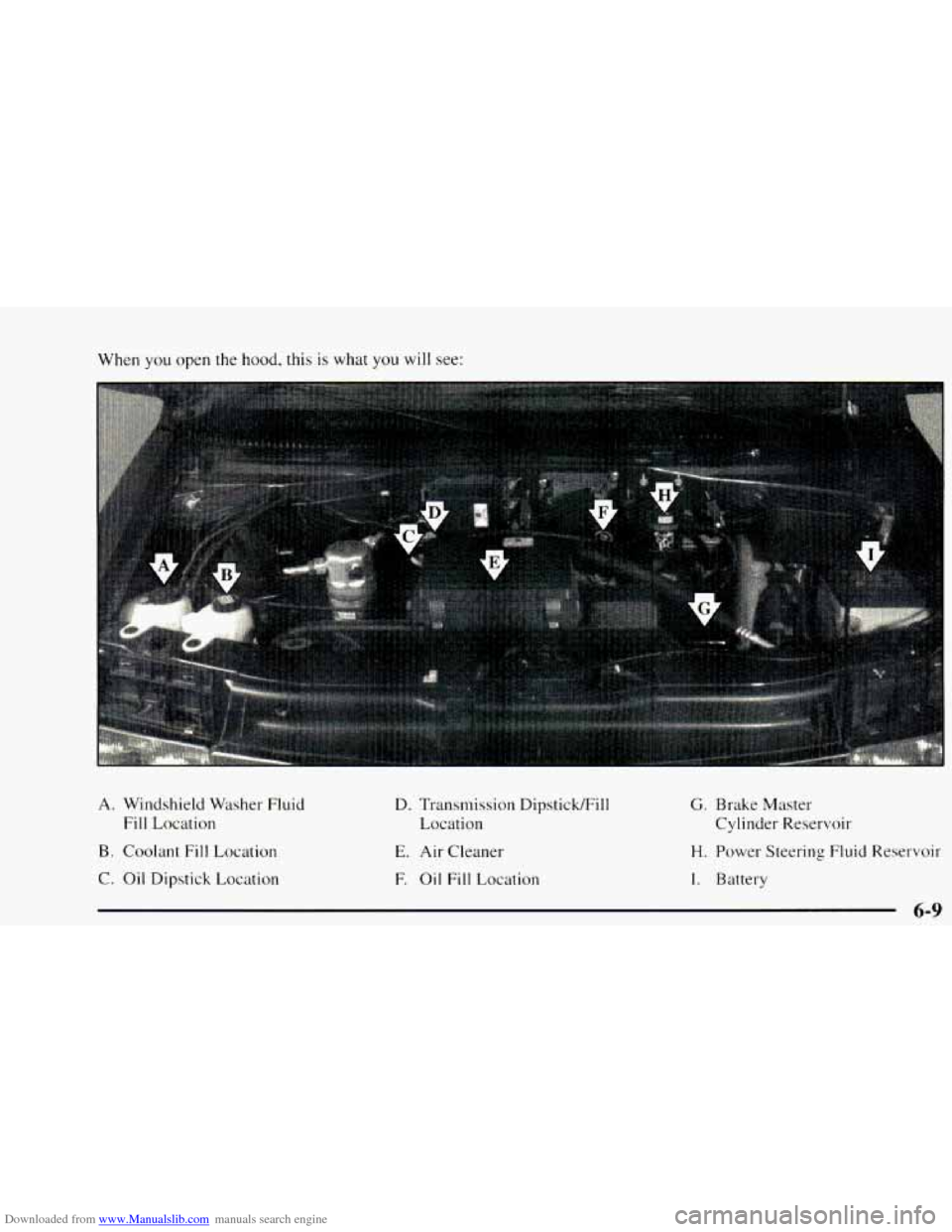
Downloaded from www.Manualslib.com manuals search engine When you open the hood, this is what you will see:
A. Windshield Washer Fluid
Fill Location
B. Coolant Fill Location
C. Oil Dipstick Location D. Transmission Dipstick/Fill
Location
E. Air Cleaner
F.
Oil Fill Location
G. Brake Master
Cylinder Reservoir
H. Power Steering Fluid Reservoir
I. Battery
6-9
Page 281 of 404

Downloaded from www.Manualslib.com manuals search engine Rear Axle What to Use .
When to Check and Change Lubricant
Refer to the Maintenance Schedule to determine how
often
to check the lubricant and when to change it. See
“Scheduled Maintenance Services” in the Index.
How to Check Lubricant
If the level is below the bottom of the filler plug hole,
you’ll need
to add some lubricant. Add enough lubricant
to raise
the level to the bottom of the filler plug hole. Refer to the Maintenance Schedule to
determine what
kind of lubricant to use. See “Recommended Fluids and
Lubricants”
in the Index.
Engine Coolant
The cooling s stem in your vehicle is filled with new
DEX-COOL
J engine coolant. This coolant is designed
to remain in your vehicle for 5 years or 150,000 miles
(240 000 km) whichever occurs first, if you add only
DEX-COOL’ extended life coolant.
The following explains your cooling system and how to
add coolant when
it is low. If you have a problem with
engine overheating, see “Engine Overheating”
in
the Index.
A 50/50 mixture of water and DEX-COOL@ coolant for
your vehicle
will:
Give freezing protection down to -34°F (-37°C).
Give boiling protection up to 265°F (129°C).
Protect against rust and corrosion.
Help keep the proper engine temperature.
0 Let the warning lights and gages work as they should.
6-25
Page 282 of 404
Downloaded from www.Manualslib.com manuals search engine I
NOTICE:
When adding coolant, it is important that you use
only
DEX-COOL’ (silicate-free) coolant.
If coolant other than DEX-COOL’ is added to
the system, premature engine, heater core or radiator corrosion may result. In addition, the
engine coolant will require change sooner
-- at
30,000 miles (50 000 km) or 24 months,
whichever occurs first. Damage caused by the
use
of coolant other than DEX-COOL@ is not
covered by your new vehicle warranty.
What to Use
Use a mixture of one-half clean wuter (preferably
distilled) and one-half
DEX-COOL@ coolant which
won’t damage aluminum parts.
If you use this mixture,
you don’t need to add anything else.
Adding only plain water to your cooling system
can be dangerous. Plain water, or some other
liquid like alcohol, can boil before the proper
coolant mix will, Your vehicle’s coolant warning
system is set for the proper coolant mix. With
plain water or the wrong mix, your engine could
get too hot but you wouldn’t get the overheat
warning. Your engine could catch fire and you or
others could be burned, Use a
50/50 mix of clean
water and DEX-COOL@ antifreeze.
6-26
Page 283 of 404
Downloaded from www.Manualslib.com manuals search engine NOTICE:
If you use an improper coolant mix, your engine
could overheat and be badly damaged. The repair cost wouldn’t be covered by your
warranty. Too much water in the mix can freeze
and crack the engine, radiator, heater core and
other parts.
If you have to add coolant more than four times a year,
have your dealer check your cooling system.
I NOTICE:
If you use the proper coolant, you don’t have to
add extra inhibitors or additives which claim to
improve the system. These can be harmful.
Checking Coolant
When your engine is cold, the coolant level should be at
ADD, or a little higher. When your engine is warm, the
level should be up
to FULL HOT, or a little higher.
6-27
Page 284 of 404
Downloaded from www.Manualslib.com manuals search engine Adding Coolant
If you need more coolant, add the proper DEX-COOL@
coolant mixture at the coolant recovery tank.
I
I:
A
Add coolant mix at the recovery tank, but be careful not
to spill it.
'hrning the radiator pressure cap when the
engine and radiator are hot can allow steam and
scalding liquids to blow out and burn you badly.
With the coolant recovery tank,
you will almost
never have to add coolant
at the radiator.
Never turn the radiator pressure cap
-- even a
little -- when the engine and radiator are hot.
I A CAUTION:
You can be burned if you spill coolant on hot
engine parts. Coolant contains ethylene glycol,
and it will burn if the engine parts
are hot
enough. Don't spill coolant on
a hot engine.
6-28
Page 285 of 404
Downloaded from www.Manualslib.com manuals search engine Radiator Pressure Cap
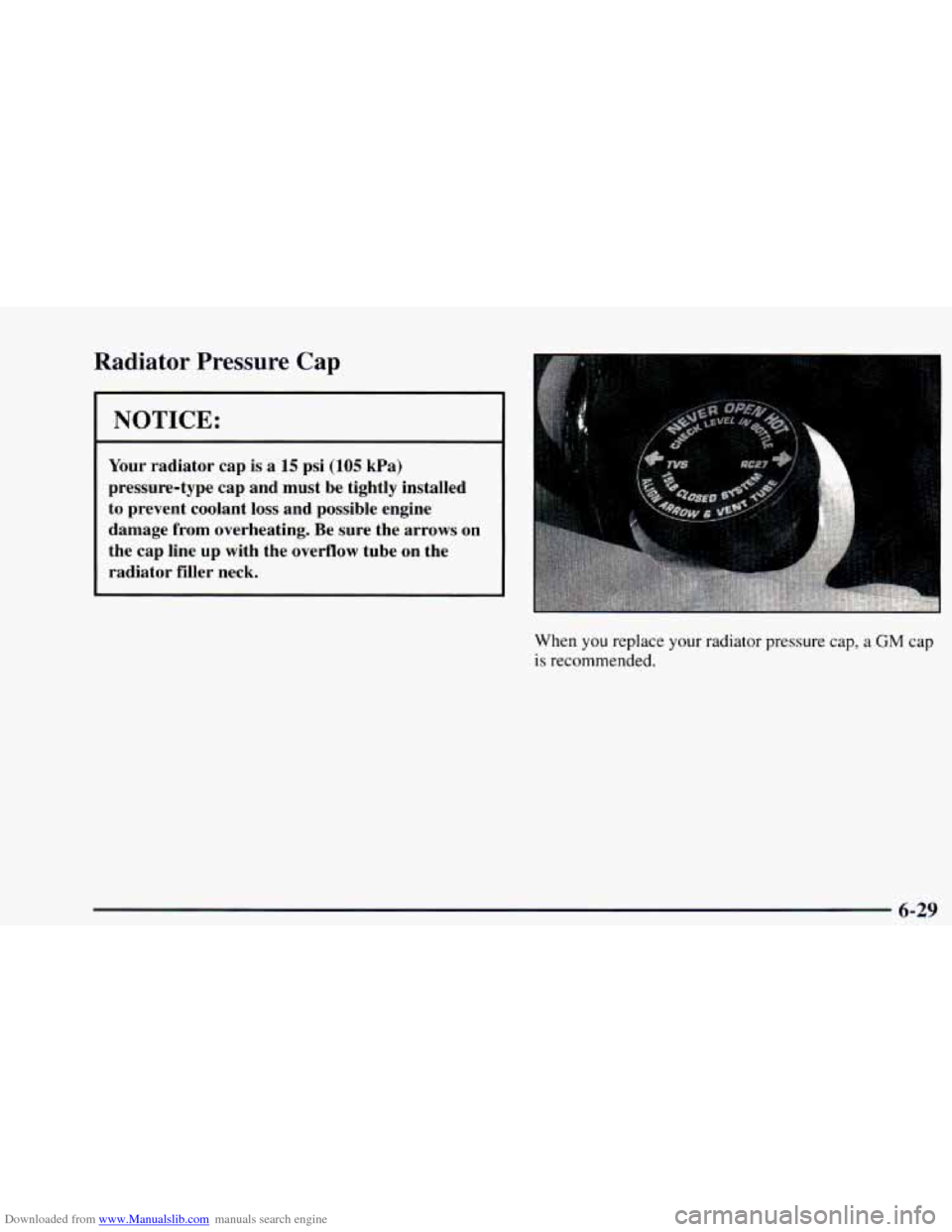
I NOTICE:
~~
Your radiator cap is a 15 psi (105 kPa)
pressure-type cap and must be tightly installed
to prevent coolant loss and possible engine
damage from overheating. Be sure the arrows
on
the cap line up with the overflow tube on the
radiator filler neck.
When you replace your radiator pressure cap, a GM cap
is recommended.
6-29
Page 286 of 404

Downloaded from www.Manualslib.com manuals search engine Thermostat
Engine coolant temperature is controlled by a thermostat
in the engine coolant system. The thermostat stops the
flow
of coolant through the radiator until the coolant
reaches
a preset temperature.
Power Steering Fluid
When to Check Power Steering Fluid
It is not necessary to regularly check power steering
fluid unless you suspect there is
a leak in the system or
you hear an unusual noise. A fluid loss in this system
could indicate a problem. Have the system inspected
and repaired.
How To Check Power Steering Fluid
When the engine compartment is cool, unscrew the cap
and wipe the dipstick
with a clean rag. Replace the cap
and completely tighten it. Then remove the cap again
and look at the fluid level on the dipstick.
The level should be at the
FULL COLD mark. If
necessary, add only enough fluid to bring the level up
to the mark.
What to Use
To determine what kind of fluid to use, see
“Recommended Fluids and Lubricants”
in the Index.
Always use the proper fluid. Failure to use the proper
fluid can cause leaks and damage
hoses and seals.
6-30
Page 353 of 404
Downloaded from www.Manualslib.com manuals search engine I Short Trip/City Maintenance Schedule I
100,000 Miles (166 000 km)
CI Inspect spark plug wires.
An Emission Control Service.
Replace spark plugs.
0 Inspect Positive Crankcase Ventilation
(Pcv) valve.
An Emission Control Service.
An Emission Control Service.
DATE
SERVICED BY: ACTUAL MILEAGE
150,000 Miles (240 000 km)
CI Drain, flush and refill cooling system
(or
every 60 months since last service,
whichever occurs first). See “Engine
Coolant” in the Index for what to use.
Inspect hoses. Clean radiator, condenser,
pressure cap and neck. Pressure test cooling
system and pressure cap.
An Emission Control Service.
DATE ACTUAL MILEAGE
I I
SERVICED BY: I
I
7-29