1997 CHEVROLET ASTRO wheel
[x] Cancel search: wheelPage 90 of 404
Downloaded from www.Manualslib.com manuals search engine NOTICE:
Don’t operate accessories in the ACCESSORY
position for long periods of time. Prolonged
operation
of accessories in the ACCESSORY
position could drain your battery and prevent
you from starting your vehicle.
LOCK (B): This position locks your ignition, steering
wheel and transmission shift lever in
PARK (P). It’s a
theft-deterrent feature. You will only be able to remove
your key when the ignition
is turned to LOCK.
OFF (C): This position lets you turn off the engine but
still turn the steering wheel. Use
OFF if you must have
your vehicle
in motion while the engine is off (for
example, if your vehicle is being towed).
RUN (D): This is the position for driving.
START (E): This starts your engine.
NOTICE:
If your key seems stuck in LOCK and you can’t
turn it, be sure you are using the correct key; if
so, is it all the way in? If it is, then turn the
steering wheel left and right while you turn the
key hard. But turn the key only with your hand.
Using
a tool to force it could break the key or the
ignition switch. If none of this works, then your
vehicle needs service.
2-16
Page 93 of 404
Downloaded from www.Manualslib.com manuals search engine A CAUTION:
Plugging the cord into an ungrounded outlet could cause an electrical shock.
Also, the wrong
kind of extension cord could overheat and cause
a fire. You could be seriously injured. Plug the
cord into a properly grounded three-prong 110-volt
AC outlet. If the cord won’t reach, use
a heavy-duty three-prong extension cord rated
for at least
15 amps.
4. Before starting the engine, be sure to unplug and
store the cord as it was before
to keep it away
from moving engine parts. If
you don’t, it could
be damaged.
How long should you keep the coolant heater plugged
in? The answer depends on the outside temperature, the
kind of oil you have, and some other things. Instead
of
trying to list everything here, we ask that you contact
your
GM dealer in the area where you’ll be parking your
vehicle. The dealer can give you the best advice for that
particular area.
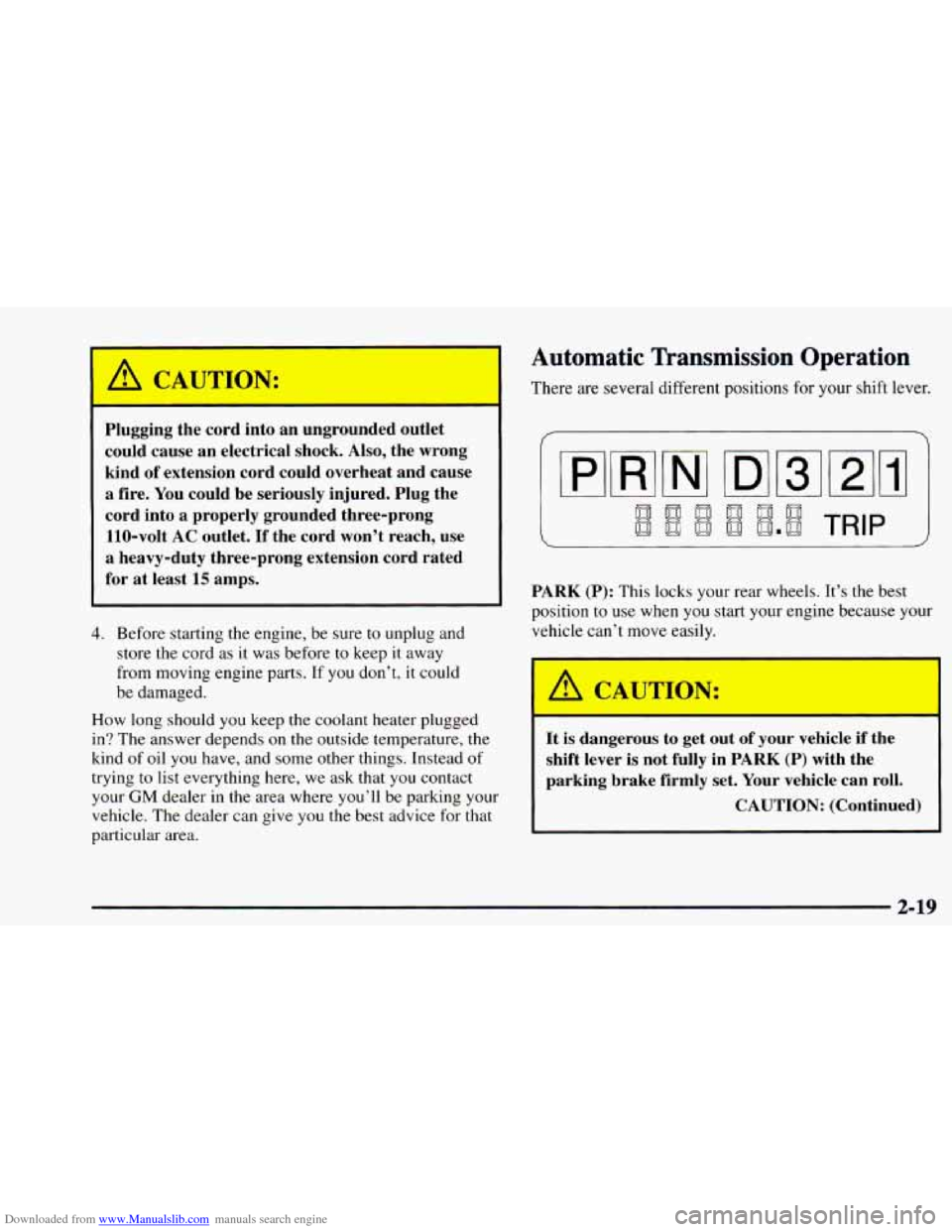
Automatic Transmission Operation
There are several different positions for your shift lever.
PARK
(P): This locks your rear wheels. It’s the best
position to use when you start your engine because your
vehicle can’t move easily.
I A CAUTION:
It is dangerous to get out of your vehicle if the
shift lever is not fully in
PARK (P) with the
parking brake firmly set. Your vehicle can roll.
CAUTION: (Continued)
2-19
Page 95 of 404

Downloaded from www.Manualslib.com manuals search engine NEUTRAL (N): In this position, your engine doesn’t
connect with the wheels.
To restart when you’re
already moving,
use NEUTRAL (N) only. Also, use
NEUTRAL (N) when your vehicle is being towed.
I
Shifting out of PARK (P) or NEU’I AL (N) while
your engine is “racing” (running at high speed)
is
dangerous. Unless your foot is firmly on the
brake pedal, your vehicle could move very
rapidly.
You could lose control and hit people or
objects. Don’t shift out of PARK (P) or
NEUTRAL
(N) while your engine is racing.
NOTICE:
Damage to your transmission caused by shifting
out of PARK (P) or NEUTRAL
(N) with the
engine racing isn’t covered by your warranty. DRIVE
(D):
This position is for normal driving. If you
need more power for passing, and you’re:
0 Going less than about 35 mph (56 kmk), push your
accelerator pedal about halfway down.
0 Going about 35 mph (56 kdh) or more, push the
accelerator pedal all the way down. You’ll shift
down
to the next gear and have more power.
DRIVE
(D) should be used for normal towing.
THIRD (3): This position is also used for normal
driving, however
it offers more power and lower fuel
economy than DRIVE (D).
You should use THIRD (3)
when carrying a heavy load or driving on steep hills.
SECOND (2): This position gives you more power but
lower
fuel economy. You can use SECOND (2) on hills.
It can help control your speed as
you go down steep
mountain roads, but then
you would also want to use
your brakes
off and on.
If you manually select SECOND
(2), the transmission
will drive in second gear.
You may use this feature
for reducing torque to the rear wheels when you are
trying
to start your vehicle from a stop on slippery
road surfaces.
2-21
Page 96 of 404
Downloaded from www.Manualslib.com manuals search engine FIRST (1): This position gives you even more power
(but lower fuel economy) than
SECOND (2). You can
use it
on very steep hills, or in deep snow or mud. If the
selector lever is put in FIRST
(l), the transmission
won’t shift into first gear until the vehicle is going
slow enough.
NOTICE:
If your rear wheels can’t rotate, don’t try to
drive. This might happen if you were stuck in
very deep sand or mud or were up against
a solid
object. You could damage your transmission or
transfer case or both.
Also, if you stop when going uphill, don’t hold
your vehicle there with only the accelerator
pedal. This could overheat and damage the transmission. Use your brakes or shift into
PARK
(P) to hold your vehicle in position
on a hill.
Locking Rear Axle
If you have this feature, your rear axle can give you
additional traction on snow, mud, ice, sand or gravel. It
works like a standard axle most of the time, but when
one
of the rear wheels has no traction and the other does,
the locking feature will allow the wheel with traction to
move the vehicle.
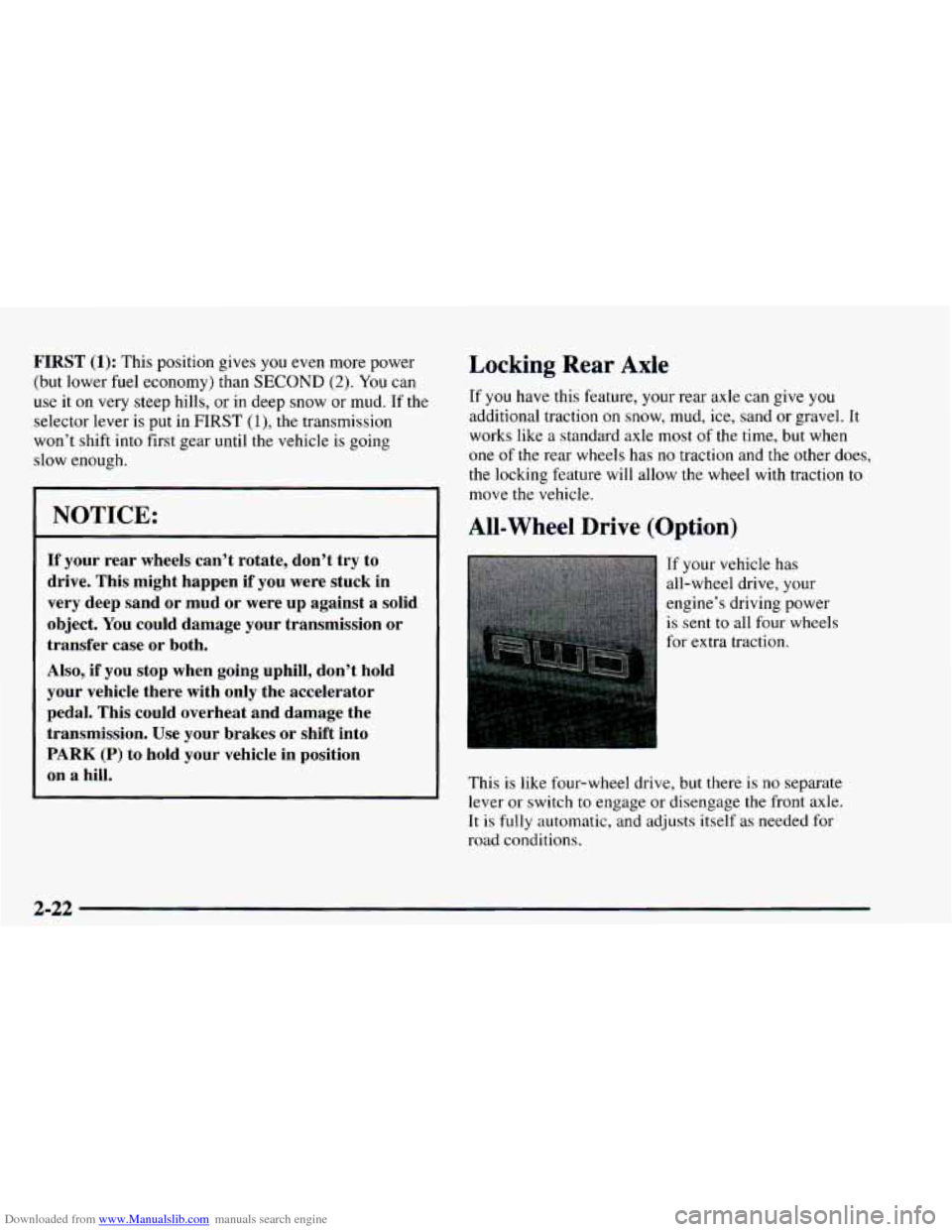
All-Wheel Drive (Option)
If your vehicle has
all-wheel drive, your
engine’s driving power
is sent to all four wheels
for extra traction.
This is like four-wheel drive, but there is
no separate
lever
or switch to engage or disengage the front axle.
It is fully automatic, and adjusts itself as needed
for
road conditions.
2-22
Page 105 of 404

Downloaded from www.Manualslib.com manuals search engine Horn
To sound the horn, press the horn symbols on the
steering wheel.
Tilt Wheel (If Equipped)
A tilt steering wheel allows you to adjust the steering
wheel before you drive.
You can also raise it to the highest level to give your
legs more room when you exit and enter the vehicle.
Turn SignaVMultifunction Lever
The lever on the driver’s side of the steering column
includes your:
Turn and Lane Change Signals
0 Headlamp HighLow Beam Changer
0 Windshield Wipers
0 Windshield Washer
0 Cruise Control (Option) To tilt the wheel, hold the steering wheel and pull the
lever. Move the steering wheel
to a comfortable level,
then release the lever to lock the wheel in place.
2-31
Page 108 of 404

Downloaded from www.Manualslib.com manuals search engine Rear Window WasherWiper (Option)
You control your rear
window washedwiper
from a switch on your
instrument panel, next to
the audio system.
To turn the wiper on, slide the switch all the way up.
For delay wiping, slide the switch even with the word
DELAY in the center position of the rear wiper control.
The wiper will cycle every
nine seconds.
To wash the window, push in on the switch, Window
washer fluid will continue to spray until the switch is
released. The wiper will continue with three more wipes
and then return to
the setting that was chosen before the
lever was pushed.
The rear window washer uses the same fluid bottle as
the front windshield washer. If the fluid level is low in
the washer bottle, you may not be able to wash your rear
window. If
you can wash your windshield, but not your
rear window, check the fluid level.
Cruise Control
With cruise control, you can maintain a speed of about
25 mph (40 kmh) or more without keeping your foot
on the accelerator. This can really help on long trips.
Cruise control does not work at speeds below about
25 mph (40 km/h).
When
you apply your brakes, the cruise control
shuts off.
Cruise control can be dangerous where you
can’t drive safely at a steady speed.
So,
don’t use your cruise control on winding
roads or in heavy traffic.
slippery roads. On such roads, fast changes
in tire traction can cause needless wheel
spinning, and you could lose control. Don’t
use cruise control on slippery roads.
Cruise control can be dangerous on
2-34
Page 185 of 404
Downloaded from www.Manualslib.com manuals search engine Remember: Anti-lock doesn’t change the time you need
to get your foot up to the brake pedal or always decrease
stopping distance.
If you get too close to the vehicle in
front of you, you won’t have time to apply your brakes
if that vehicle suddenly slows or stops. Always leave
enough room up ahead to stop,
even though you have
anti-lock brakes.
Using Anti-Lock
Don’t pump the brakes. Just hold the brake pedal down
and let anti-lock work for
you. You may feel the brakes
vibrate, or you may notice some noise, but
* ‘.s is normal.
Braking in Emergencies
With anti-lock, you can steer and brake at the same
time. In many emergencies, steering can help you more
than even the very best braking.
Steering
Power Steering
If you lose power steering assist because the engine
stops or the system
is not functioning, you can steer but
it will take much more effort.
Steering Tips
Driving on Curves
It’s important to take curves at a reasonable speed.
A lot of the “driver lost control’’ accidents mentioned on
the news happen on curves. Here’s why:
Experienced driver or beginner, each
of us is subject to
the same laws of physics when driving on curves. The
traction
of the tires against the road surface makes it
possible for the vehicle to change its path when you turn
the front wheels. If there’s no traction, inertia will keep
the vehicle going in the same direction.
If you’ve ever
tried
to steer a vehicle on wet ice, you’ll understand this.
The traction
you can get in a curve depends on the
condition of your tires and the road surface,
the angle at
which the curve is banked, and your speed. While you’re
in a curve, speed is the one Factor you can control.
Suppose you’re steering through
a sharp curve. Then you
suddenly accelerate. Both control systems -- steering and
acceleration
-- have to do their work where the tires meet
the road. Adding the sudden acceleration can demand too much
of those places. You can lose control.
4-9
Page 186 of 404
Downloaded from www.Manualslib.com manuals search engine What should you do if this ever happens? Ease up on the
accelerator pedal, steer the vehicle the way
you want it
to go, and slow down.
Speed limit signs near curves warn that
you should
adjust your speed. Of course, the posted speeds are
based
on good weather and road conditions. Under less
favorable conditions you’ll want
to go slower.
If you need
to reduce your speed as you approach a
curve,
do it before you enter the curve, while your front
wheels are straight ahead.
Try to adjust your speed
so you can “drive” through the
curve. Maintain a reasonable, steady speed. Wait to
accelerate until you are
out of the curve, and then
accelerate gently into the straightaway.
Steering in Emergencies
There are times when steering can be more effective than
braking. For example,
you come over a hill and find a
truck stopped in your
lane, or a car suddenly pulls out
from nowhere, or a child darts out from between parked
cars and stops right in front
of you. You can avoid these
problems
by braking -- if you can stop in time. But
sometimes you can’t; there isn’t room, That’s the time for
evasive action
-- steering around the problem.
Your vehicle can perform very well in emergencies like
these. First apply your brakes. (See “Braking in
Emergencies” earlier in this section.)
It is better to
remove as much speed as you can from a possible
collision. Then steer around
the problem, to the left or
right depending on the space available.
4-10