1997 CADILLAC ELDORADO ignition
[x] Cancel search: ignitionPage 83 of 361
Downloaded from www.Manualslib.com manuals search engine c
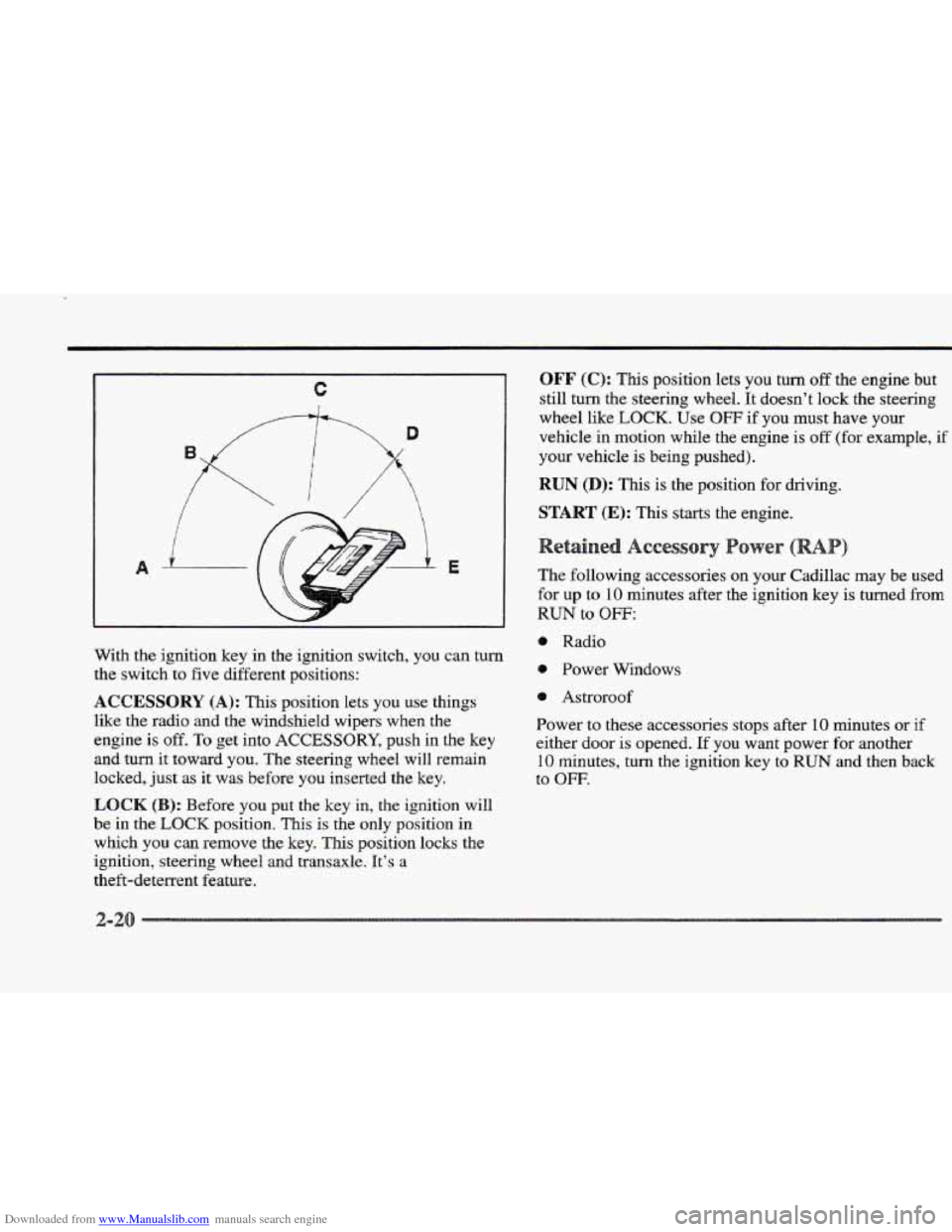
With the ignition key in the ignition switch, you can turn
the switch
to five different positions:
ACCESSORY (A): This position lets you use things
like the radio and the windsheld wipers when the
engine is off.
To get into ACCESSORY, push in the key
and turn it toward you. The steering wheel will remain
locked, just as it was before you inserted
the key.
LOCK (B): Before you put the key in, the ignition will
be
in the LOCK position. This is the only position in
which you can remove the key. This position locks the
ignition, steering wheel and transaxle.
It’s a
theft-deterrent feature.
OFF (C): This position lets you turn off the engine but
still
turn the steering wheel. It doesn’t lock the steening
wheel like
LOCK. Use OFF if you must have your
vehicle
in motion while the engine is off (for example, if
your vehicle is being pushed).
RUN (D): This is the position for driving.
START (E): This starts the engine.
Accessory
The following accessories on your Cadillac may be used
for up to 10 minutes after
the ignition key is turned from
RUN to OFF:
@ Radio
e Power Windows
@ Astroroof
Power to these accessories stops after
10 minutes or if
either door is opened. If you want power for another
10 minutes, turn the ignition key to RUN and then back
to OFF.
Page 84 of 361
Downloaded from www.Manualslib.com manuals search engine Move your shift lever to PARK (B) or NEUTRAL (N).
Your engine won’t start in any other position -- that’s a
safety feature. To restart when you’re already moving,
use NEUTRAL (N) only.
a e
Don9$ try t0 shift &O (P) if YOUr CadihC
is moving. If you do, you could damage the
transaxle. Shift to PARK (P) only when your
vehicle is stopped.
1. Without pushing the accelerator pedal, turn your
ignition key
to START. When the engine starts, let
go of the key. The idle speed will1 go down as your
engine gets warm.
2. If ,it doesn’t start right away, hold your key in
START for about three seconds at a time until your
engine starts.
Wait about 15 seconds between each
try to help avoid draining your battery.
3. If your engine still won’t start (or starts but then
stops),
it could be flooded with too much gasoline.
Try pushing your accelerator pedal all the way to thc
floor and holding it there as you hold the key in
START for about three seconds. If the vehicle starts
briefly but then stops again, do the same thing.
e 0
Your engine is designed 80 work with the
electronics
in your vehicle. Hf YOU add electrical
parts or accessories, you could change the way
the engine operates. Before adding electrical
equipment, check with your dealer. If YOU don’t,
your enginme might not perform properly.
the part of this manual that teh how t~ do it
Your Vehicle” in the Index.
IF you ever have to have your vehicle towed, see
without damaging your vehicle. See “Towing
Page 87 of 361
Downloaded from www.Manualslib.com manuals search engine Ensure the shift lever is fully in PARK (P) range before
starting the engine.
Your Cadillac has a brake-transaxle
shift interlock.
You have to fully apply your regular
brakes
before you can shift from PARK (P) when the
ignition key is in the RUN position. If you cannot shift
out
of PARK (P), ease pressure on the shift lever -- push
the shift lever all the way
into PARK (P) and release the
shift lever button
QII the floor shift console models as
you maintain brake application. Then move the shift
lever into the gear
you wish. (Press the shift lever button
before moving the shift lever on floor shift console
models.) See “Shifting Out
of PARK (P)” in this section.
EVERSE (It): Use this gear to back up.
Also use this gear to J-QC~ your vehicle back and forth to
get out of snow, ice or sand without damaging your
transaxle. See “If You’re Stuck in Sand, Mud, Ice or
Snow” in the Index for additional information.
NEUTRAL (N): In this position, the engine
doesn’t connect with
the wheels. To restart when you’re
already moving, use
NEUTRAL (N) only. Also, use
NEUTRAL (N) when your vehicle is being towed.
Shifting out of PARK (P) or NEUTWAL (N) while
your engine
is “racing” (running at high speed) is
dangerous. Unless your foot is firmly on the
brake pedal, your vehicle coulld move very
rapidly.
You could lose control and hit people or
objects. Don’t shift
out of PARK (P) or
NEUTRAL (N) while your engine is racing.
Damage to your transaxle caused by shifting out
of PARK (P) or NEWTML (N) with the engine
racing isn’t covered by your warranty.
Page 89 of 361
Downloaded from www.Manualslib.com manuals search engine FIRST (I): This position gives you even more power
than
SECOND (2). You can use it on very steep hills,
or in deep snow or mud. (If the shift lever is put in
FIRST (I), the transaxle won’t shift into gear until the
vehicle
is going slowly enough.)
If your front wheels can’t rotate, don’t try to
drive. This might happen if you were stuck in
very deep
sand OF mud or were up against a solid
object. You codd damage your transaxle.
Also, if you stop when going uphill, don’t hold
your vehicle there with only the accelerator
pedal. This could cause overheating and damage
the transaxle. Use
your brakes to hold your
vehicle in position on a hill.
1 ar e
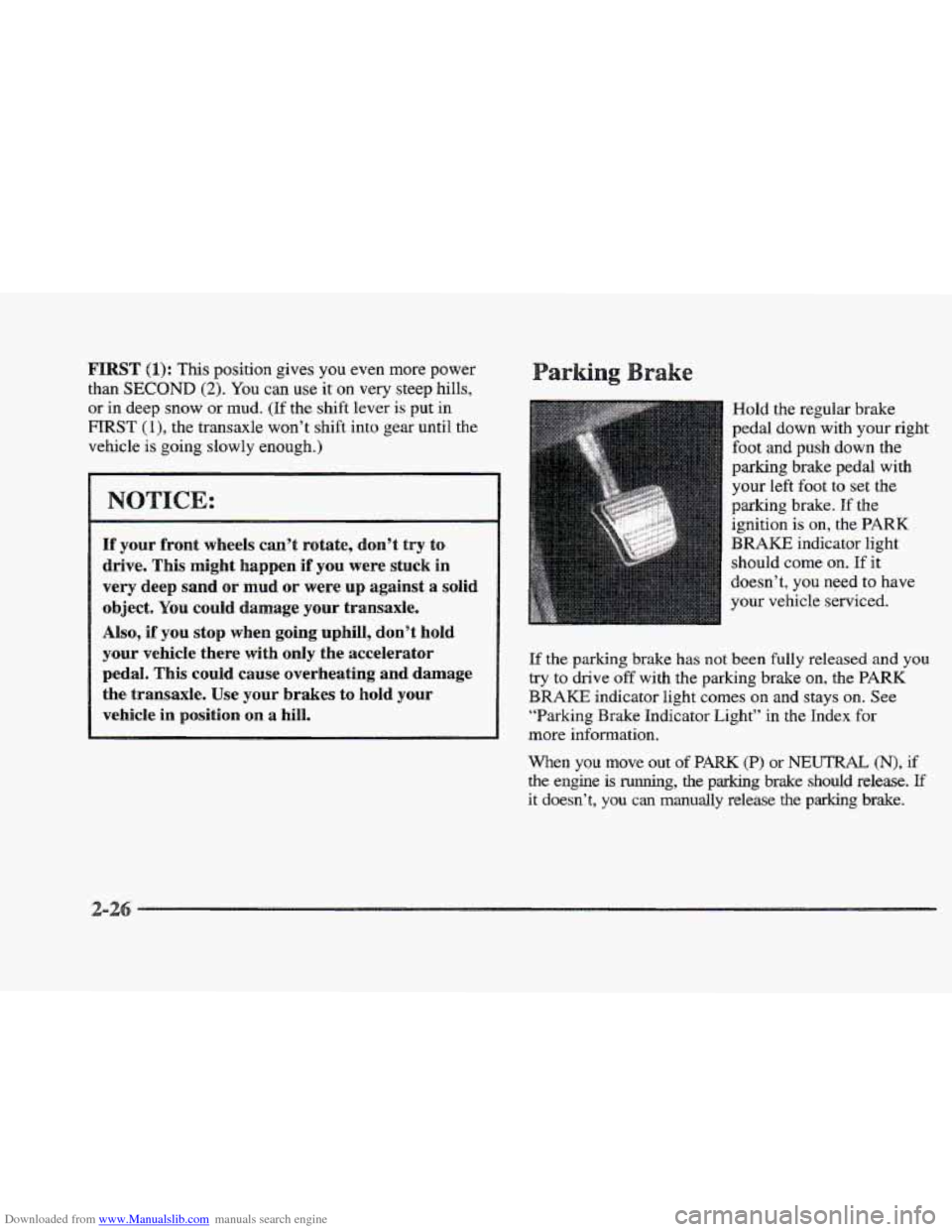
Hold the regular brake
pedal down with your
right
foot and push down the
parking brake pedal with
your
left foot to set the
parking brake. If the
ignition is
on, the PARK
BRAKE indicator light
should come
on. If it
doesn’t, you need to have
your vehicle serviced.
If the
parking brake has not been fully released and you
try to drive off with the parking brake on, the PARK
BRAKE indicator light comes on and stays on. See
“Barking Brake Indicator Light” in the Index for
more information.
When you move out of PARK (P) or NEUTRAL (N), if
the engine is running, the parking brake should release. If
it doesn’t, you can manually release the parking brake.
Page 92 of 361
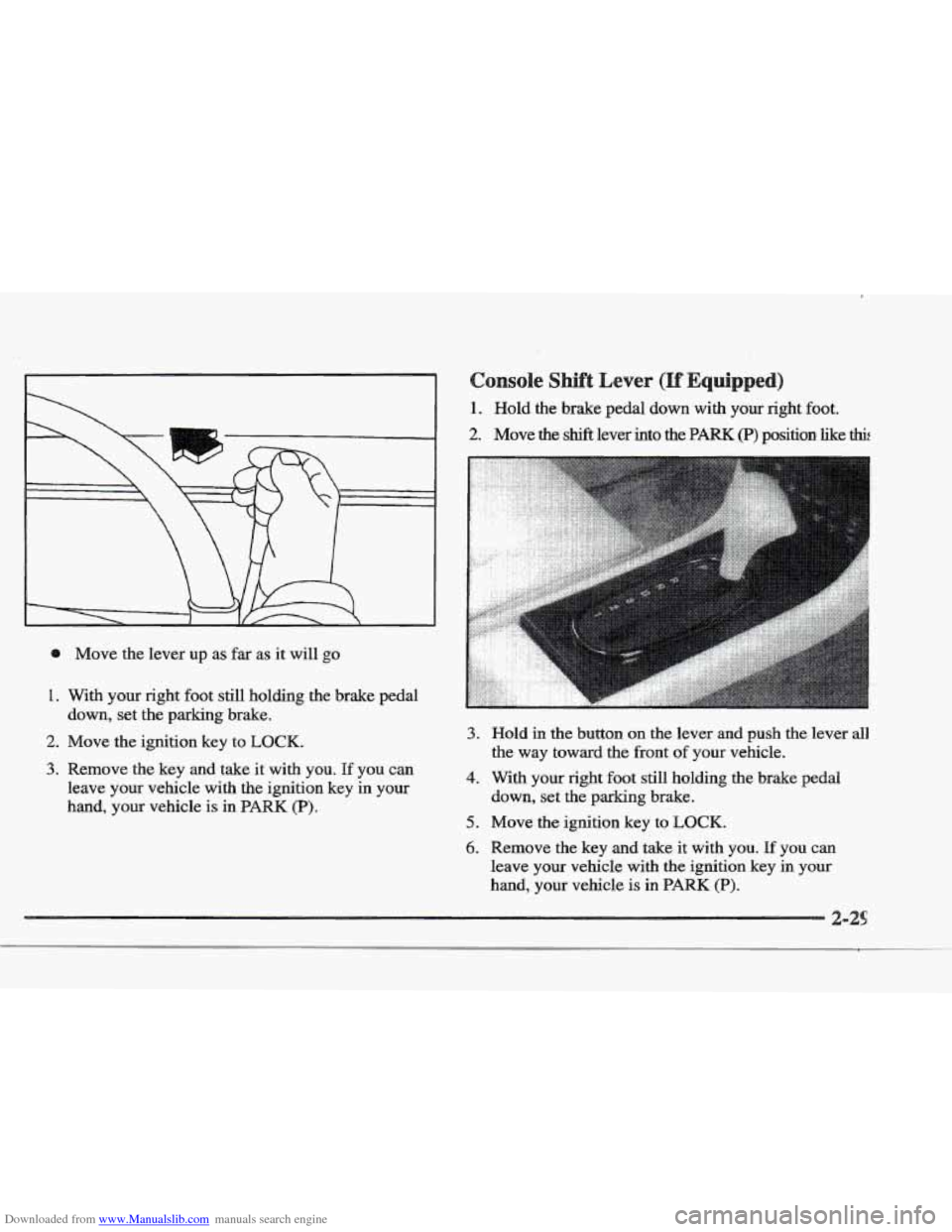
Downloaded from www.Manualslib.com manuals search engine 6 Move the lever up as far as it will go
1. With your right foot still holding the brake pedal
down, set the parking brake.
2. Move the ignition key to LOCK.
3. Remove the key and take it with you. If you can
leave your vehicle with the ignition key in your
hand, your vehicle
is in PARK (P).
1. Hold the brake pedal down with your right foot.
2. Move the shift lever into the PARK (P) position like thi:
3.
4.
5.
6.
Hold in the button on the lever and push the lever all
the way toward the front of your vehicle.
With your right foot still holding the brake pedal
down, set the parking brake.
Move the ignition key to
LOCK.
Remove the key and take it with you. If you can
leave your vehicle with the ignition key in your
hand, your vehicle
is in PARK (P).
Page 94 of 361
Downloaded from www.Manualslib.com manuals search engine Your Cadillac has a Brake-Transaxle Shift Interlock
(BTSI).
You have to fully apply your regular brakes
before you can shift from PARK (P) when the ignition
is in
the RUN position. See “Automatic Transaxle” in
the Index.
If you cannot shift out of PARK (P), ease pressure on
the shift lever -- push the shift lever all the way into
BARK (P) and also release the shift lever button on floor
shift models as YOU maintain brake application. Then
move the shift lever into
the gear you want. (Press the
shift lever button before moving the shift lever.) If
you
ever hold the brake pedal down but still can’t shift out of
PARK (P), try this:
1. Turn the key to OFF. Open and close the driver’s
2. Apply and hold the brake until the end of Step 4.
door to turn off the RAP feature.
3. Shift to N-ErnRAE (N).
4. Start the vehicle and then shift to the drive gear
you want.
5. Have the vehicle fixed as soon as you can.
II
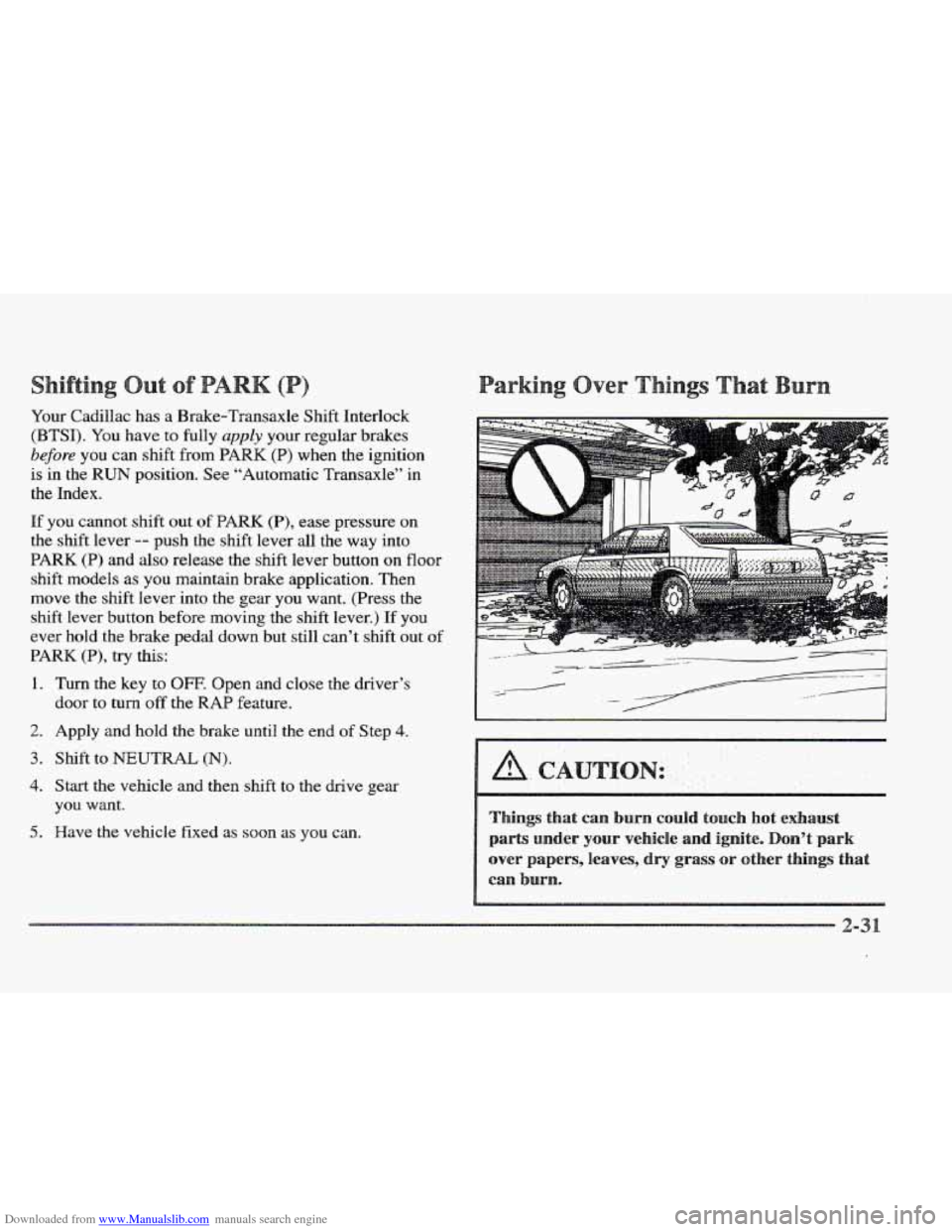
ings that can burn could touch h
parts under your vehicle and ignite
over papers, leaves, dry grass or other things that
can burn.
Page 96 of 361
Downloaded from www.Manualslib.com manuals search engine It can be dangerous to get out of your vehicle if
the shift lever is not fully in PARK (P) with the
parking brake firmly
set. Your vehicle can roll.
Don’t leave your vehicle when the engine
is
running unless you have to. If ydve left the
engine running, the vehicle can move
suddenly.
You or others cou%d be injured. TQ be sure your
vehicle move, even when you’re on fairly
level ground, always set your parking brake after
Follow the proper steps to be sure your vehicle won’t
move. See “Shifting Into
PARK (P)” in the Index.
If you are parking on a hill and if you’re pulling a
trailer, also see “Towing a Trailer” in the Index.
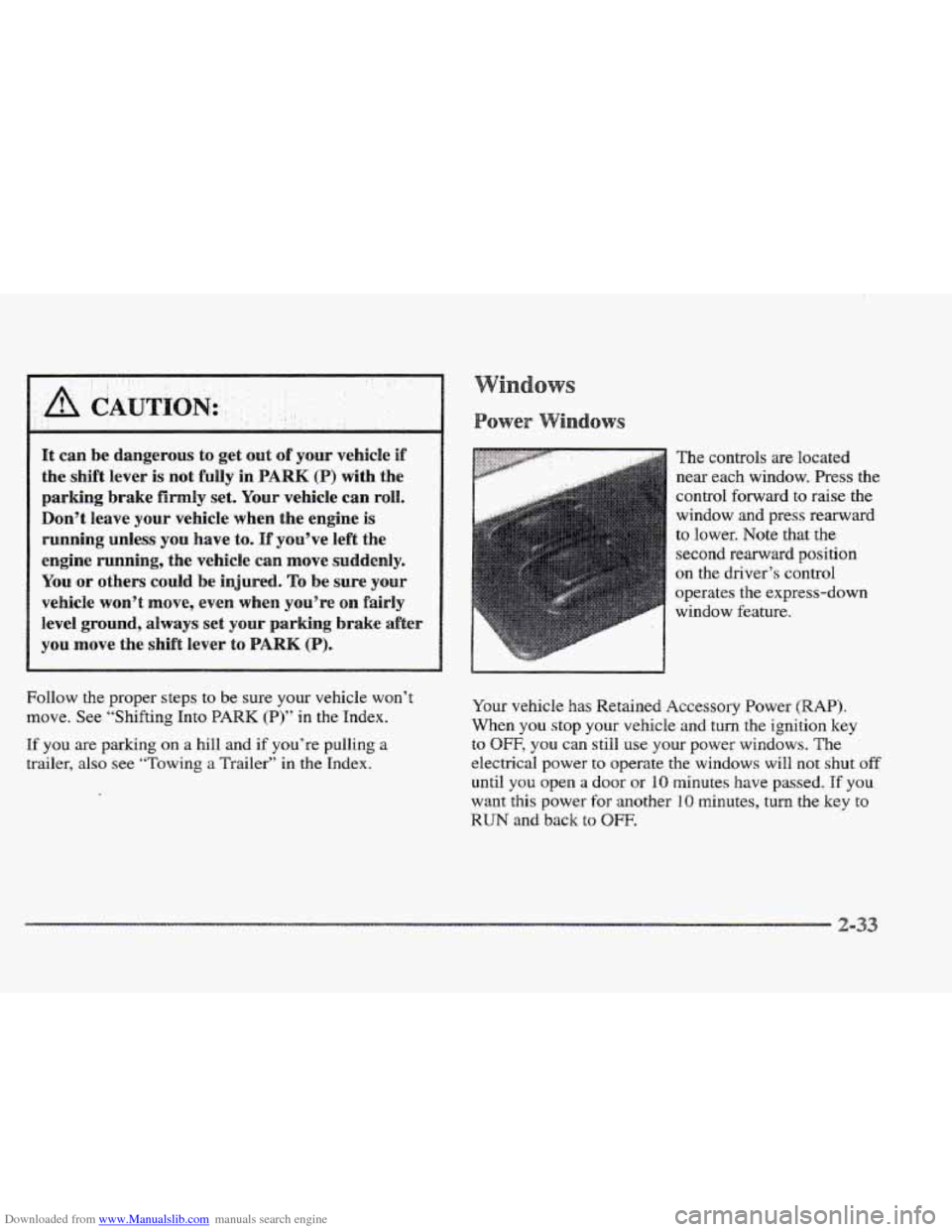
:rat~~~~~j,~.~.~.~~~:..i .I... . , .. :-., The controls are located
near each window. Press
the
control forward to raise the
window
and press rearward
to lower. Note that the
second rearward position
on the driver’s control
operates
the express-down
window feature.
Your vehicle has Retained Accessory Power (RAP).
When you stop your vehicle and turn the ignition key
to
OFF, YOU can still use your power windows. The
electrical power
to operate the windows will not shut off
until you open a door or 10 minutes have passed. If you
want this power
for another 10 minutes, turn the key BQ
RUN and back to OFF.
Page 101 of 361
Downloaded from www.Manualslib.com manuals search engine The Rainsense system can be activated by turning the
wiper stalk to one of the five sensitivity levels within the
AUTO DELAY
area. The AUTO DELAY position
closest to
OW is the lowest sensitivity setting. This
allows more water to collect on the windshield between
wipes. Rotating the stalk away from you to the other
AUTO DELAY settings increases the sensitivity of the
system and frequency
of wipes. A single wipe will occur
each time you
turn the wiper stalk to a higher sensitivity
level.
An initial wipe occurs when you turn the ignition
on as a reminder that Rainsense
is active. The
windshield wipers also remain in a “high
park” position,
even when
the ignition is turned off.
The Rainsense wipers operate in a delay mode as well as
a continuous low or high speed depending on the amount
of moisture and the sensitivity level. The MIST and
“wash” cycles operate as normal and are not affected
by the Rainsense hnction.
It is important to note that the Rainsense wiping feature
(AUTO DELAY) can be overridden at any time by
manually changing the wiper control to EO or
HI
speed.
Note that
if you ever need to replace the windshield,
make sure it
is Rainsense compatible.
~~ ~ ~~~ ~
In freezing weather, don’t use your washer until
the windshield
is warmed, Otherwise the washer
fluid
can form ice on the windshield, blocking
your vision,
Press and hold the PUSH paddle to wash the windshield.
Release the paddle when you have enough fluid.
The
wipers will clear the windshield and either stop or return
to your preset speed.
LOW WASHER
FLUID will be displayed on the DIC
when the washer fluid reaches a low level.
Driving without washer fluid can be dangerous.
A bad
mud splash can block your vision and you could hit
another vehicle or
go off the road. Check the washer
fluid level often.
-3