1997 BUICK REGAL warning
[x] Cancel search: warningPage 147 of 422
If the Light Is On Steady
You may be able to correct the emission system
malfunction by considering the following:
Did you recently
put fuel into your vehicle?
If
so, reinstall the fuel cap, making sure to fully install
the cap. The diagnostic system can determine
if the fuel
cap has been left
off or improperly installed. A loose or
missing fuel cap will allow fuel to evaporate into the
atmosphere.
A few driving trips with the cap properly
installed should turn
the light off.
Did you just drive through a deep puddle of water?
If
so, your electrical system may be wet. The condition
will usually be corrected when the electrical system
dries out.
A few driving trips should turn the light off.
Have you recently changed brands of fuel?
If
so, be sure to fuel your vehicle with quality fuel (see
“Fuel” in the Index). Poor fuel quality will cause your
engine not to run as efficiently as designed. You may
notice this as stalling after start-up, stalling when you
put the vehicle into gear, misfiring, hesitation on
acceleration or stumbling on acceleration. (These
conditions may go away once the engine is warmed up.)
This will be detected by the system and cause the light
to
turn on. If you
experience one or more of these conditions,
change the
fuel brand you use. It will require at least one
full tank of the proper fuel to turn the light off.
If none of the above steps have made the light turn off,
have your dealer or qualified service center check the vehicle. Your dealer has the proper test equipment and
diagnostic tools
to fix any mechanical or electrical
problems that may have developed.
Oil Warning Light
If you have a problem with
your oil, this light may stay
on after you start your
engine,
or come on when
you are driving.
This indicates that oil is not going through your engine
quickly enough to keep it lubricated. The engine could
be low on oil or could have some other oil problem.
Have it fixed right away.
2-71
ProCarManuals.com
Page 151 of 422
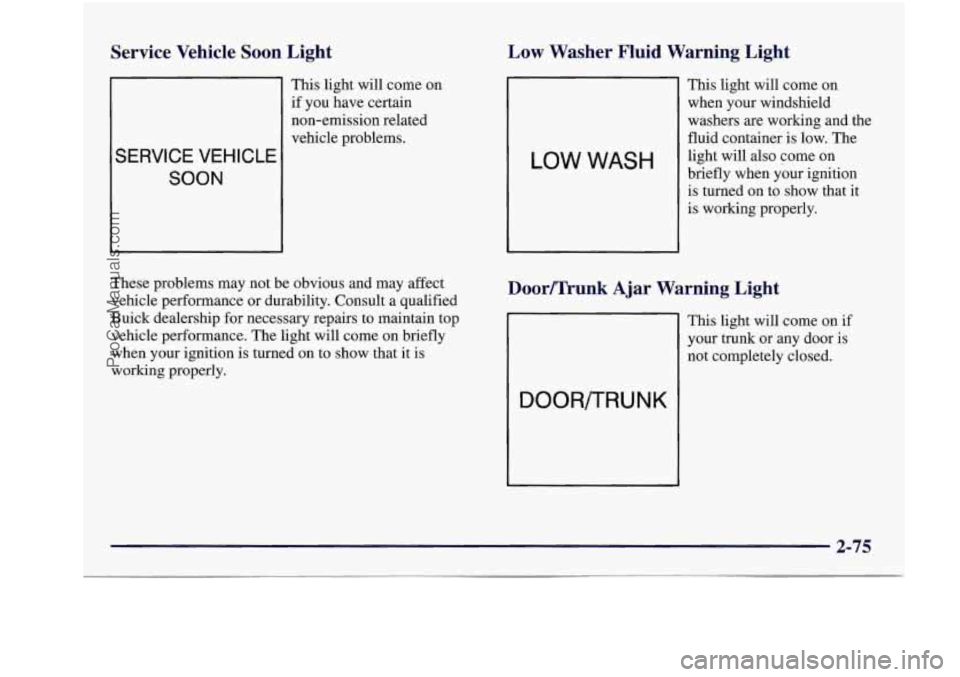
Service Vehicle Soon Light
SERVICE VEHICLE
SOON
This light will come on
if you have certain
non-emission related
vehicle problems.
These problems may not be obvious and may affect
vehicle performance or durability. Consult a qualified
Buick dealership for necessary repairs to maintain top vehicle performance. The light will come on briefly
when your ignition is turned on to show that it is
working properly.
Low Washer Fluid Warning Light
LOW WASH
This light will come on
when your windshield
washers are working and the
fluid container is low. The
light will also come on
briefly when your ignition
is turned on to show that it
is working properly.
Door/Trunk Ajar Warning Light
DOOR/TRUNK
This light will come on if
your trunk or any door is
not completely closed.
2-75
ProCarManuals.com
Page 203 of 422
Avoid needless heavy braking. Some people drive in
spurts
-- heavy acceleration followed by heavy
braking
-- rather than keeping pace with traffic. This is a
mistake. Your brakes may not have time to cool between
hard stops, Your brakes will wear
out much faster if you
do a lot of heavy braking. If you keep pace with the
traffic and allow realistic following distances, you will
eliminate
a lot of unnecessary braking. That means
better braking and longer brake life.
If your engine ever stops while you’re driving, brake
normally but don’t pump your brakes.
If you do, the
pedal may get harder to push down. If your engine
stops, you will still have some power brake assist. But
you will use it when you brake. Once the power assist is
used up, it may take longer
to stop and the brake pedal
will be harder to push.
Anti-Lock Brakes (ABS)
Your vehicle has anti-lock brakes (ABS). ABS is an
advanced electronic braking system that will help
prevent a braking skid.
When you start your engine, or when you begin to drive
away, your anti-lock brake system will check itself. You
may hear
a momentary motor or clicking noise while
this test is going on, and you may even notice that your
brake pedal moves a little. This is normal.
ANTI -
LOCK
If there’s a problem with the
anti-lock brake system, this
warning light will stay on or
flash. See “Anti-Lock
Brake System Warning
Light” in the Index.
ProCarManuals.com
Page 206 of 422
When the system is on, this
warning light will come on
to let you know if there’s a
problem with your traction
TRAC
OFF
0
To turn the system off,
press the TRACTION
button
on the black panel
located directly behind
your automatic transaxle
shift lever.
See “Traction Control System Warning Light” in the
Index. When this warning light is on, the system will not
limit wheel spin. Adjust your driving accordingly.
The traction control system automatically comes on
whenever you start your vehicle. To limit wheel spin,
especially in slippery road conditions, you should
always leave the system on. But you can turn the
traction control system off
if you ever need to. (You
should turn the system off if your vehicle ever gets stuck
in sand, mud, ice or snow.
See “Rocking Your Vehicle”
in the Index.) The
traction control system warning light will come on
and stay
on. If the system is limiting wheel spin when you
press the button, the warning light will come on -- but the
system won’t
turn off right away. It will wait until there’s
no longer a current need to limit wheel spin.
You can turn the system back on at any
time by pressing
the button again. The traction control system warning
light should go off.
4-10
ProCarManuals.com
Page 207 of 422
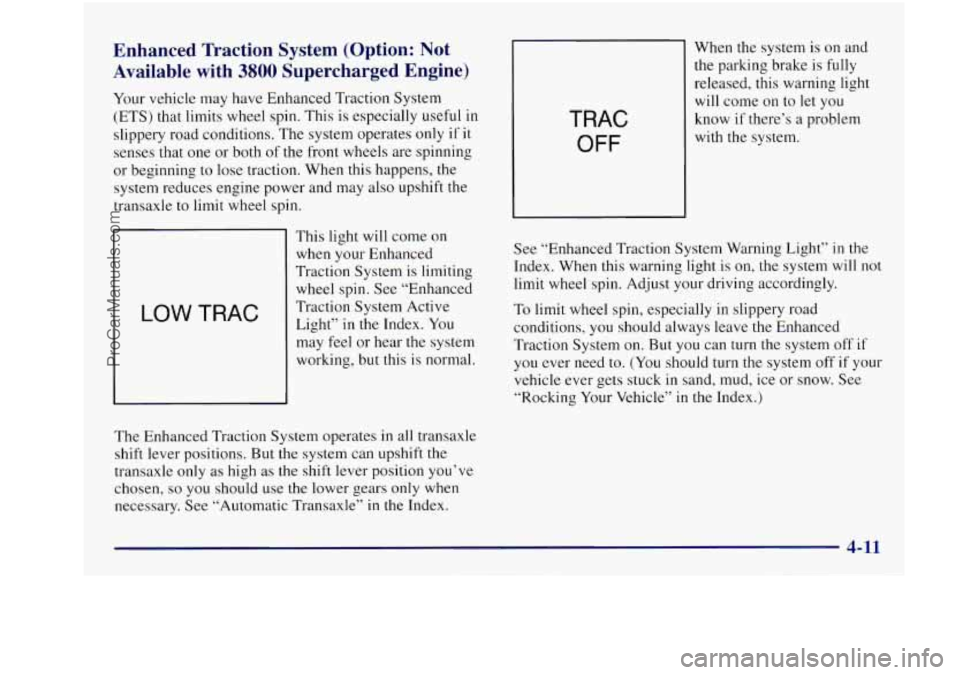
Enhanced Traction System (Option: Not
Available with
3800 Supercharged Engine)
Your vehicle may have Enhanced Traction System
(ETS) that limits wheel spin. This is especially useful in
slippery road conditions, The system operates only if it
senses that one or both of the front wheels are spinning
or beginning to lose traction. When
this happens, the
system reduces engine power and may also upshift the
transaxle to limit wheel spin.
LOW TRAC
This light will come on
when
your Enhanced
Traction System is limiting
wheel spin. See “Enhanced
Traction System Active
Light” in the Index. You
may feel or hear the system
working, but this is normal.
The Enhanced Traction System operates in all transaxle
shift lever positions. But the system can upshift the
transaxle only as high as the shift lever position you’ve
chosen,
so you should use the lower gears only when
necessary. See “Automatic Transaxle” in the Index.
TRAC
OFF
When the system is on and
the parking brake is
fully
released, this warning light
will come on to
let you
know if there’s a problem
with the system.
See “Enhanced Traction System Warning Light”
in the
Index. When this warning light
is on, the system will not
limit wheel spin. Adjust your driving accordingly.
To limit wheel spin, especially in slippery road
conditions, you should always leave the Enhanced
Traction System on. But
you can turn the system off if
you ever need to. (You should turn the system off if your
vehicle ever gets stuck
in sand, mud, ice or snow. See
“Rocking Your Vehicle”
in the Index.)
4-11
ProCarManuals.com
Page 208 of 422
0
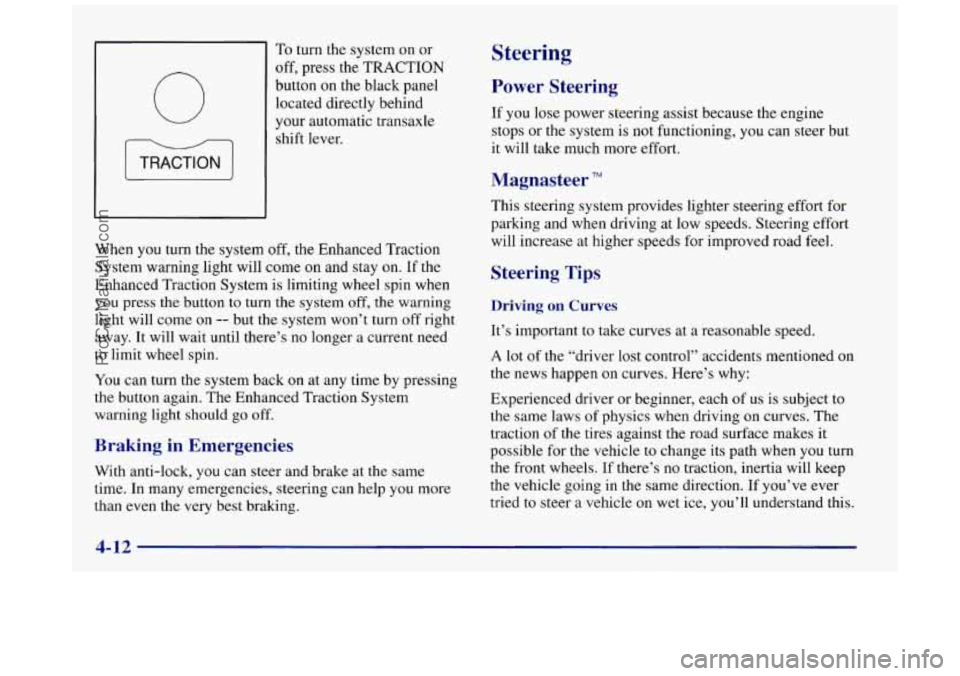
To turn the system on or
off, press the
TRACTION
button on the black panel
located directly behind
your automatic transaxle
shift lever.
When you turn the system off, the Enhanced Traction
System warning light will come on and stay on.
If the
Enhanced Traction System is limiting wheel spin when
you press the button to turn the system off, the warning
light will come on
-- but the system won’t turn off right
away. It will wait until there’s no longer a current need
to limit wheel spin.
You can turn the system back on at any time by pressing
the button again. The Enhanced Traction System
warning light should go off.
Braking in Emergencies
With anti-lock, you can steer and brake at the same
time. In many emergencies, steering can help you more
than even the very best braking.
Steering
Power Steering
If you lose power steering assist because the engine
stops or the system is not functioning,
you can steer but
it will take much more effort.
Magnasteer TM
This steering system provides lighter steering effort for
parking and when driving at low speeds. Steering effort
will increase at higher speeds for improved road feel.
Steering Tips
Driving on Curves
It’s important to take curves at a reasonable speed.
A lot of the “driver lost control” accidents mentioned on
the news happen on curves. Here’s why:
Experienced driver or beginner, each of us is subject to
the same laws of physics when driving on curves. The
traction
of the tires against the road surface makes it
possible for the vehicle
to change its path when you turn
the front wheels. If there’s no traction, inertia will keep
the vehicle going in
the same direction. If you’ve ever
tried
to steer a vehicle on wet ice, you’ll understand this.
ProCarManuals.com
Page 213 of 422
If your vehicle starts to slide, ease your foot off the
accelerator pedal and quickly steer the way you want the
vehicle to go.
If you start steering quickly enough, your
vehicle may straighten
out. Always be ready for a
second skid
if it occurs.
Of course, traction is reduced when water, snow, ice,
gravel or other material is
on the road. For safety, you’ll
want to slow down and adjust your driving to these
conditions. It is important to slow down on slippery
surfaces because stopping distance will be longer and
vehicle control more limited.
While driving on a surface with reduced traction, try
your best
to avoid sudden steering, acceleration or
braking (including engine braking by shifting to a lower
gear). Any sudden changes could cause the tires to
slide. You may not realize the surface
is slippery until
your vehicle is skidding. Learn
to recognize warning
clues
-- such as enough water, ice or packed snow on
the road to make a “mirrored surface’’
-- and slow
down when you have any doubt.
Remember: Any anti-lock brake system (ABS) helps
avoid only the braking skid.
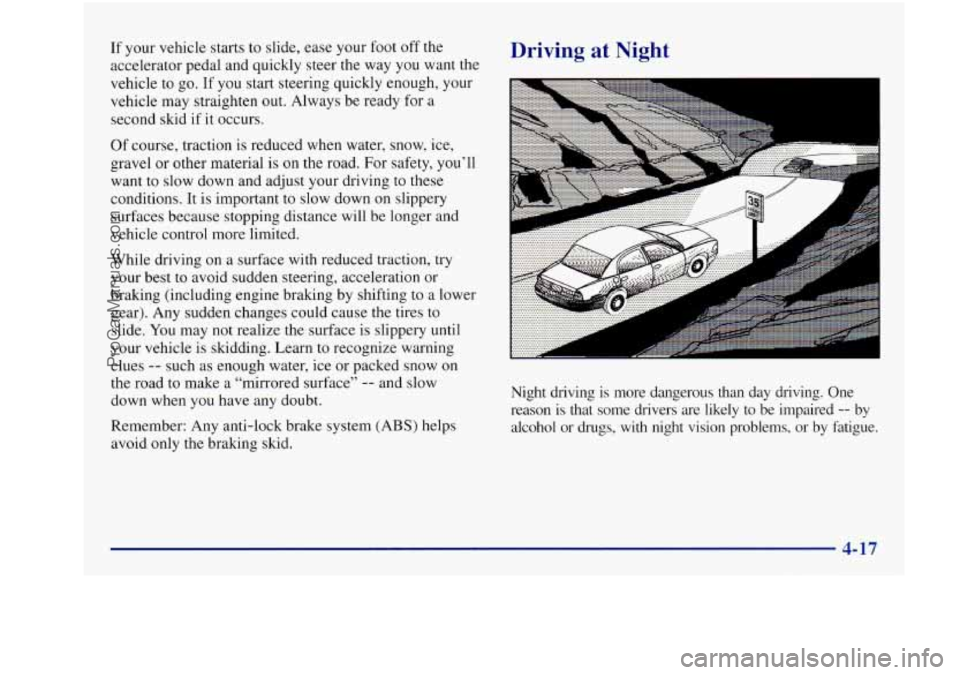
Driving at Night
/’ ,//
..... ....A
A
A
Night driving is more dangerous than day driving. One
reason is that
some drivers are likely to be impaired -- by
alcohol or drugs, with night vision problems, or by fatigue.
ProCarManuals.com
Page 218 of 422
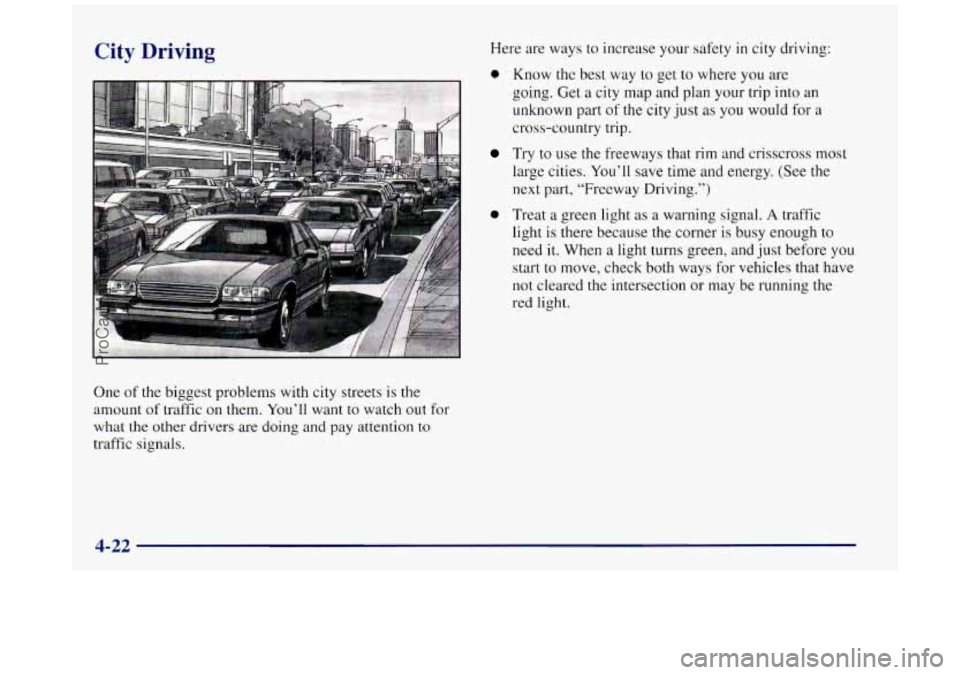
City Driving
One of the biggest problems with city streets is the
amount of traffic on them.
~0~~11 want to watch out for
what the other drivers are doing and pay attention to
traffic signals. Here are ways
to increase your safety
in city driving:
0 Know the best way to get to where you are
going. Get a city map and plan your trip into
an
unknown part of the city just as you would for a
cross-country trip.
Try to use the freeways that rim and crisscross most
large cities. You’ll save time and energy. (See the
next part, “Freeway Driving.”)
0 Treat a green light as a warning signal. A traffic
light is there because the corner
is busy enough to
need it. When
a light turns green, and just before you
start
to move, check both ways for vehicles that have
not cleared the intersection
or may be running the
red
light.
4-22
ProCarManuals.com