1997 BUICK REGAL brake light
[x] Cancel search: brake lightPage 240 of 422
2.
3.
Get the vehicles close enough so the jumper cables
can reach, but be
sure the vehicles aren’t touching
each other.
If they are, it could cause a ground
connection you don’t want.
You wouldn’t be able to
start your Buick, and the bad grounding could
damage the electrical systems.
To avoid the possibility of the vehicles rolling, set
the parking brake firmly on both vehicles involved
in
the jump start procedure. Put your automatic
transaxle in
PARK (P) before setting the
parking brake.
Turn
off the ignition on both vehicles. Unplug
unnecessary accessories plugged into the cigarette
lighter
or accessory power outlet. Turn off all lamps
that aren’t needed as well as radios. This will avoid
sparks and help save both batteries. In addition,
it
could save your radio!
I NOTICE:
If you leave your radio on, it could be badly
damaged. The repairs wouldn’t be covered by
your warranty.
4. Open the hoods and locate the batteries. (Your
vehicle’s battery is located under the windshield
washer fluid reservoir.)
An electric fan can start up even when the engine
is not running and can injure you. Keep hands,
clothing and tools away from any underhood
electric fan.
5-4
ProCarManuals.com
Page 283 of 422
When you put the cap back on, turn it to the right
(clockwise) until
you hear a clicking sound. Make
sure
you fully install the cap. The diagnostic system
can determine
if the fuel cap has been left off or
improperly installed. This would allow fuel to
evaporate into the atmosphere. See “Malfunction
Indicator Lamp” in the Index.
NOTICE:
If you need a new cap, be sure to get the right
type. Your dealer can get one
for you. If you get
the wrong type, it may not
fit properly. This may
cause your malfunction indicator lamp to light
and your
fuel tank and emissions system may be
damaged. See “Malfunction Indicator Lamp” in
the Index.
Checking Things Under the Yood
An electric fan under the hood can start up and
injure you even when the engine is not running.
Keep hands, clothing and tools away from any
underhood electric fan.
Things that burn can get
on hot engine parts and
start a fire. These include liquids like gasoline,
oil, coolant, brake fluid, windshield washer and
other fluids, and plastic or rubber. You or others
could be burned. Be careful not to drop
or spill
things that will burn onto a hot engine.
ProCarManuals.com
Page 305 of 422
There are only two reasons why the brake fluid level in the
reservoir might go down. The
first is that the brake fluid
goes down
to an acceptable level during normal brake
lining wear. When new linings are put in, the fluid level
goes back up. The other reason is that fluid is leaking out
of the brake system.
If it is, you should have your brake
system fixed, since
a leak means that sooner or later your
brakes won’t work well, or won’t work at all.
So, it isn’t a good idea to “top off’ your brake fluid.
Adding brake fluid won’t correct a leak. If you add fluid
when your linings are worn, then you’ll have too much
fluid when you get new brake linings. You should add
(or remove) brake fluid, as necessary, only when work is
done on the brake hydraulic system.
If you have too much brake fluid, it can spill
on the engine. The fluid will burn
if the engine
is hot enough. You or others could be burned,
and your vehicle could be damaged. Add brake
fluid only when work is done on the brake
hydraulic system.
When your brake fluid falls to a low level, your brake
warning light will come on. See “Brake System Warning
Light” in the Index.
What to Add
When you do need brake fluid, use only DOT-3
brake fluid -- such as Delco Supreme 11 @ (GM Part
No. 12377967). Use new brake fluid from a sealed
container only.
Always clean the brake fluid reservoir cap and the area
around the cap before removing it. This will help keep
dirt from entering the reservoir.
1 CAUTIC
With the wrong kind of fluid in your brake
system, your brakes may not work well, or they
may not even work at all. This could cause a
crash. Always use the proper brake fluid.
ProCarManuals.com
Page 307 of 422
Some driving conditions or climates may cause a
brake squeal when the brakes are first applied or lightly
applied. This does
not mean something is wrong with
your brakes.
Properly torqued wheel nuts are necessary to help
prevent brake pulsation. When tires are rotated, inspect
brake pads for wear and evenly torque wheel nuts
in
the proper sequence to GM specifications.
Brake linings should always be replaced as complete
axle sets.
See “Brake System Inspection” in Section
7 of this
manual under Part
C “Periodic Maintenance
Inspections.”
Brake Pedal Travel
See your dealer if the brake pedal does not return to
normal height, or if there is a rapid increase
in pedal
travel. This could be a sign of brake trouble.
Brake Adjustment
Every time you apply the brakes, with or without the
vehicle moving, your brakes adjust for wear.
Replacing Brake System Parts
The braking system on a modern vehicle is complex.
Its many parts have to be of top quality and work well
together if the vehicle is to have really good braking.
Your vehicle was designed and tested with top-quality
GM brake parts. When you replace parts
of your braking
system
-- for example, when your brake linings wear
down and you have to have new ones put in
-- be sure
you get new approved GM replacement parts. If you
don’t, your brakes may no longer work properly. For
example,
if someone puts in brake linings that are wrong
for your vehicle, the balance between your front and
rear brakes can change
-- for the worse. The braking
performance you’ve come
to expect can change in many
other ways if someone puts in the wrong replacement
brake parts.
Battery
Every new Buick has a Delco Freedom@ battery. You
never have to add water to one of these. When it’s time
for a new battery, we recommend a Delco Freedom
battery. Get one that has the replacement number shown
on the original battery’s label.
~ 6-31
ProCarManuals.com
Page 336 of 422
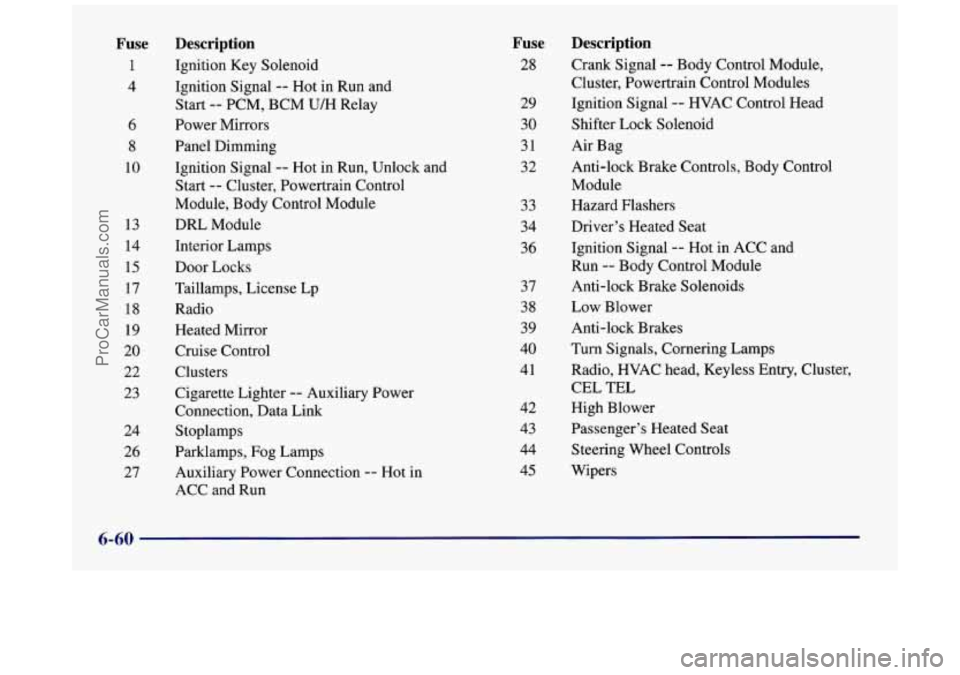
Fuse
1
4
6
8
10
13
14 15
17
18
19
20
22
23
24 26
27 Description
Ignition
Key Solenoid
Ignition Signal
-- Hot in Run and
Start
-- PCM, BCM U/H Relay
Power Mirrors
Panel Dimming Ignition Signal
-- Hot in Run, Unlock and
Start
-- Cluster, Powertrain Control
Module, Body Control Module
DRL Module
Interior Lamps
Door Locks
Taillamps, License Lp
Radio Heated Mirror
Cruise Control
Clusters
Cigarette Lighter
-- Auxiliary Power
Connection, Data Link
Stoplamps
Parklamps, Fog Lamps
Auxiliary Power Connection
-- Hot in
ACC and Run
Fuse
28
29
30
31
32
33
34
36
37
38
39
40
41
42
43
44
45
Description
Crank Signal -- Body Control Module,
Cluster, Powertrain Control Modules
Ignition Signal
-- HVAC Control Head
Shifter Lock Solenoid
Air Bag
Anti-lock Brake Controls, Body Control
Module
Hazard Flashers
Driver’s Heated Seat
Ignition Signal
-- Hot in ACC and
Run
-- Body Control Module
Anti-lock Brake Solenoids
Low Blower
Anti-lock Brakes
Turn Signals, Cornering Lamps
Radio, HVAC head, Keyless En
CEL
TEL
High Blower
Passenger’s Heated Seat
Steering Wheel Controls
Wipers ltry,
Clus
; ter,
6-60
ProCarManuals.com
Page 349 of 422
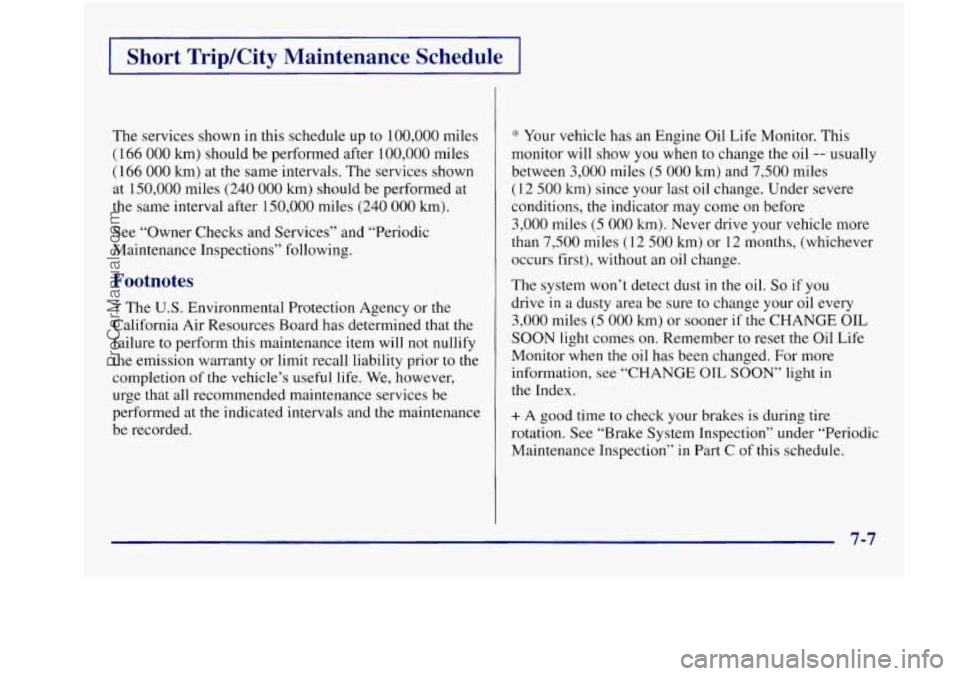
* Your vehicle has an Engine Oil L’
Short TripKity Maintenance Schedule
The services shown in this schedule up to 100,000 miles
(166 000 km) should be performed after 100,000 miles
(166 000 km) at the same intervals. The services shown
at
150,000 miles (240 000 km) should be performed at
the same interval after
150,000 miles (240 000 km).
See “Owner Checks and Services” and “Periodic
Maintenance Inspections” following.
Footnotes
-f The U.S. Environmental Protection Agency or the
California Air Resources Board has determined that the
failure to perform this maintenance item will not nullify
the emission warranty or limit recall liability prior to the
completion of the vehicle’s useful life. We, however,
urge that all recommended maintenance services be
performed at
the indicated intervals and the maintenance
be recorded. ~fe
Monitor. Thi
.s
monitor will show you when to change the oil -- usually
between
3,000 miles (5 000 km) and 7,500 miles
(1 2 500 km) since your last oil change. Under severe
conditions,
the indicator may come on before
3,000 miles (5 000 km). Never drive your vehicle more
than
7,500 miles (1 2 500 km) or 12 months, (whichever
occurs first), without an oil change.
The system won’t detect dust in the oil.
So if you
drive in
a dusty area be sure to change your oil every
3,000 miles (5 000 km) or sooner if the CHANGE OIL
SOON light comes on. Remember to reset the Oil Life
Monitor when the oil has been changed. For more
information, see
“CHANGE OIL SOON” light in
the Index.
+ A good time to check your brakes is during tire
rotation.
See “Brake System Inspection” under “Periodic
Maintenance Inspection” in Part C
of this schedule.
7-7
ProCarManuals.com
Page 370 of 422
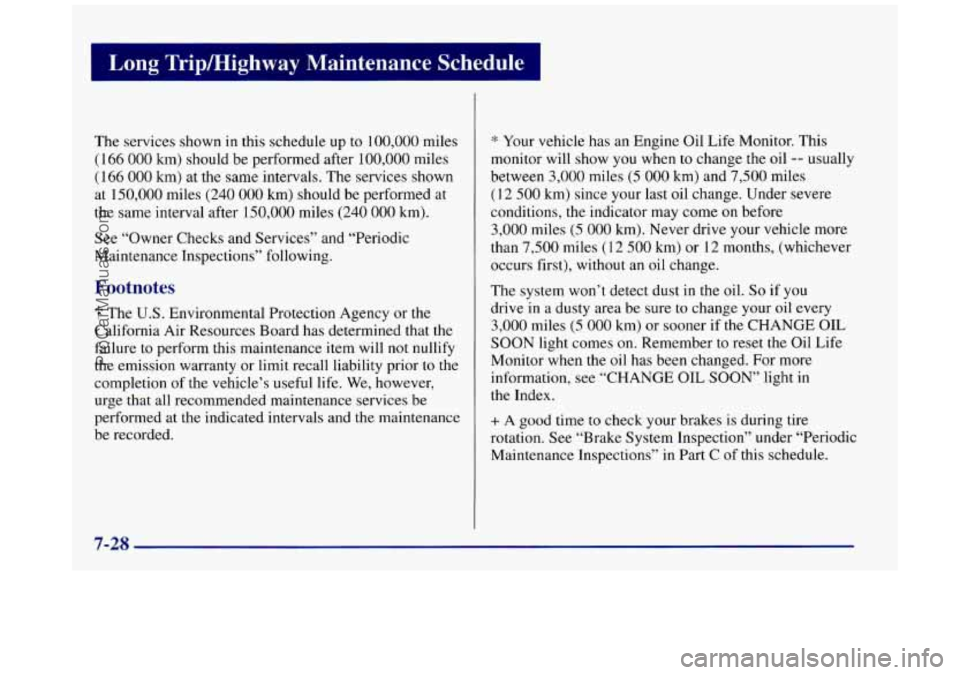
I Long Tripmighway Maintenance Schedule 1
The services shown in this schedule up to 100,000 miles
( 166 000 km) should be performed after 100,000 miles
(166 000 km) at the same intervals. The services shown
at
150,000 miles (240 000 km) should be performed at
the same interval after 150,000 miles
(240 000 km).
See “Owner Checks and Services” and “Periodic
Maintenance Inspections” following.
Footnotes
The U.S. Environmental Protection Agency or the
California Air Resources Board has determined that the
failure to perform this maintenance item will not nullify
the emission warranty or limit recall liability prior to the
completion of the vehicle’s useful life.
We, however,
urge that all recommended maintenance services be
performed at the indicated intervals and the maintenance
be recorded.
* Your vehicle has an Engine Oil Life Monitor. This
monitor will show you when to change the oil
-- usually
between
3,000 miles (5 000 km) and 7,500 miles
(1 2 500 km) since your last oil change. Under severe
conditions, the indicator may come on before
3,000 miles (5 000 km). Never drive your vehicle more
than
7,500 miles (1 2 500 km) or 12 months, (whichever
occurs first), without an oil change.
The system won’t detect dust in the oil.
So if you
drive in a dusty area be sure to change your oil every
3,000 miles (5 000 km) or sooner if the CHANGE OIL
SOON light comes on. Remember to reset the Oil Life
Monitor when the
oil has been changed. For more
information, see “CHANGE OIL
SOON’ light in
the Index.
+ A good time to check your brakes is during tire
rotation.
See “Brake System Inspection” under “Periodic
Maintenance Inspections” in Part
C of this schedule.
7-28
ProCarManuals.com
Page 407 of 422
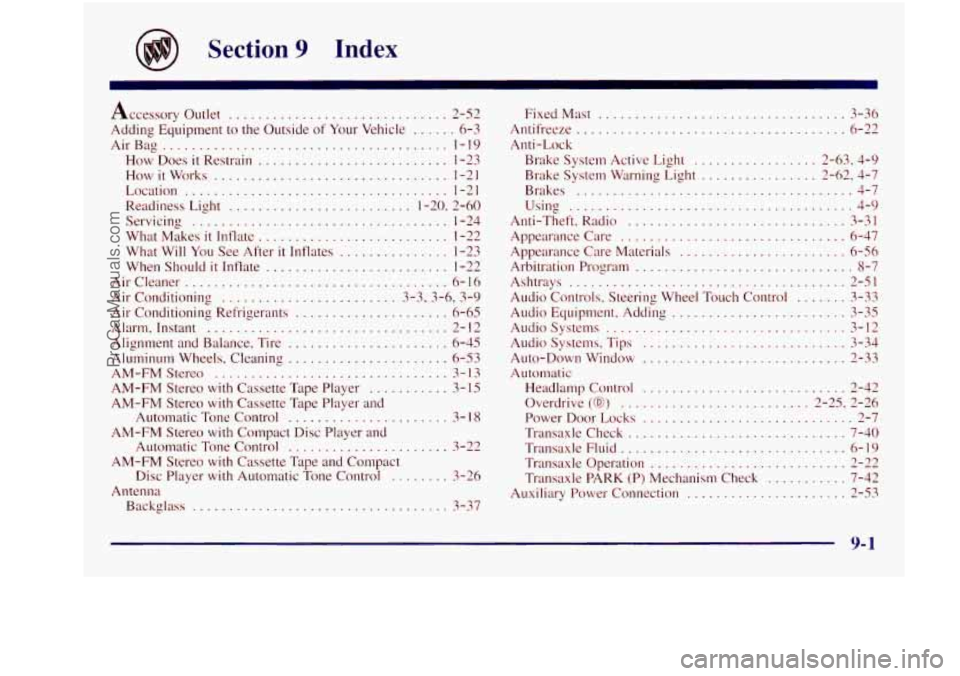
Section 9 Index
Accessory outlet .............................. 2-52
Adding Equipment to the Outside
of Your Vehicle ...... 6-3
AirBag
....................................... 1-19
How Does it Restrain .......................... 1-23
How
it Works ................................ 1-2 1
Location .................................... 1-21
Readiness Light
......................... 1-20. 2-60
Servicing
................................... 1-24
What Makes
it Inflate .......................... 1-22
What Will You See After
it Inflates ............... 1-23
When Should it Inflate ......................... 1-22
Aircleaner .................................... 6-16
Air Conditioning
........................ 3-3.3-6. 3-9
Air Conditioning Refrigerants ..................... 6-65
Alarm. Instant
................................. 2- 12
Alignment and Balance. Tire
...................... 6-45
Aluminum Wheels. Cleaning
...................... 6-53
AM-FMStereo ................................ 3-13
AM-FM Stereo with Cassette Tape Player and
AM-FM Stereo with Compact Disc Player and
AM-FM Stereo
with Cassette Tape and Compact
Antenna AM-FM Stereo
with Cassette Tape Player ........... 3- I5
Automatic Tone Control
...................... 3- 18
Automatic Tone Control
...................... 3-22
Disc Player
with Automatic Tone Control ........ 3-26
Backglass
................................... 3-37 Fixed Mast
.................................. 346
Antifreeze ..................................... 6-22
Anti-Lock
Brake System Active Light
................. 2.63. 4.9
Brake System Wa-ning Light
................ 2.62. 4.7
Brakes
...................................... 4-7
Using
....................................... 4-9
Anti.Theft. Radio .............................. 3-31
Appearancecare
............................... 6-47
Appearance Care Materials
....................... 6-56
Arbitration Program
.............................. 8-7
Ashtrays
...................................... 2-51
Audio Controls. Steering Wheel Touch Control
....... 3-33
Audio Equipment. Adding ........................ 3-35
AudioSyste~ns
................................. 3-12
Auto-Down Window
............................ 2-33
Automatic
Audio Systems.
Tips
............................ 3-34
Headlamp Control ............................ 2-42
Overdrive
(a) .......................... 2.25. 2.26
Power Door Locks
............................. 2-7
Transaxle Check
.............................. 7-40
Transaxle Fluid
............................... 6-19
Transaxle Operation ........................... 2-22
Transaxle PARK
(P) Mechanism Check ........... 7-42
Auxiliary Power Connection
...................... 2-53
ProCarManuals.com