1997 BUICK REGAL traction control
[x] Cancel search: traction controlPage 209 of 422
The traction you can get in a curve depends on the
condition
of your tires and the road surface, the angle at
which the curve is banked, and your speed. While you’re
in
a curve, speed is the one factor you can control.
Suppose you’re steering through a sharp curve. Then you
suddenly accelerate. Both control systems
-- steering and
acceleration
-- have to do their work where the tires meet
the road. Adding
the sudden acceleration can demand too
much of those places. You can lose control.
What should
you do if this ever happens? Ease up on the
accelerator pedal, steer the vehicle the way you want
it
to go, and slow down.
Speed limit signs near curves warn that you should
adjust your speed. Of course, the posted speeds are
based on good weather and road conditions. Under less
favorable conditions you’ll want to go slower.
If you need to reduce your speed as you approach a
curve, do it before
you enter the curve, while your front
wheels are straight ahead.
Try
to adjust your speed so you can “drive” through the
curve. Maintain a reasonable, steady speed. Wait to
accelerate until you are out
of the curve, and then
accelerate gently into the straightaway.
Steering in Emergencies
There are times when steering can be more effective
than braking. For example,
you come over a hill and
find a truck stopped in your lane, or a car suddenly pulls
out from nowhere, or a child darts out from between
parked cars and stops right
in front of you. You can
avoid these problems by braking
-- if you can stop in
time. But sometimes you can’t; there isn’t room.
That’s the time for evasive action
-- steering around
the problem.
Your Buick can perform very well in emergencies like
these. First apply your brakes. (See “Braking in
Emergencies” earlier in this section.) It
is better to
remove as much speed as you can from a possible
collision. Then steer around the problem, to the left or
right depending on the space available.
ProCarManuals.com
Page 213 of 422
If your vehicle starts to slide, ease your foot off the
accelerator pedal and quickly steer the way you want the
vehicle to go.
If you start steering quickly enough, your
vehicle may straighten
out. Always be ready for a
second skid
if it occurs.
Of course, traction is reduced when water, snow, ice,
gravel or other material is
on the road. For safety, you’ll
want to slow down and adjust your driving to these
conditions. It is important to slow down on slippery
surfaces because stopping distance will be longer and
vehicle control more limited.
While driving on a surface with reduced traction, try
your best
to avoid sudden steering, acceleration or
braking (including engine braking by shifting to a lower
gear). Any sudden changes could cause the tires to
slide. You may not realize the surface
is slippery until
your vehicle is skidding. Learn
to recognize warning
clues
-- such as enough water, ice or packed snow on
the road to make a “mirrored surface’’
-- and slow
down when you have any doubt.
Remember: Any anti-lock brake system (ABS) helps
avoid only the braking skid.
Driving at Night
/’ ,//
..... ....A
A
A
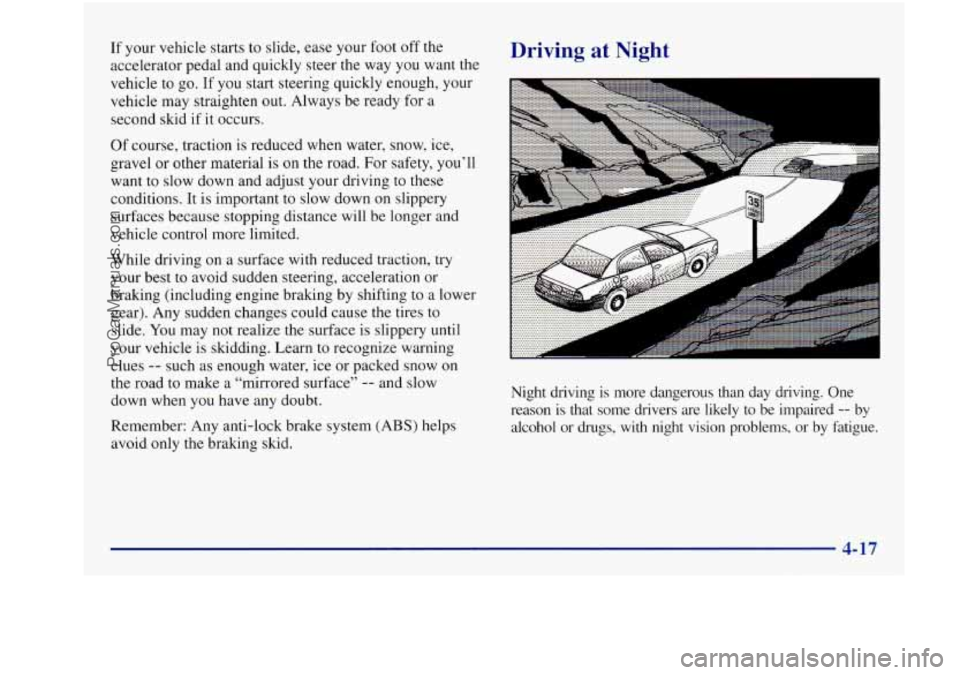
Night driving is more dangerous than day driving. One
reason is that
some drivers are likely to be impaired -- by
alcohol or drugs, with night vision problems, or by fatigue.
ProCarManuals.com
Page 274 of 422
If You’re Stuck: In Sand, Mud,
Ice or Snow
What you don’t want to do when your vehicle is stuck is
to spin your wheels too fast. The method known as
“rocking” can help
you get out when you’re stuck, but
you must use caution.
If you let your tires spin at high speed, they can
explode, and you or others could be injured. And,
the transaxle
or other parts of the vehicle can
overheat. That could cause an engine
compartment fire or other damage. When you’re
stuck, spin the wheels
as little as possible. Don’t
spin the wheels above
35 mph (55 km/h) as shown
on the speedometer.
NOTICE:
Spinning your wheels can destroy parts of your
vehicle as well
as the tires. If you spin the wheels
too fast while shifting your transaxle back and
forth, you can destroy your transaxle.
For information about using tire chains on your vehicle,
see “Tire Chains” in the Index.
Rocking Your Vehicle To Get It Out
First, turn your steering wheel left and right. That will
clear the area around your front wheels. If your vehicle
has the Enhanced Traction System, you should turn
the system off.
(See “Enhanced Traction System” in
the Index.) If your vehicle has the Traction Control
System, you should turn the system
off. (See “Traction
Control System”
in the Index.) Then shift back and forth
between REVERSE (R) and a forward gear, spinning the
wheels as little
as possible. Release the accelerator pedal
while you shift, and press lightly on the accelerator
pedal when
the transaxle is in gear. If that doesn’t get
you out
after a few tries, you may need to be towed out.
If you do need to be towed out, see “Towing Your
Vehicle” in the Index.
5-38
ProCarManuals.com
Page 319 of 422
The tread or sidewall is cracked, cut or snagged deep
enough to show cord or fabric.
0 The tire has a bump, bulge or split.
The tire has a puncture, cut or other damage that
can’t be repaired well because of
the size or location
of the damage.
Buying New Tires
To find out what kind and size of tires you need, look at
the Tire-Loading Information label.
The tires installed on your vehicle when it was new had
a Tire Performance Criteria Specification (TPC Spec)
number on each tire’s sidewall. When you get new tires,
get ones with that same TPC Spec number. That way
your vehicle will continue to have tires that are designed
to give proper endurance, handling, speed rating,
traction, ride and other things during normal service
on your vehicle. If your tires have an all-season tread
design, the
TPC number will be followed by an “MS”
(for mud and snow).
If you ever replace your tires with those not having a
TPC Spec number, make sure they are the same size,
load range, speed rating and construction type (bias,
bias-belted or radial)
as your original tires.
A CAUTION:
Mixing tires c!!!uld cause you to lose control while
driving.
If you mix tires of different sizes or types
(radial and bias-belted tires), the vehicle may
not handle properly, and you could have a crash.
Using tires
of different sizes may also cause
damage to your vehicle. Be sure to
use the same
size and type tires on all wheels.
It’s
all right to drive with your compact spare,
though. It was developed for use on your vehicle.
6-43
ProCarManuals.com
Page 320 of 422
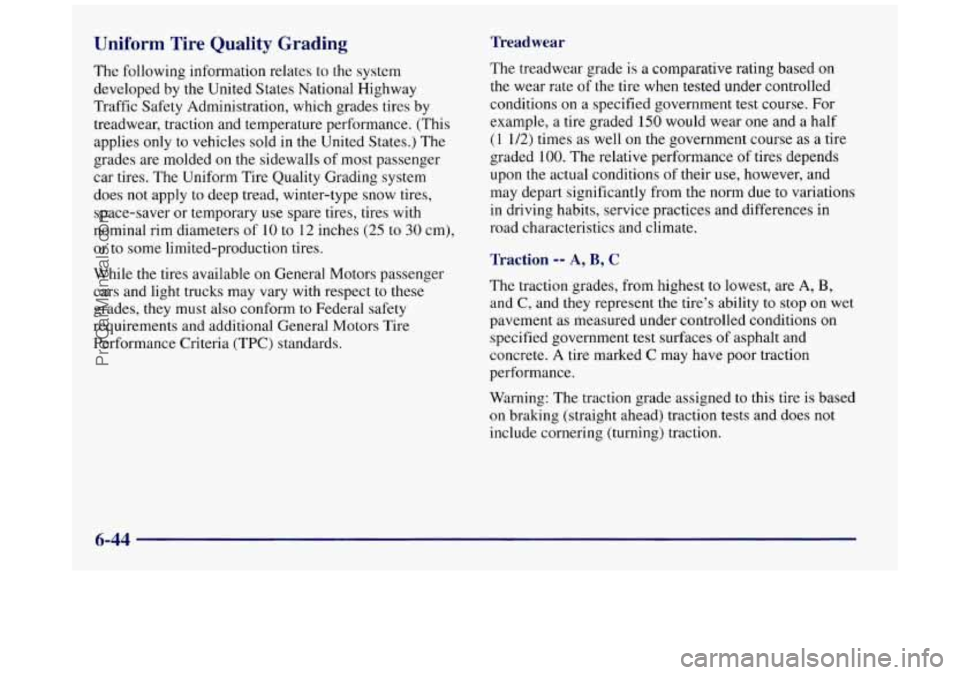
Uniform Tire Quality Grading
The following information relates to the system
developed by the United States National Highway
Traffic Safety Administration, which grades tires by
treadwear, traction and temperature performance. (This
applies only to vehicles sold in the United States.) The
grades are molded on the sidewalls of most passenger
car tires. The Uniform Tire Quality Grading system
does not apply to deep tread, winter-type snow tires,
space-saver or temporary
use spare tires, tires with
nominal rim diameters of
10 to 12 inches (25 to 30 cm),
or to some limited-production tires.
While the tires available on General Motors passenger
cars and light trucks may vary with respect to these
grades, they must also conform to Federal safety
requirements and additional General Motors Tire
Performance Criteria (TPC) standards.
Treadwear
The treadwear grade is a comparative rating based on
the wear rate
of the tire when tested under controlled
conditions on a specified government test course. For
example, a tire graded
150 would wear one and a half
( 1 1/2) times as well on the government course as a tire
graded
100. The relative performance of tires depends
upon the actual conditions
of their use, however, and
may depart significantly from the norm due to variations
in driving habits, service practices and differences in
road characteristics and climate.
Traction -- A, B, C
The traction grades, from highest to lowest, are A, B,
and C, and they represent the tire’s ability to stop on wet
pavement as measured under controlled conditions on
specified government test surfaces of asphalt and
concrete.
A tire marked C may have poor traction
performance.
Warning: The traction grade assigned to this tire is based
on braking (straight ahead) traction tests and does not
include cornering (turning) traction.
6-44
ProCarManuals.com
Page 410 of 422

Driving
........................................ City 4-22
Defensive
.................................... 4-2
Drunken
..................................... 4-3
Freeway
.................................... 4-23
InaBlizzard
................................. 4-29
IntheRain
.................................. 4-19
OnCurves
.................................. 4-12
In Foreign Countries
........................... 6-5
Night
...................................... 4-17
On Grades While Towing a Trailer
............... 4-39
On Hill and Mountain Roads .................... 4-25
On Snow or Ice
.............................. 4-28
Through Deep Standing Water
................... 4-21
With a Trailer
................................ 4-37
Drunken Driving
................................ 4-3
Dual Automatic ComforTemp Climate Control
......... 3-7
Dual ComforTemp Climate Control
.................. 3-4
WetRoads
.................................. 4-19
Winter
...................................... 4-27 Identification
................................ 6-57
Oil Level Check .............................. 7-39
Overheating
................................. 5-15
Running
While Parked ......................... 2-32
Specifications
................................ 6-64
Engine Oil
.................................... 6-11
Additives ................................... 6-15
Supercharger
................................ 6-18
Used
....................................... 6-15
What Kind to Use ............................. 6-13
When to Change
.............................. 6-15
Enhanced Traction System ........................ 4-11
Enhanced Traction System-Active Light
............. 2-64
Enhanced Traction System
Warning Light ........... 2-63
Exhaust, Engine
................................ 2-32
Exterior Lamps ................................. 2-41
StartingYow
................................ 2-20
Adding
..................................... 6-12
Checking
................................... 6-12
Ethan01
........................................ 6.- 4
Electrical Equipment. Adding ..... 2.21.2.53.3.35. 6.58
Electrical System
............................... 6-58
Electrochromic Daymight Rearview Mirror
.......... 2-47
Engine
.............................. 6.9.6.10. 6.11
Coolant
..................................... 6-22
Coolant Heater
............................... 2-21
Coolant Level Check
.......................... 7-39
Coolant Temperature Gage
..................... 2-68
Coolant Temperature Light
..................... 2-68
Exhaust
..................................... 2-32 Fabric
Cleaning
............................... 6-48
Features and Controls
............................ 2-1
Filling Your Tank
................................ 6-5
Filter, Engine Oil
............................... 6-15
Filter, Passenger Compartment Air
................. 6-17
Finish Damage
................................. 6-54
First Gear, Automatic Transaxle
................... 2-26
Flashers, Hazard Warning
......................... 5-2
Filter. Air
..................................... 6-16
Finishcare
.................................... 6-53
9-4
ProCarManuals.com
Page 412 of 422

Instrument Panel ............................... 2-55
Cleaning
.................................... 6-50
Cluster
................................ 2-56. 2-57
Fuse Block
.................................. 6-59
Instrument Panel Brightness Control
................ 2-44
Interior Lamps
................................. 2-44
Jack. Tire
...... 5.25.5.27.5.28.5.29.5.30.5.31. 5.33
Jump Starting
................................... 5-3
Key Lock Cylinders Service ..................... 7-40
Key Reminder Warning
.......................... 2- 16
Keys
.......................................... 2-2
Labels Certification
................................. 4-32
Service Parts Identification
..................... 6-57
Tire-Loading Information
...................... 4-3 1
Vehicle Identification Number ................... 6-57
Lamps
........................................ 2-41
Courtesy
.................................... 2-44
Dome
...................................... 2-46
Fog ........................................ 2-44
Exterior
.................................... 2-4 1
Interior ..................................... 2-44
Reading, Rearview Mirror
...................... 2-46
Leaving Your Vehicle
with the Engine Running ....... 2-30
Cornering
................................... 2-44
Leaving Your Vehicle
............................. 2-9 Lighter
....................................... 2-51
Lights Air Bag Readiness
....................... 1.20. 2.60
Anti-Lock Brake System Active
............. 2.63. 4.9
Brake System Warning
......................... 2-61
ChangeOilSoon
............................. 2-73
Charging System
............................. 2-60
DoorRrunk
Ajar Warning ...................... 2-75
Anti-Lock Brake System Warning
............ 2.62. 4.7
Cruise
...................................... 2-74
Engine Coolant Temperature Light
............... 2-68
Enhanced Traction System Active
................ 2-64
Enhanced Traction System Warning
.............. 2-63
Interior
..................................... 2-44
Low Coolant Warning
.................... 2-69. 6-24
LowFuel
................................... 2-76
Low Oil Level
.......................... 2.72. 6-11
Low Traction
................................ 2-66
Low Washer Fluid Warning
................ 2.38. 2-75
Oil Warning
................................. 2-71
Performance Shift
....................... 2-27. 2-74
Safety Belt Reminder
...................... 1-6. 2-59
Security
.................................... 2-74
Service Engine Soon
.......................... 2-69
Service Vehicle Soon
.......................... 2-75
Tire Pressure Monitor
......................... 2-67
Traction Control System Active
.................. 2-66
Traction Control System Warning
................ 2-65
Loading Your Vehicle
........................... 4-31
9-6
ProCarManuals.com
Page 413 of 422

Locks Automatic Power Door
......................... 2-7
Cylinders
................................... 7-40
DelayedLocking
.............................. 2-8
Ignition Transaxle Check
....................... 7-42
Key Lock Cylinder Service
..................... 7-40
Lockout Prevention Feature
...................... 2-5
ManualDoor
................................. 2-4
PowerDoor
.................................. 2-5
Rear Door Security
............................. 2-6
Trunk
...................................... 2-15
Window
.................................... 2-34
Loss
of Control ................................ 4- 16
Low Coolant Warning Light
................. 2.69. 6.24
LowFuelLight
................................ 2-76
Low Oil Level Light
....................... 2.72. 6. 11
Low Traction Light ............................. 2-66
Low Washer Fluid Warning Light
............. 2.38. 2-75
Low-Beam Headlamps
.......................... 2-36
Lubricants and Fluids
............................ 7-44
Lubrication Service. Body
........................ 7-40
Door
........................................ 2-4
Maintenance. Normal Replacement Parts
........... 6-65
Maintenance Record
............................ 7-46
Maintenance Schedule
............................ 7-1
How it’s Organized
............................ 7-3
Introduction
.................................. 7-2
Long Trip/Highway
........................... 7-28 Long
Trip/Highway Definition
................... 7-6
Long Trip/Highway Intervals
..................... 7-6
Owner Checks and Services
..................... 7-39
Periodic Maintenance Inspections
................ 7-43
Scheduled Maintenance Services
.................. 7-4
Short Trip/City
................................ 7-7
Short Trip/City Definition
....................... 7-5
Short Trip/City Intervals
........................ 7-5
Your Vehicle and the Environment
................ 7-2
Maintenance Schedule. Recommended Fluids
andLubricants
.............................. 7-44
Maintenance. Underbody
......................... 6-55
Maintenance When Trailer Towing
................. 4-40
Malfunction Indicator Lamp
...................... 2-69
Manual DoorLocks
................................... 2-4
Frontseat
.................................... 1-2
Manual Single Zone Climate Control
................ 3-2
Methanol
...................................... 6-4
Mirrors
....................................... 2-47
Convex Outside
.............................. 2-48
Electrochromic Day/Night
...................... 2-47
Heated Foldaway Outside
...................... 2-48
Inside Daymight Rearview
..................... 2-47
Power Outside
............................... 2-48
Visor Vanity
................................. 2-52
Mountain Roads
................................ 4-25
Multifunction Lever
............................. 2-35
MMT
......................................... 6-4
ProCarManuals.com