1997 BUICK REGAL maintenance
[x] Cancel search: maintenancePage 166 of 422
Heating
On cold days, use HTR with the temperature knob all
the way in the red area. The system will bring in outside
air, heat it and send it to the floor ducts.
Ventilation System
If your vehicle has an engine coolant heater, you can use
it to help your system provide warm air faster when it’s
cold outside
(0°F (-18°C) or lower). An engine coolant
heater warms the coolant your engine and heating
system use to provide heat. See “Engine Coolant
Heater” in
the Index.
Defogging and Defrosting
Your system has two settings for clearing the front and
side windows.
To defrost the windows quickly, use
FRONT and full hot
(90°F (32°C)). Driver sets
temperature and selects high fan speed.
To warm
passengers while keeping the windows clear, push the
AIR FLOW button until WINDSHTELDFLOOR
appears
in the display. Select fan speed for comfort and
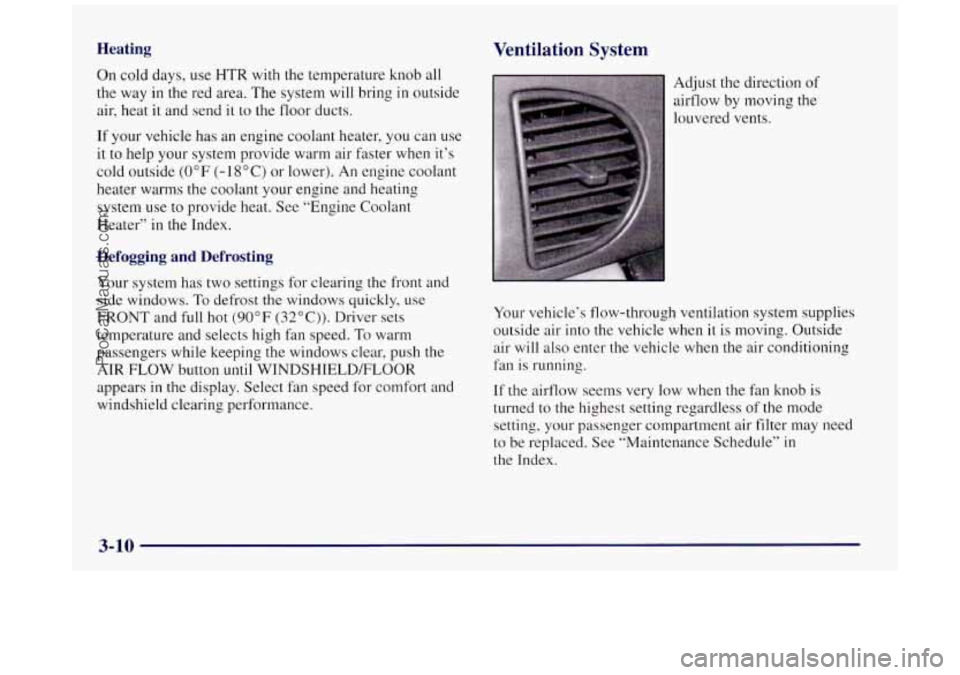
windshield clearing performance. Adjust the direction
of
airflow by moving the
louvered vents.
Your vehicle’s flow-through ventilation system supplies
outside air into the vehicle when
it is moving. Outside
air will also enter the vehicle when the
air conditioning
fan is running.
If the airflow seems very low when the fan knob is
turned to the highest setting regardless of
the mode
setting, your passenger compartment air filter may need
to be replaced. See “Maintenance Schedule” in
the Index.
3-10
ProCarManuals.com
Page 236 of 422
When You Are Ready to Leave After
Parking
on a Hill
1. Apply your regular brakes and hold the pedal down
while you:
Start your engine;
0 Shift into a gear; and
Release the parking brake.
2. Let up on the brake pedal.
3. Drive slowly until the trailer is clear of the chocks.
4. Stop and have someone pick up and store the chocks.
Maintenance When Trailer Towing
Your vehicle will need service more often when you’re
pulling
a trailer. See the Maintenance Schedule for more
on this. Things that are especially important in trailer
operation are automatic transaxle fluid (don’t overfill),
engine oil, belt, cooling system and brake adjustment.
Each
of these is covered in this manual, and the Index
will help you find them quickly. If you’re trailering, it’s
a good idea to review these sections before you start
your trip.
Check periodically to see that all hitch nuts and bolts
are tight.
4-40
ProCarManuals.com
Page 277 of 422
Section 6 Service and Appearance Care
Here you will find information about the care of your Buick. This section begins with service and fuel information,
and then it shows how
to check important fluid and lubricant levels. There is also technical information about your
6-2
6-3
6-5
6-5
6-7
6-11
6-1
1
6-16
6-19
6-22
6-26
6-27
6-28
6-3
1
6-32 6-39
6-47
6-48
6-5
1
6-5 1
vehicle, and a part devoted to its appearance care.
Service
Fuel
Fuels in Foreign Countries
Filling Your Tank
Checking Things Under the Hood
3800 Supercharged (Code 1) Engine
Engine Oil
Air Cleaner
Automatic Transaxle Fluid
Engine Coolant
Power Steering Fluid
Windshield Washer Fluid
Brakes
Battery
Bulb Replacement
Tires
Appearance Care
Cleaning the Inside
of Your Buick
Cleaning the Built-in Child Restraint
Care
of Safety Belts and Built-in Child
Restraint Harness 6-5
1
6-52
6-52
6-52
6-53
6-54 6-54
6-54
6-55
6-55
6-5 6
6-57
6-57
6-58
6-63
6-63
6-64
6-65
6-65 Cleaning Glass Surfaces
Cleaning
the Outside of the Windshield and
Wiper Blades
Weatherstrips Cleaning the Outside of Your Buick
Cleaning Aluminum or Chrome Wheels
Cleaning Tires
Sheet Metal Damage
Finish Damage
Underbody Maintenance
Chemical Paint Spotting
Appearance Care Materials Chart
Vehicle Identification Number
(VIN)
Service Parts Identification Label
Electrical System Replacement Bulbs
Capacities and Specifications
Vehicle Dimensions
Normal Maintenance Replacement Parts
Air Conditioning Refrigerants
6-1
ProCarManuals.com
Page 278 of 422
Service
Your Buick dealer knows your vehicle best and wants
you to be happy with it.
We hope you’ll go to your
dealer for all your service needs. You’ll get genuine GM
parts and GM-trained and supported service people.
We hope you’ll want
to keep your GM vehicle all GM.
Genuine GM parts have one
of these marks:
Doing Your Own Service Work
If you want to do some of your own service work, you’ll
want to use the proper Buick Service Manual. It tells
you much more about how
to service your Buick than
this manual can.
To order the proper service manual, see
“Service and Owner Publications’’ in the Index.
Your vehicle has an air bag system. Before attempting to
do your own service work, see “Servicing Your
Air
Bag-Equipped Buick” in the Index. You
should keep a record with
all parts receipts and list
the mileage and the date
of any service work you
perform. See “Maintenance Record” in the Index.
r I
I
A CAUl ON:
-
You can be injured and your vehicle could be
damaged
if you try to do service work on a
vehicle without knowing enough about it.
Be sure you have sufficient knowledge,
experience, the proper replacement parts
and tools before you attempt any vehicle
maintenance task.
Be sure to use the proper nuts, bolts and
other fasteners. “English” and “metric”
fasteners can be easily confused.
If you use
the wrong fasteners, parts can later break
or fall
off. You could be hurt.
I
6-2
ProCarManuals.com
Page 291 of 422
Engine Oil Additives
Don’t add anything to your oil. Your Buick dealer is
ready to advise
if you think something should be added.
When to Change Engine Oil
If any one of these is true for you, use the short tripkity
maintenance schedule:
a
a
a
a
Most trips are less than 5 to 10 miles (8 to 16 km).
This is particularly important when outside
temperatures are below freezing.
Most trips include extensive idling (such as frequent
driving in stop-and-go traffic).
Most trips are through dusty areas.
You frequently tow a trailer or use
a carrier on top of
your vehicle.
The vehicle
is used for delivery service, police, taxi
or other commercial application.
Driving under these conditions causes engine oil to
break down sooner. If any one of these is true for your
vehicle,
then you need to change your oil and filter every
3,000 miles (5 000 km) or 3 months -- whichever occurs
first. (See “Change Oil Soon” Light
in the Index.)
If none of them is true, use the long trip/highway
maintenance schedule. Change the oil and filter every
7,500 miles (12 500 km) or 12 months -- whichever
occurs first. Driving
a vehicle with a fully warmed
engine under highway conditions causes engine
oil to
break down slower.
(See “Change Oil Soon” Light
in the Index.)
What to Do with Used Oil
Did you know that used engine oil contains certain
elements that may be unhealthy for your skin and could
even cause cancer? Don’t let used oil stay on your skin
for very long. Clean your skin and nails with soap and
water, or
a good hand cleaner. Wash or properly throw
away clothing or rags containing used engine oil. (See
the manufacturer’s warnings about the use and disposal
of oil products.)
Used oil can be
a real threat to the environment. If you
change your own oil, be sure to drain all free-flowing oil
from the filter before disposal. Don’t ever dispose of oil
by putting
it in the trash, pouring it on the ground, into
sewers, or into streams or bodies of water. Instead,
recycle it by taking it to
a place that collects used oil. If
you have
a problem properly disposing of your used oil,
ask your dealer, a service station or
a local recycling
center for help.
ProCarManuals.com
Page 292 of 422
Air Cleaner
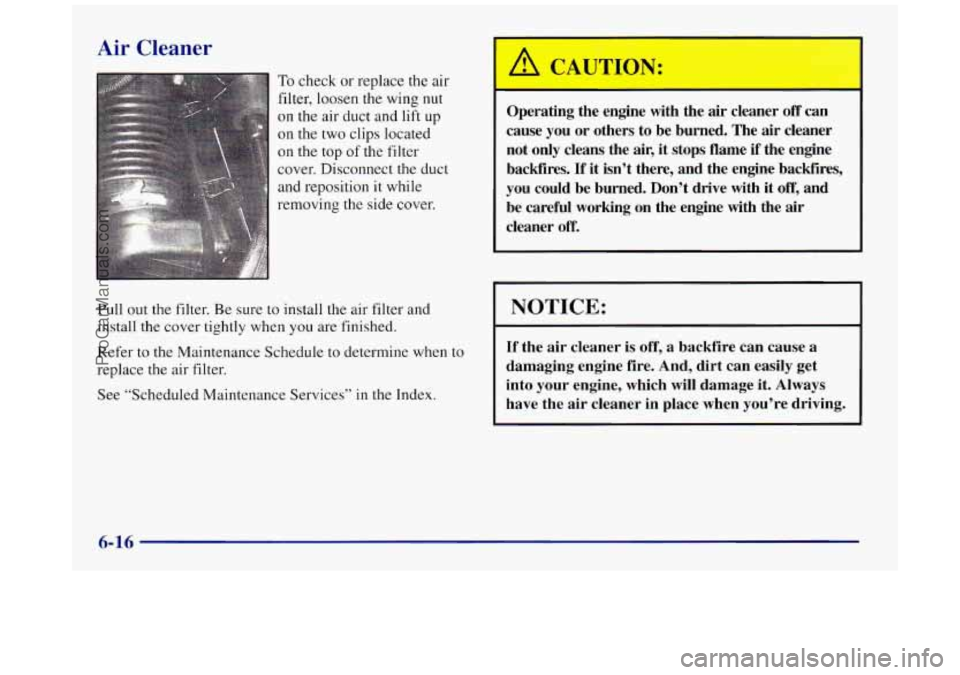
To check or replace the air
filter, loosen the wing nut
on the
air duct and lift up
on the
two clips located
on the top of the filter
cover, Disconnect the duct
and reposition it while
removing the side cover.
r
Operating the engine with the air cleaner off can
cause you or others to be burned. The air cleaner
not only cleans the air, it stops flame if the engine
backfires.
If it isn’t there, and the engine backfires,
you could be burned. Don’t drive with it
off, and
be careful working on the engine with the air
cleaner
off.
Pull out the filter. Be sure to install the air filter and NOTICE:
install the cover tightly when you are finished.
Refer to the Maintenance Schedule to determine when to
If the air cleaner is off, a backfire can cause a
replace the air filter. damaging engine fire. And, dirt can easily get
I
See “Scheduled Maintenance Services” in the Index.
I
into your engine, which will damage it. Always
have the air cleaner in place when you’re driving.
I
6-16
ProCarManuals.com
Page 293 of 422
Passenger Compartment Air Filter
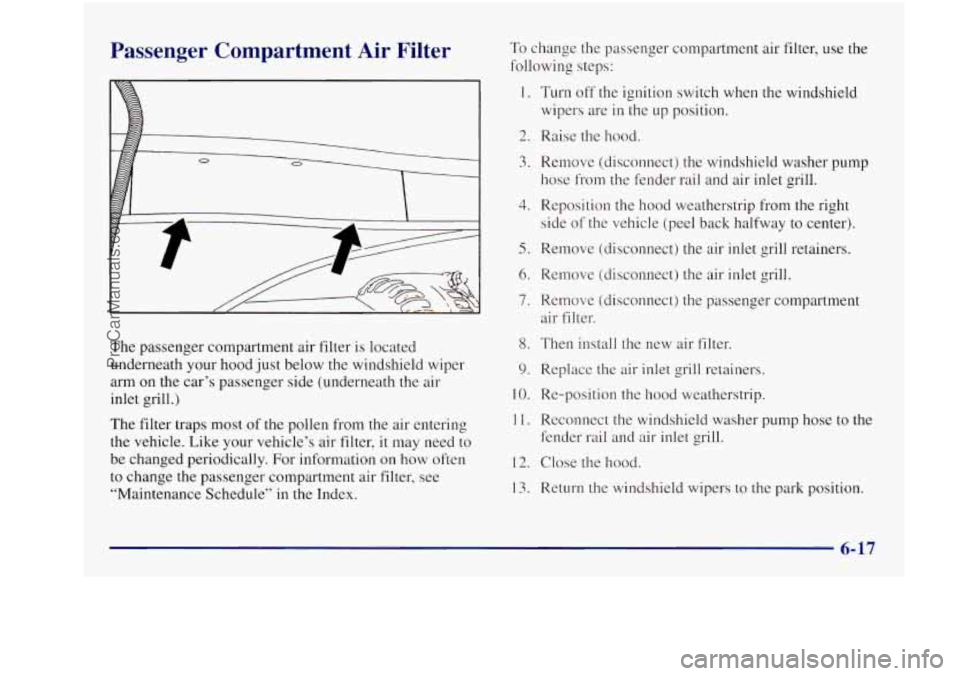
The passenger compartment air filter is located
underneath your hood just below the windshield wiper
arm on the car’s passenger side (underneath
the air
inlet grill.)
The filter traps most
of the pollen from the air entering
the vehicle. Like your vehicle’s air filter, it may need to
be changed periodically. For information on how often
to change the passenger compartment air
filter, see
“Maintenance Schedule”
in the Index.
To change the passenger compartment air filter, use the
following steps:
1.
2.
3.
4.
5.
6.
7.
8.
9.
10.
11.
12.
13.
Turn off the ignition switch when the windshield
wipers are
in the up position.
Raise the hood.
Remove (disconnect) the windshield washer pump
hose from the fender rail and air inlet grill.
Reposition the hood weatherstrip from the right
side of the vehicle (peel back halfway to center).
Remove (disconnect) the air inlet grill retainers.
Remove (disconnect) the air inlet grill.
Remove (disconnect) the passenger compartment
air filter.
Then install the new air filter.
Replace the air inlet grill retainers.
Re-position the hood weatherstrip.
Reconnect the windshield washer pump hose to the
fender rail and air inlet grill.
Close the hood.
Return the windshield wipers to the park position.
ProCarManuals.com
Page 294 of 422
Supercharger Oil
Unless you are technically qualified and have the proper
tools, you should let your dealer or a qualified service
center perform this maintenance.
When to Check
Check oil level every 30,000 miles (50 000 km) or every
36 months, whichever occurs first.
What Kind of Oil to Use
See “Recommended Fluids and Lubricants’’ in the Index
and use only the recommended oil.
How to Check and Add Oil
Check oil only when the engine is cold. Allow the
engine to cool two to three hours after running.
If you remove the supercharger oil fill plug while
the engine is hot, pressure may cause
hot oil to
blow out
of the oil fill hole. You may be burned.
Do not remove the plug until the engine cools.
1.
2.
3.
3.
Clean the area around the oil fill plug before
removing it.
Remove
the oil fill plug using a 3/16 inch Allen
wrench.
The oil level is correct when
it just reaches the
bottom
of the threads of the inspection hole.
Replace the oil plug with the O-ring
in place.
Torque to
88 lb-in (10 N-m).
6-18
ProCarManuals.com