Page 332 of 420
Fuses and Circuit Breakers
The wiring circuits in your vehicle are protected from
short circuits by a combination of fuses and circuit
breakers. This greatly reduces the chance of damage
caused by electrical problems.
Look at the silver-colored band inside the fuse. If the
band is broken or melted, replace the fuse. Be sure
you
replace a bad fuse with a new one of the identical size
and rating.
There are three fuse blocks in your vehicle: the
Instrument Panel Fuse Block located under the
instrument panel, the Underhood Fuse Block located on
the passenger’s side engine compartment, and the Rear
Fuse Block located under the rear seat.
Instrument Panel Fuse Block
The right side fuse panel is located under the
instrument panel.
Remove the hush panel to reveal the fuses.
To remove
the panel, remove the three screws located along the
rear edge of the panel. Place the wide end
of the fuse
puller over the plastic end
of the fuse. Squeeze the ends
over the fuse and pull it out.
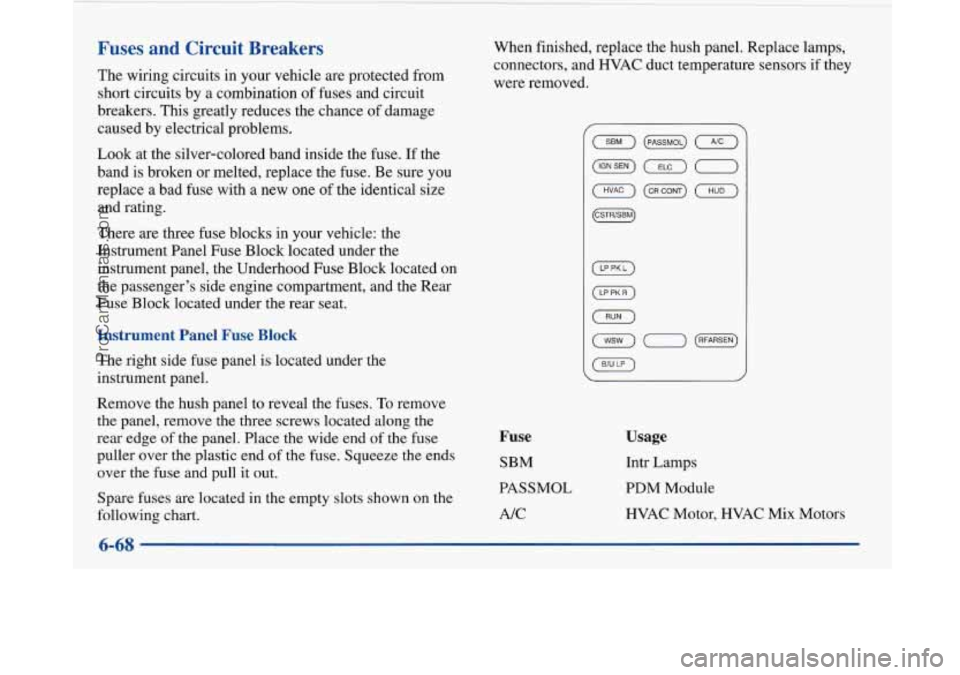
>pare fuses are located
in the empty slots shown on the
following chart. When finished, replace
the hush panel. Replace lamps,
connectors, and HVAC duct temperature sensors if they
were removed.
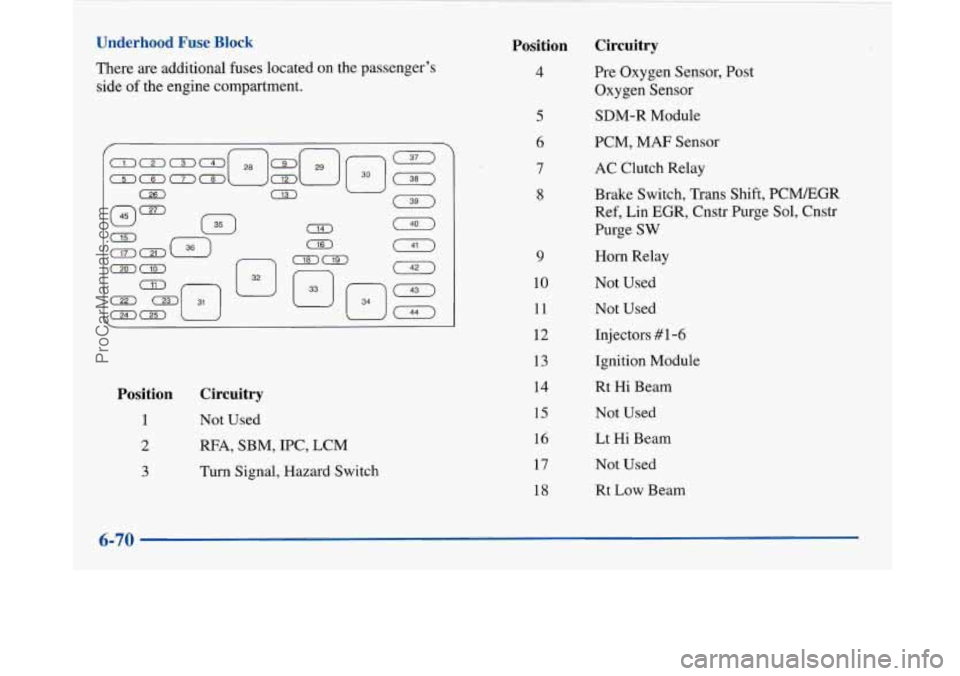
Fuse
SBM
PASSMOL
NC
(SEN) (ELC) (-)
(x) (KT) (TI
(K)
(LPPKR 1
Usage
Intr Lamps
PDM Module
HVAC Motor, HVAC Mix Motors
ProCarManuals.com
Page 334 of 420
I !
Underhood Fuse Block
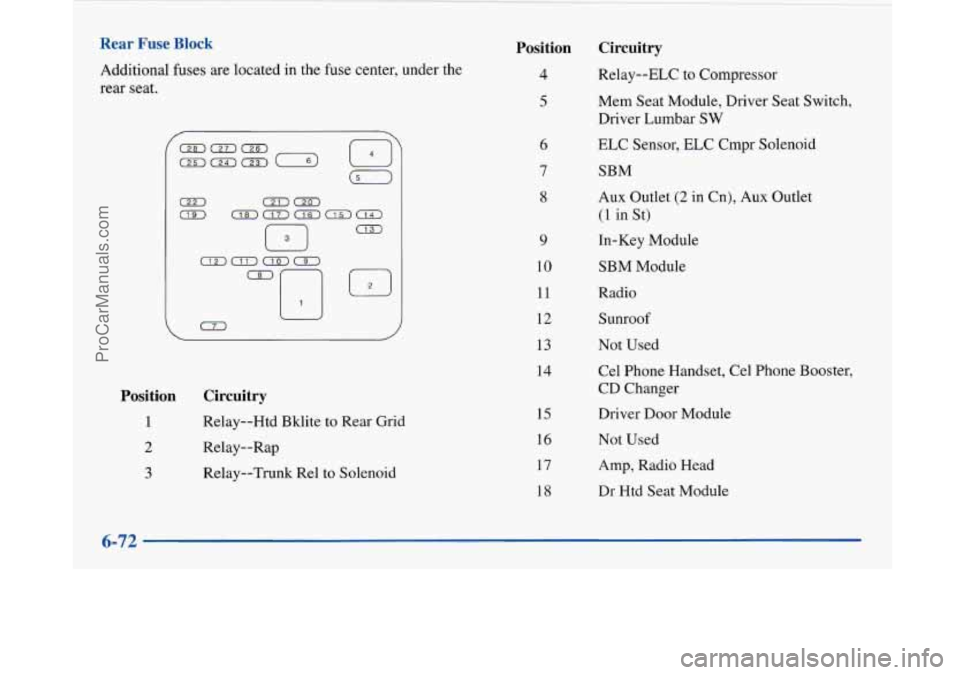
There are additional fuses located on the passenger’s
side
of the engine compartment.
Position
1
2
3
Circuitry
Not Used
RFA, SBM, IPC, LCM
Turn Signal, Hazard Switch
Position Circuitry
4
9
10
11
12
13
14
15
16
17
1s Pre Oxygen Sensor,
Post
Oxygen Sensor
SDM-R Module
PCM, MAF Sensor
AC Clutch Relay
Brake Switch, Trans Shift, PCMEGR
Ref, Lin EGR, Cnstr Purge Sol, Cnstr
Purge
SW
Horn Relay
Not Used Not Used
Injectors #1-6
Ignition Module
Rt Hi Beam
Not Used
Lt Hi Beam
Not Used
Rt Low Beam
6-70
ProCarManuals.com
Page 336 of 420
Rear Fuse Block
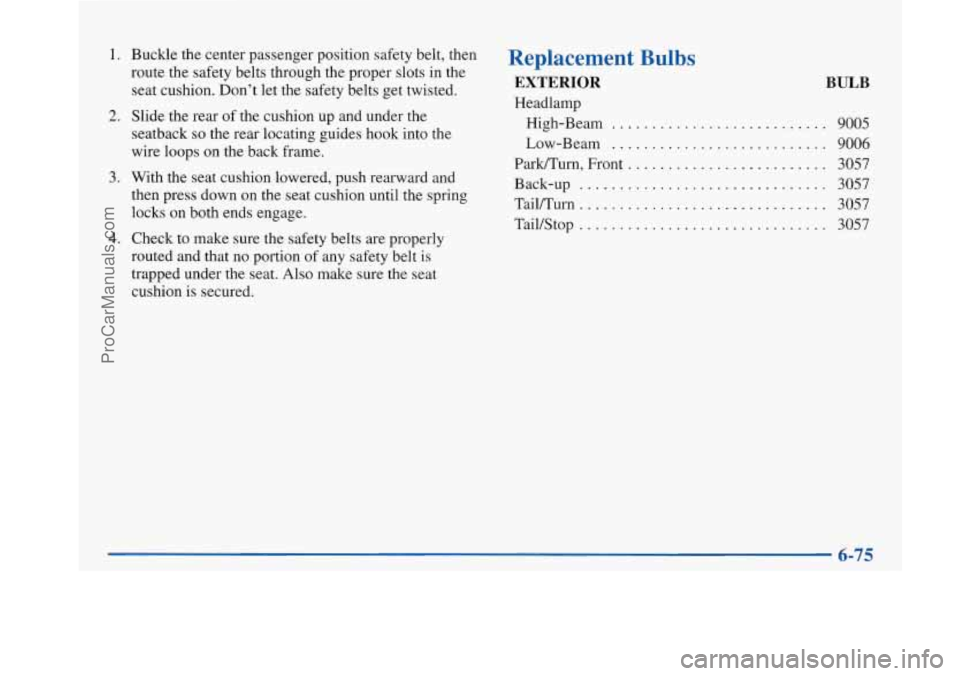
Additional fuses are located in the fuse center, under the
rear seat.
0
Position
1
2
3
Circuitry
Relay--Htd Bklite to Rear Grid
Relay--Rap
Relay--Trunk Re1 to Solenoid
Position Circuitry
4 Relay--ELC to Compressor
5
9
10
11
12
13
14
15
16
17
18 Mem
Seat Module, Driver Seat Switch.
Driver Lumbar
SW
ELC Sensor, ELC Cmpr Solenoid
SBM
Aux Outlet
(2 in Cn), Aux Outlet
(1 in St)
In-Key Module
SBM Module
Radio Sunroof
Not Used
Cel Phone Handset, Cel Phone Booster,
CD Changer
Driver
Door Module
Not Used
Amp, Radio Head
Dr Htd Seat Module
6-72
ProCarManuals.com
Page 339 of 420
1. Buckle the center passenger position safety belt, then
route the safety belts through the proper slots in the
seat cushion. Don’t let the safety belts get twisted.
seatback
so the rear locating guides hook into the
wire loops on the back frame.
2. Slide the rear of the cushion up and under the
3. With the seat cushion lowered, push rearward and
then press down on the seat cushion until the spring
locks on both ends engage.
4. Check to make sure the safety belts are properly
routed and that no portion of any safety belt is
trapped under the seat.
Also make sure the seat
cushion
is secured.
Replacement Bulbs
EXTERIOR BULB
Headlamp
High-Beam
........................... 9005
Low-Beam ........................... 9006
ParWTurn, Front ......................... 3057
Back-up
............................... 3057
Tailmum
............................... 3057
Tail/Stop
......................... . . 3057
6-75
ProCarManuals.com
Page 384 of 420
At Least Twice a Year
Restraint System Check
Make sure the safety belt reminder light and all your
belts, buckles, latch plates, retractors and anchorages are
working properly. Look for any other loose or damaged
safety belt system
parts. If you see anything that might
keep
a safety belt system from doing its job, have it
repaired. Have any torn or frayed safety belts replaced.
Also look for any opened or broken air bag coverings,
and have them repaired or replaced. (The air bag system
does not need regular maintenance.)
Wiper Blade Check
Inspect wiper blades for wear or cracking. Replace blade
inserts that appear worn or damaged or that streak or
miss areas of the windshield. Also see “Wiper Blades,
Cleaning” in the Index.
Automatic Transaxle Check
Check the transaxle fluid level; add if needed. See
“Automatic Transaxle” in the Index. A fluid loss
may indicate a problem. Check the system and repair
if needed.
At Least Once a Year
Key Lock Cylinders Service
Lubricate the key lock cylinders with the lubricant
specified in
Part D.
Body Lubrication Service
Lubricate all body door hinges. Also lubricate all hinges
and latches, including those for the hood, glove box
door and console door.
Part D tells you what to use.
More frequent lubrication may be required when
exposed to a corrosive environment.
7-40
ProCarManuals.com
Page 385 of 420
Starter Switch Check
A CAUTION:
Brake-Transaxle Shift Interlock (BTSI) Check
When you are doing this check, the vehicle could
move suddenly.
If it does, you or others could be
injured. Follow the steps below.
1. Before you start, be sure you have enough room
2. Fdy apply both the parking brake (see “Parking
around
the vehicle.
Brake” in the Index
if necessary) and the
regular brake.
NOTE: Do not use the accelerator pedal, and be
ready to turn off the engine immediately if it starts.
should work only in PARK
(P) or NEUTRAL (N). If
the starter works in any other position, your vehicle
needs service.
3. Try to start the engine in each gear. The starter
r
When you are doing this check, the vehicle could
move suddenly.
If it does, you or others could be
injured. Follow the steps below.
1. Before you start, be sure you have enough room
around the vehicle.
It should be parked on a
level surface.
2. Firmly apply the parking brake (see “Parking Brake”
in the Index if necessary).
NOTE: Be ready to apply the regular brake
immediately if the vehicle begins to move.
3. With the engine off, turn the key to the RUN
position, but don’t start the engine. Without applying
the regular brake, try to move the shift lever out
of
PARK (P) with normal effort. If the shift lever
moves out of PARK (P), your vehicle’s BTSI
needs service.
7-41
ProCarManuals.com
Page 386 of 420
1 ~~ ~~
1 !
Ignition Transaxle Lock Check
While parked, and with the parking brake set, try to turn
the ignition key to LOCK in each shift lever position.
The key should turn to LOCK only when the shift
lever is
in PARK (P).
The key should come out only in LOCK.
Parking Brake and Automatic Transaxle PARK (P)
Mechanism Check
When you are doing this check, your vehicle
could begin to move. You or others could be
injured and property could be damaged. Make
sure there
is room in front of your vehicle in case
it begins to roll. Be ready to apply the regular
brake
at once should the vehicle begin to move. Park on a fairly
steep hill, with the vehicle facing
downhill. Keeping your foot on the regular brake, set the
parking brake.
To check the parking brake’s holding ability: With
the engine running and transaxle in NEUTRAL (N),
slowly remove foot pressure from the regular brake
pedal.
Do this until the vehicle is held by the parking
brake only.
To check the PARK (P) mechanism’s holding ability:
With the engine running, shift to PARK
(P). Then
release all brakes.
Underbody Flushing Service At least every spring, use plain water to
flush any
corrosive materials from the underbody. Take care to
clean thoroughly any areas where mud and other debris
can collect.
ProCarManuals.com
Page 388 of 420

Part D: Recommended Fluids and
Lubricants
NOTE: Fluids and lubricants identified below by name,
part number or specification may be obtained from your
GM dealer.
USAGE
Engine Oil
-
Engine Coolant
Hydraulic Brake System
7-44 -
FLUIDLUBRICANT
Engine oil with the American
Petroleum Institute Certified For
Gasoline Engines “Starburst”
symbol of the proper viscosity.
To
determine the preferred viscosity
for your vehicle’s engine, see
“Engine Oil” in the Index.
50/50 mixture
of clean water
(preferably distilled) and use only
GM Goodwrench@ DEX-COOL@
or Havoline@ DEX-COOL@
coolant. See “Engine Coolant’’ in
the Index.
Delco Supreme
11@ Brake Fluid
(GM Part
No. 12377967 or
equivalent DOT-3 brake fluid).
USAGE
Parking Brake
Cable Guides
FLUID/LUBRICANT
Chassis lubricant (GM Part
No. 12377985 or equivalent) or
lubricant meeting requirements
of
NLGI # 2, Category LB or
GC-LB.
Power Steering
System
Automatic
Transaxle
Key Lock
Cylinders
Supercharger GM
Power Steering Fluid (GM
Part
No. 1052884 - 1 pint,
1050017
- 1 quart, or equivalent).
DEXRON@-111 Automatic
Transmission Fluid.
Multi-Purgse lubricant,
Superlube (GM Part
No. 12346241 or equivalent).
~
Supercharger Oil (GM Part
No. 12345982). See “Supercharger
Oil’’ in the Index.
ProCarManuals.com