1997 BUICK CENTURY oil
[x] Cancel search: oilPage 294 of 406
Brake Wear
NOTICE:
0
0
Using the wrong fluid can badly damage
brake system parts. For example, just a few
drops
of mineral-based oil, such as engine
oil, in your brake system can damage brake
system parts
so badly that they’ll have to be
replaced. Don’t let someone put in the
wrong kind of fluid.
If you spill brake fluid on your vehicle’s
painted surfaces, the paint finish can be
damaged. Be careful not to spill brake fluid
on your vehicle.
If you do, wash it off
immediately. See “Appearance Care” in
the Index. Your
Buick has front disc brakes and rear drum brakes.
Disc brake pads have built-in wear indicators that make
a
high-pitched warning sound when the brake pads are worn
and new pads are needed. The sound may come and go or
be heard all the time
your vehicle is moving (except when
you are
pushing on the brake pedal firmly).
I
I
The brake wear warning sound means that soon
your brakes won’t work well. That could lead
to
an accident. When you hear the brake wear
warning sound, have your vehicle serviced.
I NOTICE:
Continuing to drive with worn-out brake pads
could result in costly brake repair.
6-28
ProCarManuals.com
Page 312 of 406
Using Foam-Type Cleaner on Fabric
1. Vacuum and brush the area to remove any loose dirt.
2. Always clean a whole trim panel or section. Mask
3. Mix Multi-Purpose Powdered Cleaner following the
surrounding trim
along stitch or welt lines.
directions on the container label.
4. Use suds only and apply with a clean sponge. Don’t
5. As soon as you’ve cleaned the section, use a sponge
saturate
the material and don’t rub it roughly.
to remove the suds.
6. Rinse the section with a clean, wet sponge.
7. Wipe off what’s left with a slightly damp paper towel
or cloth.
8. Dry it immediately with a blow dryer.
9. Wipe with a clean cloth.
Using Solvent-Type Cleaner on Fabric
First, see if you have to use solvent-type cleaner at all.
Some spots and stains will clean off better with just
water and mild soap.
If you need to use a solvent:
1. Gently scrape excess soil from the trim material with
a clean, dull knife
or scraper.
2. Use very little cleaner, light pressure and clean cloths
(preferably cheesecloth). Cleaning should start
at the
outside
of the stain, “feathering” toward the center.
3. Keep changing to a clean section of the cloth.
4. When you clean a stain from fabric, immediately
dry
the area with a blow dryer to help prevent a
cleaning ring.
6-46
ProCarManuals.com
Page 313 of 406
Special Cleaning Problems
Greasy or Oily Stains
Stains caused by grease, oil, butter, margarine, shoe
polish, coffee with cream, chewing gum, cosmetic
creams, vegetable oils, wax crayon, tar and asphalt can
be removed as follows:
1. Carefully scrape off excess stain.
2. Follow the solvent-type instructions described
earlier.
Shoe polish, wax crayon, tar and asphalt will stain if left
on a vehicle’s seat fabric. They should be removed as
soon as possible. Be careful, because the cleaner will
dissolve them and may cause them
to spread.
Non-Greasy Stains
Stains caused by catsup, coffee (black), egg, fruit, fruit
juice, milk, soft drinks, wine, vomit, urine and blood can
be removed as follows:
1. Carefully scrape off excess stain, then sponge the
soiled area with cool water.
2. If a stain remains, follow the foam-type instructions
described earlier.
3. If an odor lingers after cleaning vomit or urine,
treat the area with a waterhaking
soda solution:
1 teaspoon (5 ml) of baking soda to 1 cup (250 ml)
of lukewarm water.
4. If needed, clean lightly with solvent-type cleaner.
Combination Stains
Stains caused by candy, ice cream, mayonnaise, chili
sauce and unknown stains can be removed as follows:
1. Carefully scrape off excess stain.
2. Clean with cool water and allow to dry.
3. If a stain remains, clean it with solvent-type cleaner.
Cleaning Vinyl
Use warm water and a clean cloth.
Rub with a clean, damp cloth to remove dirt. You
may have to do it more than once.
Things like tar, asphalt and shoe polish will stain
if you don’t get them
off quickly. Use a clean
cloth and a vinyl/leather cleaner. See your dealer for
this product.
6-47
ProCarManuals.com
Page 314 of 406
Cleaning Leather
Use a soft cloth with lukewarm water and a mild soap or
saddle soap and wipe dry with
a soft cloth. Then, let the
leather dry naturally.
Do not use heat to dry.
0 For stubborn stains, use a leather cleaner. See your
dealer for
this product.
0 Never use oils, varnishes, solvent-based or abrasive
cleaners, furniture polish or shoe polish
on leather.
Soiled or stained leather should be cleaned
immediately.
If dirt is allowed to work into the
finish, it can harm the leather.
Cleaning the Top of the Instrument Panel
Use only mild soap and water to clean the top surfaces
of the instrument panel. Sprays containing silicones or
waxes may cause annoying reflections in the windshield
and even make
it difficult to see through the windshield
under certain conditions.
Cleaning the Built-in Child Restraint
Your built-in child restraint may be cleaned with mild
soap
and lukewarm water. Don’t use household cleaners.
They may weaken the harness or damage plastic parts.
The built-in child restraint pad is attached to the child
restraint cushion and seatback with fastener strips. You
can remove the pad, machine wash it in cold water
on a
gentle cycle and tumble dry it
on a low heat setting.
Never bleach or iron the pad, and don’t dry clean it.
6-48
ProCarManuals.com
Page 317 of 406
NOTICE:
Machine compounding or aggressive polishing on
a basecoatklearcoat paint finish may dull the
finish or leave swirl marks.
Foreign materials such as calcium chloride and other
salts, ice melting agents, road oil and
tar, tree sap, bird
droppings, chemicals from industrial chimneys, etc., can
damage your vehicle’s finish if they remain on painted
surfaces. Wash the vehicle as soon as possible. If
necessary, use non-abrasive cleaners that are marked
safe for painted surfaces to remove foreign matter.
Exterior painted surfaces are subject to aging, weather
and chemical fallout that can take their toll over
a period
of years.
You can help to keep the paint finish looking
new by keeping your Buick garaged
or covered
whenever possible.
Cleaning Aluminum Wheels
(If Equipped)
Keep your wheels clean using a soft clean cloth with
mild soap and water. Rinse with clean water. After
rinsing thoroughly, dry with a soft clean towel.
A wax
may then be applied.
The surface
of these wheels is similar to the painted
surface of your vehicle. Don’t use strong soaps,
chemicals, abrasive polishes, abrasive cleaners or
abrasive cleaning brushes on them because you could
damage the surface.
Don’t take your vehicle through an automatic car wash
that has silicon carbide tire cleaning brushes. These
brushes can also damage the surface
of these wheels.
6-51
ProCarManuals.com
Page 328 of 406
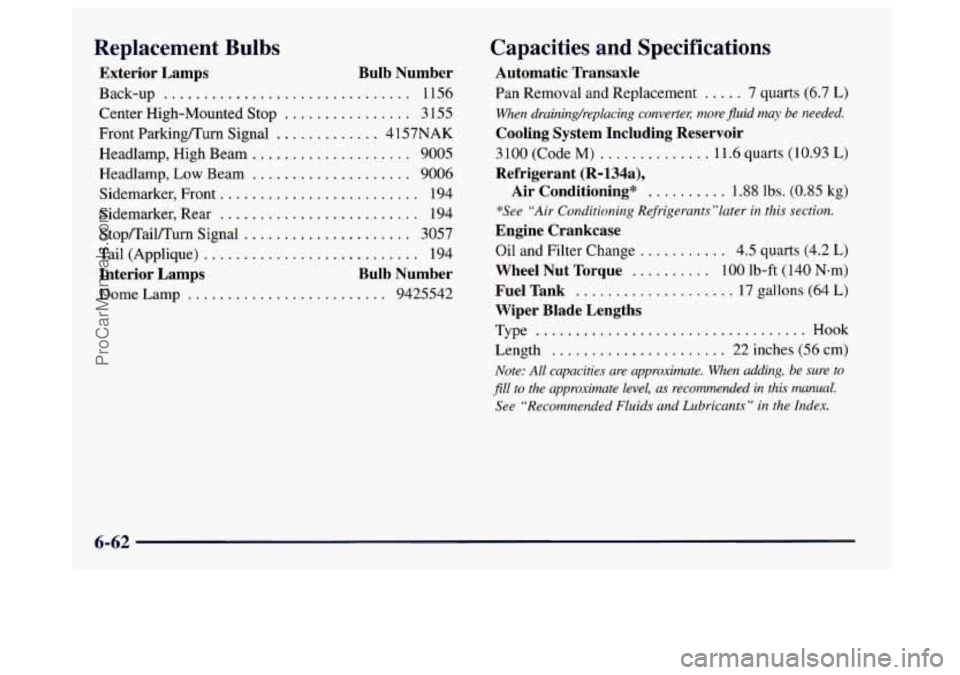
Replacement Bulbs
Exterior Lamps Bulb Number
Back-up ............................... 1156
Center High-Mounted Stop
................ 3 155
Front Parkingnurn Signal
............. 4 157NAK
Headlamp, High Beam
.................... 9005
Headlamp,
Low Beam .................... 9006
Sidemarker, Front
......................... 194
Sidemarker, Rear
......................... 194
Stop/Tail/Turn Signal
..................... 3057
Tail (Applique)
........................... 194
Interior Lamps Bulb Number
Dome Lamp ......................... 9425542
Capacities and Specifications
Automatic Transaxle
Pan
Removal and Replacement ..... 7 quarts (6.7 L)
When druiningheplacing convertec more .fluid muy be needed.
Cooling System Including Reservoir
3100 (Code M) .............. 11.6 quarts (10.93 L)
Refrigerant (R-l34a),
*See “Air Conditioning Rejrigerants”1ater in. this section.
Engine Crankcase
Oil and Filter Change ........... 4.5 quarts (4.2 L)
Wheel Nut Torque .......... 100 lb-ft (140 Nsm)
Wiper Blade Lengths
Type .................................. Hook
Note: All capacities are approximate. When adding, be sure to
.fill to the upproximate level, as recommended in this manual.
See “Recommended Fluids and Lubricants” in the Index.
Air Conditioning* .......... 1.88 lbs. (0.85 kg)
Fuel Tank .................... 17 gallons (64 L)
Length
...................... 22 inches (56 cm)
6-62
ProCarManuals.com
Page 329 of 406
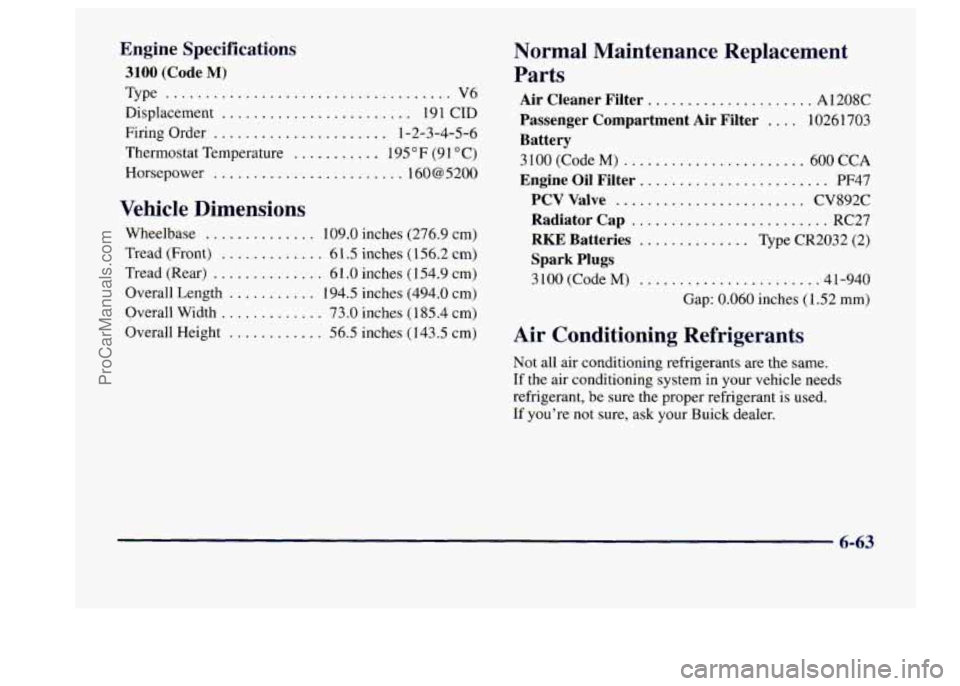
Engine Specifications
3100 (Code M)
Type .................................... V6
Displacement
........................ 191 CID
Firing Order
...................... 1-2-3-4-5-6
Thermostat Temperature
........... 195 OF (9 1 O C)
Horsepower
........................ 160 @ 5200
Vehicle Dimensions
Wheelbase .............. 109.0 inches (276.9 cm)
Tread (Front)
............. 6 1.5 inches ( 156.2 cm)
Tread (Rear)
.............. 61 .O inches ( 154.9 cm)
Overall Length
........... 194.5 inches (494.0 cm)
Overall Width
............. 73.0 inches (185.4 cm)
Overall Height
............ 56.5 inches (143.5 cm)
Normal Maintenance Replacement
Parts
Air Cleaner Filter ..................... A 1208C
Passenger Compartment Air Filter .... 10261703
Battery
3100 (Code M) ....................... 600 CCA
PCVValve ........................ CV892C
Engine Oil Filter ........................ PF47
Radiator Cap ......................... RC27
RKE Batteries .............. Type CR2032 (2)
3 100 (Code M) ...................... .41-940
Spark Plugs
Gap: 0.060 inches (1.52 mm)
Air Conditioning Refrigerants
Not all air conditioning refrigerants are the same.
If the air conditioning system in your vehicle needs
refrigerant, be sure the proper refrigerant
is used.
If you’re not sure, ask your Buick dealer.
6-63
ProCarManuals.com
Page 332 of 406
I IMPORTANT:
I
KEEP ENGINE OIL
AT THE PROPER
LEVEL AND CHANGE AS
RECOMMENDED
El
protection
Plan
Have you purchased the GM Protection Plan? The Plan
supplements
your new vehicle warranties. See your
Wlwranty and Owner Assistance booklet, or your Buick
dealer
for details.
Introduction
Your Vehicle and the Environment
Proper vehicle maintenance not only helps to keep your
vehicle in good working condition, but also helps the
environment. All recommended maintenance procedures
are important. Improper vehicle maintenance can even
affect the quality
of the air we breathe. Improper fluid
levels or the wrong tire inflation can increase the level
of emissions from your vehicle. To help protect our
environment, and to keep your vehicle in good
condition, please maintain your vehicle properly.
7-2
ProCarManuals.com