Page 140 of 196
136
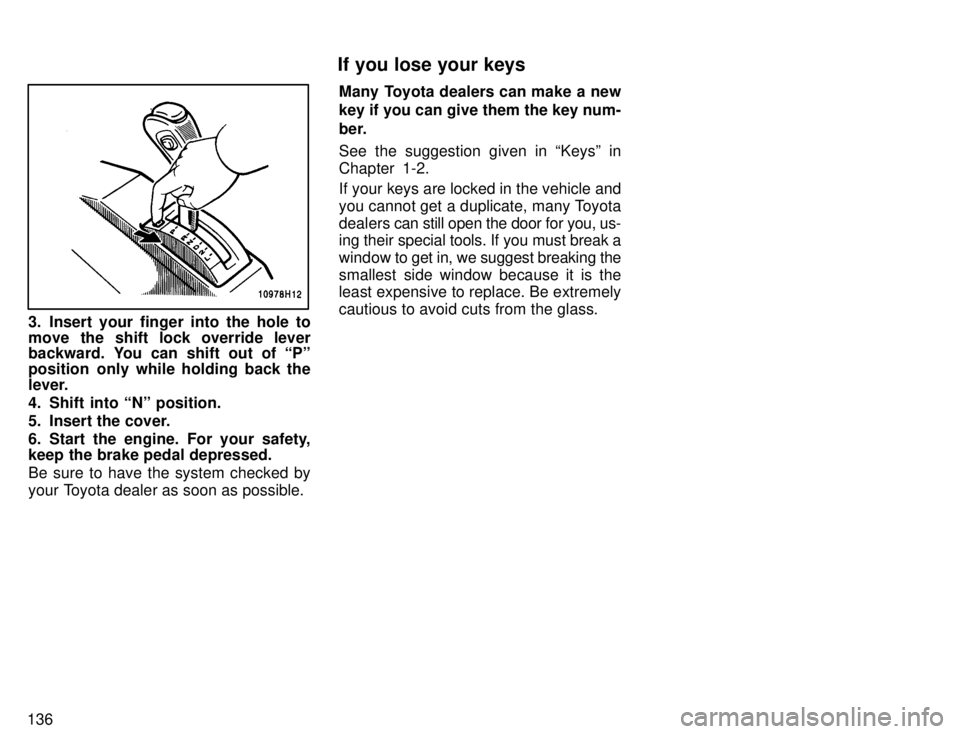
3. Insert your finger into the hole to
move the shift lock override lever
backward. You can shift out of Pº
position only while holding back the
lever.
4. Shift into Nº position.
5. Insert the cover.
6. Start the engine. For your safety, keep the brake pedal depressed.
Be sure to have the system checked by
your Toyota dealer as soon as possible.Many Toyota dealers can make a new
key if you can give them the key num-
ber. See the suggestion given in Keysº in Chapter 1-2.
If your keys are locked in the vehicle and
you cannot get a duplicate, many Toyota
dealers
can still open the door for you, us-
ing their special tools. If you must break a
window to get in, we suggest breaking the
smallest side window because it is the least expensive to replace. Be extremely cautious to avoid cuts from the glass.
If you lose your keys
Page 143 of 196

139
4. To prevent water spots, dry the vehicle using a clean soft cotton towel. Do not rub
or press hardÐyou might scratch thepaint.
Waxing your Toyota
Polishing and waxing is recommend-
ed to maintain the original beauty of
your Toyota's finish.
1. Always wash and dry the vehicle be-
fore
you begin waxing, even if you are us-
ing a combined cleaner and wax.
2. Use a good quality polish and wax. If the finish has become extremely weath-
ered, use a car-cleaning polish, followed
by a separate wax. Carefully follow the
manufacturer 's instructions and precau-
tions. Be sure to polish and wax the chrome trim as well as the paint.
3. Wax the vehicle again when water
does not bead but remains on the surface
in large patches.
CAUTION
Do not wash the vehicle floor with
water, or allow water to get onto the
floor when cleaning the vehicle in-
terior or exterior. W ater may get into
audio components or other electri-
cal components above or under the
floor carpet (or mat) and cause a
malfunction; and it may cause body
corrosion.!
Vinyl interior
The vinyl upholstery may be easily
cleaned with a mild soap or detergent
and water.
First vacuum over the upholstery to re- move loose dirt. Then, using a sponge or
soft cloth, apply the soap solution to the vi-
nyl. After allowing it to soak in for a few
minutes to loosen the dirt, remove the dirt
and wipe off the soap with a clean damp
cloth. If all the dirt does not come off, re-
peat the procedure. Commercial foam-
ing-type vinyl cleaners are also available
which work well. Follow the manufactur-
er's instructions.
Do not use solvent, thinner,
gasoline or window cleaner on the
interior.
NOTICE
Carpets
Use a good foam-type shampoo to
clean the carpets.
Begin by vacuuming thoroughly to re-
move as much dirt as possible. Several
types of foam cleaners are available; some are in aerosol cans and others are
powders or liquids which you mix with wa-
ter to produce a foam. To shampoo the
carpets, use a sponge or brush to apply the foam. Rub in overlapping circles. Do not apply waterÐthe best results are obtained by keeping the carpet as dry as possible. Read the shampoo instructions
and follow them closely. Seat belts
The seat belts may be cleaned with
mild soap and water or with lukewarm
water.
Use a cloth or sponge. As you are clean-
ing, check the belts for excessive wear,
fraying, or cuts.
Do not use dye or bleach on the
beltsÐit may weaken them.
NOTICE
Windows
The windows may be cleaned with any
household window cleaner.
Cleaning the interior
Page 144 of 196

140
When cleaning the inside of thewindows, be careful not to scratch
or damage the heater wires on therear window.
NOTICE
Air conditioning control panel, car au-
dio, instrument panel, console panel,
and switches Use a soft damp cloth for cleaning.
Soak a clean soft cloth in water or luke-
warm water then lightly wipe off any dirt.
Do not use organic substances(solvents, kerosene, alcohol, gas-
oline, etc.) or alkaline or acidicsolutions. These chemicals cancause discoloring, staining or
peeling of the surface.
If you use cleaners or polishingagents, make sure their ingredi-
ents do not include the sub-stances mentioned above.
If you use a liquid car freshener,
do not spill the liquid onto the ve-hicle's interior surfaces. It maycontain the ingredients men-
tioned above. Immediately clean any spill using the method men-tioned above.
NOTICE
Leather Interior
The leather upholstery may be cleaned
with neutral detergent for wool. Remove dirt using a soft cloth dampened with 5% solution of neutral detergent for
wool. Then thoroughly wipe off all traces
of detergent with a clean damp cloth.
After cleaning or whenever any part of the
leather gets wet, dry with a soft clean
cloth. Allow the leather to dry in a venti-
lated shaded area.
If a stain should fail to come outwith a neutral detergent, apply a
cleaner that does not contain anorganic solvent.
Never use organic substancessuch as benzine, alcohol or gaso-line, or alkaline or acid solutionsfor cleaning the leather as these
could cause discoloring.
Use of a nylon brush or syntheticfiber cloth, etc. may scratch the
fine grained surface of the leather.
NOTICE
Mildew may develop on soiled
leather upholstery. Be especially
careful to avoid oil spots. Try tokeep your upholstery alwaysclean.
Long exposure to direct sunlight
may cause the leather surface toharden and shrink. Keep your ve-
hicle in a shaded area, especiallyin the summer.
The interior of your vehicle is apt to heat up on hot summer days, so
avoid placing on the upholsteryitems made of vinyl or plastic or
containing wax as these tend to stick to leather when warm.
Improper cleaning of the leatherupholstery could result in discol-
oration or staining.
If you have any questions about the
cleaning of your Toyota, your local To-
yota dealer will be pleased to answer them.
Page 148 of 196
144IN THE ENGINE COMPARTMENT Items listed below should be checked
from time to time, e.g. each time whenrefueling.
Washer fluid
Make sure there is sufficient fluid in the
tank. See Chapter 7-3 for additional
infor-
mation.
Engine coolant level
Make sure the coolant level is between the
FULLº and LOWº lines on the see-
through reservoir. See Chapter 7- 2 for
additional information. Battery electrolyte level Make sure the electrolyte level of all bat-
tery cells is between upper and lower level
lines on the case. Add only distilled water
when replenishing. See Chapter 7-3 for
additional information. Brake fluid level
Make sure the brake fluid level is correct.
See Chapter 7- 2 for additional information.
Engine oil level
Check the l evel on the dipstick with the en-
gine turned off and the vehicle parked on
a level spot. See Chapter 7-2 for addition-
al information. Power steering fluid level Check the level on the dipstick. The level
should be in the HOTº or COLDº range
depending on the fluid temperature. See Chapter 7-2 for additional information. Exhaust system
If you notice any change in the sound of
the exhaust or smell exhaust fumes, have the cause located and corrected immedi-
ately. (See engine exhaust cautions in
Part 2.)
Be on the alert for changes in perfor-
mance, sounds, and visual tip-offs
that in-
dicate service is needed. Some important
clues are as follows: Engine missing, stumbling, or pinging
Appreciable loss of power
Strange engine noises
A leak under the vehicle (however, wa-
ter dripping from the air conditioning
after use is normal.)
Change in exhaust sound (This may
indicate a dangerous carbon monox-
ide leak. Drive with the windows open
and have the exhaust system checked
immediately.)
Flat-looking tire; excessive tire squeal
when cornering; uneven tire wear
Vehicle pulls to one side when driving straight on a level road
Strange noises related to suspensionmovement
Loss of brake effectiveness; spongy
feeling brake or clutch pedal; pedal al-
most touches floor; vehicle pulls to one
side when braking
Engine coolant temperature continual-
ly higher than normal
Does your vehicle need repairing?
Page 189 of 196
185
Fuses (type B)
27. HEATER 40 A:
A.Cº fuse
28. AM1 40 A: All components in STAº,
ECU-Bº, POWERº' RADIOº, CIGº,
GAUGEº, TURNº, ECU-IGº, WIPERº
and 4WDº fuses
29. AM2 30 A: All components in IGNº
fuse
30. POWER 30 A: Power windows, pow-
er door lock control system Fuses (type C)
31. ABS 60 A: Anti-lock brake system
32. ALT 80 A: All components in ABSº,
AM1º, STAº, ECU-Bº, POWERº, RA-
DIOº, CIGº, GAUGEº, TURNº, ECU-
IGº, WIPERº, 4WDº, HEATERº, A.Cº,
TAILº, PANELº, STOPº and ALT-Sº fuses