128Xtra-cab modelsÐTo raise the vehicle,
insert the jack handle extension into the jack (it is a loose fit) and turn it clockwisewith the handle, making sure the handle remains firmly fitted onto the jack handle
extension. As the j
ack touches the vehicle
and begins to lift, double-check that it is
properly positioned.
Never get under the vehicle when
the vehicle is supported by the jack alone. CAUTION
!
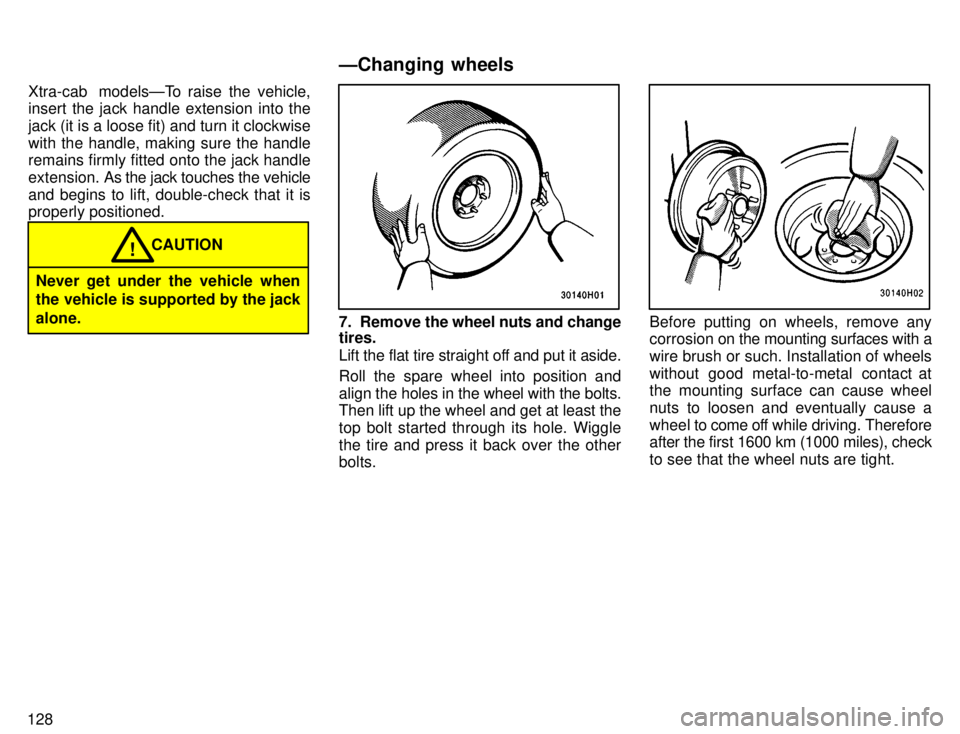
7. Remove the wheel nuts and change tires.
Lift the flat tire straight off and put it aside.
Roll the spare wheel into position and
align the holes in the
wheel with the bolts.
Then lift up the wheel and get at least thetop bolt started through its hole. Wigglethe tire and press it back over the other bolts.Before putting on wheels, remove any
corrosion on the mounting surfaces with a
wire brush or such. Installation of wheels
without good metal-to-metal contact at
the mounting surface can cause wheel
nuts to loosen and eventually cause a
wheel to come off while driving. Therefore
after the first 1600 km (1000 miles), check
to see that the wheel nuts are tight.
ÐChanging wheels
129
8. Reinstall all the wheel nuts finger tight.
Reinstall the wheel nuts (tapered end in-
ward) and tighten them as much as youcan by hand. Press back on the tire back and see if you can tighten them more.Two-wheel drive models
Four-wheel drive models9. Lower the vehicle completely and
tighten the wheel nuts.
Normal cab modelsÐTurn the jack han-
dle counterclockwise to lower the vehicle.
Xtra-cab modelsÐTurn the jack handle
extension counterclockwise with handle
to lower the vehicle, making sure the han-dle remains firmly fitted onto the jack han-
dle extension.
Use only the wheel nut wrench and turn it
clockwise to tighten the nuts. Do not use other
tools or any additional leverage oth-
er than your hands, such as a hammer,
pipe or your foot. Make sure the wrench is
securely engaged over the nut.
Tighten each nut a little at a time in the or-
der shown. Repeat the process until all the nuts are tight.
ÐLowering your vehicle
ÐReinstalling wheel nuts
158To check the fluid level, simply look at
the see-through reservoir. The level
should be between the MAXº and
MINº lines on the reservoir. It is normal for the brake fluid level to go
down slightly as the brake pads wear. So be sure to keep the reservoir filled.
If the reservoir needs frequent refilling, it may indicate a serious mechanical prob- lem.
If the level is low, add SAE J1703 or
FMVSS No. 116 DOT 3 brake fluid to the
brake reservoir. Remove and replace the reservoir cover
by hand. Fill the brake fluid to the dotted
line.
This brings the fluid to the correct lev-
el when you put the cover back on. Use only newly opened brake fluid. Once
opened, brake fluid absorbs moisture
from the air, and excess moisture can cause a dangerous loss of braking.
CAUTION
Take care when filling the reservoir
because brake fluid can harm your
eyes and damage painted surfaces.
If fluid gets in your eyes, flush your
eyes with clean water.!
If you spill the fluid, be sure to wash it off with water to prevent it from
damaging the parts or paint.
NOTICE
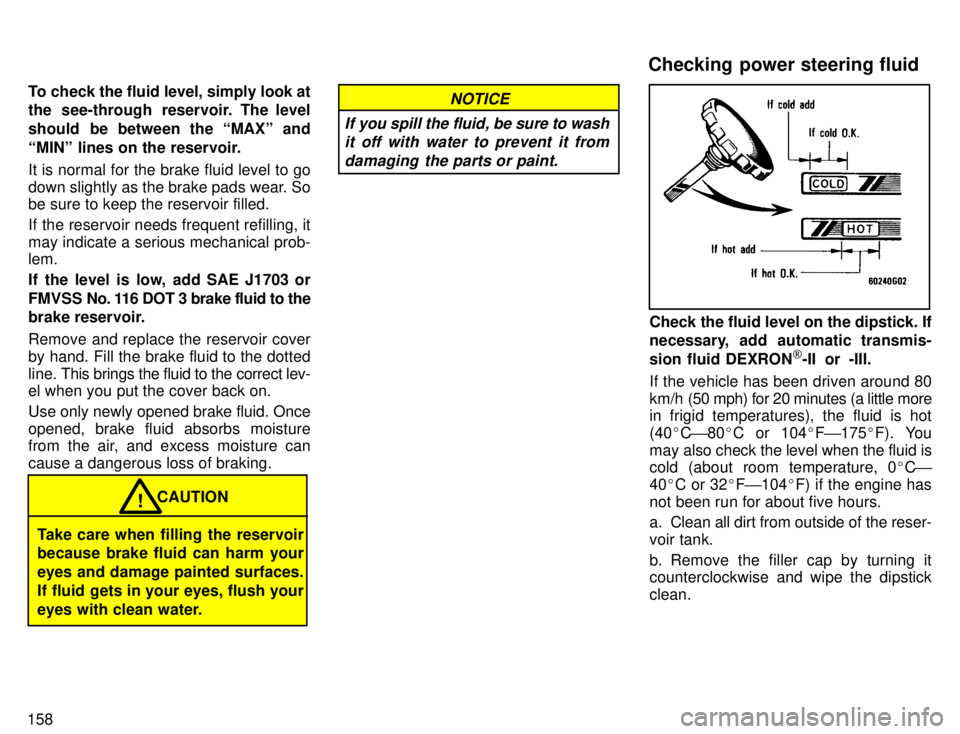
Check the fluid level on the dipstick. If
necessary, add automatic transmis-
sion fluid DEXRON [
-II or -III.
If the vehicle has been driven around 80
km/h (50 mph) for 20 minutes (a little more
in frigid temperatures), the fluid is hot (40 C ' 80 C or 104 F ' 175 F). You
may also check the level when the fluid is
cold (about room temperature, 0 C '
40 C or 32 F ' 104 F) if the engine has
not been run for about five hours.
a. Clean all dirt from outside of the reser- voir tank.
b. Remove the filler cap by turning it
counterclockwise and wipe the dipstick clean.
Checking power steering fluid
184
Engine compartment (Canada)
7. DOME 15 A: Car audio system, power
antenna, interior light, clock, ignition
switch light, personal lights, door courtesy
lights
8. TAIL 10 A: Tail lights, license plate
lights
9. PANEL 10 A: Emergency flashers,
heater control system, air conditioning
cooling system, gauges and meters,
clock, car audio system overdrive indica-
tor light, glovebox light, cigarette lighter,
instrument panel lights
10. A.C 10 A: Air conditioning cooling
system
11. HEAD (RH) 10 A: Right-hand head-
lightInstrument panel
12. HEAD (LH) 10 A: Left-hand head-
light
13. HEAD (HI RH) 10 A: Right-hand
headlight (high beam), hi-beam indicator light
14. HEAD (HI LH) 10 A: Left-hand head-
light (high beam)
15. HEAD (LO RH) 10 A: Right-hand
headlight (low beam)
16. HEAD (LO LH) 10 A: Left-hand
headlight (low beam)
17. DRL 7.5 A: Daytime running light sys-
tem
18. 4WD 15 A: A.D.D. control system,
four-wheel drive control system, rear dif- ferential lock system 19. GAUGE 10 A:
Gauges and meters,
back-up lights, cruise control system,
power antenna, power door lock control
system, electronically controlled automatic
transmission system, starting system,
charging system, heater control system
20. TURN 10 A: Turn signal lights, emer-
gency flashers
21. ECU-IG 15 A: Cruise control system,
anti-lock brake system, shift lock system
22. WIPER 20 A: Windshield wipers and
washer
23. IGN 7.5 A: Discharge warning light,
SRS airbag system
24. RADIO 7.5 A: Car audio system,
power antenna
25. CIG 15 A: Cigarette lighter, clock,
power rear view mirrors, back-up lights,
shift lock system
26. ECU-B 15 A: SRS airbag warning
light, daytime running light system, cruise control system, anti-lock brake system