Page 168 of 188
166
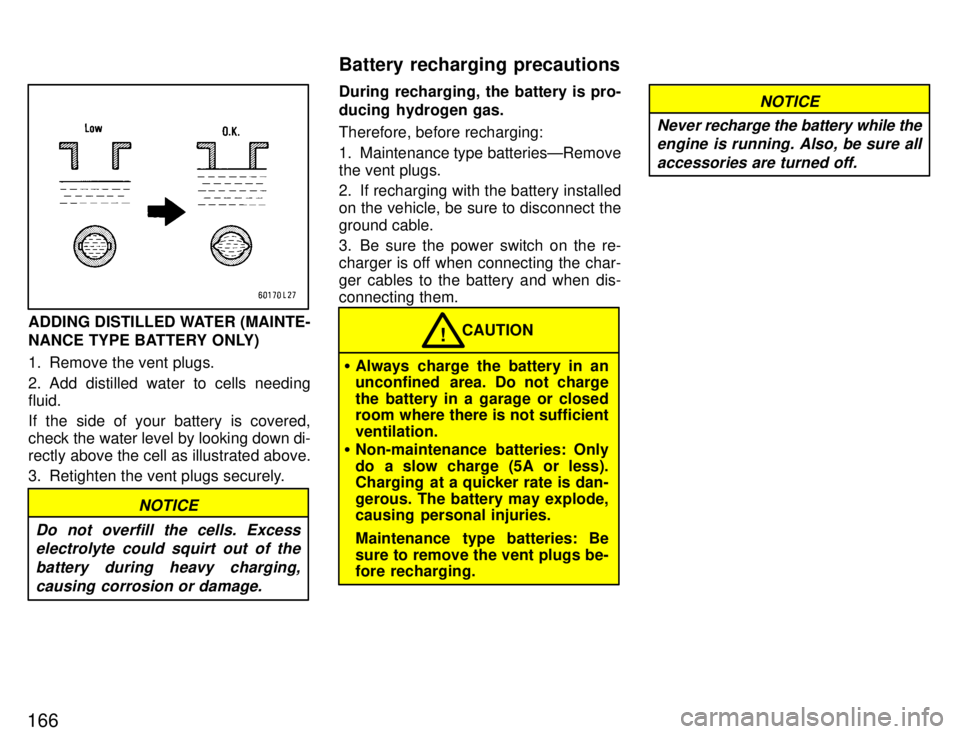
ADDING DISTILLED WATER (MAINTE-
NANCE TYPE BATTERY ONLY)
1. Remove the vent plugs.
2. Add distilled water to cells needing fluid.
If the side of your battery is covered,
check the water level by looking down di-
rectly above the cell as illustrated above.
3. Retighten the vent plugs securely.
NOTICE
Do not overfill the cells. Excess electrolyte could squirt out of the
battery during heavy charging,causing corrosion or damage.
During recharging, the battery is pro-
ducing hydrogen gas. Therefore, before recharging:
1. Maintenance type batteriesÐRemove the vent plugs.
2. If recharging with the battery installed on the vehicle, be sure to disconnect theground cable.
3. Be sure the power switch on the re-
charger is off when connecting the char-ger cables to the battery and when dis-
connecting them.
Always charge the battery in an
unconfined area. Do not charge
the battery in a garage or closed
room where there is not sufficient ventilation.
Non-maintenance batteries: Only
do a slow charge (5A or less).
Charging at a quicker rate is dan- gerous. The battery may explode,
causing personal injuries.
Maintenance type batteries: Be sure to remove the vent plugs be- fore recharging. CAUTION
!
NOTICE
Never recharge the battery while the
engine is running. Also, be sure all
accessories are turned off.
Battery recharging precautions
Page 170 of 188
168
Never use a fuse with a higher am-
perage rating, or any other object, in
place of a fuse. This may cause ex-
tensive damage and possibly a fire.CAUTION
!
If any washer does not work, the wash-
er tank may be empty. Add washer fluid.
You may use plain water as washer fluid.
However, in cold areas where tempera-
tures range below freezing point, use
washer fluid containing antifreeze. This
product is available at your Toyota dealer
and most auto parts stores. Follow the
manufacturer 's directions for how much
to mix with water.
NOTICE
Do not use engine antifreeze or any other substitute because it may
damage your vehicle's paint.
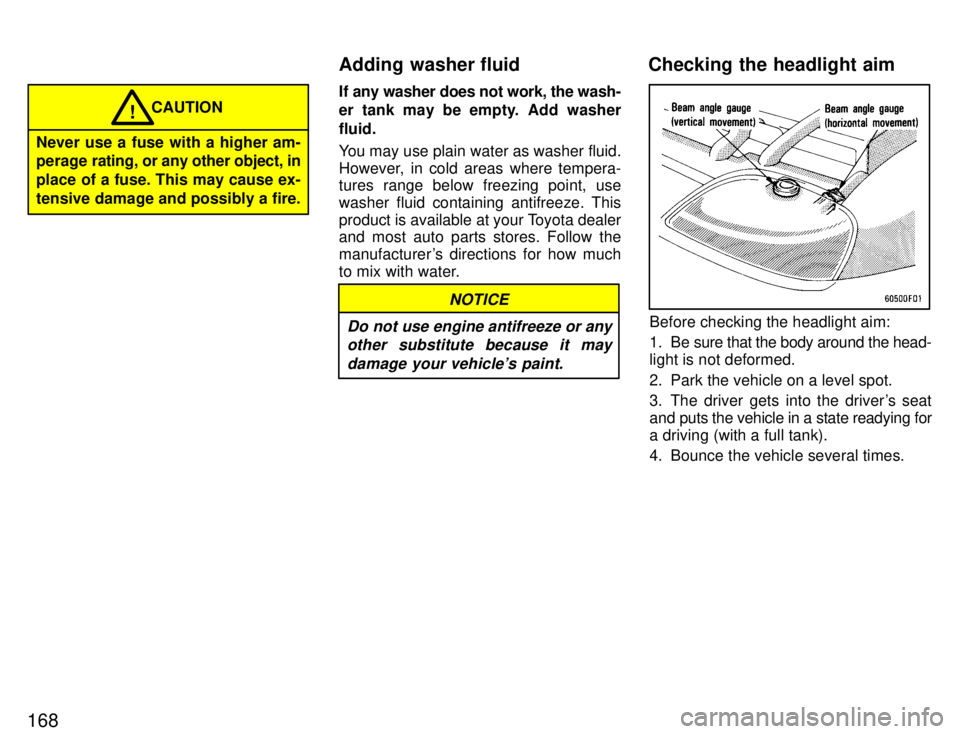
Before checking the headlight aim:
1. Be sure that the body around the head-
light is not deformed.
2. Park the vehicle on a level spot.
3. The driver gets into the driver's seat
and puts the vehicle in a state readying fora driving (with a full tank).
4. Bounce the vehicle several times.
Adding washer fluid Checking the headlight aim
Page 181 of 188
Part 8Dimensions and weight Engine
179
SPECIFICATIONS
Dimensions and weight
Engine
Fuel
Service specifications
Tires
Fuses
Overall length mm (in.) 4515 (177.7)
Overall width mm (in.) 1810 ( 71.3)
Overall height mm (in.) 1265 ( 49.8)*
1275 ( 50.2)*
Wheelbase mm (in.) 2550 (100.4)
Front tread mm (in.) 1520 ( 59.9)
Rear tread mm (in.) 1525 ( 60.1)
Vehicle capacity weight (occupants + luggage) kg (lb.) 330 (725)
* : Unladen vehicle plus two occupants
* : Unladen vehicle Model:
2JZ-GE and 2JZ-GTE
Type: 2JZ-GE engine 6 cylinder in line, 4 cycle, gasoline
2JZ-GTE engine 6 cylinder in line, 4 cycle, gasoline (with turbocharger)
Bore and stroke, mm (in.): 86.0 x 86.0 (3.39 x 3.39)
Displacement, cm 3
(cu. in.):
2997 (182.9)
Page 182 of 188
180Fuel type:
Premium unleaded gasoline, Research Octane Number 96 (Octane Rating 91)or higher
Fuel tank capacity, L (gal., Imp. gal.):
70 (18.5, 15.4) ENGINE
Valve clearance (engine cold), mm (in.):
Intake 0.15 '0.25 (0.006 '0.010)
Exhaust 0.25 '0.35 (0.010 '0.014)
Spark plug type: 2JZ-GE engine
NIPPONDENSO PK16R11
NGK BKR5EP11
2JZ-GTE engine NIPPONDENSO PK20R11
NGK BKR6EP11
Spark plug gap, mm (in.):
1.1 (0.043)
ENGINE LUBRICATIONOil capacity (drain and refill), L (qt., Imp. qt.):
2JZ-GE engineWith filter 5.2 (5.5, 4.6)
Without filter 4.9 (5.2, 4.3)
2JZ-GTE engine
With filter 5.0 (5.3, 4.4)
Without filter 4.7 (5.0, 4.1)
Oil grade:
API SH, Energy-Conserving IIº multi-
grade engine oil or ILSAC multigrade
engine oil
Fuel Service specifications
Page 183 of 188

181
COOLING SYSTEM
Total capacity, L (qt., Imp. qt.):
2JZ-GE engineWith manual transmission 7.3 (7.7, 6.4)
With automatic transmission 8.3 (8.8, 7.3)
2JZ-GTE engine With manual transmission
9.5 (10.0, 8.4)
With automatic transmission
9.4 (9.9, 8.3)
Coolant type:
With ethylene-glycol antifreeze (Do not use alcohol type.)
BATTERY Open voltage* at 20 C (68 F):
12.7 V Fully charged
12.3 V Half charged
11.9 V Discharged
*: Voltage that is checked 20 minutes af-
ter the key is removed with all the lights
turned off Charging rates:
5 A max. CLUTCH
Pedal freeplay, mm (in.):
5' 15 (0.2 '0.6)
Fluid type:
SAE J1703 or FMVSS No. 116 DOT 3
MANUAL TRANSMISSION (2JZ-GE engine only)
Oil capacity, L (qt., Imp. qt.):
2.6 (2.7, 2.3) Oil type:
Multipurpose gear oil API GL-4 or GL-5
Recommended oil viscosity:
SAE 75W-90
AUTOMATIC TRANSMISSION Fluid capacity (drain and refill), L (qt., Imp. qt.):
2JZ-GE engine Up to 1.6 (1.7, 1.4)
2JZ-GTE engine Up to 1.9 (2.0, 1.7)
Fluid type: 2JZ-GE engine
Automatic transmission fluid DII or DEXRON )
-II
2JZ-GTE engine Automatic transmission fluidTYPE T-II or equivalent DIFFERENTIAL
Oil capacity, L (qt., Imp. qt.):
1.35 (1.43, 1.19)
Oil type: Hypoid gear oil API GL-5
Recommended oil viscosity: Above -18 5C (0 5F)
SAE 90
Below -18 5C (0 5F)
SAE 80W or 80W-90
BRAKES Minimum pedal clearance when depressed, mm (in.):
2JZ-GE engine 72 (2.8)
2JZ-GTE engine 70 (2.8)
Pedal freeplay, mm (in.):
1Ð6 (0.04Ð0.24)
Pad wear limit, mm (in.):
1.0 (0.04)
Lining wear limit, mm (in.): 1.0 (0.04)
Parking brake adjustment: 5' 8 clicks
Fluid type: SAE J1703 or FMVSS No. 116 DOT 3
Page 184 of 188

182STEERING Wheel freeplay:
Less than 30 mm (1.2 in.)
Power steering fluid type: Automatic transmission fluid DEXRON )
-II or -III Tire size:
Spare tireT145/70 R 17
Except spare tire 2JZ-GE engine
225/50R 16 (for front use only) 245/50R 16 (for rear use only)
2JZ-GTE engine
235/45 ZR 17 (for front use only)255/40 ZR 17 (for rear use only)
Tire pressure, kPa (kgf/cm 2
or bar, psi):
Spare tire 420 (4.2, 60)Except spare tire 225/50 ZR 16 230 (2.3, 33)
others 250 (2.5, 36)
Wheel size:
225/50 ZR 16 16 x 8JJ
245/50 ZR 16 16 x 9JJ
235/45 ZR 17 17 x 8JJ
255/40 ZR 17 17 x 9.5JJ
T145/70 R 17 17 x 4T
Wheel nut torque, N Vm (kgf Vm, ft Vlbf):
103 (10.5, 76)
Fuses (type A)
1. WIPER 20 A: Windshield wipers and
washer, rear window wiper and washer
2. HTR 7.5 A: Air conditioning system
3. SEAT-HTR 7.5 A: Seat heater
4. ST 7.5 A: Starter system
5. IGN 7.5 A: Charging system, dis-
charge warning light, multiport fuel injec- tion system/sequential multiport fuel in-
jection system, SRS airbag system
6. PANEL 10 A: Instrument panel lights,
instrument panel lights control
7. MIR-HTR 10 A: Mirror heaters
8. TURN 7.5 A: Turn signal lights
Tires Fuses