Page 142 of 195
137
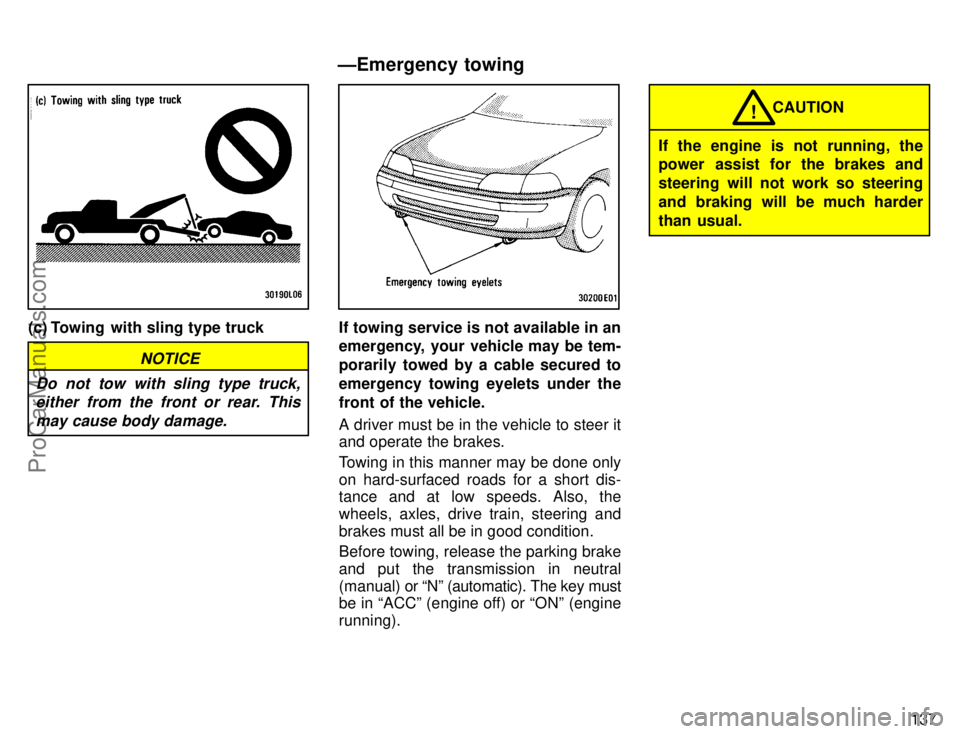
(c) Towing with sling type truck
NOTICE
Do not tow with sling type truck,
either from the front or rear. This
may cause body damage.
If towing service is not available in an
emergency, your vehicle may be tem-
porarily towed by a cable secured to
emergency towing eyelets under the
front of the vehicle.
A driver must be in the vehicle to steer it
and operate the brakes.
Towing in this manner may be done only
on hard-surfaced roads for a short dis-
tance and at low speeds. Also, the
wheels, axles, drive train, steering and
brakes must all be in good condition.
Before towing, release the parking brake
and put the transmission in neutral
(manual) or Nº (automatic). The key must
be in ACCº (engine off) or ONº (engine
running).
CAUTION!
If the engine is not running, the
power assist for the brakes and
steering will not work so steering
and braking will be much harder
than usual.
ÐEmergency towing
ProCarManuals.com
Page 150 of 195

145 Steering wheel
Be alert for changes in steering condition,
such as hard steering or strange noise.
Seats
Check that all front seat controls such as
seat adjusters, seatback recliner, etc. op-
erate smoothly and that all latches lock
securely in any position. Check that the
head restraints move up and down
smoothly and that the locks hold securely
in any latched position. For folding-down
rear seatbacks and swing-up rear seat
cushion, check that the latches lock se-
curely.
Seat belts
Check that the seat belt system such as
buckles, retractors and anchors operate
properly and smoothly. Make sure the belt
webbing is not cut, frayed, worn or dam-
aged.
Accelerator pedal
Check the pedal for smooth operation and
uneven pedal effort or catching.
Clutch pedal
Check the pedal for smooth operation.
Brake pedal
Check the pedal for smooth operation and
that the pedal has the proper clearance.
Check the brake booster function.Brakes
At a safe place, check that the brakes do
not pull to one side when applied.
Parking brake
Check that the lever has the proper travel
and that, on a safe incline, your vehicle is
held securely with only the parking brake
applied.
Automatic transmission Parkº mech-
anism
Check the lock release button of the se-
lector lever for proper and smooth opera-
tion. On a safe incline, check that your ve-
hicle is held securely with the selector
lever in Pº position and all brakes re-
leased.
IN THE ENGINE COMPARTMENT
Items listed below should be checked
from time to time , e.g. each time when
refueling.
Washer fluid
Make sure there is sufficient fluid in the
tank. See Chapter 7-3 for additional infor-
mation.
Engine coolant level
Make sure the coolant level is between
the FULLº and LOWº lines on the see-
through reservoir when the engine is cold.
See Chapter 7-2 for additional informa-
tion.Battery electrolyte level
Make sure the electrolyte level of all bat-
tery cells is between upper and lower level
lines on the case. Add only distilled water
when replenishing. See Chapter 7-3 for
additional information.
Brake fluid level
Make sure the brake fluid level is correct.
See Chapter 7-2 for additional informa-
tion.
Engine oil level
Check the level on the dipstick with the en-
gine turned off and the vehicle parked on
a level spot. See Chapter 7-2 for addition-
al information.
Power steering fluid level
Check the level on the dipstick. The level
should be in the HOTº or COLDº range
depending on the fluid temperature. See
Chapter 7-2 for additional information.
Exhaust system
If you notice any change in the sound of
the exhaust or smell exhaust fumes, have
the cause located and corrected immedi-
ately. (See engine exhaust cautions in
Part 2.)ProCarManuals.com
Page 160 of 195

Part 7Checking the engine oil level
155
DO-IT-YOURSELF
MAINTENANCEÐ
Chapter 7-2
Engine and Chassis
�Checking the engine oil level
�Checking the engine coolant
level
�Checking brake fluid
�Checking power steering fluid
�Checking tire pressure
�Checking and replacing tires
�Rotating tires
�Installing snow tires and chains
�Replacing wheels
�Aluminum wheel precautions
With the engine at operating tempera-
ture and turned off, check the oil level
on the dipstick.
1. To get a true reading, the vehicle
should be on a level spot. After turning off
the engine, wait a few minutes for the oil
to drain back into the bottom of the en-
gine.
2. Pull out the dipstick, and wipe it clean
with a rag.
3. Reinsert the dipstick'push it in as far
as it will go, or the reading will not be cor-
rect.
4. Pull the dipstick out and look at the oil
level on the end.If the oil level is below or only slightly
above the low level line, add engine oil
of the same type as already in the en-
gine.
Remove the oil filter cap and add engine
oil in small quantities at a time, checking
the dipstick.
The approximate quantity of oil needed to
fill between the low level line and the full
level line on the dipstick is indicated below
for reference.
When the level reaches within the correct
range, install the filler cap hand-tight.
Oil quantity, L (qt., Imp. qt.):
4A-FE engine 1.0 (1.1, 0.9)
7A-FE engine 1.2 (1.3, 1.1)
NOTICE
�Avoid overfilling, or the engine
could be damaged.
�Check the oil level on the dipstick
once again after adding the oil.
ProCarManuals.com
Page 189 of 195

184 DIFFERENTIAL
(3- speed type automatic transmission)
Fluid capacity, L (qt., Imp. qt.):
1.4 (1.5, 1.2)
Fluid type:
Automatic transmission fluid DEX-
RON
[II
BRAKES
Minimum pedal clearance when de-
pressed, with the pressure of 490 N (50 kgf,
110 lbf) with the engine running, mm (in.):
70 (2.8)
Pedal freeplay, mm (in.):
1Ð6 (0.04Ð0.24)
Pad wear limit, mm (in.):
1.0 (0.04)
Lining wear limit, mm (in.):
1.0 (0.04)
Parking brake adjustment when pulled
with the force of 196 N (20 kgf, 44 lbf):
4Ð7 clicks
Fluid type:
SAE J1703 or FMVSS No. 116 DOT 3
STEERING
Wheel freeplay:
Less than 30 mm (1.2 in.)
Power steering fluid type:
Automatic transmission fluid DEX-
RON
[-II or-IIITire size:
Spare tire
T115/70D14
T135/70D15
175/65R14 82S
P175/65R14 81S
185/65R14 85S
185/65R14 86S
P185/65R14 85S
Except spare tire
175/65R14 82S
P175/65R14 81S
185/65R14 85S
185/65R14 86S
P185/65R14 85S
Tire pressure, kPa (kgf/cm
2 or bar, psi):
T115/70D14 420 (4.2, 60)
T115/70D15 420 (4.2, 60)
175/65R14 82S 210 (2.1, 30)
P175/65R14 81S 210 (2.1, 30)
185/65R14 85S 210 (2.1, 30)
185/65R14 86S 210 (2.1, 30)
P185/65R14 85S 210 (2.1, 30)Wheel size:
T115/70D14 14 x 4T
T135/70D15 15 x 4T
Other tires 14 x 5.5J
14 x 5.5JJ
Wheel nut torque, NVm (kgfVm, ftVlbf):
103 (10.5, 76)
Tires
ProCarManuals.com
Page:
< prev 1-8 9-16 17-24