Page 16 of 203
11
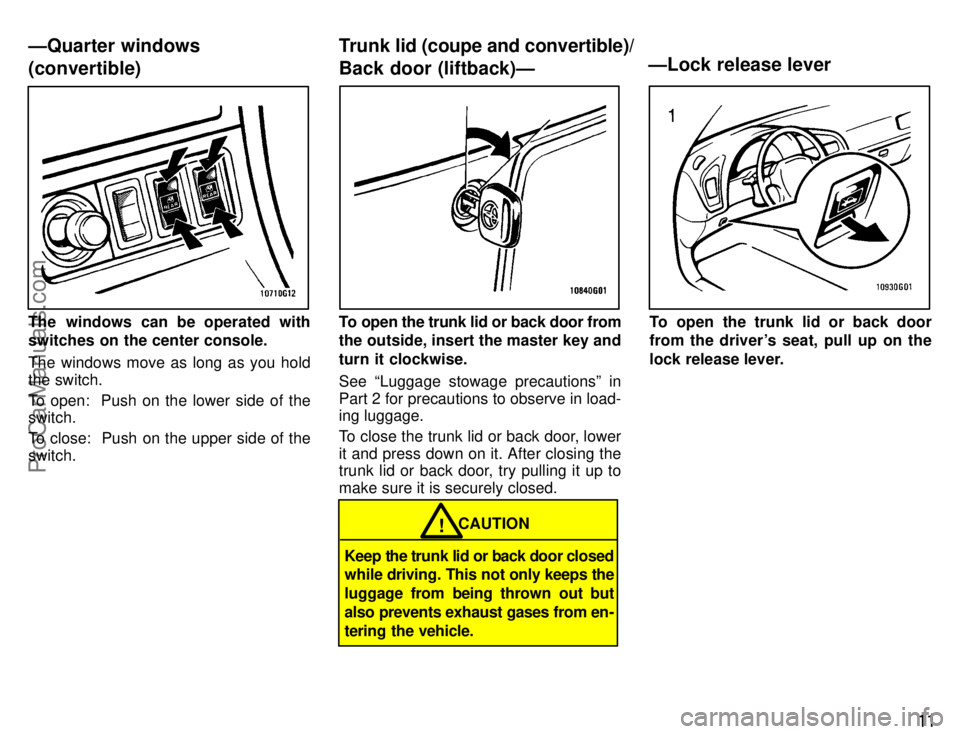
The windows can be operated with
switches on the center console.
The windows move as long as you hold
the switch.
To open: Push on the lower side of the
switch.
To close: Push on the upper side of the
switch.To open the trunk lid or back door from
the outside, insert the master key and
turn it clockwise.
See Luggage stowage precautionsº in
Part 2 for precautions to observe in load-
ing luggage.
To close the trunk lid or back door, lower
it and press down on it. After closing the
trunk lid or back door, try pulling it up to
make sure it is securely closed.
Keep the trunk lid or back door closed
while driving. This not only keeps the
luggage from being thrown out but
also prevents exhaust gases from en-
tering the vehicle.
CAUTION!
To open the trunk lid or back door
from the driver's seat, pull up on the
lock release lever.
ÐLock release lever
ÐQuarter windows
(convertible) Trunk lid (c
oupe and convertible)/
Back door (liftback)Ð
ProCarManuals.com
Page 17 of 203
12
This system deactivates the lock re-
lease lever so that things locked in the
trunk or luggage compartment can be
protected.
1. (Except convertible) Push down the
security lock levers to lock the rear
seatbacks.
After locking the rear seatbacks, try fold-
ing them down to make sure they are se-
curely lockedÐotherwise, someone
could get into the trunk or luggage
compartment by folding down a rear seat.2. After closing the trunk lid or back
door, insert the master key and turn it
counterclockwise to deactivate the
lock release lever.
After closing the trunk lid or back door, try
pulling it up to make sure it is securely
locked.To open the hood, do the following.
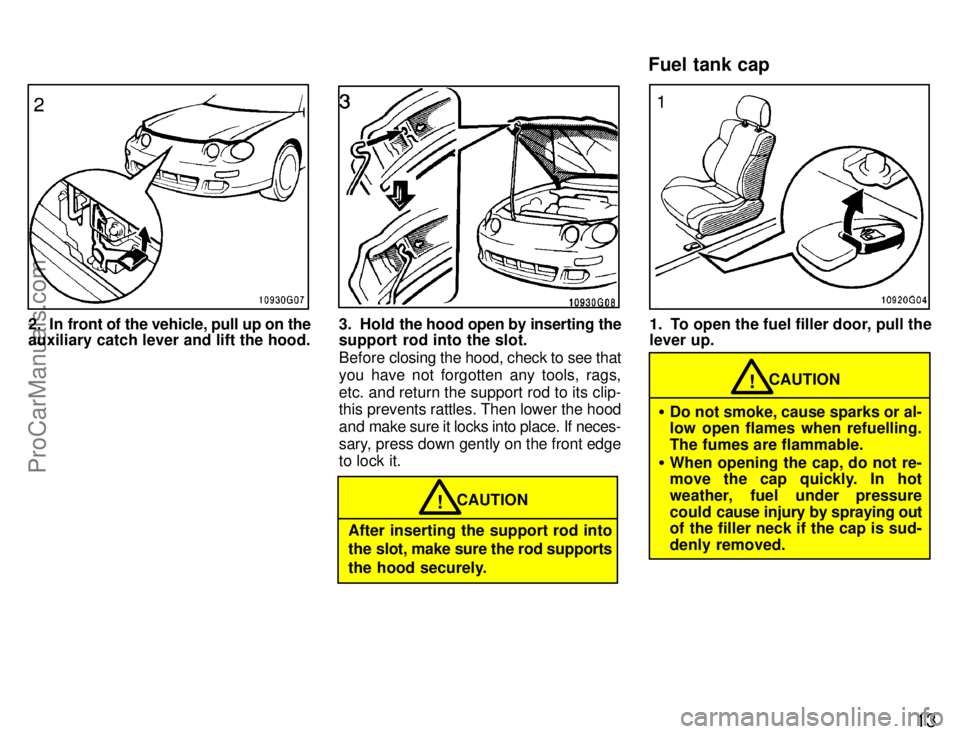
1. Pull the hood lock release lever.
The hood will spring up slightly.
ÐLuggage security system Hood
ProCarManuals.com
Page 18 of 203
13
2. In front of the vehicle, pull up on the
auxiliary catch lever and lift the hood.3. Hold the hood open by inserting the
support rod into the slot.
Before closing the hood, check to see that
you have not forgotten any tools, rags,
etc. and return the support rod to its clip-
this prevents rattles. Then lower the hood
and make sure it locks into place. If neces-
sary, press down gently on the front edge
to lock it.
After inserting the support rod into
the slot, make sure the rod supports
the hood securely.
CAUTION!
1. To open the fuel filler door, pull the
lever up.
� Do not smoke, cause sparks or al-
low open flames when refuelling.
The fumes are flammable.
� When opening the cap, do not re-
move the cap quickly. In hot
weather, fuel under pressure
could cause injury by spraying out
of the filler neck if the cap is sud-
denly removed. CAUTION
!
Fuel tank cap
ProCarManuals.com
Page 22 of 203
17
4. Secure the top boot snaps to the
ones on the quarter trim.5. Attach the fastener tape on the top
boot to that on the rear seatback.REMOVING THE TOP BOOT
1. Push the top boot backward to sep-
arate its fastener tape from the tape be-
hind the rear seatback.
ÐRaising the convertible top
ProCarManuals.com
Page 24 of 203
19
5. Push the latch handles fully forward
till they are hooked.
Visually check that the latch handles are
fully seated in the strikers. Also, pull on
the convertible top side rails to make sure
the top is securely hooked.
6. Raise all the side windows, quarter
windows, and sun visors.
ProCarManuals.com
Page 27 of 203
22
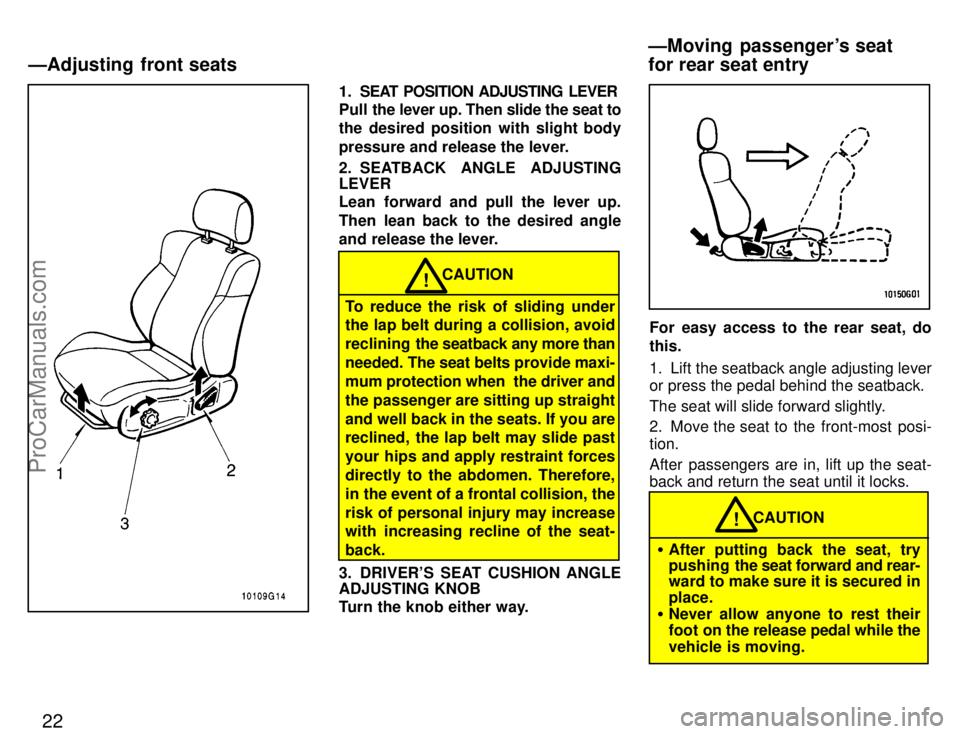
1. SEAT POSITION ADJUSTING LEVER
Pull the lever up. Then slide the seat to
the desired position with slight body
pressure and release the lever.
2. SEATBACK ANGLE ADJUSTING
LEVER
Lean forward and pull the lever up.
Then lean back to the desired angle
and release the lever.
CAUTION
To reduce the risk of sliding under
the lap belt during a collision, avoid
reclining the seatback any more than
needed. The seat belts provide maxi-
mum protection when the driver and
the passenger are sitting up straight
and well back in the seats. If you are
reclined, the lap belt may slide past
your hips and apply restraint forces
directly to the abdomen. Therefore,
in the event of a frontal collision, the
risk of personal injury may increase
with increasing recline of the seat-
back.!
3. DRIVER'S SEAT CUSHION ANGLE
ADJUSTING KNOB
Turn the knob either way.
For easy access to the rear seat, do
this.
1. Lift the seatback angle adjusting lever
or press the pedal behind the seatback.
The seat will slide forward slightly.
2. Move the seat to the front-most posi-
tion.
After passengers are in, lift up the seat-
back and return the seat until it locks.
CAUTION
� After putting back the seat, try
pushing the seat forward and rear-
ward to make sure it is secured in
place.
� Never allow anyone to rest their
foot on the release pedal while the
vehicle is moving.!
ÐAdjusting front seats
ÐMoving passenger's seat
for rear seat entry
ProCarManuals.com
Page 28 of 203
23
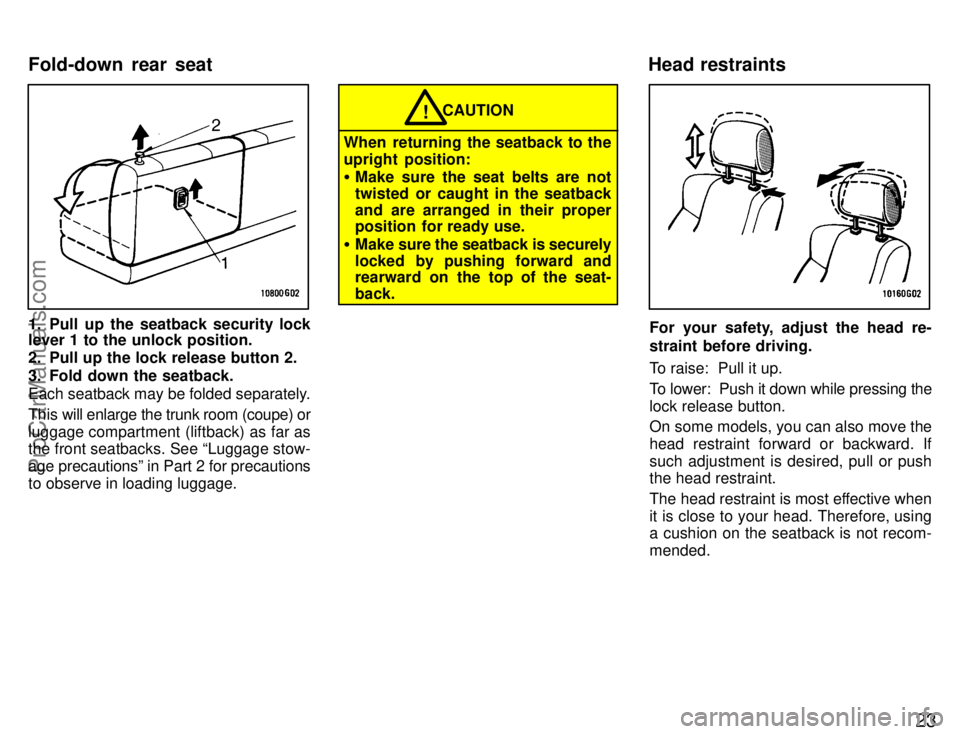
1. Pull up the seatback security lock
lever 1 to the unlock position.
2. Pull up the lock release button 2.
3. Fold down the seatback.
Each seatback may be folded separately.
This will enlarge the trunk room (coupe) or
luggage compartment (liftback) as far as
the front seatbacks. See Luggage stow-
age precautionsº in Part 2 for precautions
to observe in loading luggage.
CAUTION
When returning the seatback to the
upright position:
� Make sure the seat belts are not
twisted or caught in the seatback
and are arranged in their proper
position for ready use.
� Make sure the seatback is securely
locked by pushing forward and
rearward on the top of the seat-
back.!
For your safety, adjust the head re-
straint before driving.
To raise: Pull it up.
To lower: Push it down while pressing the
lock release button.
On some models, you can also move the
head restraint forward or backward. If
such adjustment is desired, pull or push
the head restraint.
The head restraint is most effective when
it is close to your head. Therefore, using
a cushion on the seatback is not recom-
mended.
Fold-down rear seat Head restraints
ProCarManuals.com
Page 29 of 203
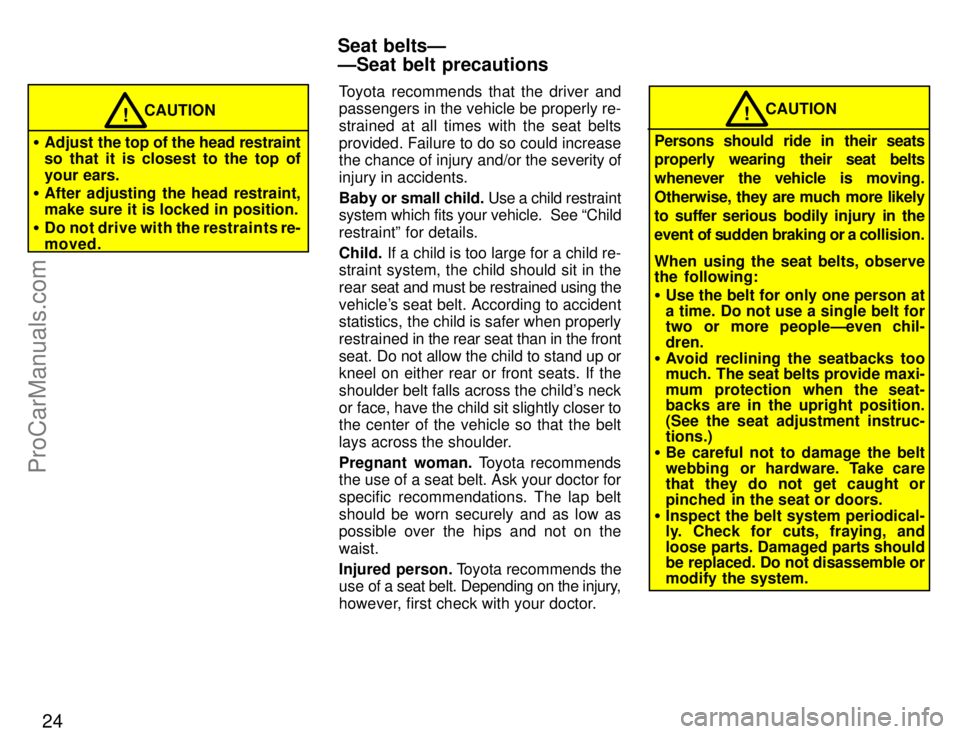
24
CAUTION!
�Adjust the top of the head restraint
so that it is closest to the top of
your ears.
� After adjusting the head restraint,
make sure it is locked in position.
� Do not drive with the restraints re-
moved. Toyota recommends that the driver and
passengers in the vehicle be properly re-
strained at all times with the seat belts
provided. Failure to do so could increase
the chance of injury and/or the severity of
injury in accidents.
Baby or small child. Use a child
restraint
system which fits your vehicle. See Child
restraintº for details.
Child. If a child is too large for a child re-
straint system, the child should sit in the
rear seat and must be restrained using the
vehicle's seat belt. According to accident
statistics, the child is safer when properly
restrained in the rear seat than in the front
seat. Do not allow the child to stand up or
kneel on either rear or front seats. If the
shoulder belt falls across the child's neck
or face, have the child sit slightly closer to
the center of the vehicle so that the belt
lays across the shoulder.
Pregnant woman. Toyota recommends
the use of a seat belt. Ask your doctor for
specific recommendations. The lap belt
should be worn securely and as low as
possible over the hips and not on the
waist.
Injured person. Toyota recommends the
use of a seat belt. Depending on the injury,
however, first check with your doctor.
CAUTION!
Persons should ride in their seats
properly wearing their seat belts
whenever the vehicle is moving.
Otherwise, they are much more likely
to suffer serious bodily injury in the
event of s udden braking or a collision.
When using the seat belts, observe
the following:
� Use the belt for only one person at
a time. Do not use a single belt for
two or more peopleÐeven chil-
dren.
� Avoid reclining the seatbacks too
much. The seat belts provide maxi-
mum protection when the seat-
backs are in the upright position.
(See the seat adjustment instruc-
tions.)
� Be careful not to damage the belt
webbing or hardware. Take care
that they do not get caught or
pinched in the seat or doors.
� Inspect the belt system periodical-
ly. Check for cuts, fraying, and
loose parts. Damaged parts should
be replaced. Do not disassemble or
modify the system.
Seat beltsÐ
ÐSeat belt precautions
ProCarManuals.com