Page 133 of 203
126
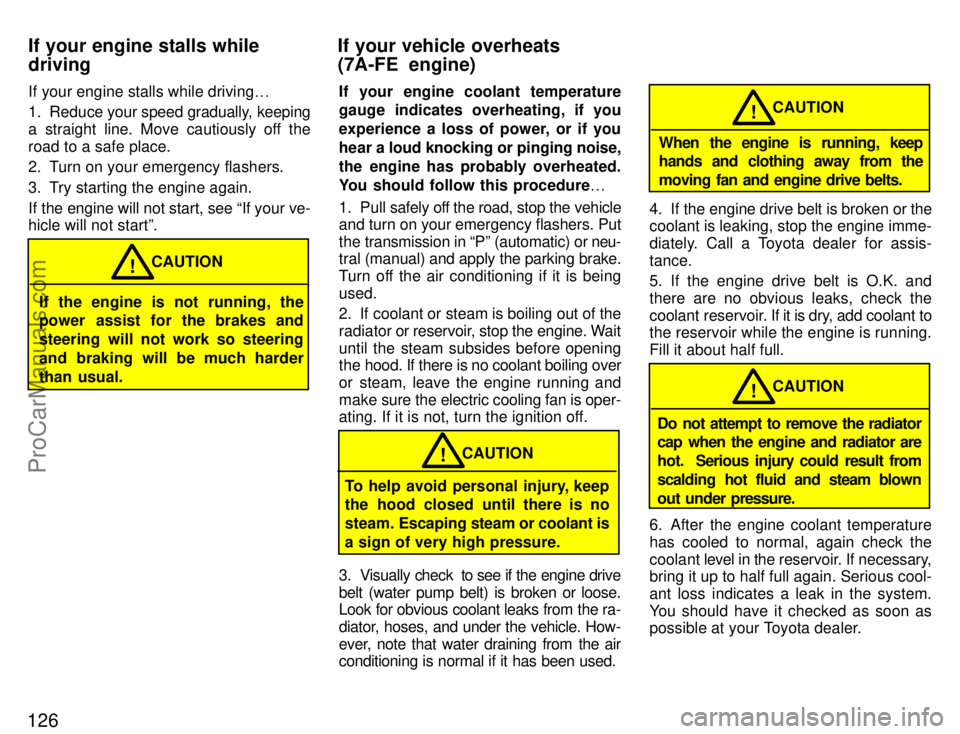
If your engine stalls while driving0
1. Reduce your speed gradually, keeping
a straight line. Move cautiously off the
road to a safe place.
2. Turn on your emergency flashers.
3. Try starting the engine again.
If the engine will not start, see If your ve-
hicle will not startº.
If the engine is not running, the
power assist for the brakes and
steering will not work so steering
and braking will be much harder
than usual. CAUTION
!
If your engine coolant temperature
gauge indicates overheating, if you
experience a loss of power, or if you
hear a loud knocking or pinging noise,
the engine has probably overheated.
You should follow this procedure
0
1. Pull safely off the road, stop the vehicle
and turn on your emergency flashers. Put
the transmission in Pº (automatic) or neu-
tral ( manual) and apply the parking brake.
Turn off the air conditioning if it is being
used.
2. If coolant or steam is boiling out of the
radiator or reservoir, stop the engine. Wait
until the steam subsides before opening
the hood. If there is no coolant boiling over
or steam, leave the engine running and
make sure the electric cooling fan is oper-
ating. If it is not, turn the ignition off.
To help avoid personal injury, keep
the hood closed until there is no
steam. Escaping steam or coolant is
a sign of very high pressure. CAUTION
!
3. Visually check to see if the engine drive
belt (water pump belt) is broken or loose.
Look for obvious coolant leaks from the ra-
diator, hoses, and under the vehicle. How-
ever, note that water draining from the air
conditioning is normal if it has been used.
When the engine is running, keep
hands and clothing away from the
moving fan and engine drive belts.
CAUTION
!
4. If the engine drive belt is broken or the
coolant is leaking, stop the engine imme-
diately. Call a Toyota dealer for assis-
tance.
5. If the engine drive belt is O.K. and
there are no obvious leaks, check the
coolant reservoir. If it is dry,
add coolant to
the reservoir while the engine is running.
Fill it about half full.
Do not attempt to remove the radiator
cap when the engine and radiator are
hot. Serious injury could result from
scalding hot fluid and steam blown
out under pressure. CAUTION
!
6. After the engine coolant temperature
has cooled to normal, again check the
coolant
level in the reservoir. If necessary,
bring it up to half full again. Serious cool-
ant loss indicates a leak in the system.
You should have it checked as soon as
possible at your Toyota dealer.
If your engine stalls while
driving If your vehicle overheats
(7A-FE engine)
ProCarManuals.com
Page 134 of 203
127
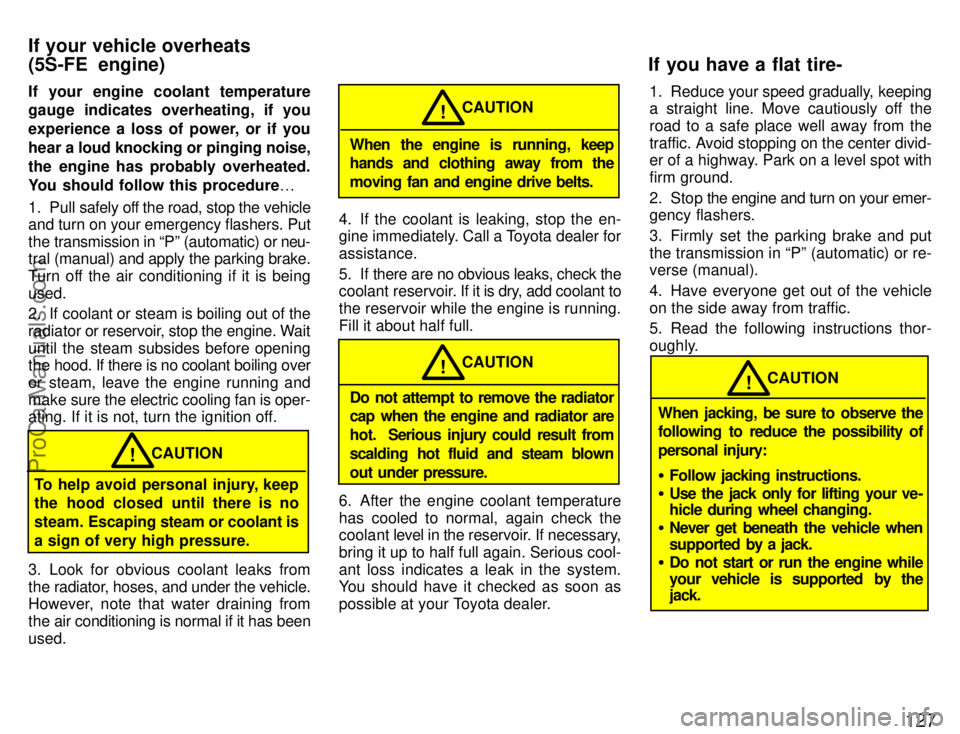
If your engine coolant temperature
gauge indicates overheating, if you
experience a loss of power, or if you
hear a loud knocking or pinging noise,
the engine has probably overheated.
You should follow this procedure0
1. Pull safely off the road, stop the vehicle
and turn on your emergency flashers. Put
the transmission in Pº (automatic) or neu-
tral ( manual) and apply the parking brake.
Turn off the air conditioning if it is being
used.
2. If coolant or steam is boiling out of the
radiator or reservoir, stop the engine. Wait
until the steam subsides before opening
the hood. If there is no coolant boiling over
or steam, leave the engine running and
make sure the electric cooling fan is oper-
ating. If it is not, turn the ignition off.
To help avoid personal injury, keep
the hood closed until there is no
steam. Escaping steam or coolant is
a sign of very high pressure. CAUTION
!
3. Look for obvious coolant leaks from
the radiator, hoses, and under the vehicle.
However, note that water draining from
the air conditioning is normal if it has been
used.
When the engine is running, keep
hands and clothing away from the
moving fan and engine drive belts.
CAUTION
!
4. If the coolant is leaking, stop the en-
gine immediately.
Call a Toyota dealer for
assistance.
5. If there are no obvious leaks, check the
coolant reservoir. If it is dry, add coolant to
the reservoir while the engine is running.
Fill it about half full.
Do not attempt to remove the radiator
cap when the engine and radiator are
hot. Serious injury could result from
scalding hot fluid and steam blown
out under pressure. CAUTION
!
6. After the engine coolant temperature
has cooled to normal, again check the
coolant
level in the reservoir. If necessary,
bring it up to half full again. Serious cool-
ant loss indicates a leak in the system.
You should have it checked as soon as
possible at your Toyota dealer. 1. Reduce
your speed gradually, keeping
a straight line. Move cautiously off the
road to a safe place well away from the
traffic. Avoid stopping on the center divid-
er of a highway. Park on a level spot with
firm ground.
2. Stop the engine and turn on your emer-
gency flashers.
3. Firmly set the parking brake and put
the transmission in Pº (automatic) or re-
verse (manual).
4. Have everyone get out of the vehicle
on the side away from traffic.
5. Read the following instructions thor-
oughly.
CAUTION!
When jacking, be sure to observe the
following to reduce the possibility of
personal injury:
� Follow jacking instructions.
� Use the jack only for lifting your ve-
hicle during wheel changing.
� Never get beneath the vehicle when
supported by a j ack.
� Do not start or run the engine while
your vehicle is supported by the
jack.
If your vehicle overheats
(5S-FE engine) If you have a flat tire-
ProCarManuals.com
Page 201 of 203

194
18 HEAD-HI (LH) 15 A: Left-hand
headlight (high beam)
19 DRL 7.5 A: Daytime running light sys-
tem
20 ECU-IG 15 A: Electronically con-
trolled automatic transmission system,
anti-lock brake system
21 SEAT-HTR 20 A: No circuit
22 PANEL 7.5 A: Instrument panel lights
23 STOP 15 A: Stop lights, high mounted
stoplight, multiport fuel injection system/
sequential multiport fuel injection system,
cruise control system cancel device, elec-
tronically controlled automatic transmis-
sion system, anti-lock brake system 24 FOG 20 A: Front fog lights
25 CIG & RAD 15 A: Cigarette lighter,
dig-
ital clock display, car audio system
26 IGN 7.5 A: Charging system, dis-
charge warning light, multiport fuel injec-
tion system/sequential multiport fuel in-
jection system, SRS airbag system
27 WIPER 20 A: Windshield wipers and
washer, rear window wiper and washer
28 MIR-HTR 10 A: Multiport fuel injection
system/sequential multiport fuel injection
system
29 TURN 10 A: Turn signal lights, emer-
gency flashers
30 TAIL 15 A: Tail lights, parking lights,
front side marker lights, rear side marker
lights, license plate lights
31 HTR 10 A: Air conditioning system,
rear window defogger
32 GAUGE 10 A: Gauges and meters,
power door lock system
33 ST 7.5 A: Starting system, multiport
fuel injection system/sequential multiport
fuel injection system
34 A/C 10 A: Air conditioning system
35 OBD II 7.5A: On-board diagnosis sys-
tem Fuses (type B)
36 RDI 30 A: Electric cooling fan
37 CDS 30 A: Electric cooling fan
38 AM1 40 A:
Electronic ignition system/
distributor ignition system
39 DOOR 30 A: Power door lock system,
convertible top control system
40 DEF 30 A: Rear window defogger
41 POWER 30 A: Power windows, elec-
tric moon roof
Fuses (type C)
42 HTR 40 A: Air conditioning system
43 ALT 100 A: ALT-Sº, TAILº, DOORº,
DEFº and POWERº fuses
44 MAIN 60 A: Starting system, head-
lights, AM2º, HAZARDº, HORNº,
DOMEº and RADIOº fuses
45 ABS 50 A: Anti-lock brake system
ProCarManuals.com