Page 130 of 203
Part 4
If your vehicle will not startÐ
(a) Simple checks123
IN CASE OF
AN EMERGENCY
�If your vehicle will not start
� If your engine stalls while
driving
� If your vehicle overheats
� If you have a flat tire
� If your vehicle needs to be
towed
� If you cannot shift automatic
transmission selector lever
� If the convertible top does not
raise or lower
� If you lose your keys
Before making these checks, make sure
you have followed the correct starting pro-
cedure given in How to start the engineº
in Part 3 and that you have sufficient fuel.
If the engine is not turning over or is
turning over too slowlyÐ
1. Check that the battery terminals are
tight and clean.
2. If the battery terminals are O.K., switch
on the interior light.
3. If the light is out, dim or goes out when
the starter is cranked, the battery is dis-
charged. You may try jump starting. See
(c) Jump startingº for further instructions.
If the light is O.K., but the engine still will
not start, it needs adjustment or repair.
Call a Toyota dealer or qualified repair
shop.
NOTICE
Do not pull- or push-start the vehicle. It may damage the vehicle
or cause a collision when the enginestarts. Also the three-way catalyticconverter may overheat andbecome a fire hazard.
If the engine turns over at its normal
speed but will not startÐ
1. Check that all the push-on connectors
are tight. (For example, connectors at the
distributor and spark plugs)
2. If the connectors are O.K., the engine
may be flooded because of repeated
cranking. See (b) Starting a flooded en-
gineº for further instructions.
ProCarManuals.com
Page 131 of 203
124
If the engine will not start, your engine
may be flooded because of repeated
cranking.
If this happens, turn the key to STARTº
with the accelerator pedal held down.
Keep the key and accelerator pedal so for
15 seconds and release them. Then try
starting the engine with your foot off the
accelerator pedal.
If the engine does not start after 15 sec-
onds of cranking, release the key, wait a
few minutes and try again.
If the engine still will not start, it needs ad-
justment or repair. Call a Toyota dealer or
qualified repair shop for assistance.
NOTICE
Do not crank for more than 15 seconds at a time. This may
overheat the starter and wiringsystems.
To avoid serious personal injury and
damage to your vehicle which might
result from battery explosion, acid
burns, electrical burns, or damaged
electronic components, these instruc-
tions must be followed precisely.
If you are unsure about how to follow this
procedure, we strongly recommend that
you seek the help of a competent me-
chanic or towing service.
� Batteries contain sulfuric acid
which is poisonous and corrosive.
Wear protective safety glasses
when jump starting, and avoid spil-
ling acid on your skin, clothing, or
vehicle. CAUTION
!
�
If you should accidentally get acid
on yourself or in your eyes, re-
move any contaminated clothing
and flush the affected area with
water for at least 15 minutes. Then
get immediate medical attention. If
possible, continue to apply water
with a sponge or cloth while en
route to the medical office.
� The gas normally produced by a
battery will explode if a flame or
spark is brought near. Use only
standardized jumper cables and
do not smoke or light a match
while jump starting.
(b) Starting a flooded engine (c) Jump starting
ProCarManuals.com
Page 132 of 203

125
NOTICE
The battery used for boosting must be 12 V. Do not jump start unless
you are sure that the booster batteryis correct.
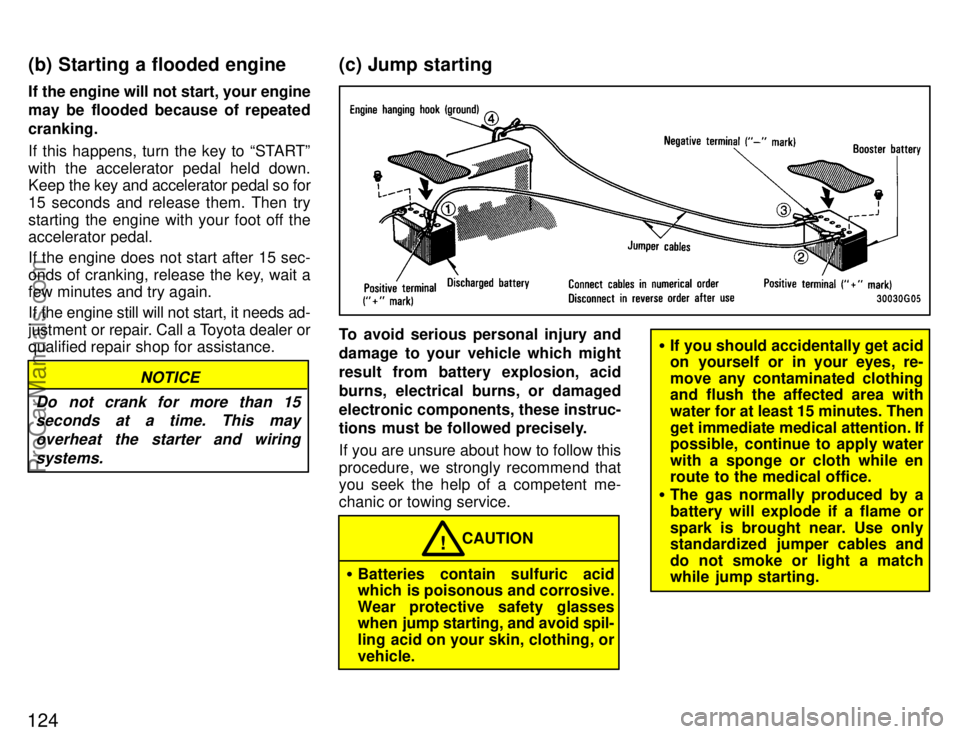
JUMP STARTING PROCEDURE
1. If the booster battery is installed in
another vehicle, make sure the vehicles
are not touching. Turn off all unnecessary
lights and accessories.
2. If required, remove all the vent plugs
from the booster and discharged batter-
ies. Lay a cloth over the open vents on the
batteries. (This helps reduce the explo-
sion hazard, personal injuries and burns.)
3. If the engine in the vehicle with the
booster battery is not running, start it and
let it run for a few minutes. During jump
starting, run the engine at about 2000 rpm
with the accelerator pedal lightly de-
pressed. 4. Connect
the jumper cables in the exact
order shown in the illustration: positive
terminal (º+º mark)-to-positive termi-
nal(º+º mark), and negative terminal (º-º
mark)-to-engine or body ground. Note
that you first connect the positive cable to
the discharged battery and then to the
booster battery. Next, connect the nega-
tive cable to the booster battery and then
to a solid, stationary, unpainted metallic
point (e.g. engine hanging hook) away
from the battery. Do not connect it to or
near any part that moves when the engine
is cranked.
NOTICE
When making the connections, to avoid serious injury, do not lean
over the battery or accidentally letthe jumper cables or clamps touchanything except the correct batteryterminals or the ground.
5. Start your engine in the normal way. Af-
ter starting, run it at about 2000 rpm for
several minutes with the accelerator ped-
al lightly depressed. 6. Carefully disconnect the cables in the
exact reverse order: the negative cable
and then the positive cable.
7. Carefully dispose of the battery cover
clothsÐthey may now contain sulfuric
acid.
8. If removed, replace all the battery vent
plugs.
If the cause of your battery discharging is
not apparent (for example, lights left on),
you should have it checked.
ProCarManuals.com
Page 144 of 203
137
If the power mechanism for the con-
vertible top should become inopera-
tive, you may operate the convertible
top manually. Have the system
checked as soon as possible at your
Toyota dealer.
RAISING THE CONVERTIBLE TOP
MANUALLY
1. Open the trunk and remove the cov-
er from the front trim. Push the manual
control switch on the MANUALº side.
2. Lower the sun visors. Check that all
the side windows and quarter win-
dows are lowered.
If the battery is discharged and the win-
dows cannot be lowered, open both side
doors.3. From the rear seat, place one hand
on top of the rear seatback. With the
other hand, grasp the convertible top
edge at the center and slowly raise the
top half way.4. Move to the front seat, grasp the
handle which is under the convertible
top and pull the top fully forward.
If the convertible top does not
raise or lower
ProCarManuals.com
Page 146 of 203
139
2. Lower all the side windows, quarter
windows, and sun visors. Then pull
the latch handles fully backward.
If the battery is discharged and the win-
dows cannot be lowered, open both side
doors.3. Place your palms under either front
convertible top side rail around its
center and lower the convertible top
all the way down. Raise the sun visors.
To prevent personal injury, do not
grasp the convertible top side rails.CAUTION
!
4. Return
the manual control switch to
the opposite side of the MANUALº
position, attach the cover, and close
the trunk.
ProCarManuals.com
Page 157 of 203

150
Washer fluid
Make sure there is sufficient fluid in the
tank. See Chapter 7-3 for additional infor-
mation.
Engine coolant level
Make sure the coolant level is between
the FULLº and LOWº lines on the see-
through reservoir when the engine is cold.
See Chapter 7-2 for additional informa-
tion.
Battery electrolyte level
Make sure the electrolyte level of all bat-
tery cells is between upper and lower level
lines on the case. Add only distilled water
when replenishing. See Chapter 7-3 for
additional information.
Brake fluid level
Make sure the brake fluid level is correct.
See Chapter 7-2 for additional informa-
tion.
Engine oil level
Check the l evel on the dipstick with the en-
gine turned off and the vehicle parked on
a level spot. See Chapter 7-2 for addition-
al information.
Power steering fluid level
Check the level on the dipstick (vehicles
with 7A-FE engine), or check the level
through the reservoir (vehicles with 5S-
FE engine). The level should be in the
HOTº or COLDº range depending on the
fluid temperature. See Chapter 7-2 for
additional information. Exhaust system
If you notice any change in the sound of
the exhaust or smell exhaust fumes, have
the cause located and corrected immedi-
ately. (See engine exhaust cautions in
Part 2.)
Be on the alert for changes in perfor-
mance, sounds, and visual tip-offs
that in-
dicate service is needed. Some important
clues are as follows:
� Engine missing, stumbling, or pinging
� Appreciable loss of power
� Strange engine noises
� A leak under the vehicle (however, wa-
ter dripping from the air conditioning
after use is normal.)
� Change in exhaust sound (This may
indicate a dangerous carbon monox-
ide leak. Drive with the windows open
and have the exhaust system checked
immediately.)
� Flat-looking tire; excessive tire squeal
when cornering; uneven tire wear
� Vehicle pulls to one side when driving
straight on a level road
� Strange noises related to suspension
movement
� Loss of brake effectiveness; spongy
feeling brake or clutch pedal; pedal al-
most touches floor; vehicle pulls to one
side when braking
� Engine coolant temperature continual-
ly higher than normal
Does your vehicle need
repairing?
ProCarManuals.com
Page 161 of 203
154
1. Engine oil level dipstick
2. Power steering fluid reservoir
3. Brake fluid reservoir
4. Fuse blocks
5. Battery
6. Engine coolant reservoir
7. Electric cooling fans
8. Engine oil filler cap
9. Windshield and rear window washer fluid tank
Engine compartment overview
�7A-FE engine
ProCarManuals.com
Page 162 of 203
155
1. Power steering fluid reservoir
2. Engine oil filler cap
3. Brake fluid reservoir
4. Fuse blocks
5. Battery
6. Engine coolant reservoir
7. Electric cooling fans
8. Engine oil level dipstick
9. Windshield and rear window washer fluid tank
Engine compartment overview
�5S-FE engine
ProCarManuals.com