Page 5 of 226

Publication No. OM33447U
Part No. 01999-33447
Printed in Japan 29- 9810- 04
Quick index
�If a service reminder indicator or warning buzzer comes on 65. . . . .
�If your vehicle will not start 149. . . . . . . . . . . . . . . . . . . . . . . . . . . . . . . . . . .
�If your engine stalls while driving 152. . . . . . . . . . . . . . . . . . . . . . . . . . . . . .
�If your vehicle overheats 152,153. . . . . . . . . . . . . . . . . . . . . . . . . . . . . . . . . .
�If you have a flat tire 153. . . . . . . . . . . . . . . . . . . . . . . . . . . . . . . . . . . . . . . . .
�If your vehicle needs to be towed 163. . . . . . . . . . . . . . . . . . . . . . . . . . . . .
�Tips for driving during break- in period 129. . . . . . . . . . . . . . . . . . . . . . . . .
�How to start the engine 139. . . . . . . . . . . . . . . . . . . . . . . . . . . . . . . . . . . . . . .
�General maintenance 172. . . . . . . . . . . . . . . . . . . . . . . . . . . . . . . . . . . . . . . . . .
�Complete index 221. . . . . . . . . . . . . . . . . . . . . . . . . . . . . . . . . . . . . . . . . . . . . . .
Gas station information
Fuel type:
5S- FE engine: UNLEADED gasoline, Research Octane Number 91 (Octane
Rating 87) or higher.
1MZ- FE engine: UNLEADED gasoline, Research Octane Number 91 (Octane
Rating 87) or higher. For improved vehicle performance, the use of premium
unleaded gasoline with a Research Octane Number of 96 (Octane Rating
91) or higher is recommended.
See page 129 for detailed information.
Fuel tank capacity: 70 L (18.5 gal., 15.4 lmp. gal.)
Engine oil:
API SH, 'Energy- Conserving II'' multigrade engine oil or ILSAC multigrade
engine oil is recommended.
See page 186 for detailed information.
Automatic transmission fluid:
Automatic transmission fluid DEXRON
[- II.
Tire information: See pages 189 through 193.
Tire pressure: See pages 214 and 215.
A�7
I
ProCarManuals.com
Page 14 of 226
9
CAUTION!
Before driving, be sure that the
doors are closed and locked, espe-
cially when small children are in the
vehicle. Along with the proper use of
seat belts, locking the doors helps
prevent the driver and passengers
from being thrown out from the ve-
hicle during an accident. It also
helps prevent the doors from being
opened unintentionally.
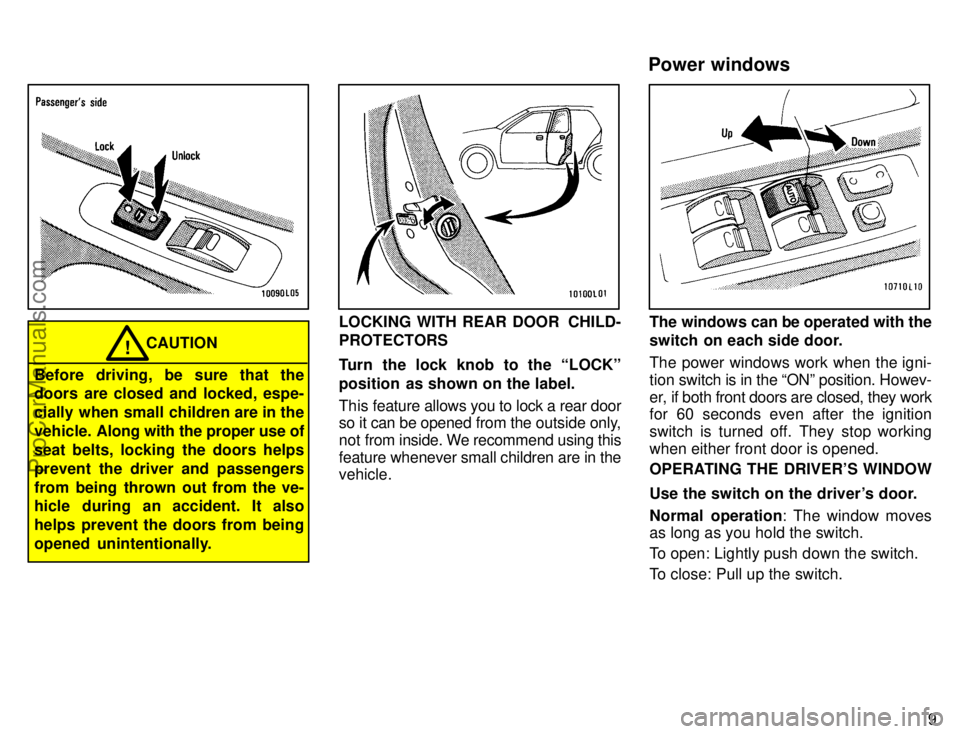
LOCKING WITH REAR DOOR CHILD-
PROTECTORS
Turn the lock knob to the LOCKº
position as shown on the label.
This feature allows you to lock a rear door
so it can be opened from the outside only,
not from inside. We recommend using this
feature whenever small children are in the
vehicle.The windows can be operated with the
switch on each side door.
The power windows work when the igni-
tion switch is in the ONº position. Howev-
er, if both front doors are closed, they work
for 60 seconds even after the ignition
switch is turned off. They stop working
when either front door is opened.
OPERATING THE DRIVER'S WINDOW
Use the switch on the driver's door.
Normal operation: The window moves
as long as you hold the switch.
To open: Lightly push down the switch.
To close: Pull up the switch.
Power windows
ProCarManuals.com
Page 16 of 226
11
�Never leave small children alone in
the vehicle, especially with the igni-
tion key still inserted. They could
use the power window switches
and get trapped in a window. Unat-
tended children can become in-
volved in serious accidents.
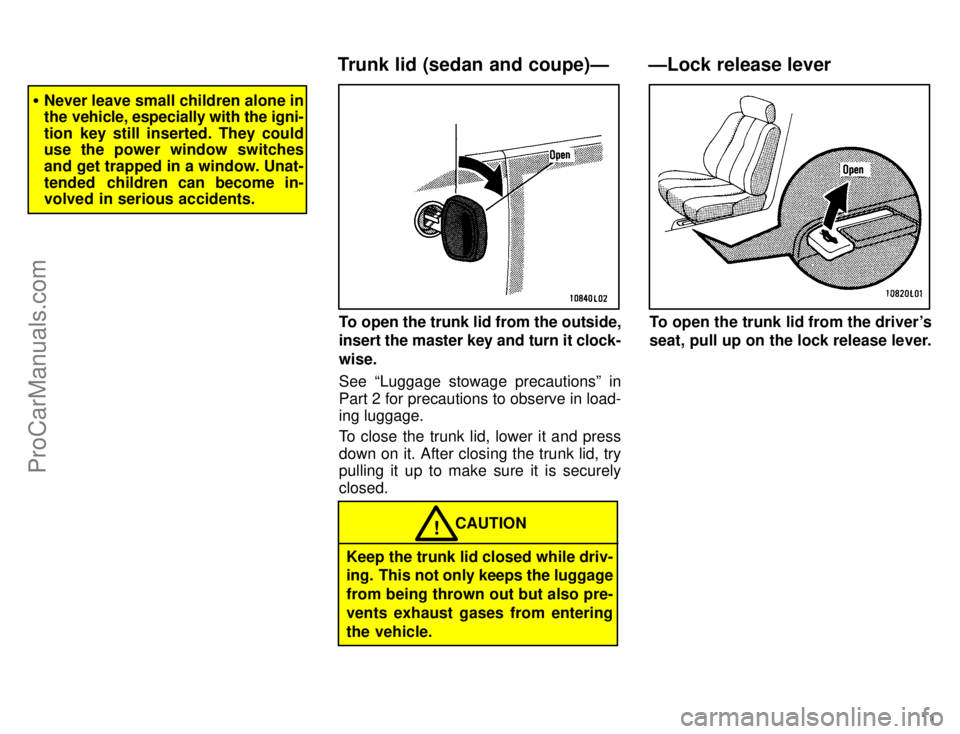
To open the trunk lid from the outside,
insert the master key and turn it clock-
wise.
See Luggage stowage precautionsº in
Part 2 for precautions to observe in load-
ing luggage.
To close the trunk lid, lower it and press
down on it. After closing the trunk lid, try
pulling it up to make sure it is securely
closed.
CAUTION!
Keep the trunk lid closed while driv-
ing. This not only keeps the luggage
from being thrown out but also pre-
vents exhaust gases from entering
the vehicle.
To open the trunk lid from the driver's
seat, pull up on the lock release lever.
ÐLock release lever Trunk lid (sedan and coupe)Ð
ProCarManuals.com
Page 19 of 226
14
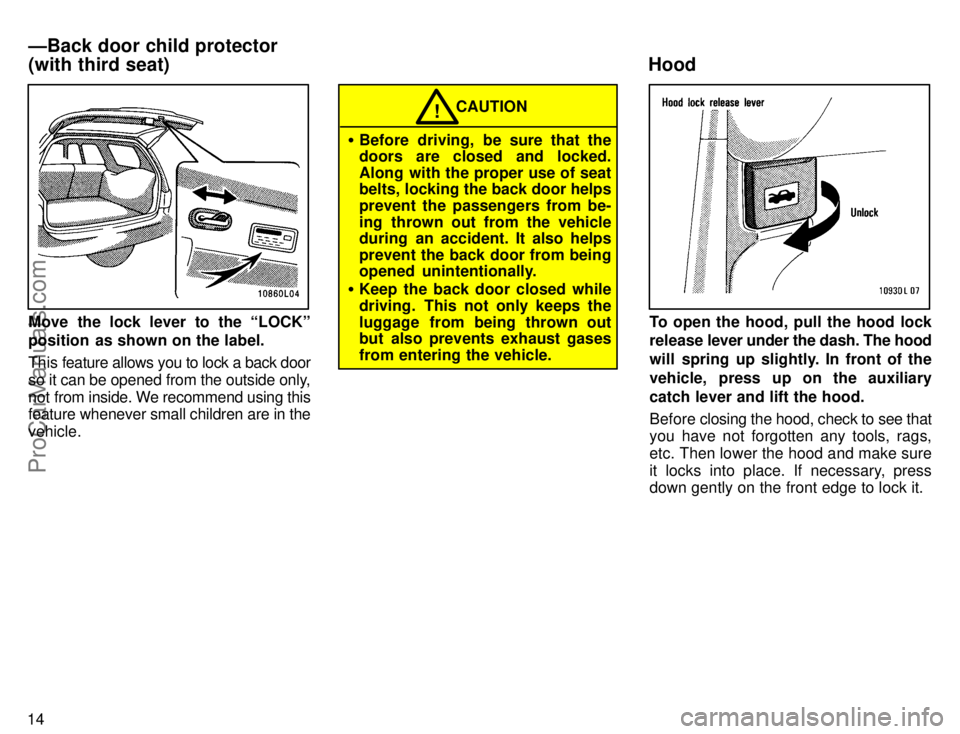
Move the lock lever to the LOCKº
position as shown on the label.
This feature allows you to lock a back door
so it can be opened from the outside only,
not from inside. We recommend using this
feature whenever small children are in the
vehicle.
CAUTION!
�Before driving, be sure that the
doors are closed and locked.
Along with the proper use of seat
belts, locking the back door helps
prevent the passengers from be-
ing thrown out from the vehicle
during an accident. It also helps
prevent the back door from being
opened unintentionally.
�Keep the back door closed while
driving. This not only keeps the
luggage from being thrown out
but also prevents exhaust gases
from entering the vehicle.
To open the hood, pull the hood lock
release lever under the dash. The hood
will spring up slightly. In front of the
vehicle, press up on the auxiliary
catch lever and lift the hood.
Before closing the hood, check to see that
you have not forgotten any tools, rags,
etc. Then lower the hood and make sure
it locks into place. If necessary, press
down gently on the front edge to lock it.
ÐBack door child protector
(with third seat) Hood
ProCarManuals.com
Page 21 of 226
16
CAUTION!
�Make sure the cap is tightened se-
curely to prevent fuel spillage in
case of an accident.
�Use only a genuine Toyota fuel
tank cap for replacement. It has a
built-in check valve to reduce fuel
tank vacuum.
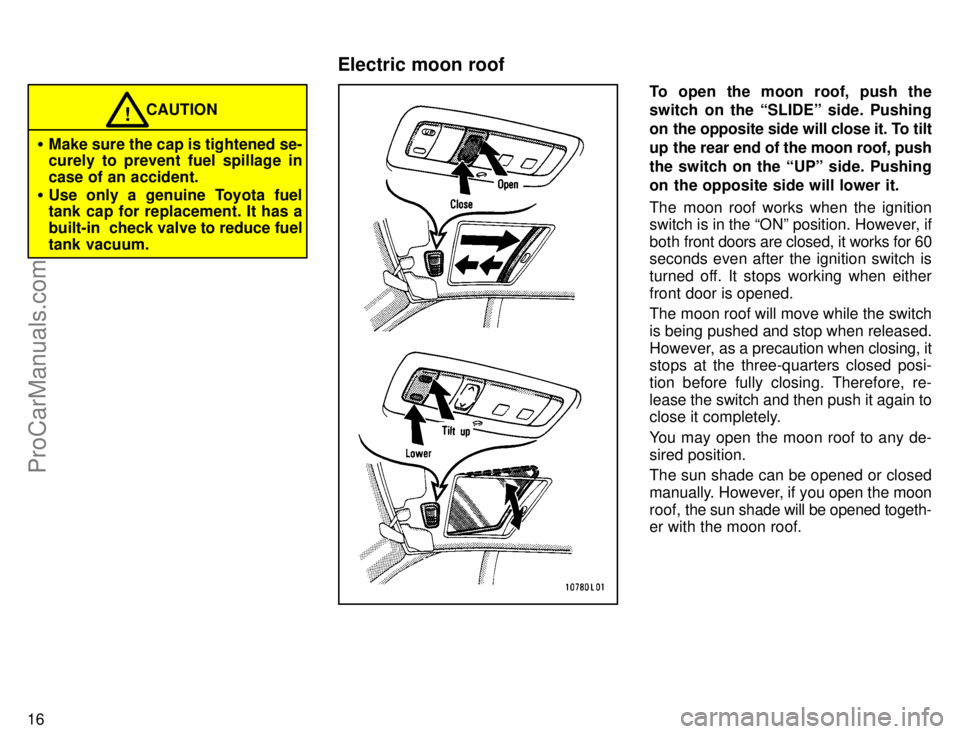
To open the moon roof, push the
switch on the SLIDEº side. Pushing
on the opposite side will close it. To tilt
up the rear end of the moon roof, push
the switch on the UPº side. Pushing
on the opposite side will lower it.
The moon roof works when the ignition
switch is in the ONº position. However, if
both front doors are closed, it works for 60
seconds even after the ignition switch is
turned off. It stops working when either
front door is opened.
The moon roof will move while the switch
is being pushed and stop when released.
However, as a precaution when closing, it
stops at the three-quarters closed posi-
tion before fully closing. Therefore, re-
lease the switch and then push it again to
close it completely.
You may open the moon roof to any de-
sired position.
The sun shade can be opened or closed
manually. However, if you open the moon
roof, the sun shade will be opened togeth-
er with the moon roof.
Electric moon roof
ProCarManuals.com
Page 33 of 226
28
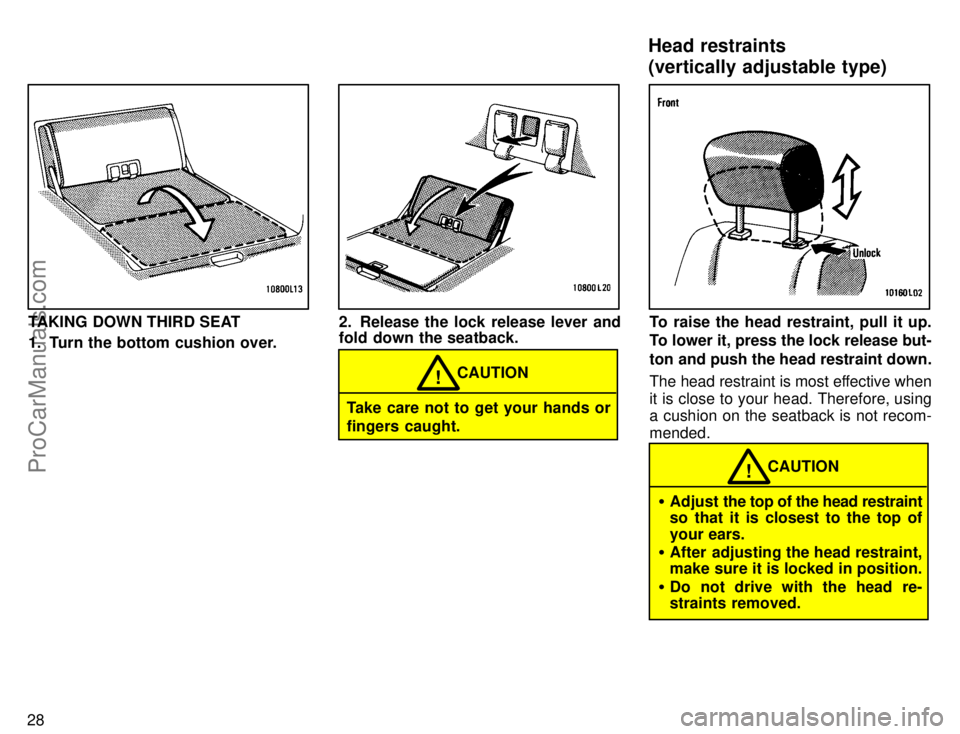
TAKING DOWN THIRD SEAT
1. Turn the bottom cushion over.2. Release the lock release lever and
fold down the seatback.
CAUTION!
Take care not to get your hands or
fingers caught.
To raise the head restraint, pull it up.
To lower it, press the lock release but-
ton and push the head restraint down.
The head restraint is most effective when
it is close to your head. Therefore, using
a cushion on the seatback is not recom-
mended.
CAUTION!
�Adjust the top of the head restraint
so that it is closest to the top of
your ears.
�After adjusting the head restraint,
make sure it is locked in position.
�Do not drive with the head re-
straints removed.
Head restraints
(vertically adjustable type)
ProCarManuals.com
Page 34 of 226
29
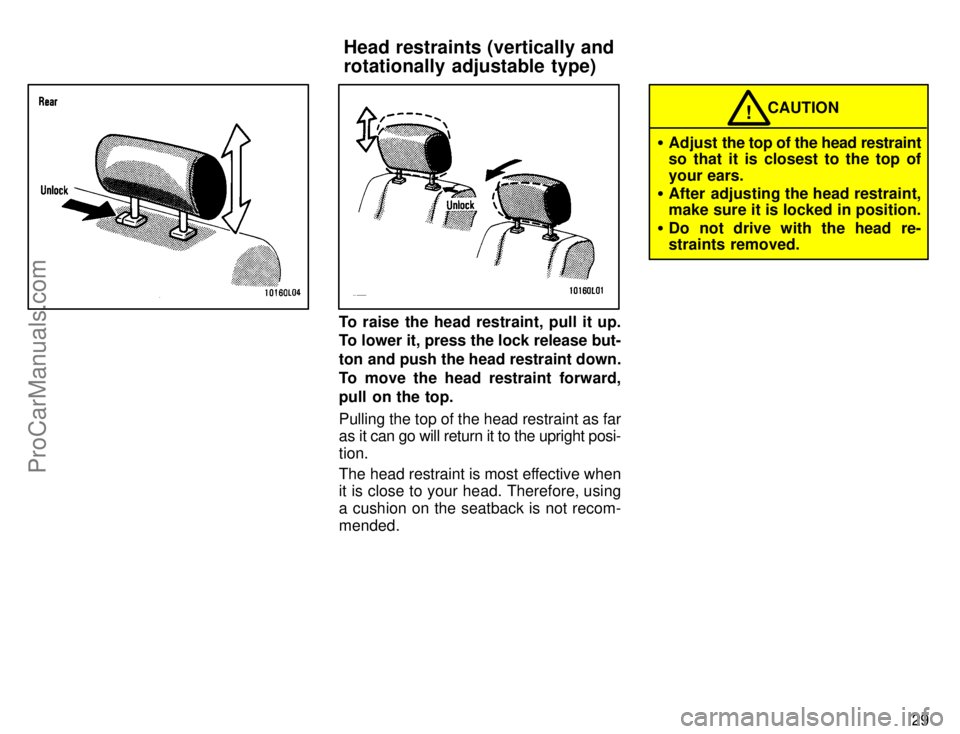
To raise the head restraint, pull it up.
To lower it, press the lock release but-
ton and push the head restraint down.
To move the head restraint forward,
pull on the top.
Pulling the top of the head restraint as far
as it can go will return it to the upright posi-
tion.
The head restraint is most effective when
it is close to your head. Therefore, using
a cushion on the seatback is not recom-
mended.
CAUTION!
�Adjust the top of the head restraint
so that it is closest to the top of
your ears.
�After adjusting the head restraint,
make sure it is locked in position.
�Do not drive with the head re-
straints removed.
Head restraints (vertically and
rotationally adjustable type)
ProCarManuals.com
Page 35 of 226
30Toyota recommends that the driver and
passengers in the vehicle be properly re-
strained at all times with the seat belts pro-
vided. Failure to do so could increase the
chance of injury and/or the severity of injury
in accidents.
Baby or small child. Use a child restraint
system which fits your vehicle. See Child
restraintº for details.
Child. If a child is too large for a child re-
straint system, the child should sit in the
rear seat and must be restrained using the
vehicle's seat belt. According to accident
statistics, the child is safer when properly
restrained in the rear seat than in the front
seat. Do not allow the child to stand up or
kneel on either rear or front seats. If the
shoulder belt falls across the child's neck or
face, move the child to the center position
and use the center lap belt.
Pregnant woman. Toyota recommends
the use of a seat belt. Ask your doctor for
specific recommendations. The lap belt
should be worn securely and as low as pos -
sible over the hips and not on the waist.
Injured person. Toyota recommends the
use of a seat belt. Depending on the injury,
however, first check with your doctor.
CAUTION!
Persons should ride in their seats
properly wearing their seat belts
whenever the vehicle is moving.
Otherwise, they are much more like-
ly to suffer serious bodily injury in
the event of sudden braking or a col-
lision.
When using the seat belts, observe
the following:
�Use the belt for only one person at
a time. Do not use a single belt for
two or more peopleÐeven chil-
dren.
�Avoid reclining the seatbacks too
much. The seat belts provide maxi-
mum protection when the seat-
backs are in the upright position.
(See the seat adjustment instruc-
tions.)
�Be careful not to damage the belt
webbing or hardware. Take care
that they do not get caught or
pinched in the seat or doors.
�Inspect the belt system periodical-
ly. Check for cuts, fraying, and
loose parts. Damaged parts should
be replaced. Do not disassemble or
modify the system.
�Keep the belts clean and dry. If they
need cleaning, use a mild soap
solution or lukewarm water. Never
use bleach, dye, or abrasive clean-
ersÐthey may severely weaken the
belts.
�Replace the belt assembly (includ-
ing bolts) if it has been used in a
severe impact. The entire assem-
bly should be replaced even if
damage is not obvious.
Seat beltsÐ
ÐSeat belt precautions
ProCarManuals.com