Page 167 of 226
161
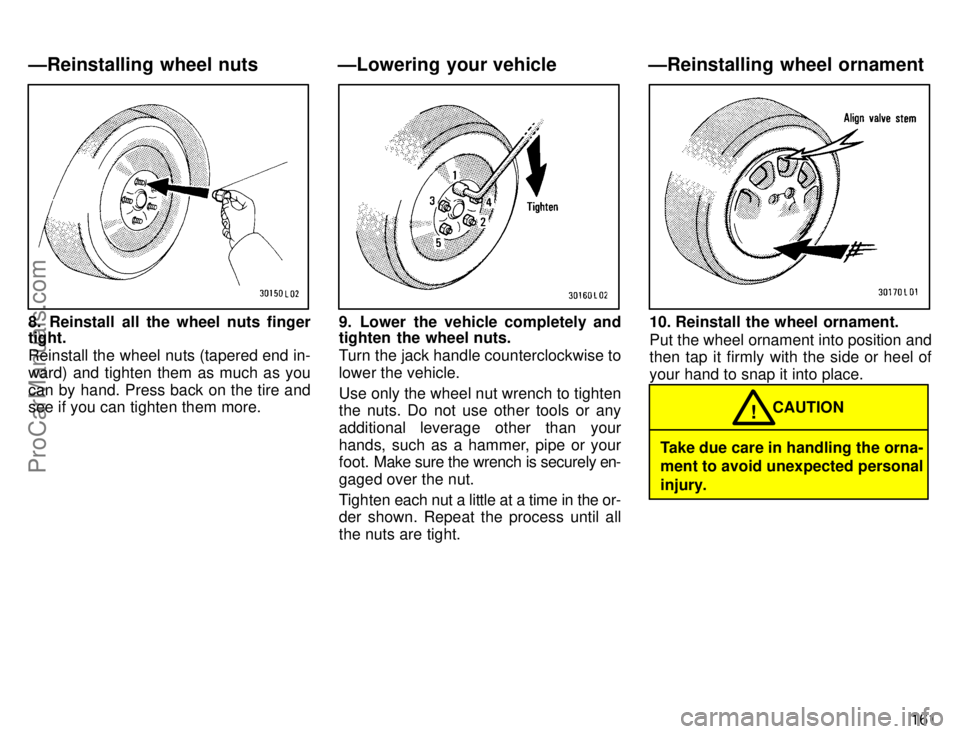
8. Reinstall all the wheel nuts finger
tight.
Reinstall the wheel nuts (tapered end in-
ward) and tighten them as much as you
can by hand. Press back on the tire and
see if you can tighten them more.9. Lower the vehicle completely and
tighten the wheel nuts.
Turn the jack handle counterclockwise to
lower the vehicle.
Use only the wheel nut wrench to tighten
the nuts. Do not use other tools or any
additional leverage other than your
hands, such as a hammer, pipe or your
foot. Make sure the wrench is securely en-
gaged over the nut.
Tighten each nut a little at a time in the or-
der shown. Repeat the process until all
the nuts are tight.10. Reinstall the wheel ornament.
Put the wheel ornament into position and
then tap it firmly with the side or heel of
your hand to snap it into place.
Take due care in handling the orna-
ment to avoid unexpected personal
injury.CAUTION
! ÐLowering your vehicle ÐReinstalling wheel ornament ÐReinstalling wheel nuts
ProCarManuals.com
Page 195 of 226
189 Clean all dirt from outside of the reservoir
tank and look at the fluid level. If the fluid
is cold, the level should be in the COLDº
range. Similarly, if it is hot, the fluid level
should be in the HOTº range. If the level
is at the low side of either range, add auto-
matic transmission fluid DEXRON
[-II or
-III to bring the level within the range.
To remove the filler cap, turn it counter-
clockwise and lift up. To reinstall it, turn it
clockwise. After replacing the filler cap,
visually check the steering box case, vane
pump and hose connections for leaks or
damage.
CAUTION!
The reservoir tank may be hot so be
careful not to burn yourself.
NOTICE
Avoid overfilling, or the power
steering could be damaged.
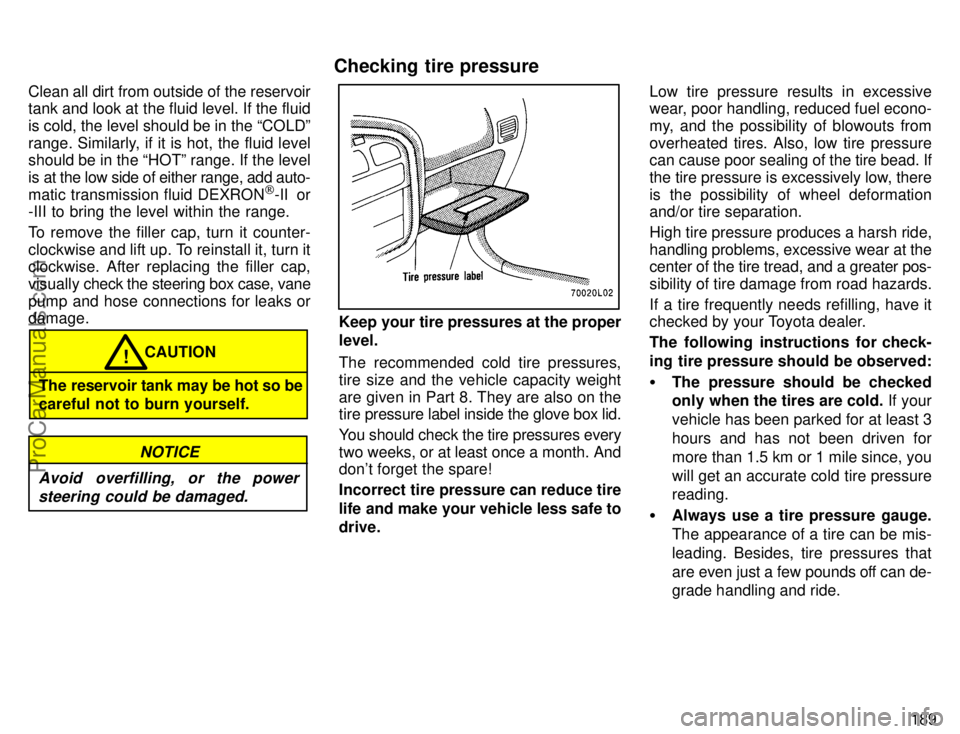
Keep your tire pressures at the proper
level.
The recommended cold tire pressures,
tire size and the vehicle capacity weight
are given in Part 8. They are also on the
tire pressure label inside the glove box lid.
You should check the tire pressures every
two weeks, or at least once a month. And
don't forget the spare!
Incorrect tire pressure can reduce tire
life and make your vehicle less safe to
drive.Low tire pressure results in excessive
wear, poor handling, reduced fuel econo-
my, and the possibility of blowouts from
overheated tires. Also, low tire pressure
can cause poor sealing of the tire bead. If
the tire pressure is excessively low, there
is the possibility of wheel deformation
and/or tire separation.
High tire pressure produces a harsh ride,
handling problems, excessive wear at the
center of the tire tread, and a greater pos-
sibility of tire damage from road hazards.
If a tire frequently needs refilling, have it
checked by your Toyota dealer.
The following instructions for check-
ing tire pressure should be observed:
�The pressure should be checked
only when the tires are cold. If your
vehicle has been parked for at least 3
hours and has not been driven for
more than 1.5 km or 1 mile since, you
will get an accurate cold tire pressure
reading.
�Always use a tire pressure gauge.
The appearance of a tire can be mis-
leading. Besides, tire pressures that
are even just a few pounds off can de-
grade handling and ride.
Checking tire pressure
ProCarManuals.com
Page 222 of 226

216
Fuses (type A)
1. HORN 10 A: Horn
2. HEAD (LH) 15 A: Left-hand headlight
3. ALT-S 7.5 A: Charging system
4. HEAD (RH) 15 A: Right-hand head-
light
5. DOME 20 A: Audio system, interior
light, clock, ignition switch light, personal
light, trunk light, luggage compartment
light, vanity mirror light, electric moon roof
6. EFI 15 A: Multiport fuel injection sys-
tem/sequential multiport fuel injection
system
7. AM2 30 A: Multiport fuel injection sys-
tem/sequential multiport fuel injection
system, starting system8. ECU-B 15 A: Anti-lock brake system,
daytime running light system, cruise con-
trol system
9. HAZ 10 A: Emergency flasher
10. HEAD HI (LH) 15 A: Left-hand head-
light (high beam)
11.HEAD HI (RH) 15 A: Right-hand
headlight (high beam)
12. OBD 7.5 A: On-board diagnosis sys-
tem
13. SPARE 7.5 A: Spare fuse
14. SPARE 15 A: Spare fuse
15. SPARE 30 A: Spare fuse
16. TEL 15 A: No circuitFuses (type B)
17. ECU-IG 15 A: Electronically con-
trolled automatic transmission system,
cruise control system, anti-lock brake
system
18. GAUGE 10 A: Gauges and meters,
back-up lights, air conditioning control
system, rear window defogger, service re-
minder indicators, daytime running light
system, tilt steering
19. STOP 15 A: Stop lights, cruise con-
trol system, anti-lock brake system, shift
lock system
20. SEAT HTR 15 A: No circuit
Fuses
ProCarManuals.com
Page 223 of 226

217
21. WIPER 20 A: Windshield wipers and
washer, rear window wipers and washer,
air bag system
22. TURN 7.5 A: Turn signal lights
23. IGN 7.5 A: Multiport fuel injection sys-
tem/sequential multiport fuel injection
system, charging system, air bag system
24. CIG/RADIO 15 A: Audio system,
daytime running light system, clock, ciga-
rette lighter, air bag system, shift lock sys-
tem
25. MIR. HTR 10 A: Outside rear view
mirror heater26. TAIL 15 A: Tail lights, parking lights,
license plate lights, instrument panel
lights, rear light failure warning system
27. SRS 7.5 A: SRS airbag system
28. A/C 10 A: Air conditioning control
system
29. HEAD (LWR-RH) 15 A: Right-hand
headlight (low beam)
30. HEAD (LWR-LH) 15 A: Left-hand
headlight (low beam)
31. DRL 5 A: Daytime running light sys-
tem
32. ST 10 A: Starting systemFuses (type C)
33. AM1 40 A: Starting system
34. P/W 30 A: Electric moon roof, power
windows, tilt steering, power door lock
controls, power back door lock control,
power seat
35. DEFOG 40 A: Rear window defogger
36. HTR 40 A: Air conditioning control
system
37. MAIN NO. 1 40 A: Starting system
38. CDS 30 A: Electric cooling fan
39. RDI 30 A: Electric cooling fan
ProCarManuals.com