Page 195 of 217
192Check the tires regularly for damage
such as cuts, splits and cracks. If any damage is found, consult with a tech-
nician and have the tire repaired or re-placed. Even if the damage does not appear seri-
ous, a qualified technician should ex-
amine the damage. Objects which havepenetrated the tire may have caused in- ternal damage.
Any tires which are over six years old
must be checked by a qualified techni-
cian even if damage is not obvious.
Tires deteriorate with age even if they
have never or seldom been used.
This
also applies to the spare tire and tires
stored for future use.REPLACING YOUR TIRES
When replacing a tire, use only the
same size and construction as origi-
nally installed and with the same or
greater load capacity.
Using any other size or type of tire may se-
riously affect handling, ride, speedome-
ter/odometer calibration, ground clear-
ance, and clearance between the body
and tires or snow chains.
CAUTION!
Do not mix radial, bias belted, or
bias-ply tires on your vehicle. It
can cause dangerous handling
characteristics, resulting in loss
of control.
Do not use tires or wheels other
than the manufacturer's recom-
mended size.
Toyota recommends all four tires, or at
least both of the front or rear tires be
replaced at a time as a set.
See If you have a flat tireº in Part 4 for tire
change procedure.
When a tire is replaced, the wheel
should always be balanced.
An unbalanced wheel may affect vehicle
handling and tire life. Wheels can get out
of balance with regular use and should
therefore be balanced occasionally.
When replacing a tubeless tire, the air
valve should also be replaced with a
new one.
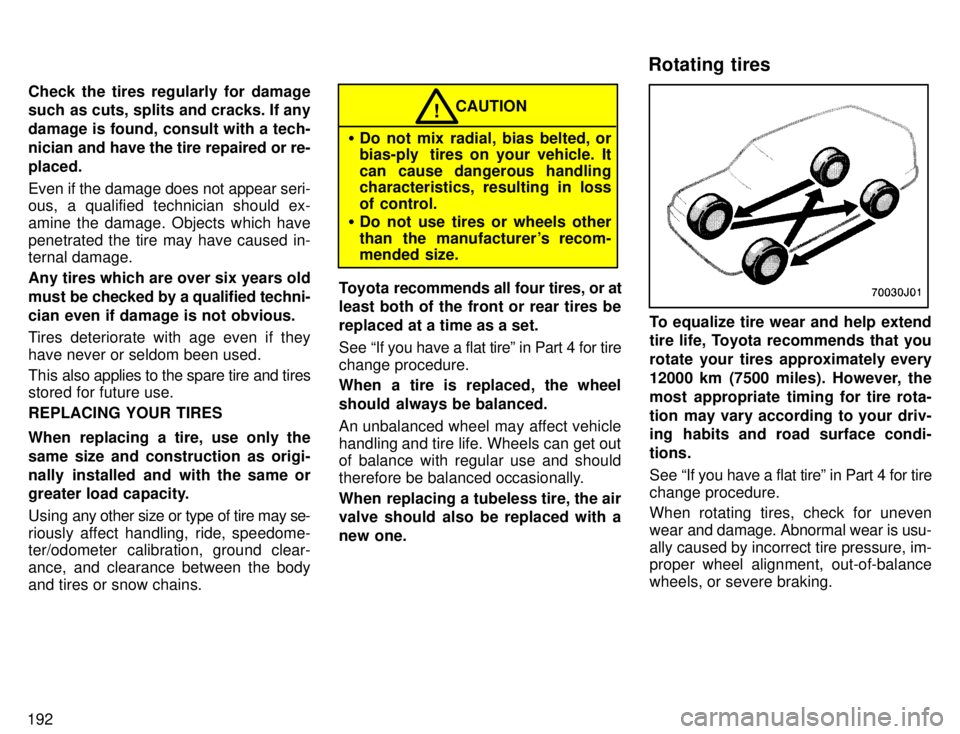
To equalize tire wear and help extend
tire life, Toyota recommends that you
rotate your tires approximately every
12000 km (7500 miles). However, the
most appropriate timing for tire rota-
tion may vary according to your driv-
ing habits and road surface condi- tions.
See If you have a flat tireº in Part 4 for tire
change procedure. When rotating tires, check for uneven
wear and damage. Abnormal wear is usu-
ally caused by incorrect tire pressure, im-
proper wheel alignment, out-of-balance
wheels, or severe braking.
Rotating tires
Page 196 of 217
193
WHEN TO USE SNOW TIRES OR CHAINS
Snow tires or chains are recom-
mended when driving on snow or ice.
On wet or dry roads, conventional tires
provide better traction than snow tires. SNOW TIRE SELECTION
If you need snow tires, select the same
size, construction and load capacity
as the original tires on your Toyota.
Do not use tires other than those men-
tioned above. Do not install studded tires
without first checking local regulations for
possible restrictions.
SNOW TIRE INSTALLATION
Snow tires should be installed on all wheels. Installing snow tires on the front wheels
only can lead to an excessive difference
in road grip capability between the front
and rear tires which would cause loss of
vehicle control.
When storing removed tires, you should
store them in a cool dry place.
Mark the direction of rotation and be sure to install them in the same direction whenreplacing.
CAUTION!
Do not drive with the snow tires in- correctly inflated.
Never drive over 120 km/h (75 mph)
with any type of snow tires.
TIRE CHAIN SELECTION Use the tire chains of correct size.
Regulations regarding the use of tire
chains vary according to location or
type of r oad, so always check them be-
fore installing chains.
CHAIN INSTALLATION
Install the chains on the rear tires as
tightly as possible. Do not use tirechains on the front tires. Retighten
chains after driving 0.5 '1.0 km
(1/4 '1/2 mile).
When installing chains on your tires, care- fully follow the instructions of the chain
manufacturer.
If wheel covers are used, they will be
scratched by the chain band, so removethe covers before putting on the chains.CAUTION!
Do not exceed 50 km/h (30 mph) or
the chain manufacturer's recom-
mended speed limit, whichever is
lower.
Drive carefully avoiding bumps,
holes, and sharp turns, which maycause the vehicle to bounce.
Avoid sharp turns or locked-
wheel braking, as use of chains
may adversely affect vehicle han- dling.
Installing snow tires and chains
Page 197 of 217

194WHEN TO REPLACE YOUR WHEELS
If you have wheel damage such as
bending, cracks or heavy corrosion,
the wheel should be replaced.
If you fail to replace damaged wheels, the
tire may slip off the wheel or they may cause loss of handling control. WHEEL SELECTION
When replacing wheels, care should
be taken to ensure that the wheels are
replaced by ones with the same load
capacity, diameter, rim width, and off-set.
Correct
replacement wheels are available
at your Toyota dealer.
A wheel of a different size or type may ad-
versely affect handling, wheel and bear-
ing life, brake cooling, speedometer/
odometer calibration, stopping ability,
headlight aim, bumper height, vehicle
ground clearance, and tire or snow chain clearance to the body and chassis. Replacement
with used wheels is not rec-
ommended as they may have been sub-jected to rough treatment or high mileageand could fail without warning. Also, bent
wheels which have been straightened
may have structural damage and there-
fore should not be used. Never use an in-
ner tube in a leaking wheel which is de-
signed for a tubeless tire.
After driving your vehicle the first 1600
km (1000 miles), check that the wheel
nuts are tight.
If you have rotated, repaired, or
changed your tires, check that the
wheel nuts are still tight after driving
1600 km (1000 miles).
When using tire chains, be careful not
to damage the aluminum wheels.
Use only the Toyota wheel nuts and
wrench designed for your aluminumwheels.
When balancing your wheels, use only
Toyota balance weights or equivalent
and a plastic or rubber hammer.
As with any wheel, periodically checkyour aluminum wheels for damage. If
damaged, replace immediately.
Aluminum wheel precautions
Replacing wheels
Page 212 of 217
P265/70R16 200 (2.2, 32) 220 (2.2, 32) 7J x 16J*1
7JJ x 16 *2
P225/75R15 200 (2.0, 29) 200 (2.0, 29) 7J x 15 *1
7JJ x 15 *2
Tire size
Tire pressure
kPa (kgf/cm 2
or bar, psi)
Front Rear Wheel size
Wheel nut torque, N
m (kgf m, ft lbf):
110 (11.5, 83)
* 1:
Vehicles with steel wheels
* 2:
Vehicles with aluminum wheel
209
BRAKES Minimum pedal clearance when de- pressed with the pressure of 490 N (50
kgf, 110 lbf) with the engine running, mm (in.):
75 (2.9)
Pedal freeplay, mm (in.): 3' 6 (0.12 '0.24)
Pad wear limit, mm (in.): 1.0 (0.04)
Lining wear limit, mm (in.):
1.0 (0.04)
Parking brake adjustment when pulledwith the force of 196 N (20 kgf, 44 lbf): 7' 9 clicks
Fluid type: SAE J1703 or FMVSS No. 116 DOT 3
STEERING Wheel freeplay: Less than 30 mm (1.2 in.)
Power steering fluid type:
Automatic transmission fluid DEXRON [
-II or -III Tires