1996 TOYOTA 4RUNNER ECO mode
[x] Cancel search: ECO modePage 28 of 217
27
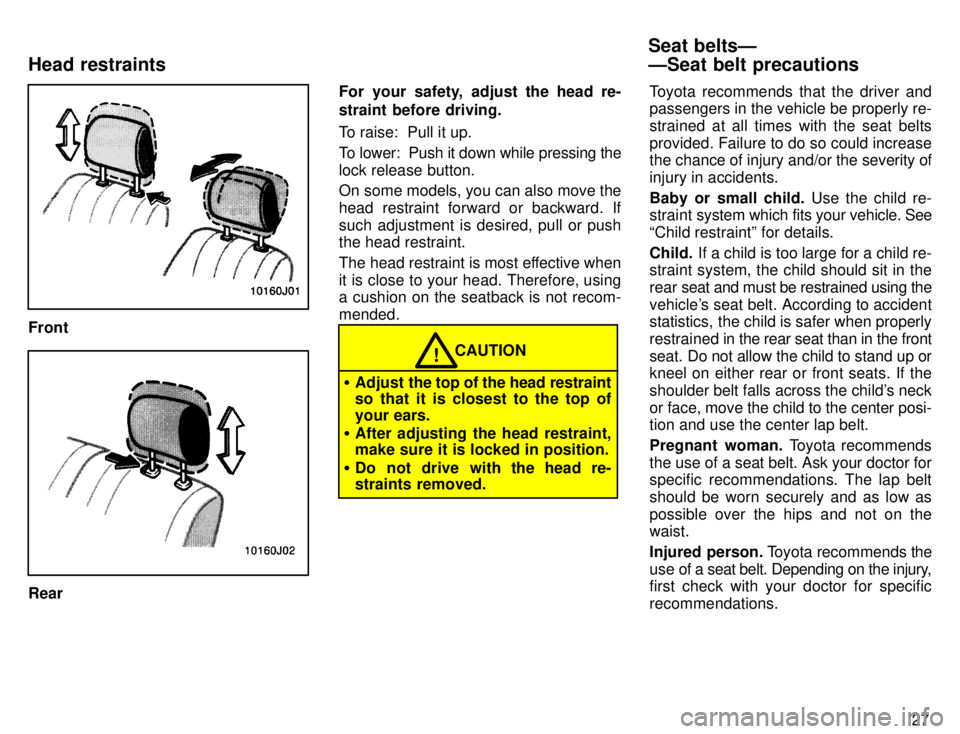
Front
RearFor your safety, adjust the head re-
straint before driving.
To raise: Pull it up.
To lower: Push it down while pressing the lock release button.
On some models, you can also move the
head restraint forward or backward. If
such adjustment is desired, pull or push the head restraint.
The head restraint is most effective when
it is close to your head. Therefore, using a cushion on the seatback is not recom- mended.
CAUTION!
Adjust the top of the head restraint
so that it is closest to the top of
your ears.
After adjusting the head restraint,
make sure it is locked in position.
Do not drive with the head re-
straints removed. Toyota recommends that the driver and
passengers in the vehicle be properly re- strained at all times with the seat belts
provided. Failure to do so could increase
the chance of injury and/or the severity of
injury in accidents. Baby or small child.
Use the child re-
straint system which fits your vehicle. See
Child restraintº for details.Child. If a child is too large for a child re-
straint system, the child should sit in the rear seat and must be restrained using the
vehicle's seat belt. According to accident
statistics, the child is safer when properly
restrained in the rear seat than in the front
seat. Do not allow the child to stand up or
kneel on either rear or front seats. If the
shoulder belt falls across the child's neck
or face, move the child to the center posi- tion and use the center lap belt.
Pregnant woman. Toyota recommends
the use of a seat belt. Ask your doctor for
specific recommendations. The lap belt
should be worn securely and as low as
possible over the hips and not on the waist.
Injured person. Toyota recommends the
use of a seat belt. Depending on the injury,
first check with your doctor for specific recommendations.
Seat beltsÐ ÐSeat belt precautions
Head restraints
Page 29 of 217
27
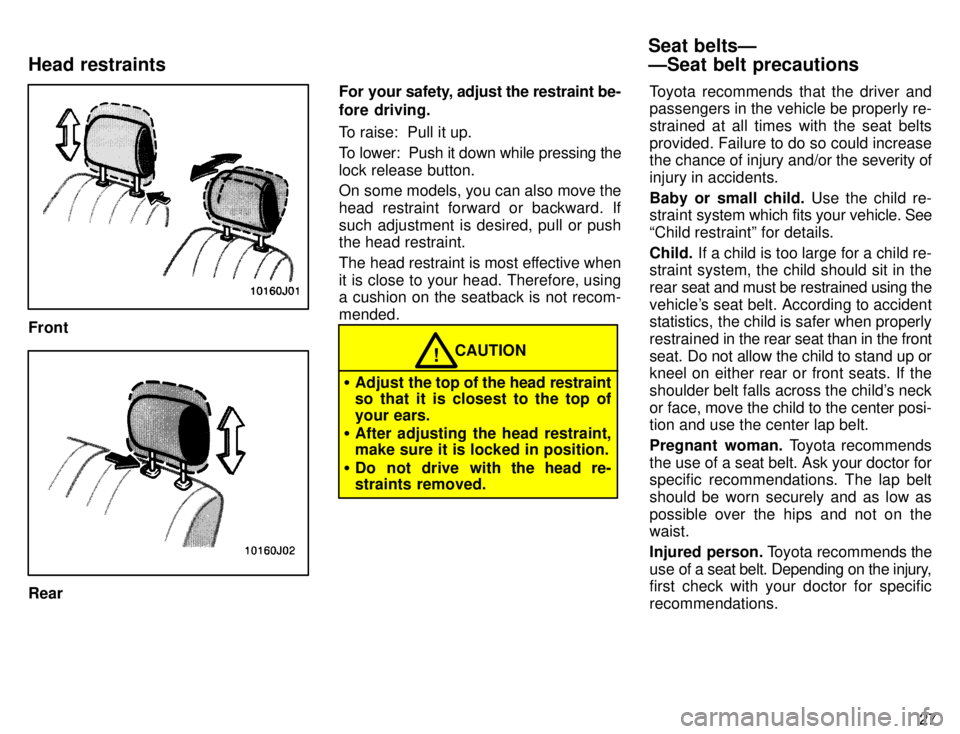
Front
RearFor your s
afety, adjust the restraint be-
fore driving.
To raise: Pull it up.
To lower: Push it down while pressing the lock release button.
On some models, you can also move the
head restraint forward or backward. If
such adjustment is desired, pull or push the head restraint.
The head restraint is most effective when
it is close to your head. Therefore, using a cushion on the seatback is not recom- mended.
CAUTION!
Adjust the top of the head restraint
so that it is closest to the top of
your ears.
After adjusting the head restraint,
make sure it is locked in position.
Do not drive with the head re-
straints removed. Toyota recommends that the driver and
passengers in the vehicle be properly re- strained at all times with the seat belts
provided. Failure to do so could increase
the chance of injury and/or the severity of
injury in accidents. Baby or small child.
Use the child re-
straint system which fits your vehicle. See
Child restraintº for details.Child. If a child is too large for a child re-
straint system, the child should sit in the rear seat and must be restrained using the
vehicle's seat belt. According to accident
statistics, the child is safer when properly
restrained in the rear seat than in the front
seat. Do not allow the child to stand up or
kneel on either rear or front seats. If the
shoulder belt falls across the child's neck
or face, move the child to the center posi- tion and use the center lap belt.
Pregnant woman. Toyota recommends
the use of a seat belt. Ask your doctor for
specific recommendations. The lap belt
should be worn securely and as low as
possible over the hips and not on the waist.
Injured person. Toyota recommends the
use of a seat belt. Depending on the injury,
first check with your doctor for specific recommendations.
Seat beltsÐ ÐSeat belt precautions
Head restraints
Page 72 of 217

69
(g) Driving in PWRº (power) mode
In the PWRº mode, the transmission is shifted up and down at a higher vehicle
speed
than in the NORMº (Normal) mode
and a more powerful acceleration is
achieved. To set the PWRº mode, push
in the driving pattern selector button. The
PWRº mode indicator light comes on.
For ordinary driving, Toyota recommends
using the NORMº mode to improve fuel
economy.
(h) If you cannot shift the selector lever
out of Pº position
If you cannot shift the selector lever from the Pº position even though the brake
pedal is depressed, use the shift lock
override button. For instructions, see If you cannot shift automatic transmissionselector leverº in Part 4.
Page 76 of 217
73
While the vehicle is moving, never
attempt to move the selector lever
into Pº position under any circum-
stances. Serious mechanical dam-
age and loss of vehicle control mayresult.CAUTION
!
(f) Good driving practice If the transmission is repeatedly up-
shifted and downshifted between third
gear and overdrive when climbing a
gentle slope, the overdrive switch
should be turned off. Be sure to turn the switch on immediately afterward.
When towing a trailer, in order to main-
tain engine braking efficiency, do notuse overdrive.
Always keep your foot on the brake
pedal while stopped with the engine
running. This prevents the vehicle
from creeping. CAUTION
!
NOTICE
Do not hold the vehicle on an upgrade with the accelerator pedal.
It can cause the transmission tooverheat. Always use the brake pedal or parking brake.
(g) Driving in PWRº(Power) mode
In the PWRº mode, the transmission is shifted up and down at a higher vehicle
speed than in the NORMº (Normal) mode
and a more powerful acceleration is
achieved. To set the PWRº mode, push
in the driving pattern selector button. The
PWRº mode indicator light comes on.
For ordinary driving, Toyota recommends
using the NORMº mode to improve fuel
economy.
(h) If you cannot shift the selector lever
out of Pº position
If you cannot shift the selector lever from the Pº position even though the brake
pedal is depressed, use the shift lock
override lever. For instructions, see If you
cannot shift automatic transmission se- lector leverº in Part 4.
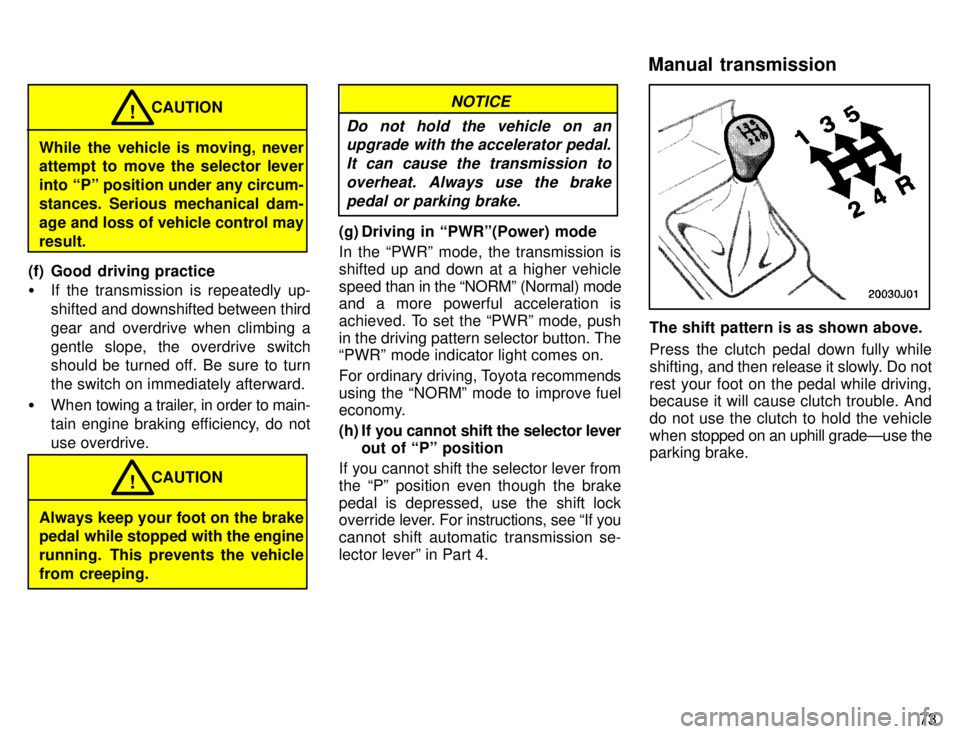
The shift pattern is as shown above.
Press the clutch pedal down fully while
shifting, and then release it slowly. Do not
rest your foot on the pedal while driving, because it will cause clutch trouble. And do not use the clutch to hold the vehicle
when stopped on an uphill gradeÐuse the
parking brake.
Manual transmission
Page 77 of 217
74Recommended shifting speeds
The transmission is fully synchronized
and upshifting or downshifting is easy.
For the best compromise between fuel
economy and vehicle performance, you
should upshift or downshift at the follow-
ing speeds:
gear km/h (mph)
1 to 2 or 2 to 1 24 (15)
2 to 3 or 3 to 2 40 (25)
3 to 4 or 4 to 3 64 (40)
4 to 5 or 5 to 4 72 (45)
Downshift to the appropriate gear if accel-
eration is needed when you are cruising
below the above downshifting speeds.
Upshifting too soon or downshifting too late will cause lugging, and possibly, ping-
ing. Regularly revving the engine to maxi-
mum speed in each gear will cause exces-
sive engine wear and high fuel consumption. Maximum allowable speeds
To get on a highway or to pass slower traf- fic, maximum acceleration may be neces-
sary.
Make sure you observe the following
maximum allowable speeds in each gear:
Two-wheel drive models gear km/h (mph)
1 48 (29)
2 90 (55)
3 139 (86)
4 165 (102)
Four-wheel drive models 3RZ-FE enginegear km/h (mph)
H2º and H4º L4º
1 45 (28) 17 (11)
2 84 (52) 32 (20)
3 130 (81) 50 (31)
4 165 (102) 64 (39)
5VZ-FE engine
gear km/h (mph) H2º and H4º L4º
1 48 (29) 18 (11)
2 89 (55) 34 (21)
3 127 (79) 49 (31)
4 165 (102) 64 (39)
NOTICE
Do not downshift if you are going faster than the maximum allowable
speed for the next lower gear.
Good driving practice If it is difficult to shift into reverse, put
the transmission in neutral, release
the clutch pedal momentarily, and then
try again.
When towing a trailer, in order to main-
tain engine braking efficiency, do not
use the fifth gear.
Be careful when downshifting on a
slippery surface. Abrupt shifting
could cause the vehicle to spin orskid. CAUTION
!
NOTICE
Make sure the vehicle is completely
stopped before shifting into re-
verse.
Page 78 of 217

75
Use the front drive control lever to se-
lect the following transfer modes. H2º (high speed position, two-wheel
drive): Lever at H2º
Use this for normal driving on dry hard-
surfaced roads. This position gives great-
er economy, quietest ride and least wear.
H4º (high speed position, four-wheel
drive): Lever at H4º
Use this for normal driving on wet, icy or
snow-covered roads. This position pro-
vides greater traction than two-wheel drive. Nº (neutral position):
Lever at Nº
No power is delivered to the wheels. The vehicle must be stopped.
L4º (low speed position, four-wheel
drive): Lever at L4º
Use this for maximum power and traction. Use L4º for climbing or descending steep
hills, off-road driving, and hard pulling in
sand, mud or deep snow.
The four-wheel drive indicator light
comes on when the H4º, Nº or L4º mode is selected. See (c) Shifting procedure (lever type)º
for further instructions.Use the front drive control lever and
4WDº button to select the following transfer modes. H2º (high speed position, two-wheel
drive): Lever at Hº, 4WDº button left out
Use this for normal driving on dry hard-
surfaced roads. This position gives great-
er economy, quietest ride and least wear.
H4º (high speed position, four-wheel
drive): Lever at Hº, 4WDº button pushed
in
Use this for normal driving on wet, icy or
snow-covered roads. This position pro-
vides greater traction than two-wheel drive.
Four-wheel drive systemÐ (a) Front drive control (lever type)
(a) Front drive control (lever/button type)
Page 97 of 217

94There must be at
least 3 seconds of blank
space between tracks in order for the APS
feature to work correctly. In addition, the
APS feature may not work well with some
spoken word, live, or cl assical recordings.
BAL (Balance)
This knob lets you adjust the balance be- tween the right and left speakers. BASS This knob lets you adjust the bass level. Push BASS/TREBº so that it pops out of
its retracted position. Turn the knob to ad-
just the bass. Push the knob back into its
retracted position. Dolby )
NR*
Type 2-1 only If you are listening to a tape that was re-
corded with Dolby )
Noise Reduction,
push the button marked with the
double-D symbol. The double-D symbol
will appear on the display. Push the button
again to turn off Dolby )
NR.
The Dolby NR mode reduces tape noise
by about 10 dB. For best sound reproduc- tion, play your tapes with this button on or
off according to the mode used for record-
ing the tape. *
: Dolby noise reduction manufactured under license from Dolby Lab-
oratories Licensing Corporation. DOLBYº and the double-D sym- bol
are trademark of Dolby Laboratories Licensing Corporation.
Dolby )
B VC*
Type 2-2 only If you are listening to a tape that was re- corded with Dolby )
B or C Noise Reduc-
tion, push the button marked with the
double-D symbol until the appropriate symbol appears on the display. To turn off
Dolby )
, push the button until the symbol
disappears from the display.
The Dolby B NR mode reduces tape noise by about 10 dB. The Dolby C NR mode re-duces tape noise by another 10 dB, or
about 20 dB total. For best sound repro-
duction, select the same NR mode thatwas used to record the tape. * : Dolby noise reduction manufactured under license from Dolby Lab-
oratories Licensing Corporation. DOLBYº and the double-D sym- bol
are trademark of Dolby Laboratories Licensing Corporation.
FADE
Move the FADEº ring around PWR/
VOLº to adjust the front/rear balance. MTL (Metal) display
Type 2-2 only
If a metal or chrome equivalent cassette
tape is
put in the cassette player, the play-
er will automatically adapt to it and MTLº
will appear on the display. PROG (Program)
Push PROGº to select the other side of
a cassette tape. The display indicates
which side is currently selected ( ~º indi-
cates top side, !º indicates bottom side).
Auto-reverse featureÐAfter the cassette
player reaches the end of a tape side, itautomatically reverses and begins to play
the other side. This is true whether the
cassette was playing or fast forwarding.
PWR/VOL (Power/Volume) Push PWR/VOLº to turn the audio sys-
tem on and off. T urn the PWR/VOLº knob
to adjust the volume. Pull out and then turn PWR/VOLº to ad- just the balance between the right and left
speakers. Move FADEº around PWR/
VOLº to adjust the front/rear balance.
Page 99 of 217

96Push SKIPº. SKIPº will appear on the
display. The cassette player will keep
track of how much blank space it plays.
Any time it has played about 10 seconds
of blank tape, it will automatically fast for-
ward to the next track and begin to play.
Push the button a second time to turn off the skip feature. ST (Stereo reception) display
Your radio automatically changes to ste- reo reception when a stereo broadcast is
received. STº appears on the display. Ifthe signal becomes weak, the radio re-
duces the amount of channel separation to prevent the weak signal from creating
noise. If the signal becomes extremely weak, the radio switches from stereo to mono reception.
TAPE
Push TAPEº to switch from radio opera-
tion to cassette operation. If the audio
system is off,
you can turn on the cassette
player by pushing TAPEº. In both cases,a cassette must already be loaded in the
player. TREB (Treble)
This knob lets you adjust the treble level. Push BASS/TREBº so that it pops out of
its retracted position. Pull out the knob.
Turn the knob to adjust the treble. Push the knob back into its retracted position. TUNE
Tuning
Your Toyota has an electronic tuning radio (ETR). Push and release the
~º (up) or !º
(down) side of TUNEº to step up or down
the station band. If you hear a beep, you
held the button too long and the radio will
go into the seek mode. Seeking
In the seek mode, the radio finds and plays the next station up or down the sta- tion band.
To seek a station, push and hold the ~º or
! º side of TUNEº until you hear a beep.
Do this again to find another station.