1996 TOYOTA 4RUNNER belt
[x] Cancel search: beltPage 28 of 217
27
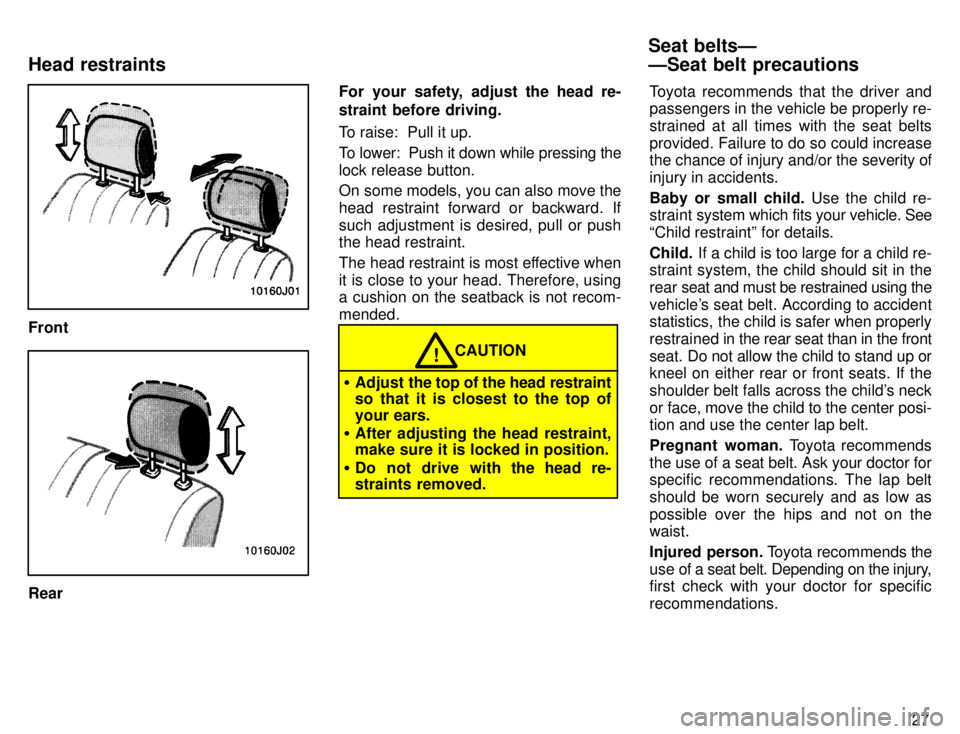
Front
RearFor your safety, adjust the head re-
straint before driving.
To raise: Pull it up.
To lower: Push it down while pressing the lock release button.
On some models, you can also move the
head restraint forward or backward. If
such adjustment is desired, pull or push the head restraint.
The head restraint is most effective when
it is close to your head. Therefore, using a cushion on the seatback is not recom- mended.
CAUTION!
Adjust the top of the head restraint
so that it is closest to the top of
your ears.
After adjusting the head restraint,
make sure it is locked in position.
Do not drive with the head re-
straints removed. Toyota recommends that the driver and
passengers in the vehicle be properly re- strained at all times with the seat belts
provided. Failure to do so could increase
the chance of injury and/or the severity of
injury in accidents. Baby or small child.
Use the child re-
straint system which fits your vehicle. See
Child restraintº for details.Child. If a child is too large for a child re-
straint system, the child should sit in the rear seat and must be restrained using the
vehicle's seat belt. According to accident
statistics, the child is safer when properly
restrained in the rear seat than in the front
seat. Do not allow the child to stand up or
kneel on either rear or front seats. If the
shoulder belt falls across the child's neck
or face, move the child to the center posi- tion and use the center lap belt.
Pregnant woman. Toyota recommends
the use of a seat belt. Ask your doctor for
specific recommendations. The lap belt
should be worn securely and as low as
possible over the hips and not on the waist.
Injured person. Toyota recommends the
use of a seat belt. Depending on the injury,
first check with your doctor for specific recommendations.
Seat beltsÐ ÐSeat belt precautions
Head restraints
Page 29 of 217
27
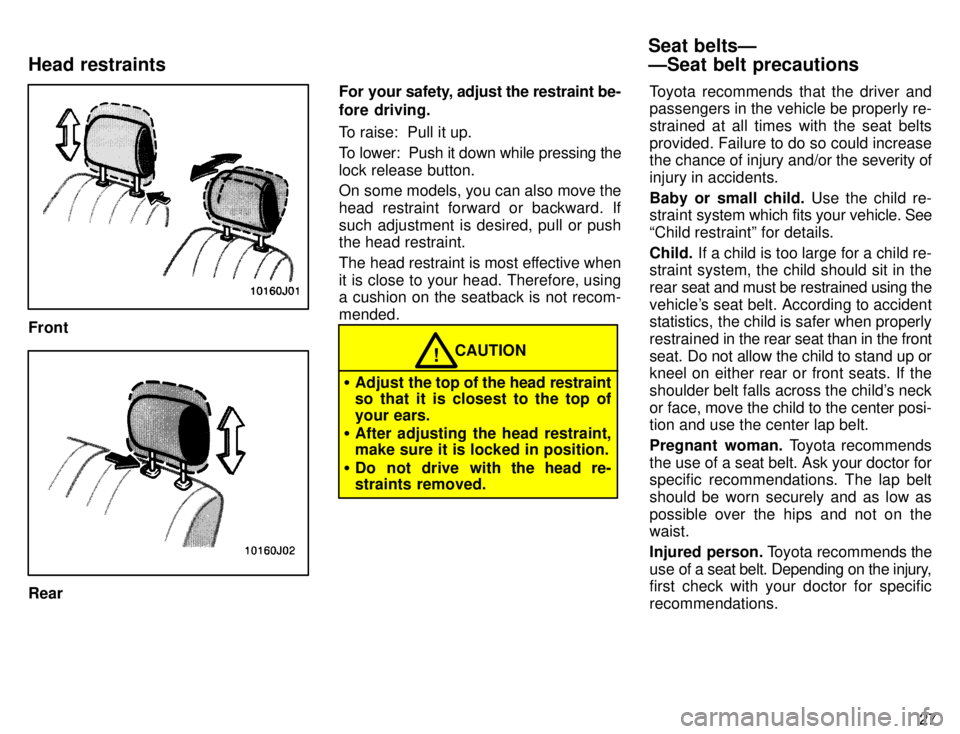
Front
RearFor your s
afety, adjust the restraint be-
fore driving.
To raise: Pull it up.
To lower: Push it down while pressing the lock release button.
On some models, you can also move the
head restraint forward or backward. If
such adjustment is desired, pull or push the head restraint.
The head restraint is most effective when
it is close to your head. Therefore, using a cushion on the seatback is not recom- mended.
CAUTION!
Adjust the top of the head restraint
so that it is closest to the top of
your ears.
After adjusting the head restraint,
make sure it is locked in position.
Do not drive with the head re-
straints removed. Toyota recommends that the driver and
passengers in the vehicle be properly re- strained at all times with the seat belts
provided. Failure to do so could increase
the chance of injury and/or the severity of
injury in accidents. Baby or small child.
Use the child re-
straint system which fits your vehicle. See
Child restraintº for details.Child. If a child is too large for a child re-
straint system, the child should sit in the rear seat and must be restrained using the
vehicle's seat belt. According to accident
statistics, the child is safer when properly
restrained in the rear seat than in the front
seat. Do not allow the child to stand up or
kneel on either rear or front seats. If the
shoulder belt falls across the child's neck
or face, move the child to the center posi- tion and use the center lap belt.
Pregnant woman. Toyota recommends
the use of a seat belt. Ask your doctor for
specific recommendations. The lap belt
should be worn securely and as low as
possible over the hips and not on the waist.
Injured person. Toyota recommends the
use of a seat belt. Depending on the injury,
first check with your doctor for specific recommendations.
Seat beltsÐ ÐSeat belt precautions
Head restraints
Page 30 of 217
28
CAUTION!
Persons should ride in their seats
properly wearing their seat belts
whenever the vehicle is moving.
Otherwise, they are much more like-
ly to suffer serious bodily injury in
the event of sudden braking or a col-lision.
When using the seat belts, observe
the following: Use the belt for only one person at
a time. Do not use a single belt for
two or more peopleÐeven chil- dren.
Avoid reclining the seatbacks too
much. The seat belts provide maxi-
mum protection when the seat-backs are in the upright position.(See the seat adjustment instruc- tions.)
Be careful not to damage the belt
webbing or hardware. Take care
that they do not get caught or
pinched in the seat or side doors.
Inspect the belt system periodical-
ly. Check for cuts, fraying, and
loose parts. Damaged parts should
be replaced. Do not disassemble or
modify the system.
Keep the belts clean and dry. If they
need cleaning, use a mild soap
solution or lukewarm water. Never
use bleach, dye, or abrasive clean-
ersÐthey may severely weaken the
belts.
Replace the belt assembly (includ-
ing bolts) If it has been used in a se-
vere impact. The entire assembly
should be replaced even if damage
is not obvious.
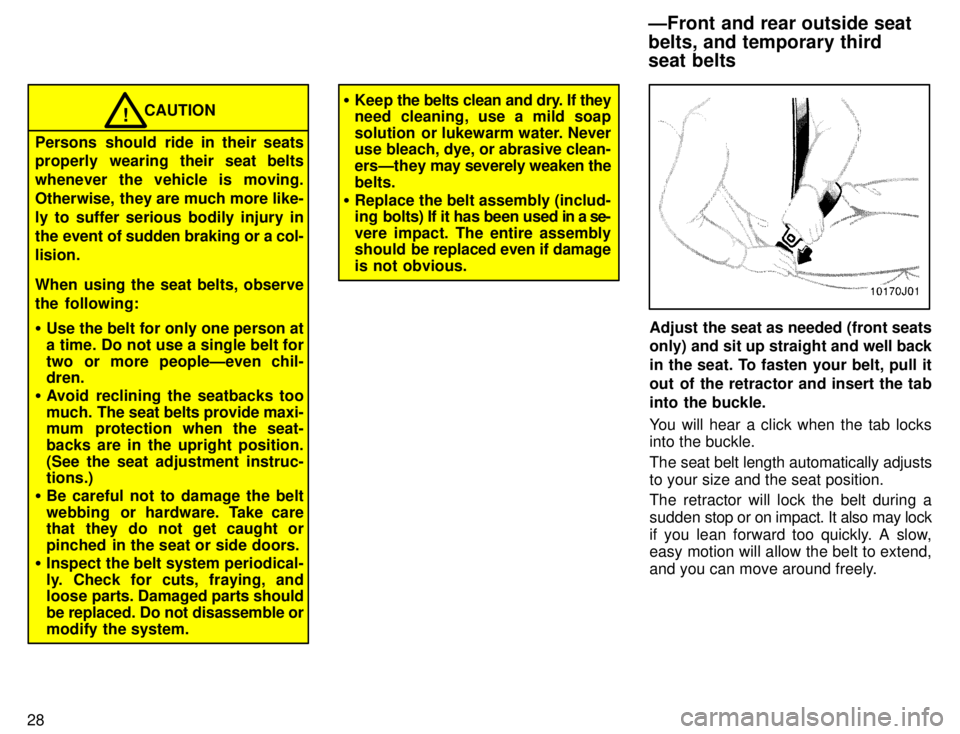
Adjust the seat as needed (front seats only) and sit up straight and well back
in the seat. To fasten your belt, pull it
out of the retractor and insert the tab
into the buckle.
You will hear a click when the tab locks into the buckle.
The seat belt length automatically adjusts
to your size and the seat position.
The retractor will lock the belt during a
sudden stop or on impact. It also may lock
if you lean forward too quickly. A slow, easy motion will allow the belt to extend,
and you can move around freely.
ÐFront and rear outside seat belts, and temporary third seat belts
Page 31 of 217
29
If the seat belt cannot be pulled out of the
retractor,
firmly pull the belt and release it.
You will then be able to smoothly pull the
belt out of the retractor.
When a passenger's shoulder belt is com-
pletely extended and is then retracted
even slightly, the belt is locked in that posi-
tion and cannot be extended. This feature
is used to hold the child restraint system
securely. (For details, see Child restraintº
in this chapter.) To free the belt again, fully
retract the belt and then pull the belt out
once more.
CAUTION!
After inserting the tab, make sure
the tab and buckle are locked and that the belt is not twisted.
Do not insert coins, clips, etc. in
the buckle as this may prevent you
from properly latching the tab andbuckle.
If the seat belt does not function
normally, i mmediately contact your
Toyota dealer.
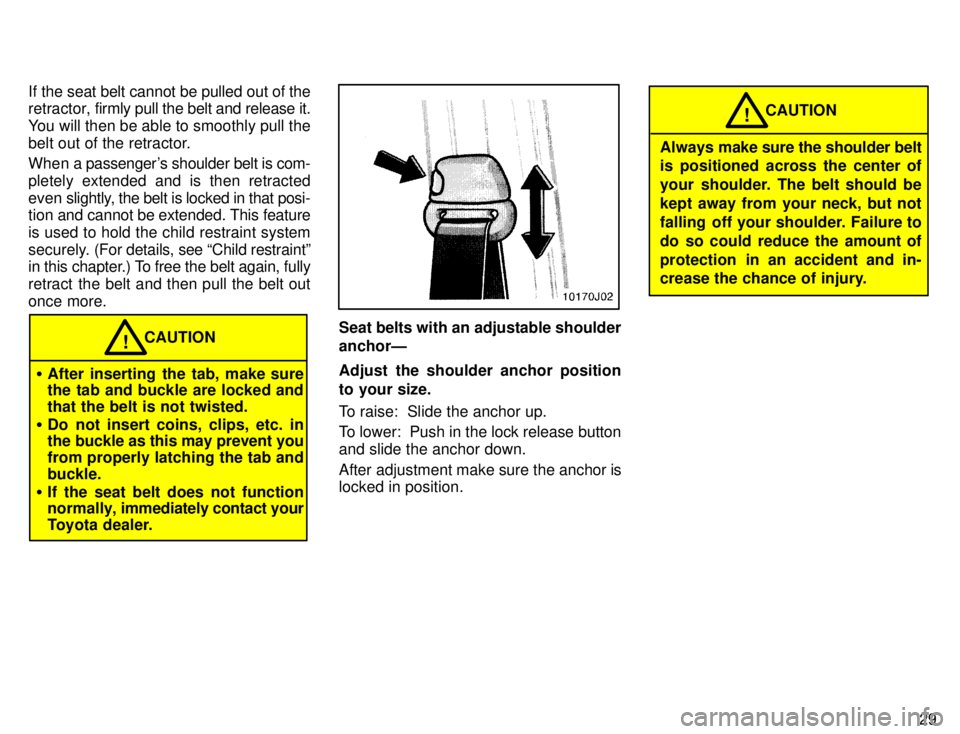
Seat belts with an adjustable shoulder anchorÐ
Adjust the shoulder anchor position
to your size.
To raise: Slide the anchor up.
To lower: Push in the lock release button
and slide the anchor down.
After adjustment make sure the anchor is
locked in position.
CAUTION!
Always make sure the shoulder belt
is positioned across the center of
your shoulder. The belt should be
kept away from your neck, but not
falling off your shoulder. Failure to
do so could reduce the amount of
protection in an accident and in-
crease the chance of injury.
Page 32 of 217
30
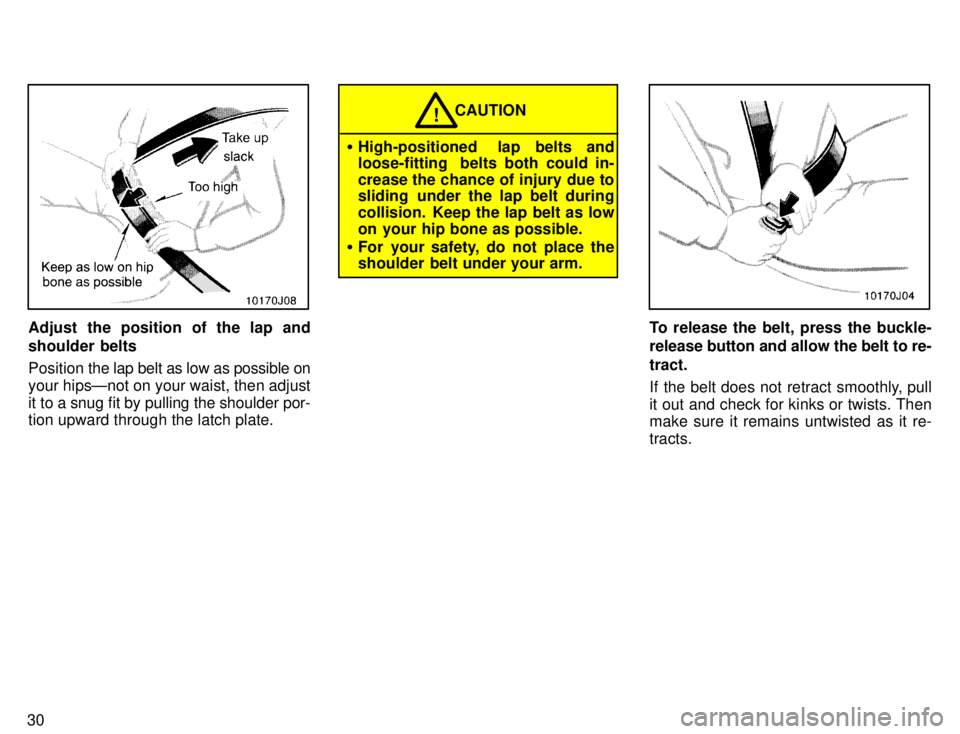
Adjust the position of the lap and
shoulder belts Position the lap belt as low as possible on
your hipsÐnot on your waist, then adjust
it to a snug fit by pulling the shoulder por- tion upward through the latch plate.
CAUTION!
High-positioned lap belts and
loose-fitting belts both could in-
crease the chance of injury due to
sliding under the lap belt during
collision. Keep the lap belt as low
on your hip bone as possible.
For your safety, do not place the
shoulder belt under your arm.
To release the belt, press the buckle-
release button and allow the belt to re- tract.
If the belt does not retract smoothly, pull
it out and check for kinks or twists. Then make sure it remains untwisted as it re- tracts.
Page 33 of 217
31
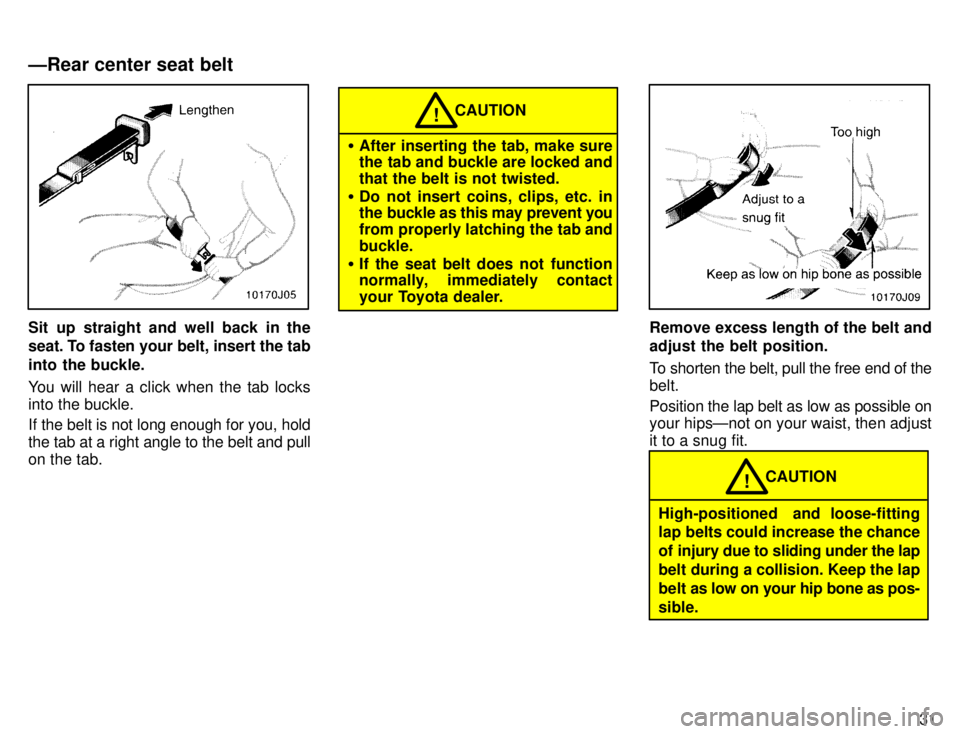
Sit up straight and well back in the
seat. To fasten your belt, insert the tab
into the buckle.
You will hear a click when the tab locks into the buckle.
If the belt is not long enough for you, hold the tab at a right angle to the belt and pull
on the tab.
CAUTION!
After inserting the tab, make sure
the tab and buckle are locked and that the belt is not twisted.
Do not insert coins, clips, etc. in
the buckle as this may prevent you
from properly latching the tab andbuckle.
If the seat belt does not function
normally, immediately contact
your Toyota dealer.
Remove excess length of the belt and adjust the belt position.
To shorten the belt, pull the free end of the belt. Position the lap belt as low as possible on your hipsÐnot on your waist, then adjust it to a snug fit.
CAUTION!
High-positioned and loose-fitting
lap belts could increase the chance
of injury due to sliding under the lap
belt during a collision. Keep the lap
belt as low on your hip bone as pos-
sible.
ÐRear center seat belt
Page 34 of 217
32
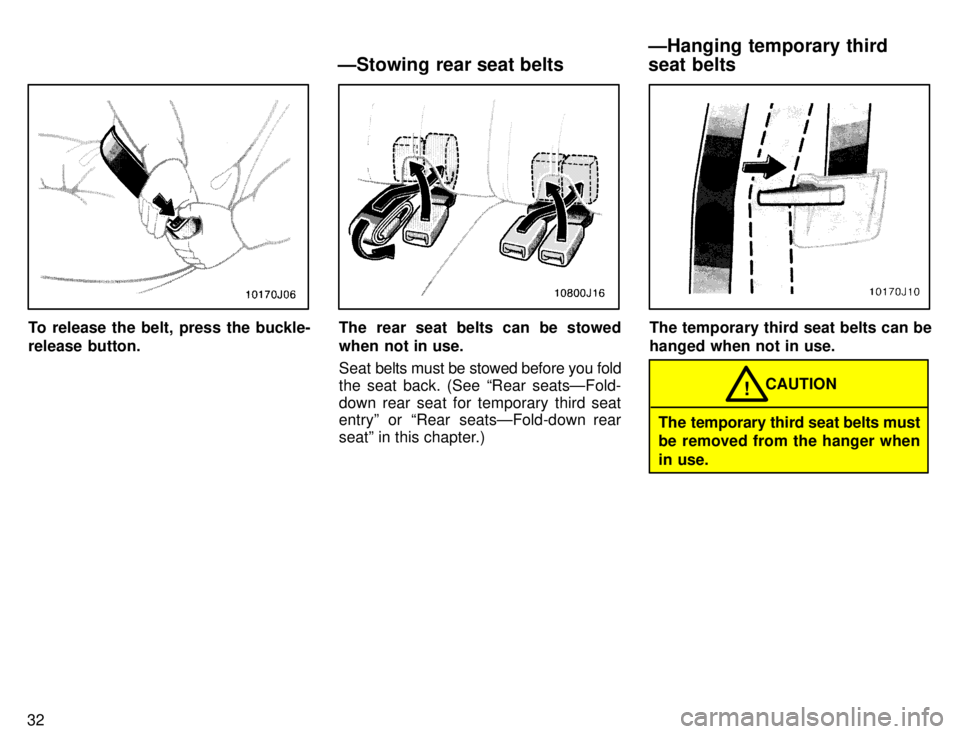
To release the belt, press the buckle-
release button.The rear seat belts can be stowed
when not in use.
Seat belts must be stowed before you fold
the seat back. (See Rear seatsÐFold-
down rear seat for temporary third seat
entryº or Rear seatsÐFold-down rear
seatº in this chapter.)The temporary third seat belts can be hanged when not in use.
CAUTION!
The temporary third seat belts must
be removed from the hanger when
in use.
ÐStowing rear seat belts
ÐHanging temporary thirdseat belts
Page 35 of 217

33
If your seat belt cannot be fastened se- curely because it is not long enough, a
personalized seat belt extender is avail-
able from your Toyota dealer free of charge.
Please contact your local Toyota dealer
so that the dealer can order the proper re-
quired length for the extender. Bring the heaviest
coat you expect to wear for prop-
er measurement and selection of length.
Additional ordering information is avail-
able at your Toyota dealer.
CAUTION!
When using the seat belt extender,
observe the following. Failure to
follow these instructions could re-
sult in less effectiveness of the seat
belt restraint system in case of ve-
hicle accident, increasing the
chance of personal injury. Never use the seat belt extender if
you can fasten the seat belt with- out it.
Remember that the extender pro-
vided for you may not be safe
when used on a different vehicle,
or for another person or at a d iffer-
ent seating position than the one
originally intended for.To connect the extender to the seat
belt, insert the tab into the seat belt
buckle so that the PRESSº signs onthe buckle-release buttons of the ex-
tender and the seat belt are both facing
outward as shown.
You will hear a click when the tab locks into the buckle.
When releasing the seatbelt, press on the
buckle-release button on the extender, not on the seat belt. This helps prevent
damage to the vehicle interior and extend-
er itself.
When not in use, remove the extender
and store in the vehicle for future use.
CAUTION!
After inserting the tab, make sure
the tab and buckle are locked and
that the seat belt extender is not twisted.
Do not insert coins, clips, etc. in
the buckle as this may prevent you
from properly latching the tab and buckle.
If the seat belt does not function
normally, immediately contact your
Toyota dealer.
ÐSeat belt extender