1996 PONTIAC BONNEVILLE maintenance
[x] Cancel search: maintenancePage 2 of 387
The 1996 Pontiac Bonneville Owner’s Manual
-
Seats and Restraint Systems ............................................................. 1-1
This section tells you how to use your seats and safety belts prop\
erly. It also explains the “SRS” system.
This section explains how to start and operate your Pontiac.
This section tells you how to adjust the ventilation and comfort co\
ntrols and how to operate your
audio system.
Here you’ll find helpful information and tips about the road\
and
how to drive under different conditions.
This section tells you what to do if you have a problem while driving, such as a flat tire or
overheated engine, etc.
Here the manual tells
you how to keep your Pontiac running properly and looking good.
This section tellp you when to perform vehicle maintenance and what \
fluids and lubricants to use.
This section tells you how to contact Pontiac for assistance and how to get service and \
owner publications.
It also gives you information on “Reporting Safety Defects”\
on page 8-9.
Here’s an alphabetical listing of almost every subject in this manual. You can use it to quickly find
something
you. want to read.
Features and Controls ..................... ; ............................................ 2-1
Comfort Controls and Audio Systems ...................................................... 3-1
. Your Driving and the Road .............................................................. 4-1
ProblemsontheRoad
.................................................................. 5-1
Service and Appearance Care.. .......................................................... 6-1
Maintenanceschedule......... .......................................................... 7-1
Customer Assistance Information ... .#. ................................................... 8-1
Index ........................................................................\
.......... 9-1
ProCarManuals.com
Page 28 of 387

0 Your vehicle is equipped with a crash sensing and
diagnostic module, which records information about
the air bag system. The module records information
about the readiness of the system, when the sensors
are activated and driver’s safety belt usage at deployment.
Let only qualified technicians work on your air bag
system. Improper service can mean that your air bag
system won’t work properly. See your dealer for
service.
NOTICE:
If you damage the cover for the driver’s or the
right front passenger’s air bag, they may not
work properly. You may have to replace the air
bag module in the steering wheel or both the air
bag module and the instrument panel for the
right front passenger’s air bag.
Do not open or
break the air bag covers.
Servicing Your Air Bag-Equipped Pontiac
Air bags affect how your Pontiac should be serviced.
There are parts of the air bag system in several places
around your vehicle. You don’t want the system to
inflate while someone is working
on your vehicle. Your
Pontiac dealer and the Bonneville Service Manual have
information about servicing your vehicle and the air bag
system.
To purchase a service manual, see “Service and
Owner Publications” in the Index.
For up to 10 seconds after the ignition key is
turned off and the battery is disconnected, an air
bag can still. inflate during improper service. You
can be injured if you are close to an air bag when
it inflates. Avoid wires wrapped with yellow tape
or yellow connectors. They are probably part
of
the air bag system. Be sure to ‘follow proper
service procedures,’and make sure the person
performing work for you is qualified to do
so.
The air bag system does not need regular maintenance.
ProCarManuals.com
Page 50 of 387

Safety Belt Extender
If the vehicle’s safety belt will fasten around you, you
should use it.
But
if a safety belt isn’t long enough to fasten, your
dealer
will order you an extender. It’s free. When you go
in to order it, take the heaviest coat you will wear,
so the
extender
will be long enough for you. The extender will
be just for you, and just for the seat
in your vehicle that
you choose. Don’t let someone else use it, and use it
only for the seat it is made to fit.
To wear it, just attach it
to the regular safety belt.
Checking Your Restraint Systems
Now and then, make sure the safety belt reminder light
and all your belts, buckles, latch plates, retractors and
anchorages are working properly. Look for any other
loose or damaged safety belt system parts.
If you see
anything that might keep
a safety belt system from
doing its
job, have it repaired.
Torn or frayed safety belts may not protect you in a
crash. They can rip apart under impact forces. If a belt is
tom or frayed, get a new one right away.
Also look for any opened OF broken air bag covers, and
have them repaired or replaced. (The
air bag system
does not need regular maintenance.)
i
Replacing Restraint System Parts After
a Crash
If you’ve had a crash, do you need new belts?
After a
very minor collision, nothing may be necessary.
But
if the belts were stretched, as they would be if worn
during a more severe crash, then you need new belts.
If b’elts are cut or damaged, replace them. Collision
damage also may mean you
will need to have safety belt
or
seat parts repaired or replaced. New parts and repairs
may be necessary even if the belt wasn’t being used at
the time
of the collision.
If your seat adjuster won’t work after a crash, the special
part
of the safety belt that goes through the seat to the
adjuster may need,to be replaced.
If
an air bag inflates, you’ll need to replace air bag
system parts, See the part
on the air bag system earlier in
this section.
ProCarManuals.com
Page 205 of 387
Parking on Hills
You really should not park your vehicle, with a trailer
attached,
on a hill. If something goes wrong, your rig
could start to move. People can be injured, and both
your vehicle and the trailer can be damaged.
But
if you ever have to park your rig on a hill, here’s
how to do it:
1. Apply your regular brakes, but don’t shift into
2. Have someone place chocks under the trailer wheels.
3. When the wheel chocks are in place, release the
regular brakes
mil the chocks absorb the load.
4. Reapply the regular brakes. Then apply your pa;rking
brake, and then shift to PdRK (P).
PARK (P) yet.
’ 5. Release the regular brakes.
~ When You Are Ready to Leave After
Parking on a Hill
1. Apply your regular brakes and hold the pedal
.down while
you:
Start your engine;
e Shift into a gear; and
Release the parking brake.
2. Let up on the brake pedal.
3. Drive slowly until the trailer is clear of the chocks.
4. Stop and have someone pick up and store the chocks.
Maintenance When Trailer Towing
Your vehicle will & service more often when you’re
pmg a trde~ See the Mainte~nance Schedule for more
on this. Things that are especially important in trailer
operation are .automatic
trande fluid (don’t overfill),
engine
oil, belts, cooling system and brake adjustment.
Each
of these is-covered in this manual, and the Index will
help you kd them quickly. If you’re tradering, it’s a good
idea to review these sections before you start your trip.
Check periodically to see that all hitch nuts and bolts
are tight.
4-38
ProCarManuals.com
Page 246 of 387

Section 6 Service and Appearance Care
Here you will find mformation about the care of your
Pontiac.
This section begins with service and fuel
information, and then it shows how to check important fluid
and lubricant levels. There is
also technical information
about your vehicle, and a part devoted to its appearance care.
Service
Your Pontiac dealer knows your vehicle best and wants
you
to be happy with it. We hope you’ll go to your
dealer for all your service needs. You’ll get genuine
GM
parts and G.M-trained and supported service people.
We hope you’ll want
to keep your GM vehicle all GM.
Genuine GM parts have one of these marks:
r-
Doing Your Own Service Work
If you want to do some of your own service work, you’ll
want to get the proper Pontiac Service Manual. It tells
you much more about how to service your Pontiac
than
this manual can. To order the proper service manual, see
“Service and Owner Publications” in the Index.
Your vehicle has an
air bag system. Before attempting to
do your own service work, see “Servicing Your Air
Bag-Equipped Pontiac” in the Index.
You should keep a record with all parts receipts and
list the mileage and the date
of any service work you
perform. See “Maintenance Record” in the Index.
6-1
ProCarManuals.com
Page 247 of 387

You can be injured and your vepicle could be
damaged
if‘ you try to do service work on a
vehicle without knowing enough about it.
Be sure you have sufficient .knowledge,
experience,
and the proper replacement
parts and tools before you attempt any
vehicle maintenance task.
Be sare to use the proper nuts, bolts and
other fasteners. %nglishs’ and “metric”
fasteners can be easily confhsed.
If you use
the wrong fasteners, parts can later break ‘
or fall off. You could be hurt. ,.
Fuel .. b ’ .’. ‘ _. . .. ,. --
-The 8th digit of your vehicle identification number .. I
(VIN) shows the code letter for your engine. You ,will
find the VIN at the top left of your instrument panel.
(See “Vehicle Identification Number”
m the Index.)
’Y i,
If you don’t have the 3.8L supercharged Code 1 engine,
use regular unleaded gasoline rated at 87 octane or higher.
If you have the 3.8L supercharged, Code 1 ehgine, use
premium unleaded gasoline rated at 9 1 octane or higher.
At a
minimum, the gasoline you use should meet
specifications
ASTM I34814 in the United States
and CGSB 3.5-M93 in Can& Improved gasoline
specifications have been developed by the American
Automobile Manufacturers Association
(AAMA) for
better vehicle performance and ehgine protection.
Gasolims meeting the AAMA specification could
provide
improved driveability and emission control
system protkction compared to other gasolines.
Be sure
the posted octane for premium is at least 91
(at least 89 for middle grade and 87 for regular), I€ the
octane is
less than 87, you may get a heavy knocking
noise when you drive. If it’s bad-enough, it can damage
your engine.
. If you have the 3.8L supercharged Code 1 engine, in an
emergency, you may be able to use a lower octane -- as
low as 87 -- if heavy knocking does not occur. If you
are using 91 or higher octane unleaded gasoline and you
still hear heavy knocking, YQW engine needs service.
/
ProCarManuals.com
Page 257 of 387
Supercharged Engine (Option)
Your Bonneville may have a 3800 Supercharged engine.
The supercharger is a device which is designed
to pump
more
air into the engine than it would normally use.
This air mixed with fuel, creates increased engine
power. Since the supercharger is a pump
and is driven
from an engine accessory drive belt, increased pressure
is available at all driving conditions.
The Powertrain Control Module (PCM), works with a
vacuum control to regulate the increased pressure
required
during specific driving conditions. When this
increased pressure or boost is not desired, such as during
idling
and light throttle cruising, the excess air that the
supercharger is pumping is routed through
a bypass.
All of these controls, working together provide high
performance character
and fuel efficiency in the
38010 V6 Supercharged engine.
The-power steering pump uses a remote reservoir
mounted on the throttle and cruise control cable bracket.
See “Maintenance Schedule”
in the Index for when you
should check the fluid.
I ’. .. ,- .. .. , . -. :? 1
Engine Oil
CHECK OIL
LEVEL
If the CHECK OIL
LEVEL light on the
instrument panel comes
on, it means
you need to check
your engine oil level
right away.
For more information, see “Check Oil Level Light”
in
the Index. You should check your engine oil level
regularly; this is
an added reminder.
It’s a good idea
to check your engine oil every time you
get fuel. In order to get an accurate reading, the oil must
be warm and the vehicle must be on level ground.
6-12
ProCarManuals.com
Page 263 of 387
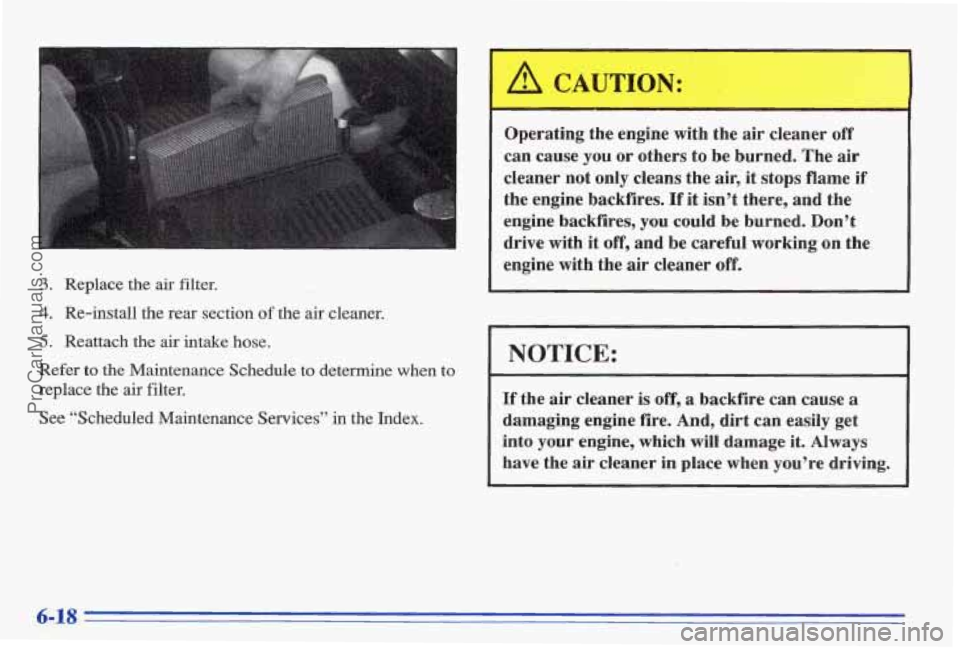
3. Replace the air filter.
4. Re-install the rear section of the air cleaner.
5. Reattach the air intake hose.
Refer to the Maintenance Schedule to determine when to
replace the air filter.
See “Scheduled Maintenance Services”
in the Index.
I
Operating the engine with the air cleaner off
can cause you or others to be burned. The air
cleaner not only cleans the air, it stops flame if
the engine backfires.
If it isn’t there, and the
engine backfires, you could be burned. Don’t
drive with it
off, and be careful working on the
engine with the air cleaner off.
NOTICE:
If the air cleaner is off, a backfire can cause a
damaging engine fire. And, dirt can easily get
into your engine, which will damage it. Always
have the
air cleaner in place when you’re driving.
,. . .. . ..
ProCarManuals.com