1996 NISSAN SENTRA Air cleaner
[x] Cancel search: Air cleanerPage 116 of 191

Most common factors contributing
to vehicle corrosion:
1. The accumulation of moisture-retaining
dirt and debris in body panel sections,
cavities, and other areas.
2. Damage to paint and other protective
coatings caused by gravel and stone
chips or minor traffic accidents.
Environmental factors influence the
rate of corrosion:
Moisture
Accumulation of sand, dirt and water on the
vehicle body underside can accelerate cor-
rosion. Wet floor coverings will not dry com-
pletely inside the vehicle, and should be
removed for drying to avoid floor panel
corrosion.
Relative humidity
Corrosion will be accelerated:
cIn areas of high relative humidity
cespecially in those areas where the tem-
peratures stay above freezing
cwhere atmospheric pollution existscwhere road salt is used
Temperature
A temperature increase accelerates the rate
of corrosion to those parts which are not
well ventilated.
Air pollution
Industrial pollution, the presence of salt in
the air in coastal areas, or heavy road salt
use accelerates the corrosion process.
Road salt also accelerates the disintegra-
tion of paint surfaces.To protect your vehicle from
corrosion:
cWash and wax your vehicle often to keep
the vehicle clean.
cAlways check for minor damage to the
paint and repair it as soon as possible.
cKeep drain holes at the bottom of the
doors open to avoid water accumulation.
cCheck the underbody for accumulation of
sand, dirt or salt. If present, wash with
water as soon as possible.
cNEVER remove dirt, sand or other
debris from the passenger compart-ment by washing it out with a hose.
Remove dirt with a vacuum cleaner or
broom.
cNever allow water or other liquids to
come in contact with electronic com-
ponents inside the vehicle.
CORROSION PROTECTION
6-5
ZX
Page 118 of 191

7 Do-it-yourself operations
Maintenance precautions ..................................... 7-2
Engine compartment check locations .................. 7-3
Engine cooling system ......................................... 7-5
Engine oil ............................................................ 7-8
Automatic transmission fluid .............................. 7-11
Power steering fluid............................................ 7-13
Brake fluid .......................................................... 7-13
Window washer fluid .......................................... 7-14
Battery ................................................................ 7-15
Drive belts .......................................................... 7-17
Spark plug replacement ..................................... 7-18
Air cleaner housing filter .................................... 7-19Wiper blades ...................................................... 7-20
Parking brake check........................................... 7-21
Brake pedal ........................................................ 7-21
Brake booster ..................................................... 7-22
Clutch pedal ....................................................... 7-23
Fuses .................................................................. 7-23
Light bulbs .......................................................... 7-25
Headlight aiming adjustment .............................. 7-26
Bulb replacement ............................................... 7-26
Wheels and tires ................................................ 7-32
ZX
Page 136 of 191
5. Fit the new plugs, one at a time, into the
spark plug socket and install them. Turn
each plug in several full turns by hand,
then tighten with a spark plug socket to
the correct torque. Do not overtighten.
Spark plug tightening torque:
14 to 22 ft-lb (20 to 29 N²m)
6. Holding the boot, re-connect each high
tension cable to its proper spark plug by
pushing it on until you feel a snap.
7. Re-install all brackets as necessary.
SR20DE Engine
Platinum-tipped spark plug
It is not necessary to replace the platinum-
tipped spark plugs as frequently as the
conventional type spark plugs since they
last much longer. Follow the maintenance
schedule, but do not reuse the spark plugs
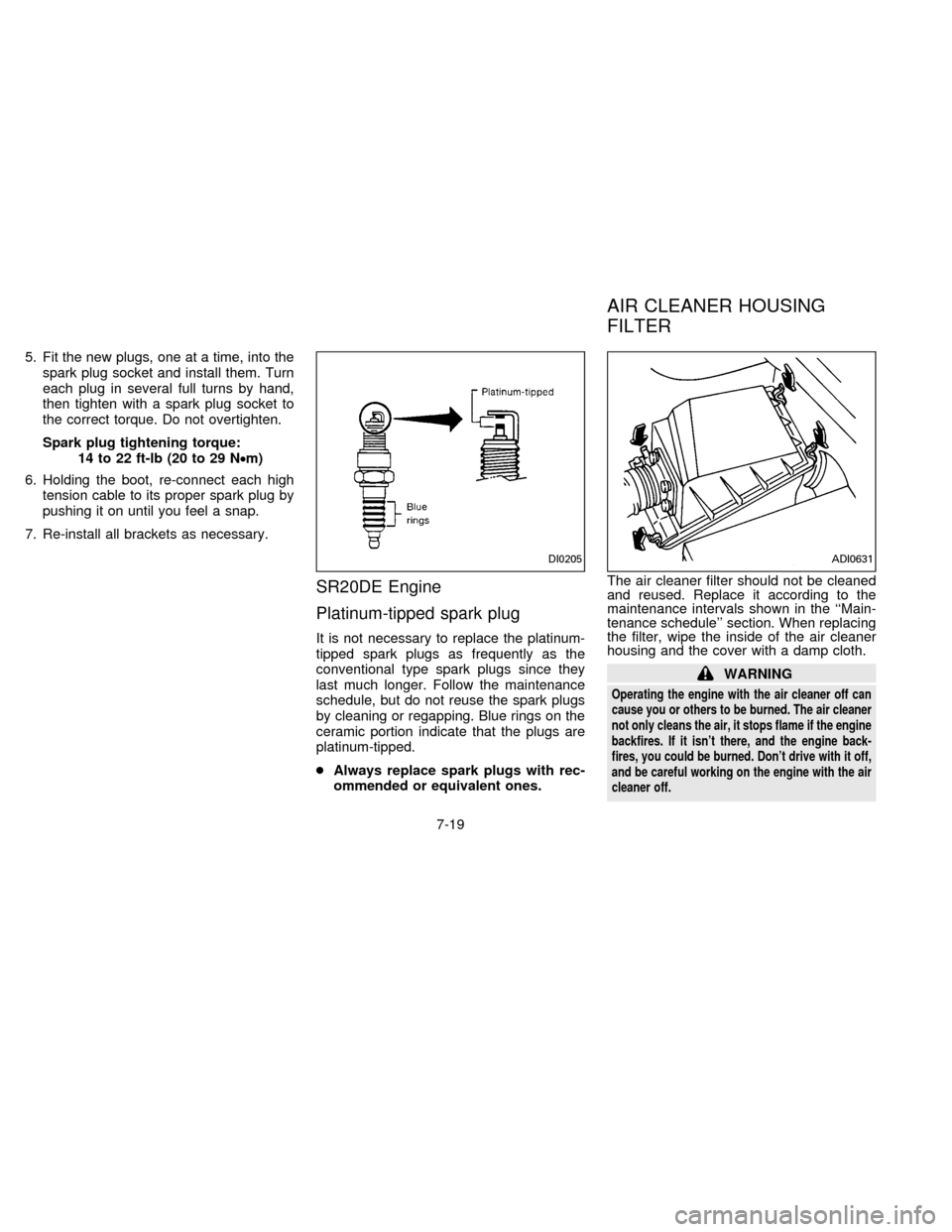
by cleaning or regapping. Blue rings on the
ceramic portion indicate that the plugs are
platinum-tipped.
cAlways replace spark plugs with rec-
ommended or equivalent ones.The air cleaner filter should not be cleaned
and reused. Replace it according to the
maintenance intervals shown in the ``Main-
tenance schedule'' section. When replacing
the filter, wipe the inside of the air cleaner
housing and the cover with a damp cloth.
WARNING
Operating the engine with the air cleaner off can
cause you or others to be burned. The air cleaner
not only cleans the air, it stops flame if the engine
backfires. If it isn't there, and the engine back-
fires, you could be burned. Don't drive with it off,
and be careful working on the engine with the air
cleaner off.
DI0205ADI0631
AIR CLEANER HOUSING
FILTER
7-19
ZX
Page 152 of 191
CAUTION
Do not install a deformed wheel or tire
even if it has been repaired. Such
wheels or tires could have structural
damage and could fail without warning.
Wheel balance
Unbalanced wheels may affect vehicle han-
dling and tire life. Even with regular use,
wheels can get out of balance. Therefore,
they should be balanced as required.
Wheel balance service should be performed
with the wheels off the vehicle. Spin balanc-
ing the front wheels on the vehicle could
lead to transmission damage.
Care of wheels
cWash the wheels when washing the ve-
hicle to maintain their appearance.
cClean the inner side of the wheels when
the wheel is changed or the underside of
the vehicle is washed.
cDo not use abrasive cleaners when
washing the wheels.
cInspect wheel rims regularly for dents or
corrosion. Such damage may cause loss
of pressure or poor seal at the tire bead.cNISSAN recommends waxing the road
wheels to protect against road salt in
areas where it is used during winter.
Spare tire (T-type spare tire)
Observe the following precautions if the T-type
spare tire must be used, otherwise your vehicle
could be damaged or involved in an accident.
CAUTION
cThe T-type spare tire should be used
only for emergency. It should be re-
placed by the standard tire at the first
opportunity.
cDrive carefully while the T-type spare
tire is installed.
Avoid sharp turns and abrupt braking
while driving.
cPeriodically check tire inflation pres-
sure, and always keep it at 60 psi (420
kPa, 4.2 bar).
cDo not drive your vehicle at speeds
faster than 50 MPH (80 km/h).
cDo not use tire chains on a T-type
spare tire. Tire chains will not fit
properly on the T-type spare tire and
may cause damage to the vehicle.cWhen driving on roads covered with
snow or ice, the T-type spare tire
should be used on the rear wheel and
the original tire used on the front
wheels (drive wheels). Use tire chains
only on the front two original tires.
cTire tread of the T-type spare tire will
wear at a faster rate than the original
tire. Replace the T-type spare tire as
soon as the tread wear indicators
appear.
cBecause the T-type spare tire is
smaller than the original tire, ground
clearance is reduced. To avoid dam-
age to the vehicle do not drive over
obstacles. Also do not drive the ve-
hicle through an automatic car wash
since the smaller tire may get caught
in the track.
cDo not use the T-type spare tire on
other vehicles.
cDo not use more than one T-type
spare tire at the same time.
cDo not tow a trailer while the T-type
spare tire is installed.
7-35
ZX
Page 159 of 191
![NISSAN SENTRA 1996 B14 / 4.G Owners Manual SCHEDULE 1
Abbreviations: R = Replace I = Inspect. Correct or replace if necessary. [ ]: At the mileage intervals only
MAINTENANCE OPERATIONMAINTENANCE INTERVAL
Perform at number of miles,
kilometers](/manual-img/5/599/w960_599-158.png "NISSAN SENTRA 1996 B14 / 4.G Owners Manual SCHEDULE 1
Abbreviations: R = Replace I = Inspect. Correct or replace if necessary. [ ]: At the mileage intervals only
MAINTENANCE OPERATIONMAINTENANCE INTERVAL
Perform at number of miles,
kilometers")
SCHEDULE 1
Abbreviations: R = Replace I = Inspect. Correct or replace if necessary. [ ]: At the mileage intervals only
MAINTENANCE OPERATIONMAINTENANCE INTERVAL
Perform at number of miles,
kilometers or months,
whichever comes first.Miles ý 1,000 3.75 7.5 11.25 15 18.75 22.5 26.25 30 33.75 37.5 41.25 45 48.75 52.5 56.25 60
(km ý 1,000) (6) (12) (18) (24) (30) (36) (42) (48) (54) (60) (66) (72) (78) (84) (90) (96)
Months 3 6 9 12 15 18 21 24 27 30 33 36 39 42 45 48
Emission control system maintenance
Drive belts See NOTE (1).I*
Air cleaner filter See NOTE (2). [R] [R]
Idle rpm (GA16DE engine)I* I*
Vapor linesI* I*
Fuel linesI* I*
Fuel filter See NOTE (3)*.
Engine coolant See NOTE (4)*.R*
Engine oilRRRRRRRRRRRRRRRR
Engine oil filter (Use Nissan PREMIUM type or equivalent)RRRRRRRRRRRRRRRR
Spark plugs (GA16DE engine)[R] [R]
(SR20DE engine) (PLATINUM-TIPPED type) See NOTE (5)*.[R]
Intake & exhaust valve clearance (GA16DE engine) See NOTE (6)*.
NOTE: (1) After 60,000 miles (96,000 km) or 48 months, inspect every 15,000 miles (24,000 km) or 12 months.
(2) If operating mainly in dusty conditions, more frequent maintenance may be required.
(3) If vehicle is operated under extremely adverse weather conditions or in areas where ambient temperatures are either extremely low or extremely
high, the filters might become clogged. In such an event, replace them immediately.
(4) After 60,000 miles (96,000 km) or 48 months, replace every 30,000 miles (48,000 km) or 24 months.
(5) Original equipment platinum-tipped plugs should be replaced at 60,000 miles (96,000 km). Conventional spark plugs can be used but should be
replaced at 30,000 miles (48,000 km) intervals. (See ``Technical and consumer Information'' section for details.)
(6) If valve noise increases, inspect valve clearance.
* Maintenance items and intervals with ``*'' are recommended by NISSAN for reliable vehicle operation. The owner need not perform such
maintenance in order to maintain the emission warranty or manufacturer recall liability. Other maintenance items and intervals are required.
8-6
ZX
Page 161 of 191
![NISSAN SENTRA 1996 B14 / 4.G Owners Manual SCHEDULE 2
Abbreviations: R = Replace I = Inspect. Correct or replace if necessary. [ ]: At the mileage intervals only
MAINTENANCE OPERATIONMAINTENANCE INTERVAL
Perform at number of miles,
kilometers](/manual-img/5/599/w960_599-160.png "NISSAN SENTRA 1996 B14 / 4.G Owners Manual SCHEDULE 2
Abbreviations: R = Replace I = Inspect. Correct or replace if necessary. [ ]: At the mileage intervals only
MAINTENANCE OPERATIONMAINTENANCE INTERVAL
Perform at number of miles,
kilometers")
SCHEDULE 2
Abbreviations: R = Replace I = Inspect. Correct or replace if necessary. [ ]: At the mileage intervals only
MAINTENANCE OPERATIONMAINTENANCE INTERVAL
Perform at number of miles,
kilometers or months, whichever comes first.Miles ý 1,000 7.5 15 22.5 30 37.5 45 52.5 60
(km ý 1,000) (12) (24) (36) (48) (60) (72) (84) (96)
Months 6 12 18 24 30 36 42 48
Emission control system maintenance
Drive belts See NOTE (1).I*
Air cleaner filter[R] [R]
Idle rpm (GA16DE engine)I* I*
Vapor linesI* I*
Fuel linesI* I*
Fuel filter See NOTE (2)*.
Engine coolant See NOTE (3)*.R*
Engine oilRRRRRRRR
Engine oil filter (Use Nissan PREMIUM type or equivalent)RRRRRRRR
Spark plugs (GA16DE engine)[R] [R]
(SR20DE engine) (PLATINUM-TIPPED type) See NOTE (4)*.[R]
Intake & exhaust valve clearance (GA16DE engine) See NOTE (5)*.
NOTE: (1) After 60,000 miles (96,000 km) or 48 months, inspect every 15,000 miles (24,000 km) or 12 months.
(2) If vehicle is operated under extremely adverse weather conditions or in areas where outside temperatures are either extremely low or extremely high, the
filters might become clogged. In such an event, replace them immediately.
(3) After 60,000 miles (96,000 km) or 48 months, replace every 30,000 miles (48,000 km) or 24 months.
(4) Original equipment platinum-tipped plugs should be replaced at 60,000 miles (96,000 km). Conventional spark plugs can be used but should be replaced
at 30,000 miles (48,000 km) intervals. (See ``Technical and consumer information'' section for details.)
(5) If valve noise increases, inspect valve clearance.
* Maintenance items and intervals with ``*'' are recommended by NISSAN for reliable vehicle operation. The owner need not perform such maintenance in
order to maintain the emission warranty or manufacturer recall liability. Other maintenance items and intervals are required.
8-8
ZX
Page 163 of 191

EXPLANATION OF MAINTE-
NANCE ITEMS
Additional information on the following
items with ``*'' is found in the ``Do-it-
yourself operations'' section.
Emission control system
maintenance
Drive belts*Check drive belts for wear,
fraying or cracking and also for proper ten-
sion. Replace the drive belts if found dam-
aged.
Air cleaner filterUnder normal driving con-
ditions, the air cleaner filter should be re-
placed in accordance with the maintenance
schedule. However, driving the vehicle in
dusty areas may cause more rapid clogging
of the element. Consequently, the element
may have to be replaced more frequently.
Idle rpmInspection and adjustment should
be made with a tachometer to ensure
accuracy.
Vapor linesCheck vapor lines and connec-
tions for failure or looseness. If leaks are
found, replace them.
Fuel linesCheck the fuel hoses, pipingand connections for leaks, looseness or
deterioration. Replace any parts if they are
damaged.
Fuel filterIf the vehicle is operated under
extremely adverse weather conditions or in
areas where ambient temperatures are ei-
ther extremely low or extremely high, the
filter might become clogged. In such an
event, replace the filter immediately.
Engine coolant*Drain and flush the cool-
ing system.
Engine oil & oil filter*Under normal driving
conditions, the engine oil and oil filter should
be replaced in accordance with the mainte-
nance schedule. However, under severe
driving conditions, they may have to be
replaced more frequently.
Spark plugs*Replace with new plugs hav-
ing the correct heat range.
Intake & exhaust valve clearanceCheck
and adjust the valve clearance.
Chassis and body maintenance
Brake lines & cablesCheck the brake lines
and hoses (including brake booster vacuum
hoses, connections & check valve) and
parking brake cables for proper attachment,leaks, cracks, chafing, abrasion, deteriora-
tion, etc.
Brake pads, discs, drums & linings
Check these and the other neighboring
brake components for wear, deterioration
and leaks. Under severe driving conditions,
they may have to be inspected more fre-
quently.
Manual & automatic transmission gear
oil*Check the oil level and visually inspect
for signs of leakage.
Under severe driving conditions, the oil
should be replaced at the specified interval.
Steering gear & linkage, axle & suspen-
sion parts, and drive shaft bootsCheck
for damage, looseness and leakage of oil or
grease. Under severe driving conditions,
more frequent inspection should be per-
formed.
Steering linkage ball joints & front sus-
pension ball jointsCheck the ball joints for
damage, looseness and grease leakage.
Exhaust systemVisually check the ex-
haust pipes, muffler, and hangers for proper
attachment, leaks, cracks, chafing, abra-
sion, deterioration, etc. Under severe
8-10
ZX
Page 168 of 191
FUEL RECOMMENDATION
All models are designed to operate on
unleaded gasoline with an octane rating
of at least 87 AKI (Anti-Knock Index)
(Research octane number 91).
CAUTION
Using a fuel other than that specified
could adversely affect the emission
control devices and systems, and could
also affect the warranty coverage.
Under no circumstances should a
leaded gasoline be used, since this will
damage the three way catalyst.
Reformulated Gasoline
Some fuel suppliers are now producing re-
formulated gasolines. These gasolines are
specially designed to reduce vehicle emis-
sions. NISSAN supports efforts towards
cleaner air and suggests that you use refor-
mulated gasoline when available.
Gasoline containing oxygenates
Some fuel suppliers sell gasoline containing
oxygenates such as ethanol, MTBE and
methanol with or without advertising theirpresence. Nissan does not recommend the
use of fuels of which the oxygenate content
and the fuel compatibility for your NISSAN
cannot be readily determined. If in doubt,
ask your service station manager.
If you use oxygenate-blend gasoline, please
take the following precautions as the usage
of such fuels may cause vehicle performance
problems and/or fuel system damage.
cThe fuel should be unleaded and have
an octane rating no lower than that
recommended for unleaded gasoline.
cIf an oxygenate-blend, excepting a
methanol blend, is used, it should
contain no more than 10% oxygenate.
(MTBE may, however, be added up to
15%.)
cIf a methanol blend is used, it should
contain no more than 5% methanol
(methyl alcohol, wood alcohol). It
should also contain a suitable amount
of appropriate cosolvents and corro-
sion inhibitors. If not properly formu-
lated with appropriate cosolvents and
corrosion inhibitors, such methanol
blends may cause fuel system dam-
age and/or vehicle performance prob-lems. At this time, sufficient data is
not available to ensure that all metha-
nol blends are suitable for use in Nis-
san vehicles.
If any driveability problems such as engine
stalling and hard hot starting are experi-
enced after using oxygenate-blend fuels,
immediately change to a non-oxygenate
fuel or a fuel with a low blend of MTBE.
Take care not to spill gasoline during
refueling. Gasoline containing oxygen-
ates can cause paint damage.
After Market Fuel Additives
NISSAN does not recommend the use of
any fuel additives (i.e., fuel injector cleaner,
octane booster, intake valve deposit remov-
ers, etc.) which are sold commercially. Many
of these additives intended for gum, varnish
or deposit removal may contain active sol-
vents or similar ingredients that can be
harmful to the fuel system and engine.
Octane rating tips
In most parts of North America, you should
use unleaded gasoline with an octane rating
of at least 87 AKI (Anti-Knock Index). How-
ever, you may use unleaded gasoline with
9-3
ZX