1996 NISSAN SENTRA Engine control
[x] Cancel search: Engine controlPage 161 of 191
![NISSAN SENTRA 1996 B14 / 4.G Owners Manual SCHEDULE 2
Abbreviations: R = Replace I = Inspect. Correct or replace if necessary. [ ]: At the mileage intervals only
MAINTENANCE OPERATIONMAINTENANCE INTERVAL
Perform at number of miles,
kilometers](/manual-img/5/599/w960_599-160.png "NISSAN SENTRA 1996 B14 / 4.G Owners Manual SCHEDULE 2
Abbreviations: R = Replace I = Inspect. Correct or replace if necessary. [ ]: At the mileage intervals only
MAINTENANCE OPERATIONMAINTENANCE INTERVAL
Perform at number of miles,
kilometers")
SCHEDULE 2
Abbreviations: R = Replace I = Inspect. Correct or replace if necessary. [ ]: At the mileage intervals only
MAINTENANCE OPERATIONMAINTENANCE INTERVAL
Perform at number of miles,
kilometers or months, whichever comes first.Miles ý 1,000 7.5 15 22.5 30 37.5 45 52.5 60
(km ý 1,000) (12) (24) (36) (48) (60) (72) (84) (96)
Months 6 12 18 24 30 36 42 48
Emission control system maintenance
Drive belts See NOTE (1).I*
Air cleaner filter[R] [R]
Idle rpm (GA16DE engine)I* I*
Vapor linesI* I*
Fuel linesI* I*
Fuel filter See NOTE (2)*.
Engine coolant See NOTE (3)*.R*
Engine oilRRRRRRRR
Engine oil filter (Use Nissan PREMIUM type or equivalent)RRRRRRRR
Spark plugs (GA16DE engine)[R] [R]
(SR20DE engine) (PLATINUM-TIPPED type) See NOTE (4)*.[R]
Intake & exhaust valve clearance (GA16DE engine) See NOTE (5)*.
NOTE: (1) After 60,000 miles (96,000 km) or 48 months, inspect every 15,000 miles (24,000 km) or 12 months.
(2) If vehicle is operated under extremely adverse weather conditions or in areas where outside temperatures are either extremely low or extremely high, the
filters might become clogged. In such an event, replace them immediately.
(3) After 60,000 miles (96,000 km) or 48 months, replace every 30,000 miles (48,000 km) or 24 months.
(4) Original equipment platinum-tipped plugs should be replaced at 60,000 miles (96,000 km). Conventional spark plugs can be used but should be replaced
at 30,000 miles (48,000 km) intervals. (See ``Technical and consumer information'' section for details.)
(5) If valve noise increases, inspect valve clearance.
* Maintenance items and intervals with ``*'' are recommended by NISSAN for reliable vehicle operation. The owner need not perform such maintenance in
order to maintain the emission warranty or manufacturer recall liability. Other maintenance items and intervals are required.
8-8
ZX
Page 163 of 191

EXPLANATION OF MAINTE-
NANCE ITEMS
Additional information on the following
items with ``*'' is found in the ``Do-it-
yourself operations'' section.
Emission control system
maintenance
Drive belts*Check drive belts for wear,
fraying or cracking and also for proper ten-
sion. Replace the drive belts if found dam-
aged.
Air cleaner filterUnder normal driving con-
ditions, the air cleaner filter should be re-
placed in accordance with the maintenance
schedule. However, driving the vehicle in
dusty areas may cause more rapid clogging
of the element. Consequently, the element
may have to be replaced more frequently.
Idle rpmInspection and adjustment should
be made with a tachometer to ensure
accuracy.
Vapor linesCheck vapor lines and connec-
tions for failure or looseness. If leaks are
found, replace them.
Fuel linesCheck the fuel hoses, pipingand connections for leaks, looseness or
deterioration. Replace any parts if they are
damaged.
Fuel filterIf the vehicle is operated under
extremely adverse weather conditions or in
areas where ambient temperatures are ei-
ther extremely low or extremely high, the
filter might become clogged. In such an
event, replace the filter immediately.
Engine coolant*Drain and flush the cool-
ing system.
Engine oil & oil filter*Under normal driving
conditions, the engine oil and oil filter should
be replaced in accordance with the mainte-
nance schedule. However, under severe
driving conditions, they may have to be
replaced more frequently.
Spark plugs*Replace with new plugs hav-
ing the correct heat range.
Intake & exhaust valve clearanceCheck
and adjust the valve clearance.
Chassis and body maintenance
Brake lines & cablesCheck the brake lines
and hoses (including brake booster vacuum
hoses, connections & check valve) and
parking brake cables for proper attachment,leaks, cracks, chafing, abrasion, deteriora-
tion, etc.
Brake pads, discs, drums & linings
Check these and the other neighboring
brake components for wear, deterioration
and leaks. Under severe driving conditions,
they may have to be inspected more fre-
quently.
Manual & automatic transmission gear
oil*Check the oil level and visually inspect
for signs of leakage.
Under severe driving conditions, the oil
should be replaced at the specified interval.
Steering gear & linkage, axle & suspen-
sion parts, and drive shaft bootsCheck
for damage, looseness and leakage of oil or
grease. Under severe driving conditions,
more frequent inspection should be per-
formed.
Steering linkage ball joints & front sus-
pension ball jointsCheck the ball joints for
damage, looseness and grease leakage.
Exhaust systemVisually check the ex-
haust pipes, muffler, and hangers for proper
attachment, leaks, cracks, chafing, abra-
sion, deterioration, etc. Under severe
8-10
ZX
Page 166 of 191

9 Technical and consumer information
Capacities and recommended
fuel/lubricants ....................................................... 9-2
Engine .................................................................. 9-9
Wheel/tire size .................................................... 9-10
Dimensions and weights .................................... 9-10
Registering your vehicle
in another country .............................................. 9-11
Vehicle identification........................................... 9-11
Installing license plate ........................................ 9-14
Trailer towing ...................................................... 9-15
Uniform tire quality grading ................................ 9-18
Emission control system warranty ..................... 9-19
Reporting safety defects (USA) ......................... 9-19
ZX
Page 168 of 191
FUEL RECOMMENDATION
All models are designed to operate on
unleaded gasoline with an octane rating
of at least 87 AKI (Anti-Knock Index)
(Research octane number 91).
CAUTION
Using a fuel other than that specified
could adversely affect the emission
control devices and systems, and could
also affect the warranty coverage.
Under no circumstances should a
leaded gasoline be used, since this will
damage the three way catalyst.
Reformulated Gasoline
Some fuel suppliers are now producing re-
formulated gasolines. These gasolines are
specially designed to reduce vehicle emis-
sions. NISSAN supports efforts towards
cleaner air and suggests that you use refor-
mulated gasoline when available.
Gasoline containing oxygenates
Some fuel suppliers sell gasoline containing
oxygenates such as ethanol, MTBE and
methanol with or without advertising theirpresence. Nissan does not recommend the
use of fuels of which the oxygenate content
and the fuel compatibility for your NISSAN
cannot be readily determined. If in doubt,
ask your service station manager.
If you use oxygenate-blend gasoline, please
take the following precautions as the usage
of such fuels may cause vehicle performance
problems and/or fuel system damage.
cThe fuel should be unleaded and have
an octane rating no lower than that
recommended for unleaded gasoline.
cIf an oxygenate-blend, excepting a
methanol blend, is used, it should
contain no more than 10% oxygenate.
(MTBE may, however, be added up to
15%.)
cIf a methanol blend is used, it should
contain no more than 5% methanol
(methyl alcohol, wood alcohol). It
should also contain a suitable amount
of appropriate cosolvents and corro-
sion inhibitors. If not properly formu-
lated with appropriate cosolvents and
corrosion inhibitors, such methanol
blends may cause fuel system dam-
age and/or vehicle performance prob-lems. At this time, sufficient data is
not available to ensure that all metha-
nol blends are suitable for use in Nis-
san vehicles.
If any driveability problems such as engine
stalling and hard hot starting are experi-
enced after using oxygenate-blend fuels,
immediately change to a non-oxygenate
fuel or a fuel with a low blend of MTBE.
Take care not to spill gasoline during
refueling. Gasoline containing oxygen-
ates can cause paint damage.
After Market Fuel Additives
NISSAN does not recommend the use of
any fuel additives (i.e., fuel injector cleaner,
octane booster, intake valve deposit remov-
ers, etc.) which are sold commercially. Many
of these additives intended for gum, varnish
or deposit removal may contain active sol-
vents or similar ingredients that can be
harmful to the fuel system and engine.
Octane rating tips
In most parts of North America, you should
use unleaded gasoline with an octane rating
of at least 87 AKI (Anti-Knock Index). How-
ever, you may use unleaded gasoline with
9-3
ZX
Page 174 of 191
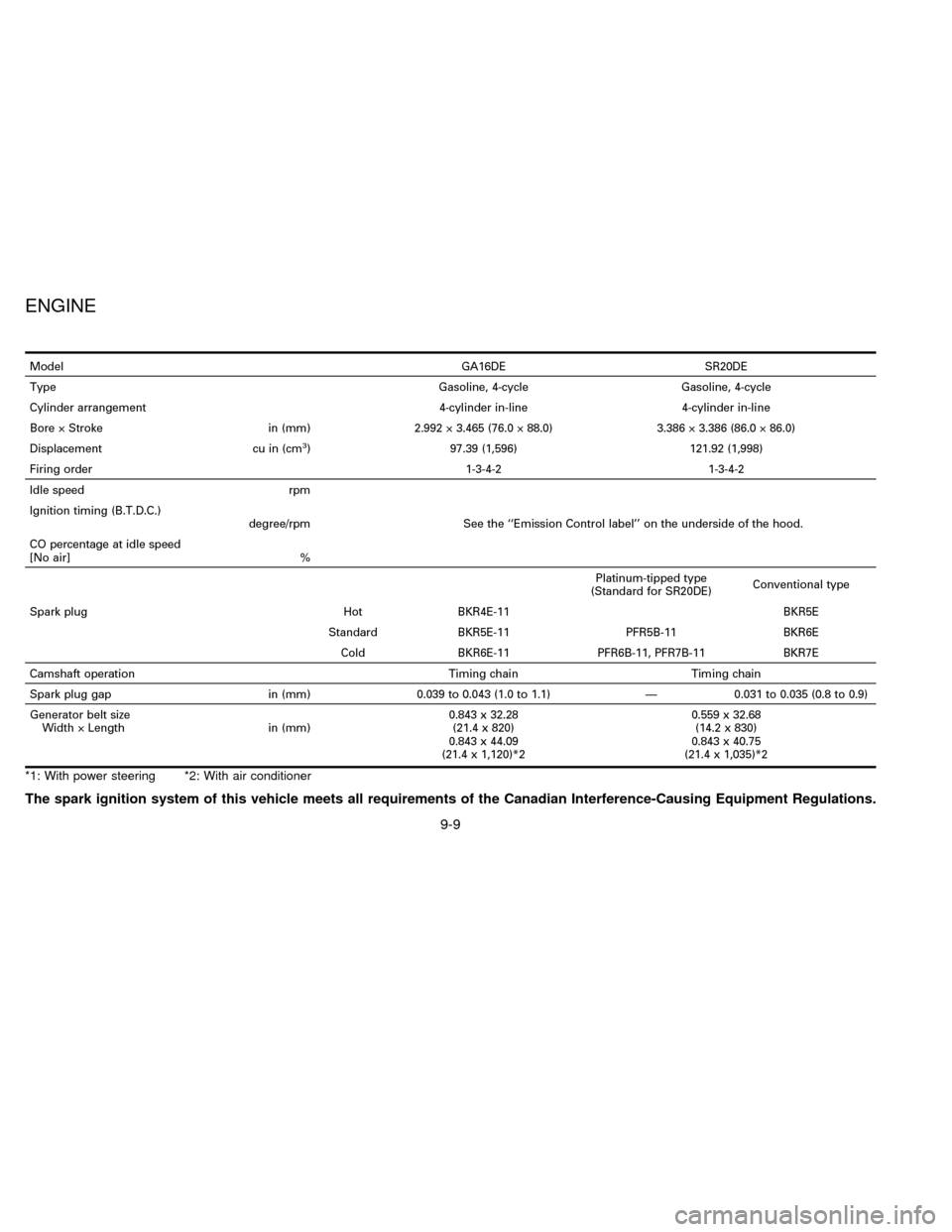
ModelGA16DE SR20DE
TypeGasoline, 4-cycle Gasoline, 4-cycle
Cylinder arrangement 4-cylinder in-line 4-cylinder in-line
Bore ý Stroke in (mm) 2.992 ý 3.465 (76.0 ý 88.0) 3.386 ý 3.386 (86.0 ý 86.0)
Displacement cu in (cm
3) 97.39 (1,596) 121.92 (1,998)
Firing order1-3-4-2 1-3-4-2
Idle speed rpm
See the ``Emission Control label'' on the underside of the hood. Ignition timing (B.T.D.C.)
degree/rpm
CO percentage at idle speed
[No air] %
Platinum-tipped type
(Standard for SR20DE)Conventional type
Spark plug Hot BKR4E-11 BKR5E
Standard BKR5E-11 PFR5B-11 BKR6E
Cold BKR6E-11 PFR6B-11, PFR7B-11 BKR7E
Camshaft operation Timing chain Timing chain
Spark plug gap in (mm) 0.039 to 0.043 (1.0 to 1.1) Ð 0.031 to 0.035 (0.8 to 0.9)
Generator belt size
Width ý Length in (mm)0.843 x 32.28
(21.4 x 820)
0.843 x 44.09
(21.4 x 1,120)*20.559 x 32.68
(14.2 x 830)
0.843 x 40.75
(21.4 x 1,035)*2
*1: With power steering *2: With air conditioner
The spark ignition system of this vehicle meets all requirements of the Canadian Interference-Causing Equipment Regulations.
ENGINE
9-9
ZX
Page 176 of 191

When planning to travel in another coun-
try,you should first find out if the fuel
available is suitable for your vehicle's en-
gine.
Using fuel with too low an octane/cetane
rating may cause engine damage. All gaso-
line vehicles must be operated with un-
leaded engine gasoline. Therefore, avoid
taking your vehicle to areas where appropri-
ate fuel is not available.
When transferring the registration of
your vehicle to another country, state,
province or district,it may be necessary to
modify the vehicle to meet local laws and
regulations.
The laws and regulations for motor vehicle
emission control and safety standards vary
according to the country, state, province or
district; therefore, vehicle specifications
may differ.
When any vehicle is to be taken into
another country, state, province or dis-
trict and registered, its modifications,
transportation, and registration are the
responsibility of the user. NISSAN is not
responsible for any inconvenience that
may result.
VEHICLE IDENTIFICATION NUM-
BER PLATE
The vehicle identification number plate is
attached to the top of the instrument panel
on the driver's side. This number is the
identification for your vehicle and is used in
the vehicle registration.
VEHICLE IDENTIFICATION
NUMBER (Chassis number)
The chassis number is stamped as shown.
TI1050MATI0605
REGISTERING YOUR VEHICLE
IN ANOTHER COUNTRYVEHICLE IDENTIFICATION
9-11
ZX
Page 180 of 191
re-weigh your vehicle to determine if
either GVWR or GAWR for your vehicle
is exceeded. If GVWR is exceeded, re-
move cargo as necessary. If either the
front or rear GAWR is exceeded, shift the
load or remove cargo as necessary.
Loading Tips
cThe GVW must not exceed GVWR or
GAWR as specified on the F.M.V.S.S.
Certification Label.
cDo not load the front and rear axle to the
GAWR. Doing so will exceed the GVWR.
CAUTION
cProperly secure all cargo to help
prevent it from sliding or shifting. In
a sudden stop or collision, unse-
cured cargo could cause personal
injury.
cDo not load your vehicle any heavier
than the GVWR or the maximum
front and rear GAWRs. If you do,
parts on your vehicle can break, or it
can change the way your vehicle
handles. This could result in loss of
control and cause personal injury.cOverloading can shorten the life of
your vehicle. Failures caused by
overloading are not covered by your
warranty.
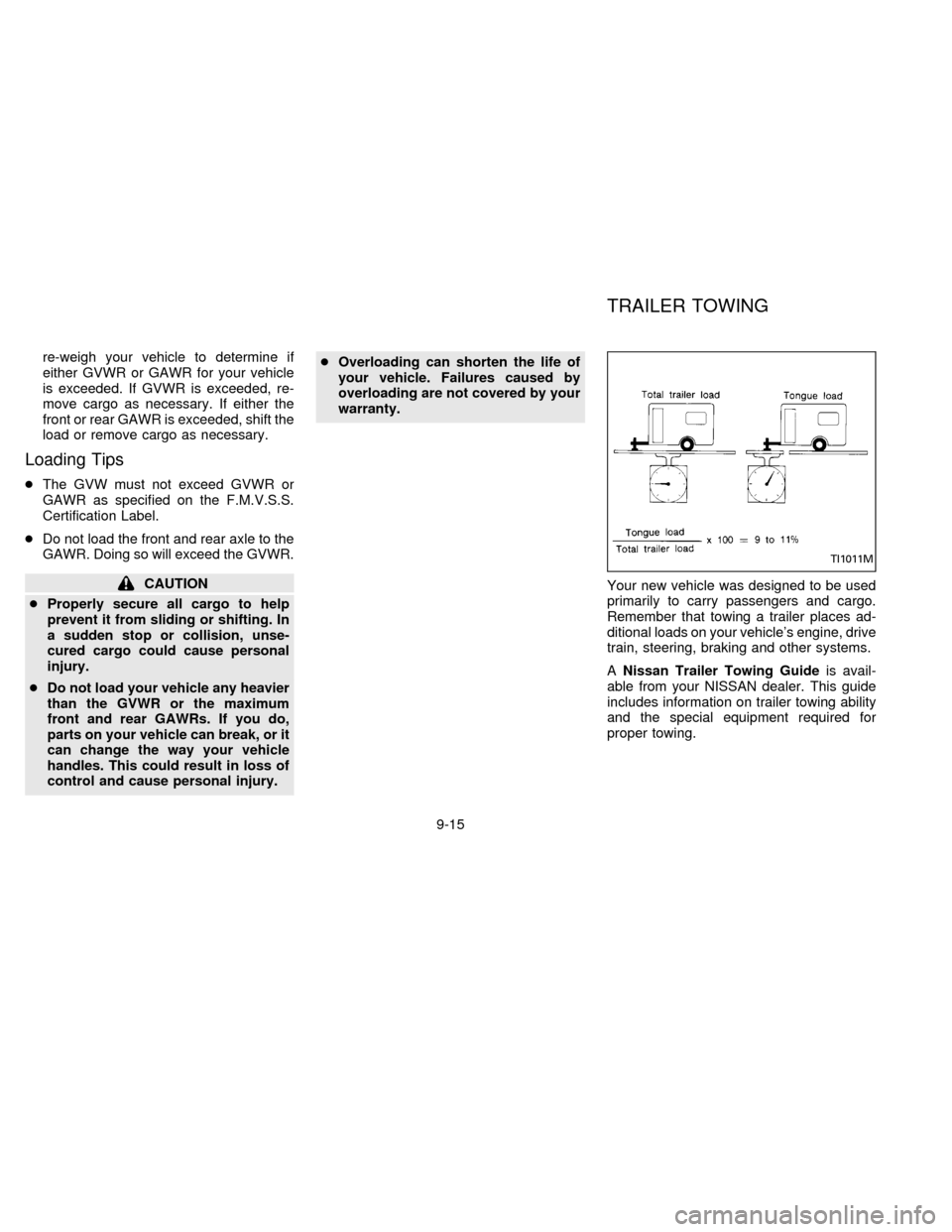
Your new vehicle was designed to be used
primarily to carry passengers and cargo.
Remember that towing a trailer places ad-
ditional loads on your vehicle's engine, drive
train, steering, braking and other systems.
ANissan Trailer Towing Guideis avail-
able from your NISSAN dealer. This guide
includes information on trailer towing ability
and the special equipment required for
proper towing.
TI1011M
TRAILER TOWING
9-15
ZX
Page 183 of 191
cWhen going down a hill, shift into a lower
gear and use the engine braking effect.
When ascending a long grade, down-
shift the transmission to a lower gear
and reduce speed to reduce chances of
engine overloading and/or overheating.
c
If the engine temperature coolant rises to
an extremely high temperature when the
air conditioning system is on, turn off the
air conditioner. Coolant heat can be addi-
tionally vented by opening the windows,
switching the fan control to high and set-
ting the temperature control to the HOT
position.
cTrailer towing requires more fuel than
normal circumstances.
cAvoid towing a trailer for your vehicle's
first 500 miles (800 km).
cHave your vehicle serviced more often
than at intervals specified in the recom-
mended Maintenance Schedule.
cWhen making a turn, your trailer wheels
will be closer to the inside of the turn
than your vehicle wheels. To compen-
sate for this, make a larger than normal
turning radius during the turn.cCrosswinds and rough roads adversely
affect vehicle/trailer handling, possibly
causing vehicle sway. When being
passed by larger vehicles, be prepared
for possible changes in crosswinds that
could affect vehicle handling. If swaying
does occur, firmly grip the steering
wheel, steer straight ahead, and imme-
diately (but gradually) reduce vehicle
speed. This combination helps to stabi-
lize the vehicle. Never increase speed.
cBe careful when passing other vehicles.
Passing while towing a trailer requires
considerably more distance than normal
passing. Remember the length of the
trailer must also pass the other vehicle
before you can safely change lanes.
cTo maintain engine braking efficiency
and electrical charging performance, do
not use fifth gear (manual transmission)
or overdrive (automatic transmission).
cAvoid holding the brake pedal down too
long or too frequently. This could cause
the brakes to overheat, resulting in re-
duced braking efficiency.
When towing a trailer, change the oil in
the transmission more frequently.
See the Maintenance Schedule.DOT Quality Grades: All passenger car tires
must conform to Federal Safety Require-
ments in addition to these grades.
Treadwear
Treadwear grade is a comparative rating
based on tire wear rate when tested under
controlled conditions on specified govern-
ment test courses. For example, a tire
graded 150 would wear one and a half
(1-1/2) times as well on the government
course as a tire graded 100. However,
relative tire performance depends on actual
driving conditions, and may vary signifi-
cantly from the norm due to variations in
driving habits, service practices and differ-
ences in road characteristics and climate.
Traction A, B and C
Traction grades are A (the highest), B and C.
They represent a tire's ability to stop on wet
pavement as measured under controlled con-
ditions, on specified government test sur-
faces of asphalt and concrete. A tire marked
with a C may have poor traction performance.
WARNING
The traction grade assigned to your
vehicle tires is based on straight line
UNIFORM TIRE QUALITY
GRADING
9-18
ZX