Page 36 of 191
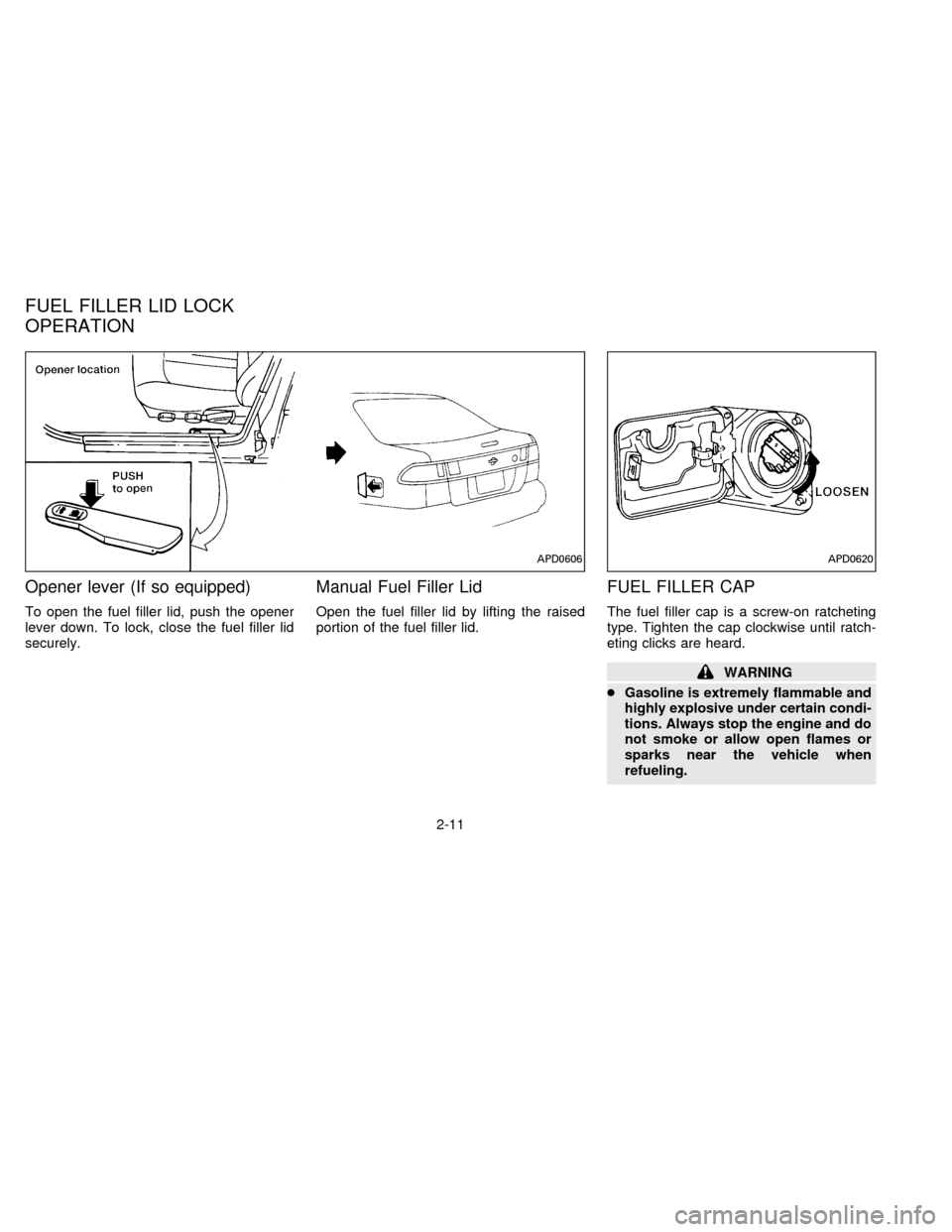
Opener lever (If so equipped)
To open the fuel filler lid, push the opener
lever down. To lock, close the fuel filler lid
securely.
Manual Fuel Filler Lid
Open the fuel filler lid by lifting the raised
portion of the fuel filler lid.
FUEL FILLER CAP
The fuel filler cap is a screw-on ratcheting
type. Tighten the cap clockwise until ratch-
eting clicks are heard.
WARNING
cGasoline is extremely flammable and
highly explosive under certain condi-
tions. Always stop the engine and do
not smoke or allow open flames or
sparks near the vehicle when
refueling.
APD0606APD0620
FUEL FILLER LID LOCK
OPERATION
2-11
ZX
Page 38 of 191
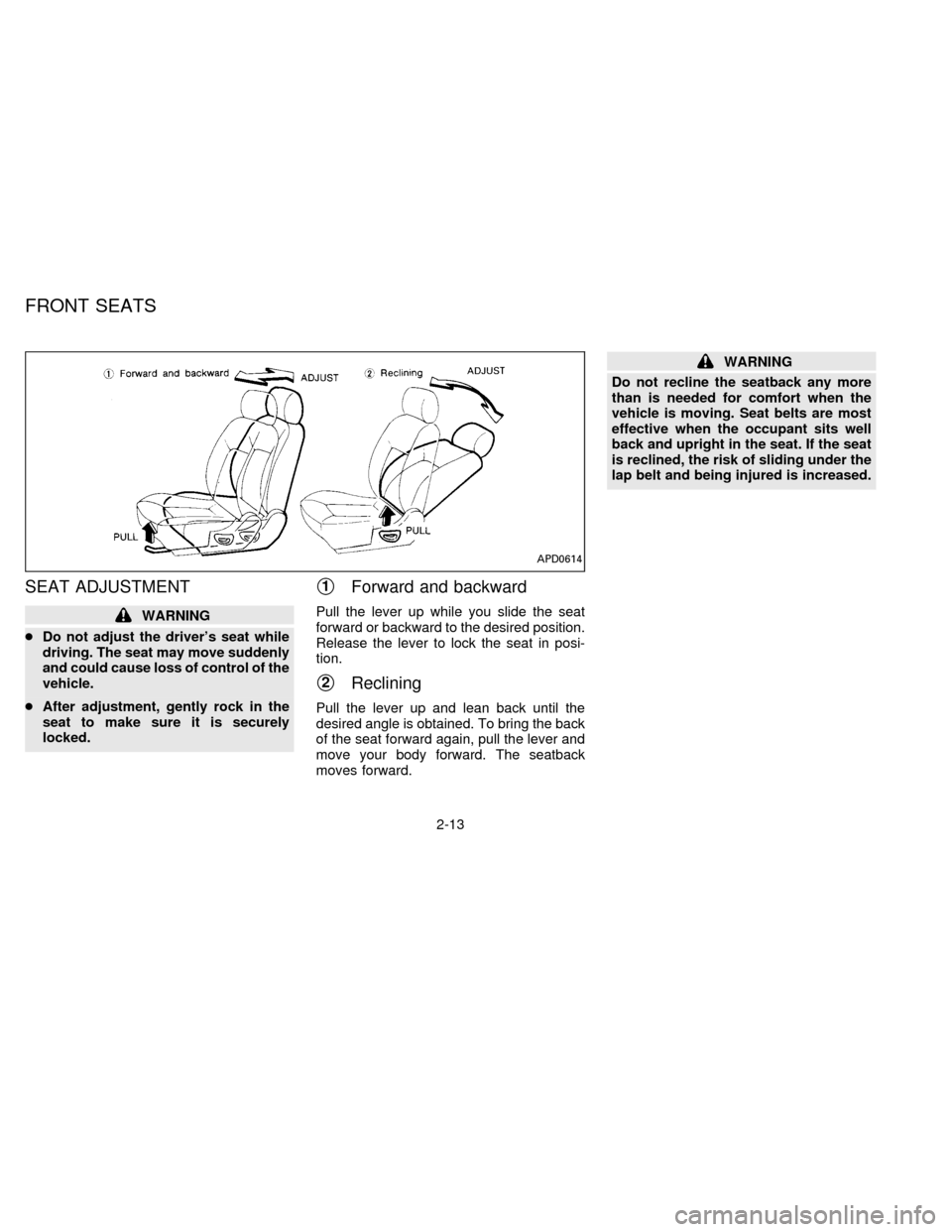
SEAT ADJUSTMENT
WARNING
cDo not adjust the driver's seat while
driving. The seat may move suddenly
and could cause loss of control of the
vehicle.
cAfter adjustment, gently rock in the
seat to make sure it is securely
locked.
s1Forward and backward
Pull the lever up while you slide the seat
forward or backward to the desired position.
Release the lever to lock the seat in posi-
tion.
s2Reclining
Pull the lever up and lean back until the
desired angle is obtained. To bring the back
of the seat forward again, pull the lever and
move your body forward. The seatback
moves forward.
WARNING
Do not recline the seatback any more
than is needed for comfort when the
vehicle is moving. Seat belts are most
effective when the occupant sits well
back and upright in the seat. If the seat
is reclined, the risk of sliding under the
lap belt and being injured is increased.
APD0614
FRONT SEATS
2-13
ZX
Page 39 of 191
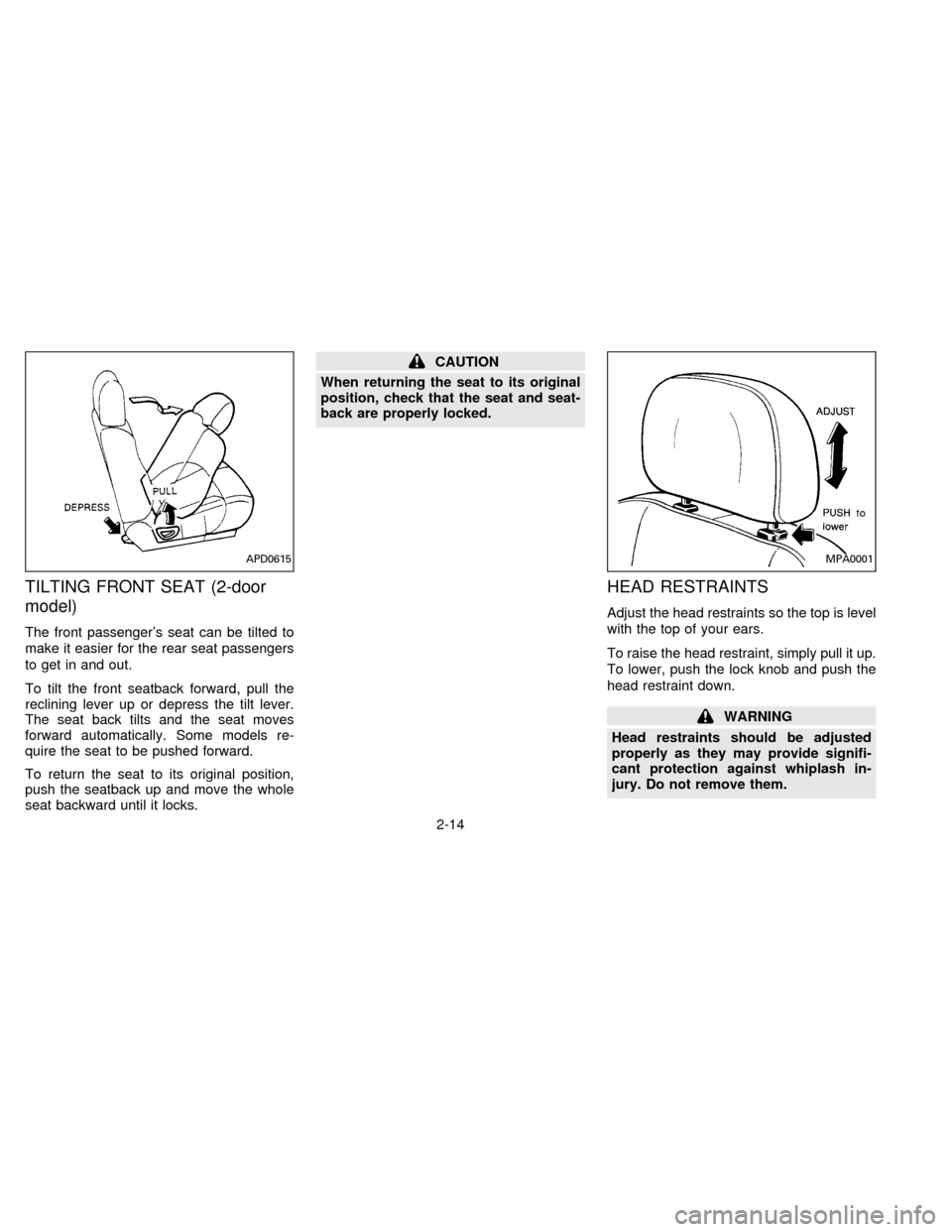
TILTING FRONT SEAT (2-door
model)
The front passenger's seat can be tilted to
make it easier for the rear seat passengers
to get in and out.
To tilt the front seatback forward, pull the
reclining lever up or depress the tilt lever.
The seat back tilts and the seat moves
forward automatically. Some models re-
quire the seat to be pushed forward.
To return the seat to its original position,
push the seatback up and move the whole
seat backward until it locks.
CAUTION
When returning the seat to its original
position, check that the seat and seat-
back are properly locked.
HEAD RESTRAINTS
Adjust the head restraints so the top is level
with the top of your ears.
To raise the head restraint, simply pull it up.
To lower, push the lock knob and push the
head restraint down.
WARNING
Head restraints should be adjusted
properly as they may provide signifi-
cant protection against whiplash in-
jury. Do not remove them.
APD0615MPA0001
2-14
ZX
Page 40 of 191
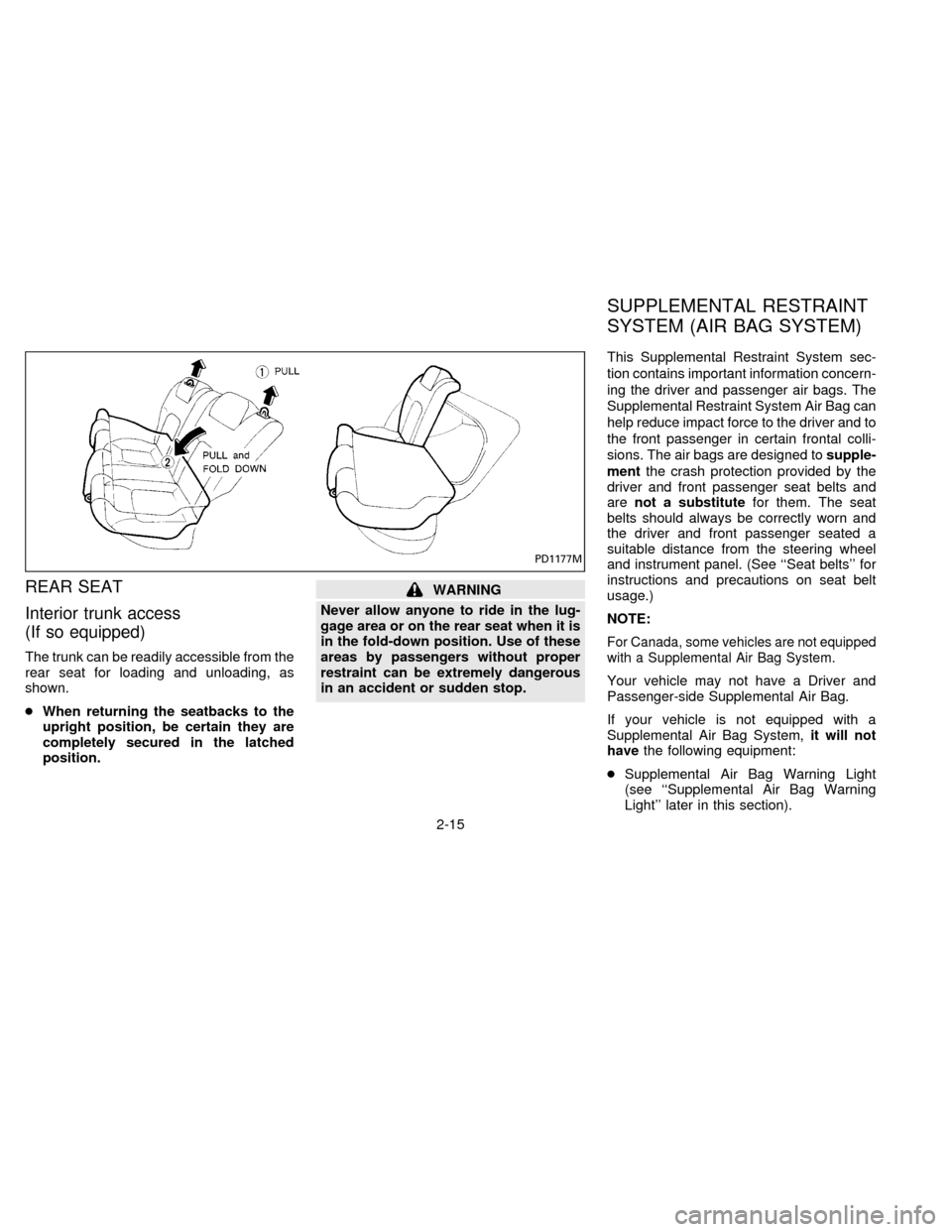
REAR SEAT
Interior trunk access
(If so equipped)
The trunk can be readily accessible from the
rear seat for loading and unloading, as
shown.
cWhen returning the seatbacks to the
upright position, be certain they are
completely secured in the latched
position.
WARNING
Never allow anyone to ride in the lug-
gage area or on the rear seat when it is
in the fold-down position. Use of these
areas by passengers without proper
restraint can be extremely dangerous
in an accident or sudden stop.This Supplemental Restraint System sec-
tion contains important information concern-
ing the driver and passenger air bags. The
Supplemental Restraint System Air Bag can
help reduce impact force to the driver and to
the front passenger in certain frontal colli-
sions. The air bags are designed tosupple-
mentthe crash protection provided by the
driver and front passenger seat belts and
arenot a substitutefor them. The seat
belts should always be correctly worn and
the driver and front passenger seated a
suitable distance from the steering wheel
and instrument panel. (See ``Seat belts'' for
instructions and precautions on seat belt
usage.)
NOTE:
For Canada, some vehicles are not equipped
with a Supplemental Air Bag System.
Your vehicle may not have a Driver and
Passenger-side Supplemental Air Bag.
If your vehicle is not equipped with a
Supplemental Air Bag System,it will not
havethe following equipment:
cSupplemental Air Bag Warning Light
(see ``Supplemental Air Bag Warning
Light'' later in this section).
PD1177M
SUPPLEMENTAL RESTRAINT
SYSTEM (AIR BAG SYSTEM)
2-15
ZX
Page 41 of 191
cDriver Supplemental Air Bag (see
``Meters and Gauges'' in the ``Instru-
ments and controls'' section).
cPassenger-side Supplemental Air Bag
(see ``Meters and Gauges'' in the ``Instru-
ments and controls'' section).
cSupplemental Restraint System Warning
Labels (see ``Warning Labels'' later in
this section).
Every person who drives or rides in this
vehicle should use a seat belt at all times.
Children should be in appropriate child re-
straints (see ``Seat belts'' and ``Child Re-
straints for Infants and Small Children'' later
in this section).
The supplemental air bags operate only
when the ignition switch is in the ON or
START position.WARNING
The supplemental air bags ordinarily
will not inflate in the event of a side
impact, rear impact, roll over, or lower
severity frontal collision; so always
wear your seat belts to help reduce the
risk or severity of injury in various
kinds of accidents.
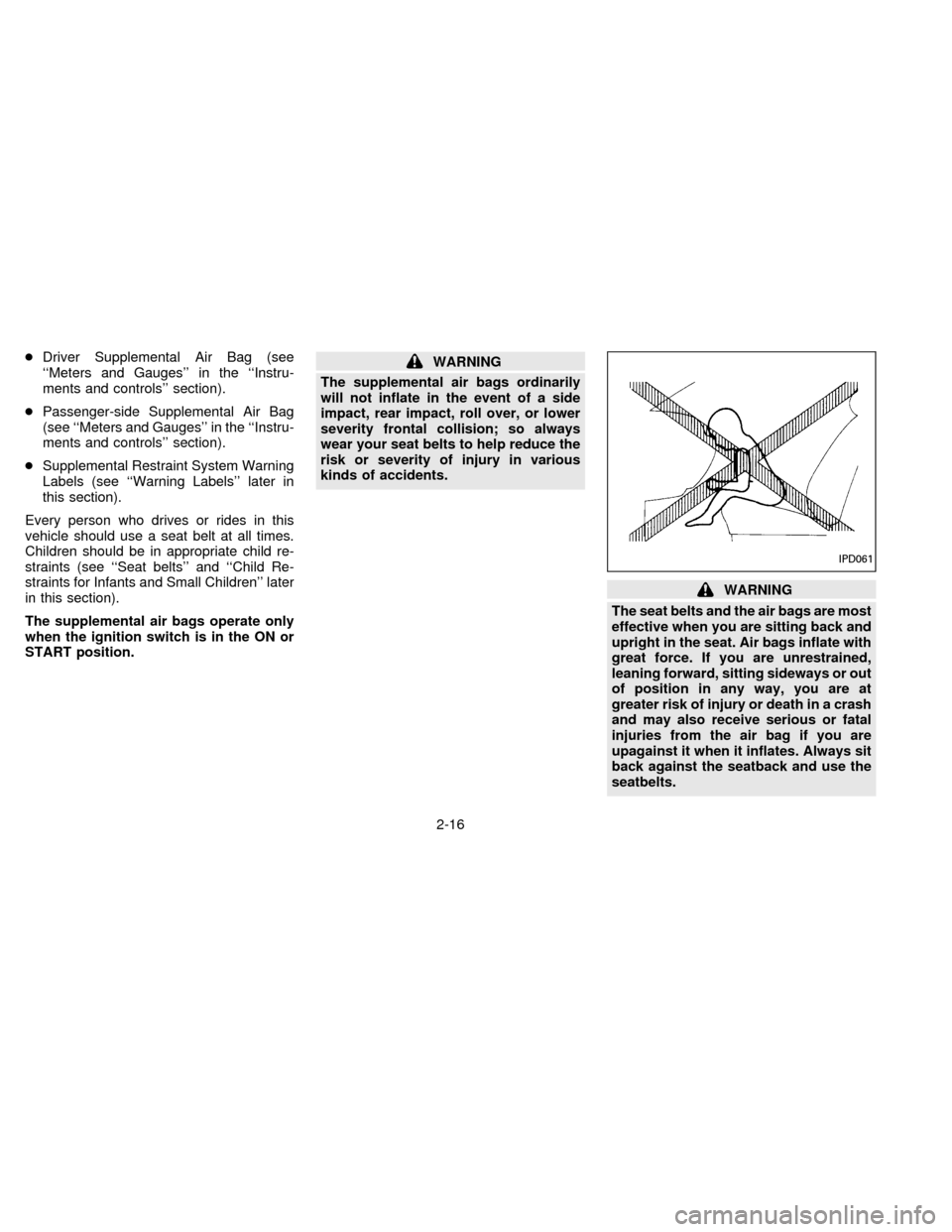
WARNING
The seat belts and the air bags are most
effective when you are sitting back and
upright in the seat. Air bags inflate with
great force. If you are unrestrained,
leaning forward, sitting sideways or out
of position in any way, you are at
greater risk of injury or death in a crash
and may also receive serious or fatal
injuries from the air bag if you are
upagainst it when it inflates. Always sit
back against the seatback and use the
seatbelts.
IPD061
2-16
ZX
Page 42 of 191
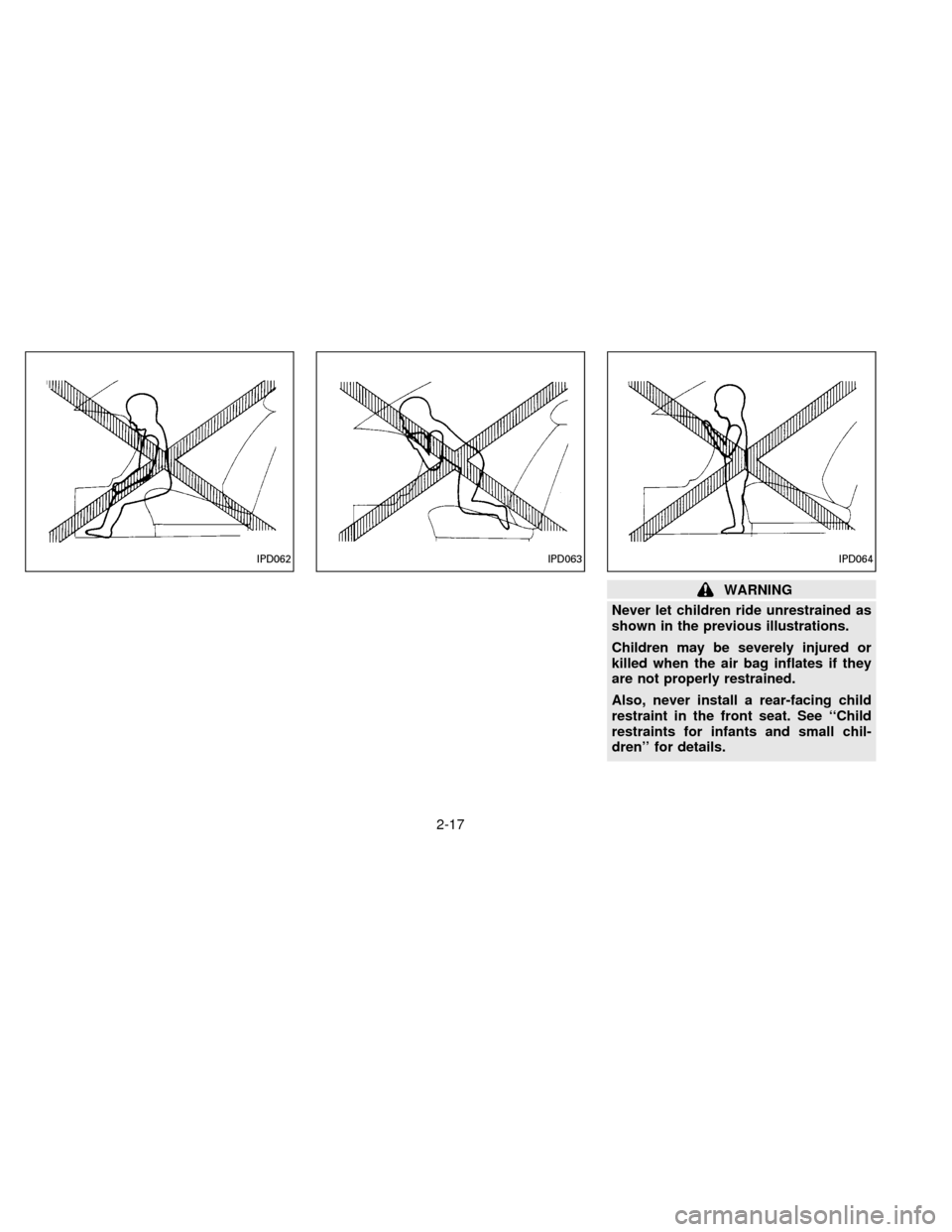
WARNING
Never let children ride unrestrained as
shown in the previous illustrations.
Children may be severely injured or
killed when the air bag inflates if they
are not properly restrained.
Also, never install a rear-facing child
restraint in the front seat. See ``Child
restraints for infants and small chil-
dren'' for details.
IPD062IPD063IPD064
2-17
ZX
Page 43 of 191
Air bag system
(If so equipped)
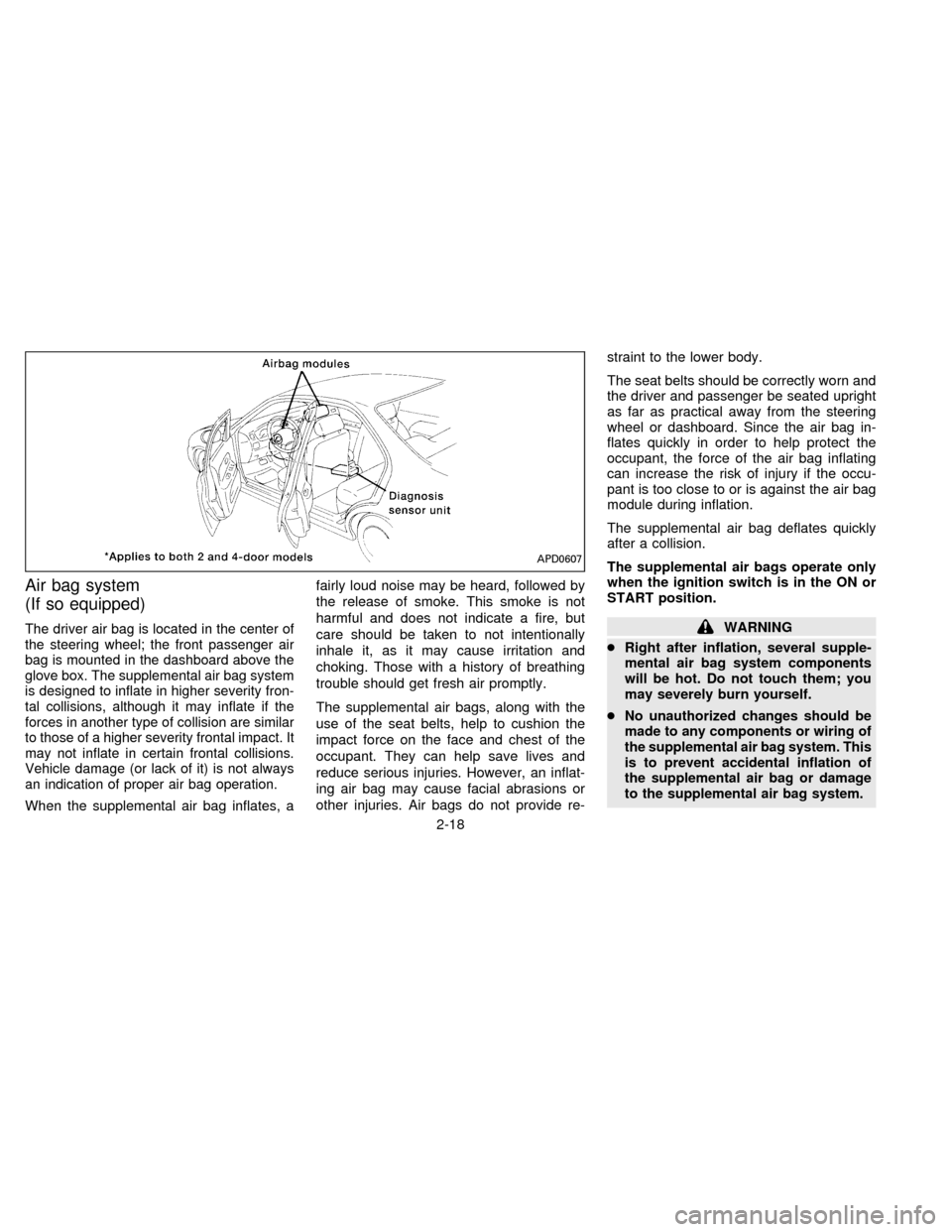
The driver air bag is located in the center of
the steering wheel; the front passenger air
bag is mounted in the dashboard above the
glove box. The supplemental air bag system
is designed to inflate in higher severity fron-
tal collisions, although it may inflate if the
forces in another type of collision are similar
to those of a higher severity frontal impact. It
may not inflate in certain frontal collisions.
Vehicle damage (or lack of it) is not always
an indication of proper air bag operation.
When the supplemental air bag inflates, afairly loud noise may be heard, followed by
the release of smoke. This smoke is not
harmful and does not indicate a fire, but
care should be taken to not intentionally
inhale it, as it may cause irritation and
choking. Those with a history of breathing
trouble should get fresh air promptly.
The supplemental air bags, along with the
use of the seat belts, help to cushion the
impact force on the face and chest of the
occupant. They can help save lives and
reduce serious injuries. However, an inflat-
ing air bag may cause facial abrasions or
other injuries. Air bags do not provide re-straint to the lower body.
The seat belts should be correctly worn and
the driver and passenger be seated upright
as far as practical away from the steering
wheel or dashboard. Since the air bag in-
flates quickly in order to help protect the
occupant, the force of the air bag inflating
can increase the risk of injury if the occu-
pant is too close to or is against the air bag
module during inflation.
The supplemental air bag deflates quickly
after a collision.
The supplemental air bags operate only
when the ignition switch is in the ON or
START position.
WARNING
cRight after inflation, several supple-
mental air bag system components
will be hot. Do not touch them; you
may severely burn yourself.
c
No unauthorized changes should be
made to any components or wiring of
the supplemental air bag system. This
is to prevent accidental inflation of
the supplemental air bag or damage
to the supplemental air bag system.
APD0607
2-18
ZX
Page 45 of 191
Warning labels about the supplemental air
bag system are placed in the vehicle as
shown in the illustration.
The supplemental air bag light, displaying
AIR BAG in the instrument panel, monitors
the circuits of the air bag. The circuits
monitored by the air bag light are the diag-
nosis sensor unit, air bag modules and all
related wiring.
APD0609
APD0610
WARNING LABELS
(If so equipped)AIR BAG WARNING LIGHT
(If so equipped)
2-20
ZX