1996 NISSAN SENTRA steering
[x] Cancel search: steeringPage 157 of 191

with only the parking brake applied.
Automatic transmission ``Park'' mecha-
nismOn a fairly steep hill check that your
vehicle is held securely with the selector
lever in the P position without applying any
brakes.
UNDER THE HOOD AND
VEHICLE
The maintenance items listed here should
be checked periodically (e.g. each time you
check the engine oil or refuel).
Additional information on the following
items with ``*'' is found in the ``Do-it-
yourself operations'' section.
Windshield washer fluid*Check for ad-
equate fluid in the tank.
Engine coolant level*Check the coolant
level when the engine is cold.
Radiator and hosesCheck the front of the
radiator and clean off any dirt, insects,
leaves, etc., that may have accumulated.
Make sure the hoses have no cracks, de-
formation, rot or loose connections.
Brake fluid level*Make sure the brake and
clutch fluid level is between the ``MAX'' and``MIN'' lines on the reservoir.
Battery*Check the fluid level in each cell.
Engine drive belts*Make sure no belt is
frayed, worn, cracked or oily.
Engine oil level*Check the level after
parking the vehicle on a level spot and
turning off the engine.
Power steering fluid level* and lines
Check the level when the fluid is cold and
the engine is turned off. Check the lines for
proper attachment, leaks, cracks, etc.
Automatic transmission fluid level*
Check the level after putting the selector
lever in P with the engine idling.
Exhaust systemMake sure there are no
loose supports, cracks or holes. If the sound
of the exhaust seems unusual or there is a
smell of exhaust fumes, immediately locate
the trouble and correct it. (See the carbon
monoxide warning in the ``Starting and driv-
ing'' section.)
UnderbodyThe underbody is frequently
exposed to corrosive substances such as
those used on icy roads or to control dust. It
is very important to remove these sub-
stances, otherwise rust forms on the floorpan, frame, fuel lines and around the ex-
haust system. At the end of winter, the
underbody should be thoroughly flushed
with plain water, being careful to clean
those areas where mud and dirt may accu-
mulate. See the ``Appearance and interior
care'' section for additional information.
Fluid leaksCheck under the vehicle for
fuel, oil, water or other fluid leaks after the
vehicle has been parked for a while. Water
dripping from the air conditioner after use is
normal. If you should notice any leaks or if
gasoline fumes are evident, check for the
cause and have it corrected immediately.
8-4
ZX
Page 160 of 191
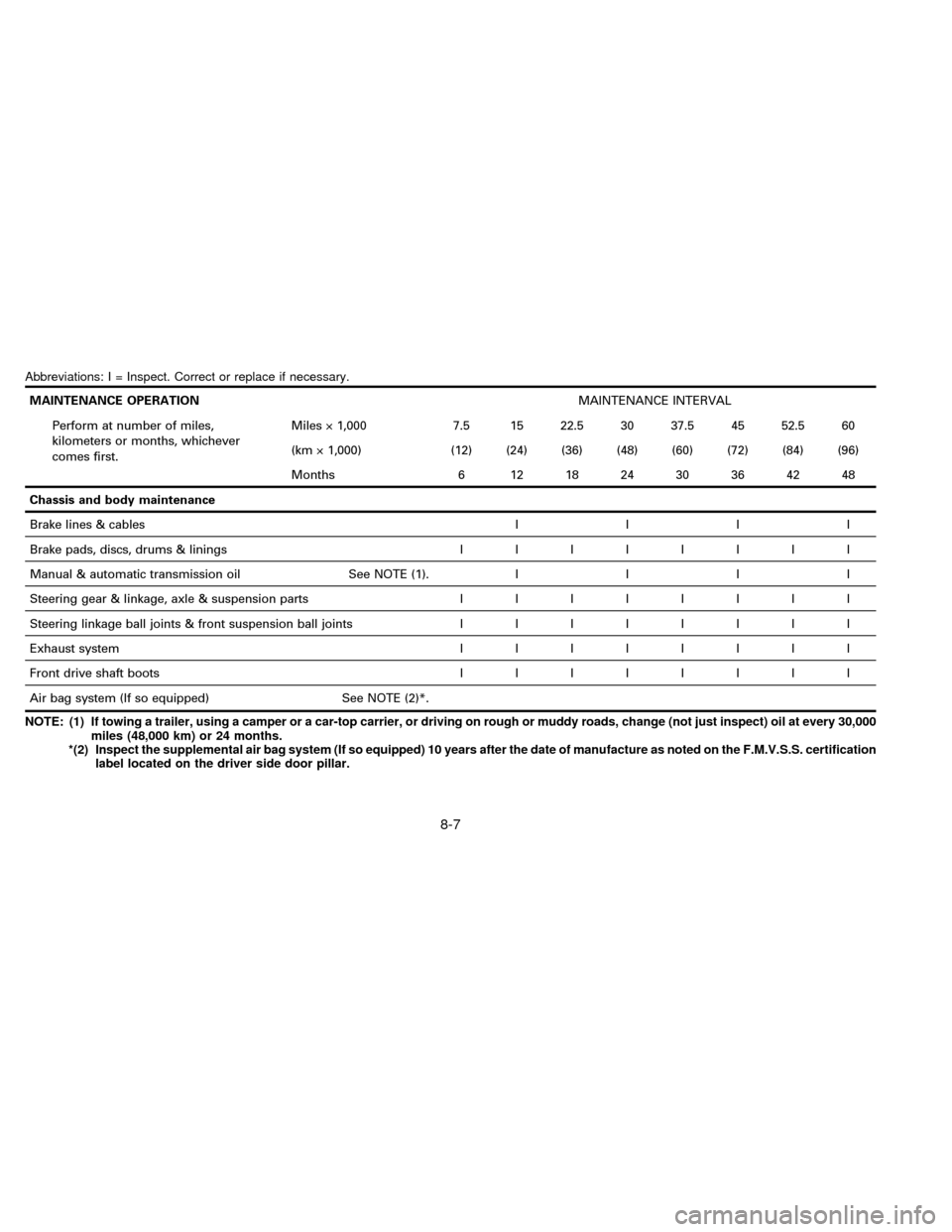
Abbreviations: I = Inspect. Correct or replace if necessary.
MAINTENANCE OPERATIONMAINTENANCE INTERVAL
Perform at number of miles,
kilometers or months, whichever
comes first.Miles ý 1,000 7.5 15 22.5 30 37.5 45 52.5 60
(km ý 1,000) (12) (24) (36) (48) (60) (72) (84) (96)
Months 6 12 18 24 30 36 42 48
Chassis and body maintenance
Brake lines & cablesIIII
Brake pads, discs, drums & liningsIIIIIIII
Manual & automatic transmission oil See NOTE (1).IIII
Steering gear & linkage, axle & suspension partsIIIIIIII
Steering linkage ball joints & front suspension ball jointsIIIIIIII
Exhaust systemIIIIIIII
Front drive shaft bootsIIIIIIII
Air bag system (If so equipped) See NOTE (2)*.
NOTE: (1) If towing a trailer, using a camper or a car-top carrier, or driving on rough or muddy roads, change (not just inspect) oil at every 30,000
miles (48,000 km) or 24 months.
*(2) Inspect the supplemental air bag system (If so equipped) 10 years after the date of manufacture as noted on the F.M.V.S.S. certification
label located on the driver side door pillar.
8-7
ZX
Page 162 of 191
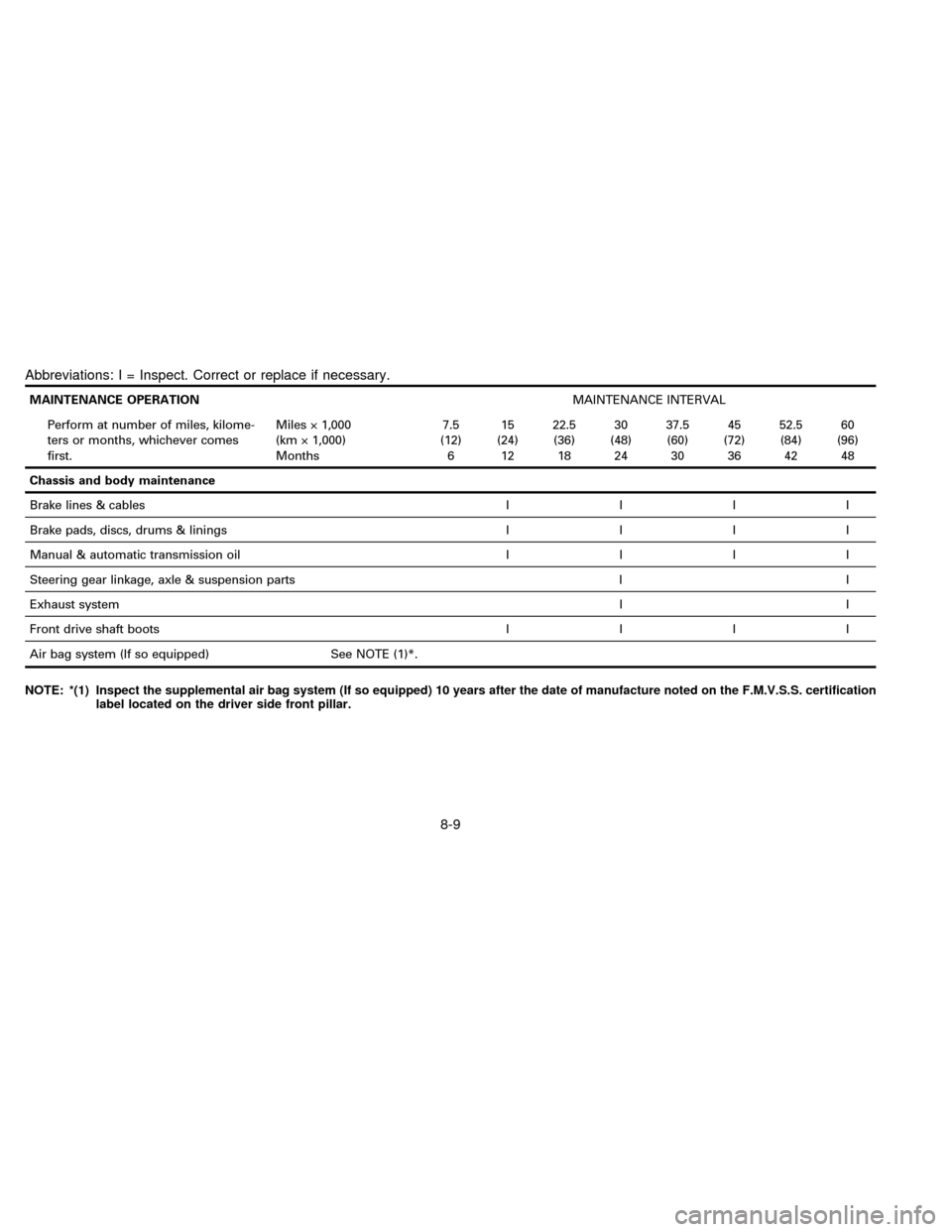
Abbreviations: I = Inspect. Correct or replace if necessary.
MAINTENANCE OPERATIONMAINTENANCE INTERVAL
Perform at number of miles, kilome-
ters or months, whichever comes
first.Miles ý 1,000
(km ý 1,000)
Months7.5
(12)
615
(24)
1222.5
(36)
1830
(48)
2437.5
(60)
3045
(72)
3652.5
(84)
4260
(96)
48
Chassis and body maintenance
Brake lines & cablesIIII
Brake pads, discs, drums & liningsIIII
Manual & automatic transmission oilIIII
Steering gear linkage, axle & suspension parts I I
Exhaust systemII
Front drive shaft bootsIIII
Air bag system (If so equipped) See NOTE (1)*.
NOTE: *(1) Inspect the supplemental air bag system (If so equipped) 10 years after the date of manufacture noted on the F.M.V.S.S. certification
label located on the driver side front pillar.
8-9
ZX
Page 163 of 191

EXPLANATION OF MAINTE-
NANCE ITEMS
Additional information on the following
items with ``*'' is found in the ``Do-it-
yourself operations'' section.
Emission control system
maintenance
Drive belts*Check drive belts for wear,
fraying or cracking and also for proper ten-
sion. Replace the drive belts if found dam-
aged.
Air cleaner filterUnder normal driving con-
ditions, the air cleaner filter should be re-
placed in accordance with the maintenance
schedule. However, driving the vehicle in
dusty areas may cause more rapid clogging
of the element. Consequently, the element
may have to be replaced more frequently.
Idle rpmInspection and adjustment should
be made with a tachometer to ensure
accuracy.
Vapor linesCheck vapor lines and connec-
tions for failure or looseness. If leaks are
found, replace them.
Fuel linesCheck the fuel hoses, pipingand connections for leaks, looseness or
deterioration. Replace any parts if they are
damaged.
Fuel filterIf the vehicle is operated under
extremely adverse weather conditions or in
areas where ambient temperatures are ei-
ther extremely low or extremely high, the
filter might become clogged. In such an
event, replace the filter immediately.
Engine coolant*Drain and flush the cool-
ing system.
Engine oil & oil filter*Under normal driving
conditions, the engine oil and oil filter should
be replaced in accordance with the mainte-
nance schedule. However, under severe
driving conditions, they may have to be
replaced more frequently.
Spark plugs*Replace with new plugs hav-
ing the correct heat range.
Intake & exhaust valve clearanceCheck
and adjust the valve clearance.
Chassis and body maintenance
Brake lines & cablesCheck the brake lines
and hoses (including brake booster vacuum
hoses, connections & check valve) and
parking brake cables for proper attachment,leaks, cracks, chafing, abrasion, deteriora-
tion, etc.
Brake pads, discs, drums & linings
Check these and the other neighboring
brake components for wear, deterioration
and leaks. Under severe driving conditions,
they may have to be inspected more fre-
quently.
Manual & automatic transmission gear
oil*Check the oil level and visually inspect
for signs of leakage.
Under severe driving conditions, the oil
should be replaced at the specified interval.
Steering gear & linkage, axle & suspen-
sion parts, and drive shaft bootsCheck
for damage, looseness and leakage of oil or
grease. Under severe driving conditions,
more frequent inspection should be per-
formed.
Steering linkage ball joints & front sus-
pension ball jointsCheck the ball joints for
damage, looseness and grease leakage.
Exhaust systemVisually check the ex-
haust pipes, muffler, and hangers for proper
attachment, leaks, cracks, chafing, abra-
sion, deterioration, etc. Under severe
8-10
ZX
Page 167 of 191
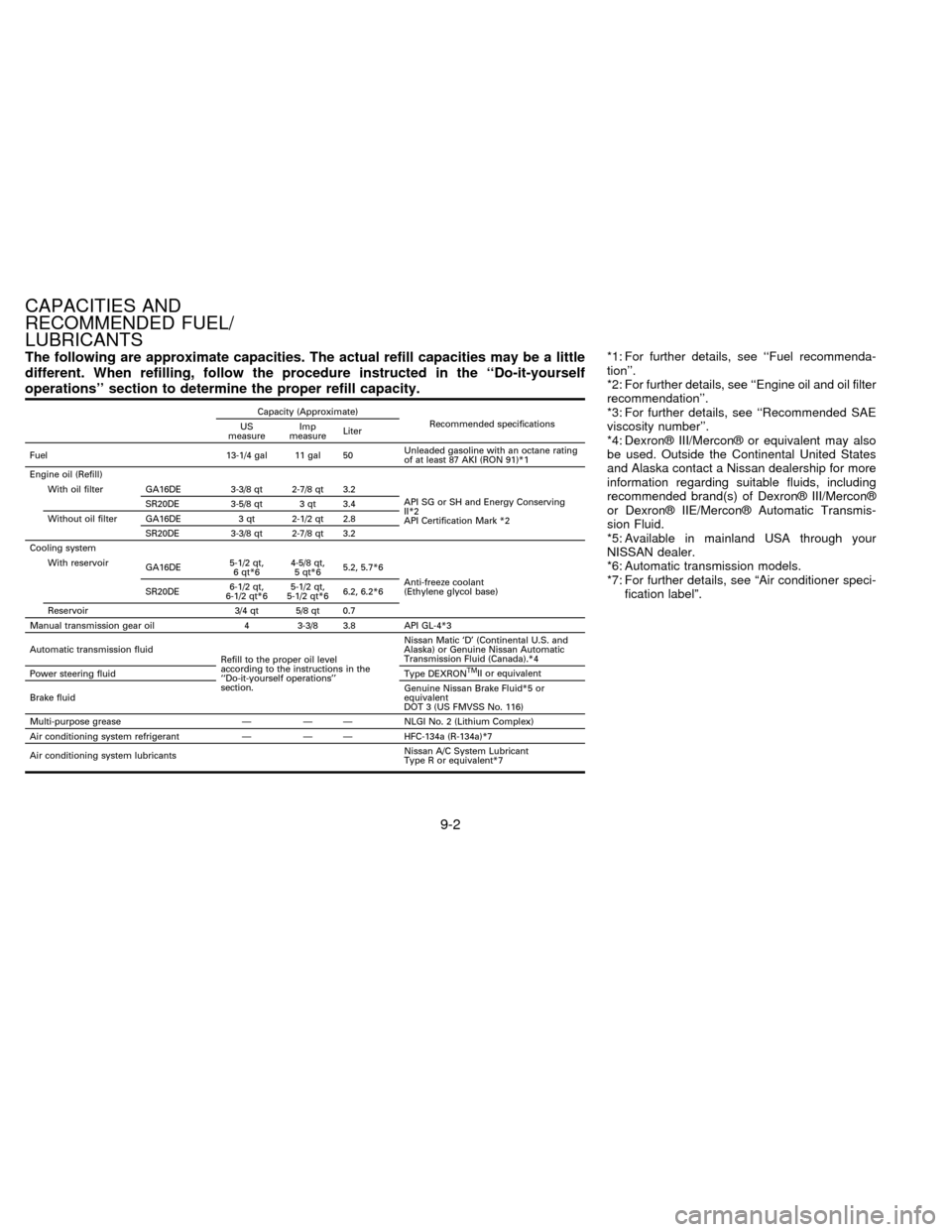
The following are approximate capacities. The actual refill capacities may be a little
different. When refilling, follow the procedure instructed in the ``Do-it-yourself
operations'' section to determine the proper refill capacity.
Capacity (Approximate)
Recommended specifications
US
measureImp
measureLiter
Fuel 13-1/4 gal 11 gal 50Unleaded gasoline with an octane rating
of at least 87 AKI (RON 91)*1
Engine oil (Refill)
With oil filter GA16DE 3-3/8 qt 2-7/8 qt 3.2
API SG or SH and Energy Conserving
II*2
API Certification Mark *2 SR20DE 3-5/8 qt 3 qt 3.4
Without oil filter GA16DE 3 qt 2-1/2 qt 2.8
SR20DE 3-3/8 qt 2-7/8 qt 3.2
Cooling system
With reservoir
GA16DE5-1/2 qt,
6 qt*64-5/8 qt,
5 qt*65.2, 5.7*6
Anti-freeze coolant
(Ethylene glycol base) SR20DE6-1/2 qt,
6-1/2 qt*65-1/2 qt,
5-1/2 qt*66.2, 6.2*6
Reservoir 3/4 qt 5/8 qt 0.7
Manual transmission gear oil 4 3-3/8 3.8 API GL-4*3
Automatic transmission fluid
Refill to the proper oil level
according to the instructions in the
``Do-it-yourself operations''
section.Nissan Matic `D' (Continental U.S. and
Alaska) or Genuine Nissan Automatic
Transmission Fluid (Canada).*4
Power steering fluid Type DEXRON
TMII or equivalent
Brake fluidGenuine Nissan Brake Fluid*5 or
equivalent
DOT 3 (US FMVSS No. 116)
Multi-purpose grease Ð Ð Ð NLGI No. 2 (Lithium Complex)
Air conditioning system refrigerant Ð Ð Ð HFC-134a (R-134a)*7
Air conditioning system lubricantsNissan A/C System Lubricant
Type R or equivalent*7
*1: For further details, see ``Fuel recommenda-
tion''.
*2: For further details, see ``Engine oil and oil filter
recommendation''.
*3: For further details, see ``Recommended SAE
viscosity number''.
*4: Dexronž III/Merconž or equivalent may also
be used. Outside the Continental United States
and Alaska contact a Nissan dealership for more
information regarding suitable fluids, including
recommended brand(s) of Dexronž III/Merconž
or Dexronž IIE/Merconž Automatic Transmis-
sion Fluid.
*5: Available in mainland USA through your
NISSAN dealer.
*6: Automatic transmission models.
*7: For further details, see ªAir conditioner speci-
fication labelº.
CAPACITIES AND
RECOMMENDED FUEL/
LUBRICANTS
9-2
ZX
Page 174 of 191
ModelGA16DE SR20DE
TypeGasoline, 4-cycle Gasoline, 4-cycle
Cylinder arrangement 4-cylinder in-line 4-cylinder in-line
Bore ý Stroke in (mm) 2.992 ý 3.465 (76.0 ý 88.0) 3.386 ý 3.386 (86.0 ý 86.0)
Displacement cu in (cm
3) 97.39 (1,596) 121.92 (1,998)
Firing order1-3-4-2 1-3-4-2
Idle speed rpm
See the ``Emission Control label'' on the underside of the hood. Ignition timing (B.T.D.C.)
degree/rpm
CO percentage at idle speed
[No air] %
Platinum-tipped type
(Standard for SR20DE)Conventional type
Spark plug Hot BKR4E-11 BKR5E
Standard BKR5E-11 PFR5B-11 BKR6E
Cold BKR6E-11 PFR6B-11, PFR7B-11 BKR7E
Camshaft operation Timing chain Timing chain
Spark plug gap in (mm) 0.039 to 0.043 (1.0 to 1.1) Ð 0.031 to 0.035 (0.8 to 0.9)
Generator belt size
Width ý Length in (mm)0.843 x 32.28
(21.4 x 820)
0.843 x 44.09
(21.4 x 1,120)*20.559 x 32.68
(14.2 x 830)
0.843 x 40.75
(21.4 x 1,035)*2
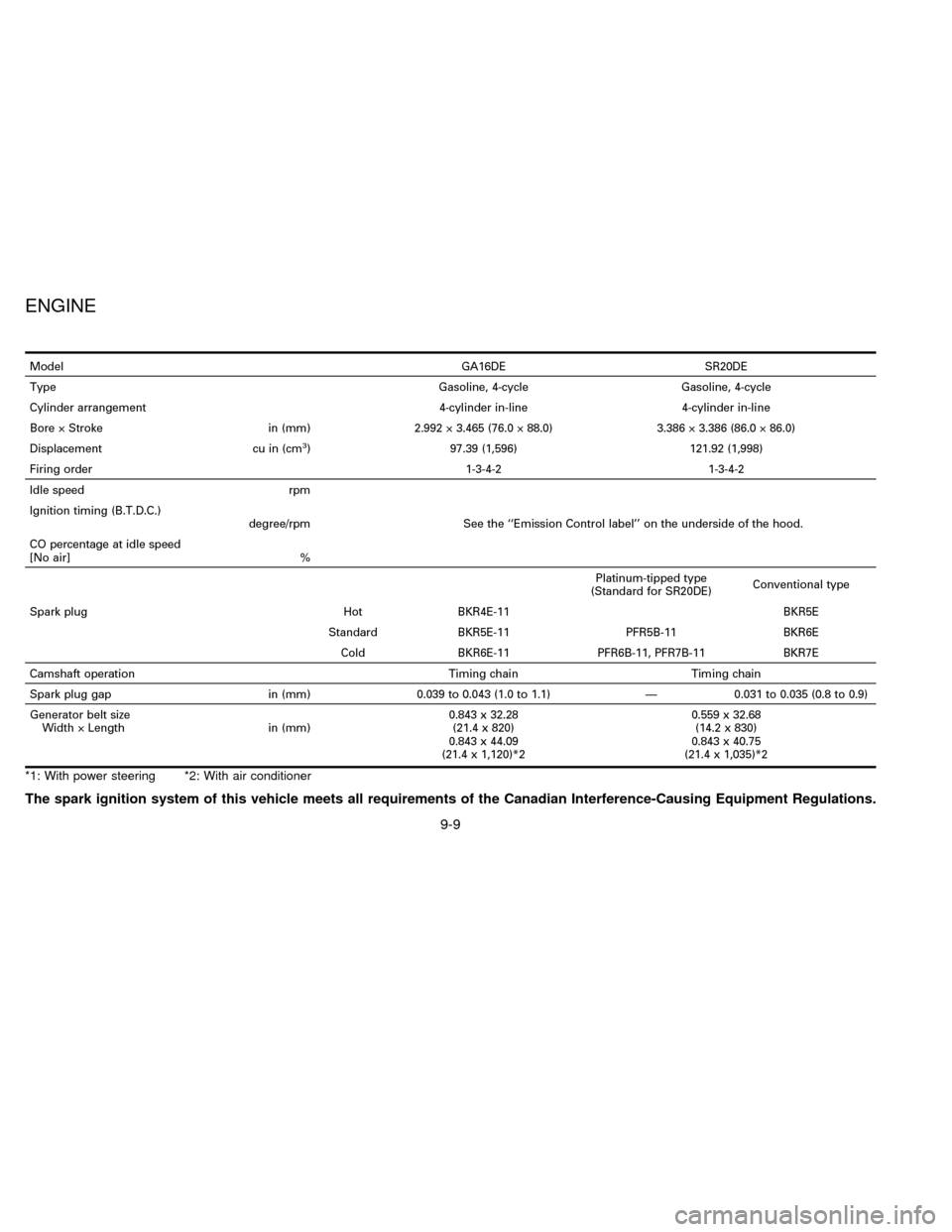
*1: With power steering *2: With air conditioner
The spark ignition system of this vehicle meets all requirements of the Canadian Interference-Causing Equipment Regulations.
ENGINE
9-9
ZX
Page 180 of 191
re-weigh your vehicle to determine if
either GVWR or GAWR for your vehicle
is exceeded. If GVWR is exceeded, re-
move cargo as necessary. If either the
front or rear GAWR is exceeded, shift the
load or remove cargo as necessary.
Loading Tips
cThe GVW must not exceed GVWR or
GAWR as specified on the F.M.V.S.S.
Certification Label.
cDo not load the front and rear axle to the
GAWR. Doing so will exceed the GVWR.
CAUTION
cProperly secure all cargo to help
prevent it from sliding or shifting. In
a sudden stop or collision, unse-
cured cargo could cause personal
injury.
cDo not load your vehicle any heavier
than the GVWR or the maximum
front and rear GAWRs. If you do,
parts on your vehicle can break, or it
can change the way your vehicle
handles. This could result in loss of
control and cause personal injury.cOverloading can shorten the life of
your vehicle. Failures caused by
overloading are not covered by your
warranty.
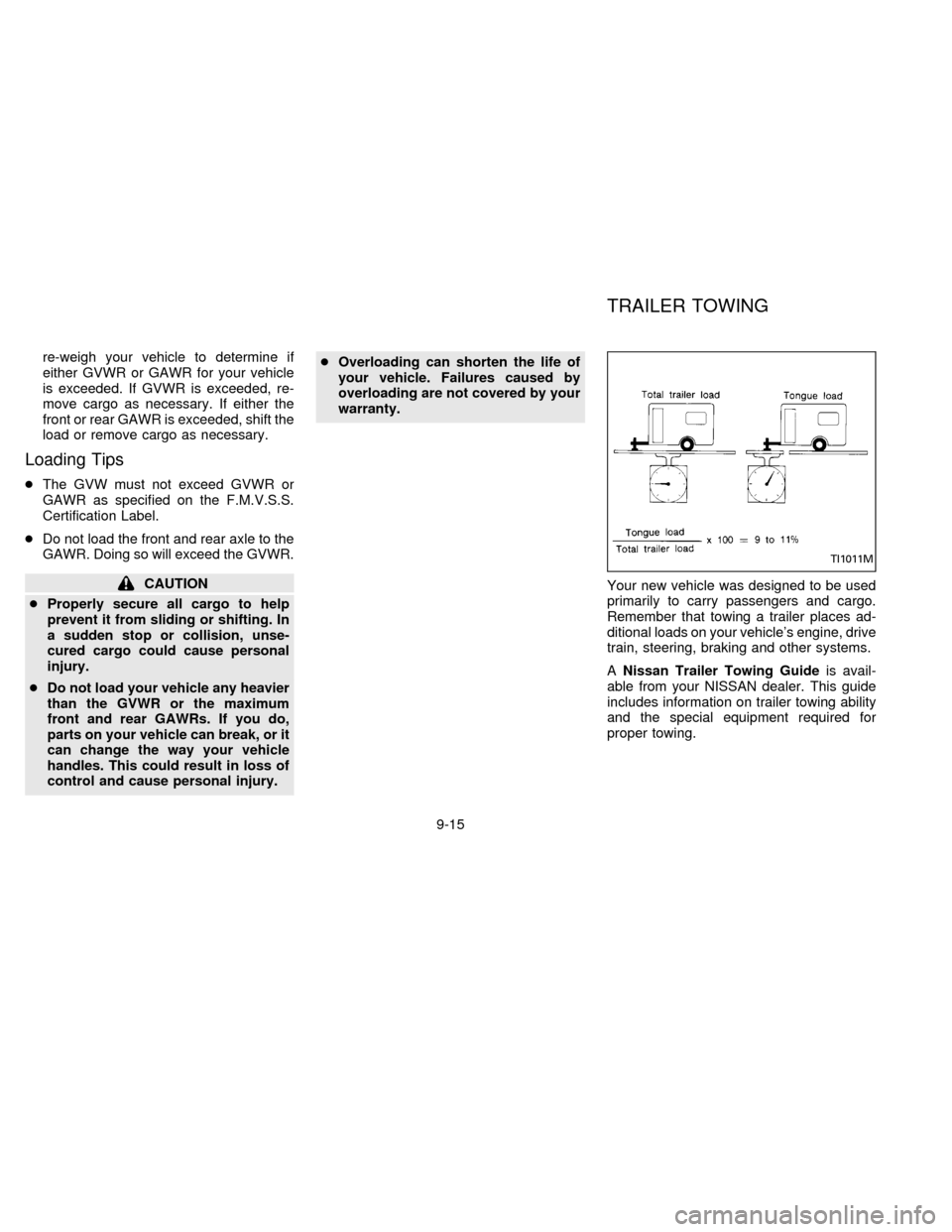
Your new vehicle was designed to be used
primarily to carry passengers and cargo.
Remember that towing a trailer places ad-
ditional loads on your vehicle's engine, drive
train, steering, braking and other systems.
ANissan Trailer Towing Guideis avail-
able from your NISSAN dealer. This guide
includes information on trailer towing ability
and the special equipment required for
proper towing.
TI1011M
TRAILER TOWING
9-15
ZX
Page 182 of 191

After the hitch is removed, seal the bolt
holes to prevent exhaust fumes, water
or dust from entering the passenger
compartment.
cRegularly check that all hitch mounting
bolts are securely mounted.
Tire pressures
cWhen towing a trailer, inflate the vehicle
tires to the recommended cold tire pres-
sure indicated on the tire placard (lo-
cated on the driver side center pillar.)
cTrailer tire condition, size, load rating
and proper inflation pressure should be
in accordance with the trailer and tire
manufacturers' specifications.
Safety chain
Always use a suitable chain between your
vehicle and the trailer. The chain should be
crossed and should be attached to the hitch,
not to the vehicle bumper or axle. Be sure to
leave enough slack in the chain to permit
turning corners.
Trailer lights
Trailer lights should comply with federal
and/ or local regulations. When wiring thevehicle for towing, connect the stop and tail
light pickup into the vehicle electrical circuit.
Trailer brakes
If your trailer is equipped with a braking
system, make sure it conforms to federal
and/or local regulations and that it is prop-
erly installed.
CAUTION
Never connect a trailer brake system
directly to the vehicle brake system.
Pre-towing tips
cBe certain your vehicle maintains a level
position when a loaded and/or unloaded
trailer is hitched. Do not drive the vehicle if
it has an abnormal nose-up or nose- down
condition; check for improper tongue load,
overload, worn suspension or other pos-
sible causes of either condition.
cAlways secure items in the trailer to
prevent load shifts while driving.
cBe certain your rear view mirrors con-
form to all federal, state or local regula-
tions. If not, install any mirrors required
for towing before driving the vehicle.
Trailer towing tips
In order to gain skill and an understanding
of the vehicle's behavior, you should prac-
tice turning, stopping and backing up in an
area which is free from traffic. Steering,
stability, and braking performance are
somewhat different than under normal driv-
ing conditions.
cAlways secure items in the trailer to
prevent load shift while driving.
c
Avoid abrupt starts, acceleration or stops.
cAvoid sharp turns or lane changes.
cAlways drive your vehicle at a moderate
speed.
c
Always block the wheels on both vehicle
and trailer when parking. Parking on a
slope is not recommended; however, if
you must do so, and if your vehicle is
equipped with automatic transmission,
first block the wheels and apply the park-
ing brake, and then move the transmis-
sion shift lever into the P position. If you
move the shift lever to the P position
before blocking the wheels and applying
the parking brake, transmission damage
could occur.
9-17
ZX