1996 NISSAN SENTRA ECU
[x] Cancel search: ECUPage 47 of 191
PRECAUTIONS ON SEAT BELT
USAGE
Your chances of being injured or killed in an
accident and/or the severity of injury may be
greatly reduced if you are wearing your seat
belt and it is properly adjusted. NISSAN
strongly encourages you and all of your
passengers to buckle up every time you
drive, even if your seating position includes
an air bag.
Some states, provinces or territories re-
quire that seat belts be worn at all times
when a vehicle is being driven.
WARNING
cEvery person who drives or rides in
this vehicle should use a seat belt at
all times. Children should be in ap-
propriate child restraints.
cThe belt should be properly adjusted
to a snug fit. Failure to do so will
reduce the effectiveness of the entire
restraint system and increases the
chances or severity of injury in an
accident.cDo not wear the belt inside out or
twisted. Be sure the seat belt tongue
is securely fastened to the proper
buckle.
cDo not allow more than one person to
use the same belt.
cAll seat belt assemblies including re-
tractors and attaching hardware
should be inspected after any colli-
sion at your NISSAN dealer. NISSAN
recommends that all seat belt assem-
blies in use during a collision be
replaced unless the collision was mi-
nor and the belts show no damage
and continue to operate properly.
Seat belt assemblies not in use dur-
ing a collision should also be in-
spected and replaced if either dam-
age or improper operation is noted.
cNever carry more people in the ve-
hicle than there are seat belts.
c
If the seat belt warning lamp glows con-
tinuously while the ignition is turned ON
with all doors closed and all seat belts
fastened, it may indicate a malfunction
in the system. Have the system checked
by your NISSAN dealer.cBe sure to observe the following pre-
cautions when using seat belts. Failure
to do so could increase the chance
and/or severity of injury in an accident.
cAlways route the shoulder belt over
your shoulder and across your chest.
Never run the belt under your arm or
across your neck. The belt should be
away from your face and neck, but
not falling off your shoulder.
cPosition the lap belt as low as pos-
sible AROUND THE HIPS, NOT THE
WAIST.
cSerious injury or death can occur if
seat belt is not worn properly.
CHILD SAFETY
Children need adults to help protect
them.
All U.S. states and provinces of Canada
require the use of approved child restraints
for infants and small children. (See ``Child
Restraints for Infants and Small Children''
later in this section.)
In addition, there are many types of child
restraints available for larger children which
SEAT BELTS
2-22
ZX
Page 50 of 191
WARNING
The automatic locking mode should be
used only for child seat installation.
During normal seat belt use by a pas-
senger, the locking mode should not be
activated. If it is activated it may cause
uncomfortable seat belt tension.
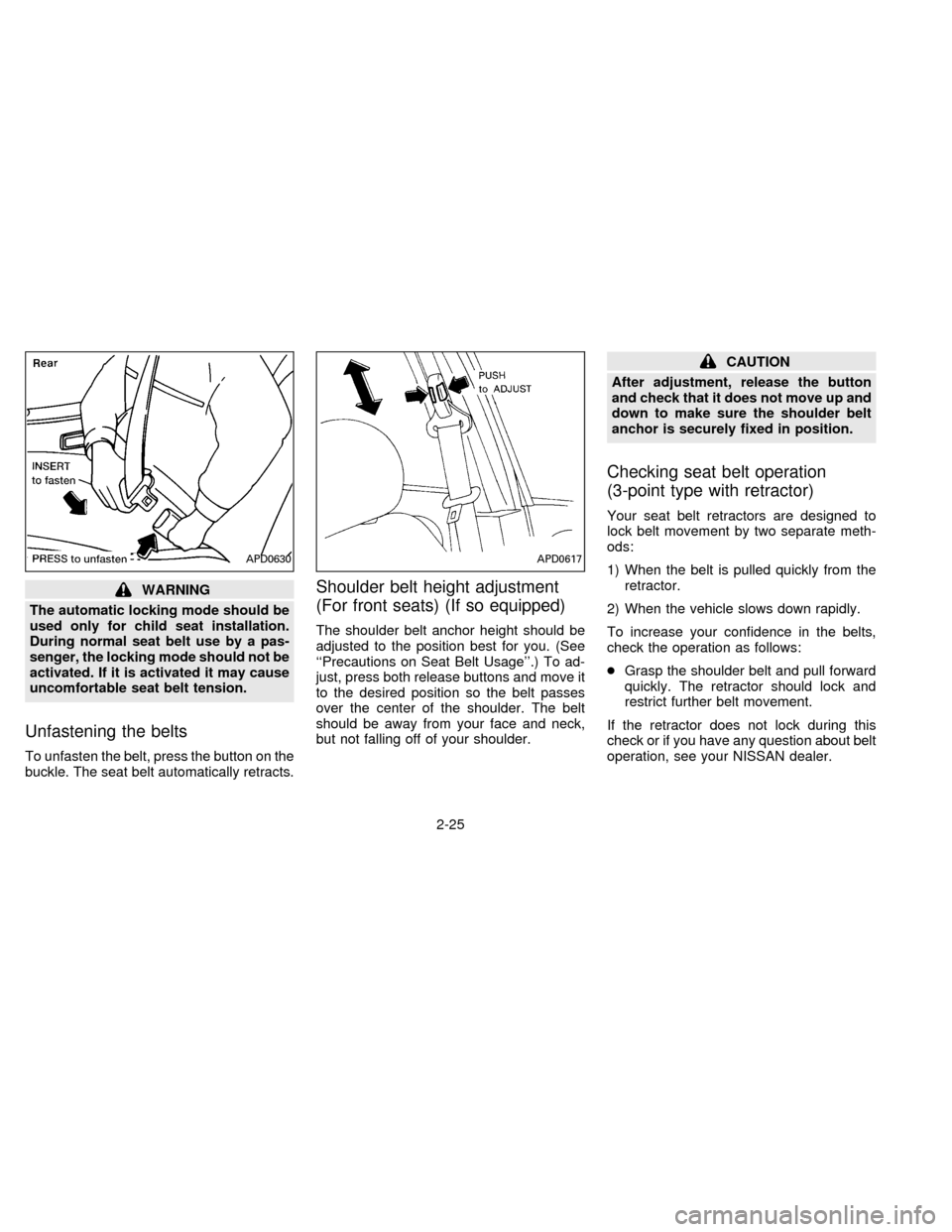
Unfastening the belts
To unfasten the belt, press the button on the
buckle. The seat belt automatically retracts.
Shoulder belt height adjustment
(For front seats) (If so equipped)
The shoulder belt anchor height should be
adjusted to the position best for you. (See
``Precautions on Seat Belt Usage''.) To ad-
just, press both release buttons and move it
to the desired position so the belt passes
over the center of the shoulder. The belt
should be away from your face and neck,
but not falling off of your shoulder.
CAUTION
After adjustment, release the button
and check that it does not move up and
down to make sure the shoulder belt
anchor is securely fixed in position.
Checking seat belt operation
(3-point type with retractor)
Your seat belt retractors are designed to
lock belt movement by two separate meth-
ods:
1) When the belt is pulled quickly from the
retractor.
2) When the vehicle slows down rapidly.
To increase your confidence in the belts,
check the operation as follows:
cGrasp the shoulder belt and pull forward
quickly. The retractor should lock and
restrict further belt movement.
If the retractor does not lock during this
check or if you have any question about belt
operation, see your NISSAN dealer.
APD0630APD0617
2-25
ZX
Page 53 of 191
WARNING
Infants and small children shouldalwaysbe
placed in an appropriate child restraint while
riding in the vehicle. Failure to use a child
restraint can result in serious injury or death.
Children and infants should never be
carried on your lap. It is not possible for
even the strongest adult to resist the
forces of a severe accident. The child
could be crushed between the adult
and parts of the vehicle. Also, do not
put the same seat belt around both
your child and yourself.
In general, child restraints are designed
to be installed with a lap belt or the lap
portion of a three-point type seat belt.
Nissan recommends that the child re-
straint system be installed in the rear
seat. According to accident statistics,
children are safer when properly re-
strained in the rear seat than in the
front seat.
An improperly installed child restraint
could lead to serious injury or death in
an accident.Child restraints specially designed for in-
fants and small children are offered by
several manufacturers. When selecting any
child restraint, keep the following points in
mind:
1) Choose only a restraint with a label cer-
tifying that it complies with Federal Motor
Vehicle Safety Standard 213 or Cana-
dian Motor Vehicle Safety Standard 213.
2) Check the child restraint in your vehicle
to be sure it is compatible with the vehi-
cle's seat belt system.
3) If the child restraint is compatible with
your vehicle, place your child in the child
restraint and check the various adjust-
ments to be sure the child restraint is
compatible with your child. Always follow
all recommended procedures.
WARNING
cNever install a rear-facing child re-
straint in the front seat. A rear-facing
child restraint must only be used in
the rear seat. See ªInstallation on
front passenger seatº for details.cFollow all of the child restraint manu-
facturer's instructions for installation
and use. When purchasing a child
restraint, be sure to select one which
will fit your child and vehicle. It may
not be possible to properly install
some types of child restraints in your
vehicle.
cImproper use of a child restraint can
result in increased injuries for both
the infant or child and other occu-
pants in the vehicle.
c
When your child restraint is not in
use, keep it secured with a seat belt to
prevent it from being thrown forward
in case of a sudden stop or accident.
cRemember that a child restraint left in
a closed vehicle can become very
hot. Check the seating surface and
buckles before placing your child in
the child restraint.
c
All U.S. states and provinces of
Canada require that infants and small
children be restrained in approved
child restraints at all times while the
vehicle is being operated.
CHILD RESTRAINTS FOR
INFANTS AND SMALL
CHILDREN
2-28
ZX
Page 54 of 191
cAfter attaching the child restraint, test
it before you place the child in it. Tilt it
from side to side. Try to tug it forward
and check to see if the belt holds the
restraint in place. If the restraint is not
secure, tighten the belt as necessary,
or put the restraint in another seat and
test it again.
cIf the child restraint is not anchored
properly, the risk of a child being
injured in a collision or a sudden stop
greatly increases.
cAdjustable seatbacks should be po-
sitioned to fit the child restraint, but
as upright as possible.
cFor a front facing child restraint, if the
seat position where it is installed has
a 3-point type lap/shoulder belt,
check to make sure the shoulder belt
does not go in front of the child's face
or neck. If it does, put the shoulder
belt behind the child restraint.
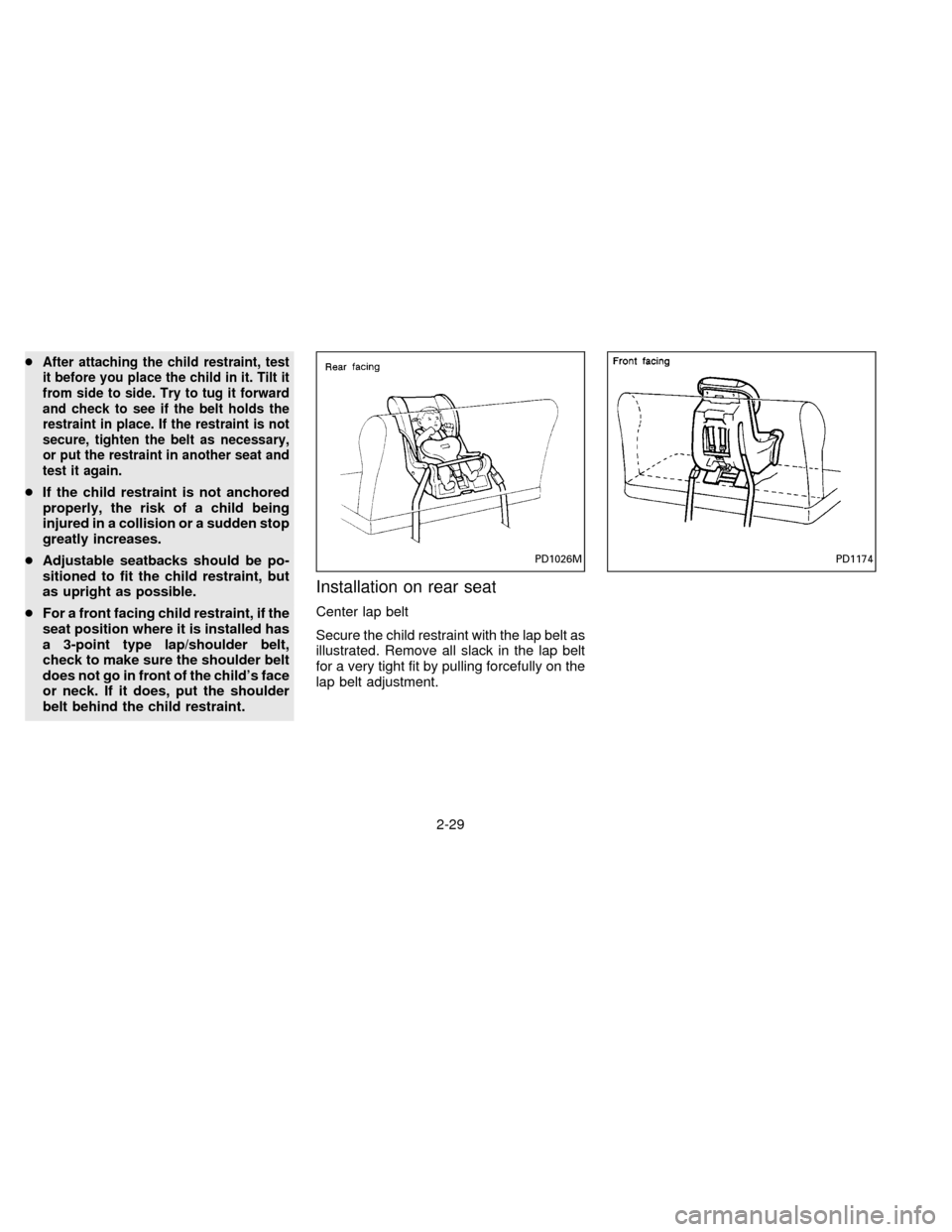
Installation on rear seat
Center lap belt
Secure the child restraint with the lap belt as
illustrated. Remove all slack in the lap belt
for a very tight fit by pulling forcefully on the
lap belt adjustment.
PD1026MPD1174
2-29
ZX
Page 55 of 191
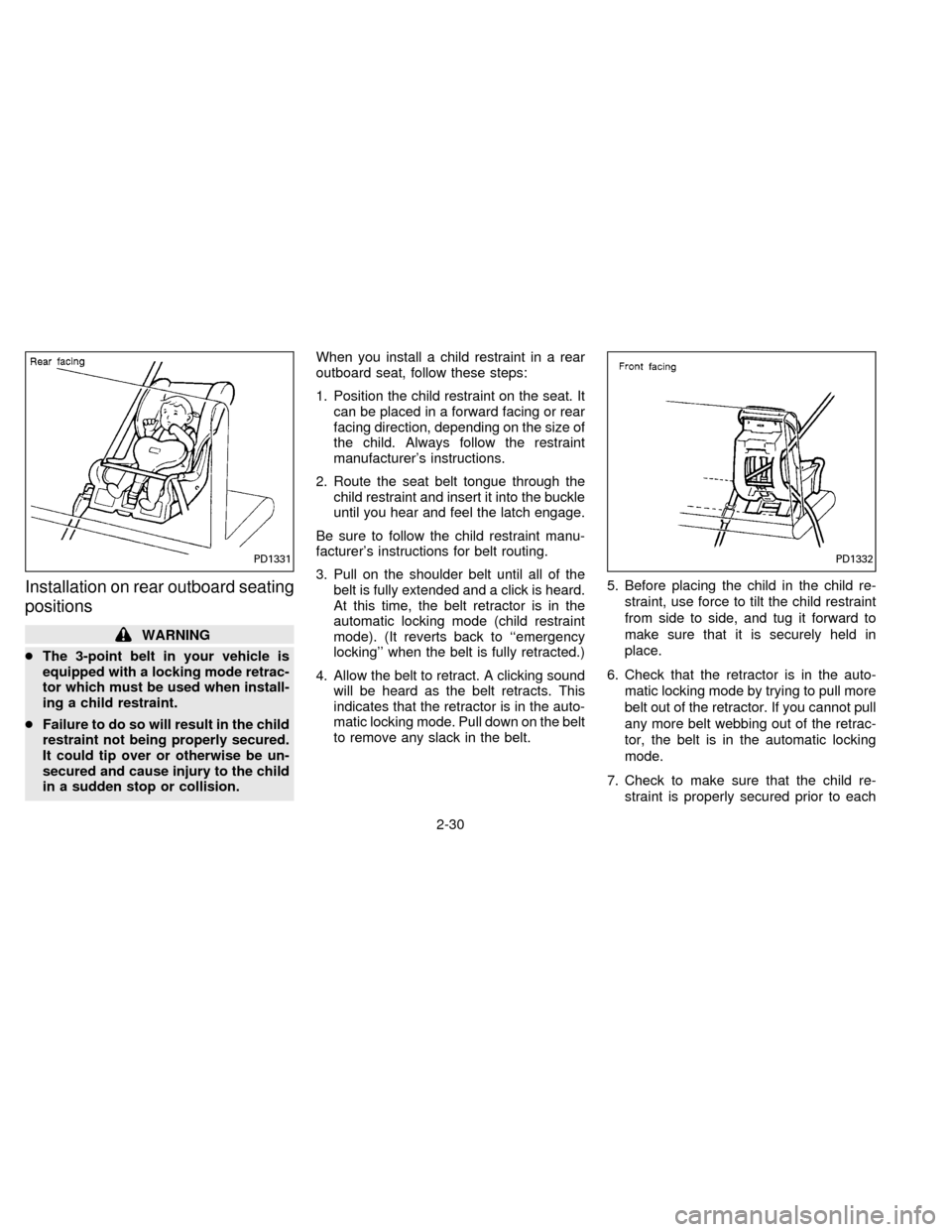
Installation on rear outboard seating
positions
WARNING
cThe 3-point belt in your vehicle is
equipped with a locking mode retrac-
tor which must be used when install-
ing a child restraint.
cFailure to do so will result in the child
restraint not being properly secured.
It could tip over or otherwise be un-
secured and cause injury to the child
in a sudden stop or collision.When you install a child restraint in a rear
outboard seat, follow these steps:
1. Position the child restraint on the seat. It
can be placed in a forward facing or rear
facing direction, depending on the size of
the child. Always follow the restraint
manufacturer's instructions.
2. Route the seat belt tongue through the
child restraint and insert it into the buckle
until you hear and feel the latch engage.
Be sure to follow the child restraint manu-
facturer's instructions for belt routing.
3. Pull on the shoulder belt until all of the
belt is fully extended and a click is heard.
At this time, the belt retractor is in the
automatic locking mode (child restraint
mode). (It reverts back to ``emergency
locking'' when the belt is fully retracted.)
4. Allow the belt to retract. A clicking sound
will be heard as the belt retracts. This
indicates that the retractor is in the auto-
matic locking mode. Pull down on the belt
to remove any slack in the belt.5. Before placing the child in the child re-
straint, use force to tilt the child restraint
from side to side, and tug it forward to
make sure that it is securely held in
place.
6. Check that the retractor is in the auto-
matic locking mode by trying to pull more
belt out of the retractor. If you cannot pull
any more belt webbing out of the retrac-
tor, the belt is in the automatic locking
mode.
7. Check to make sure that the child re-
straint is properly secured prior to each
PD1331PD1332
2-30
ZX
Page 56 of 191
use. If the belt is not locked, repeat steps
3 through 6.
After the child restraint is removed and the
seat belt is allowed to wind back into the
retractor, the automatic locking mode (child
restraint mode) is canceled; the seat belt
may be used as normal and only locks
during a sudden stop or impact.
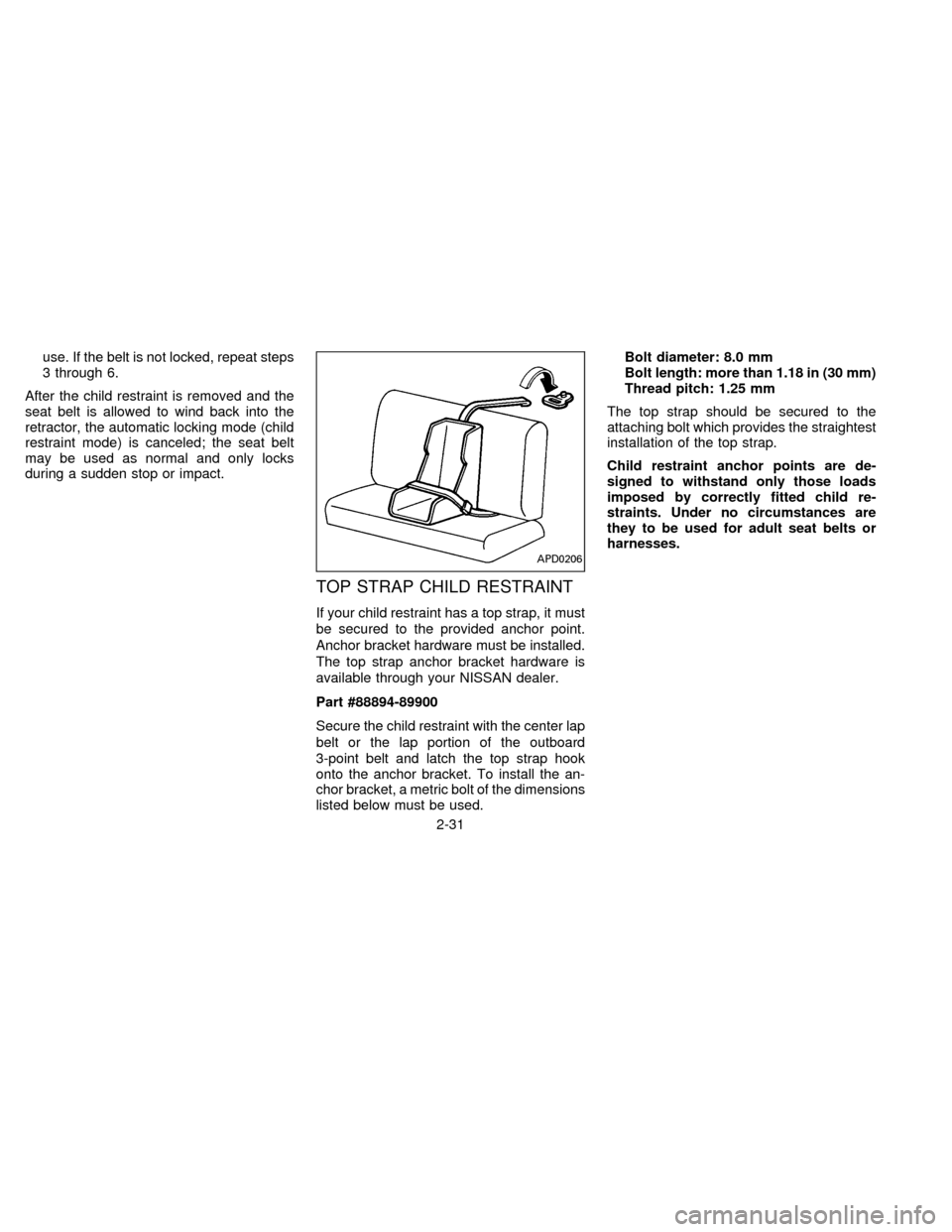
TOP STRAP CHILD RESTRAINT
If your child restraint has a top strap, it must
be secured to the provided anchor point.
Anchor bracket hardware must be installed.
The top strap anchor bracket hardware is
available through your NISSAN dealer.
Part #88894-89900
Secure the child restraint with the center lap
belt or the lap portion of the outboard
3-point belt and latch the top strap hook
onto the anchor bracket. To install the an-
chor bracket, a metric bolt of the dimensions
listed below must be used.Bolt diameter: 8.0 mm
Bolt length: more than 1.18 in (30 mm)
Thread pitch: 1.25 mm
The top strap should be secured to the
attaching bolt which provides the straightest
installation of the top strap.
Child restraint anchor points are de-
signed to withstand only those loads
imposed by correctly fitted child re-
straints. Under no circumstances are
they to be used for adult seat belts or
harnesses.
APD0206
2-31
ZX
Page 58 of 191
A child restraint with a top strap should not
be used in the front passenger seat.
WARNING
cThe 3-point belt in your vehicle is
equipped with a locking mode retrac-
tor which must be used when install-
ing a child restraint.
cFailure to use the retractor's locking
mode will result in the child restraint
not being properly secured. The re-
straint could tip over or otherwise be
unsecured and cause injury to the
child in a sudden stop or collision.
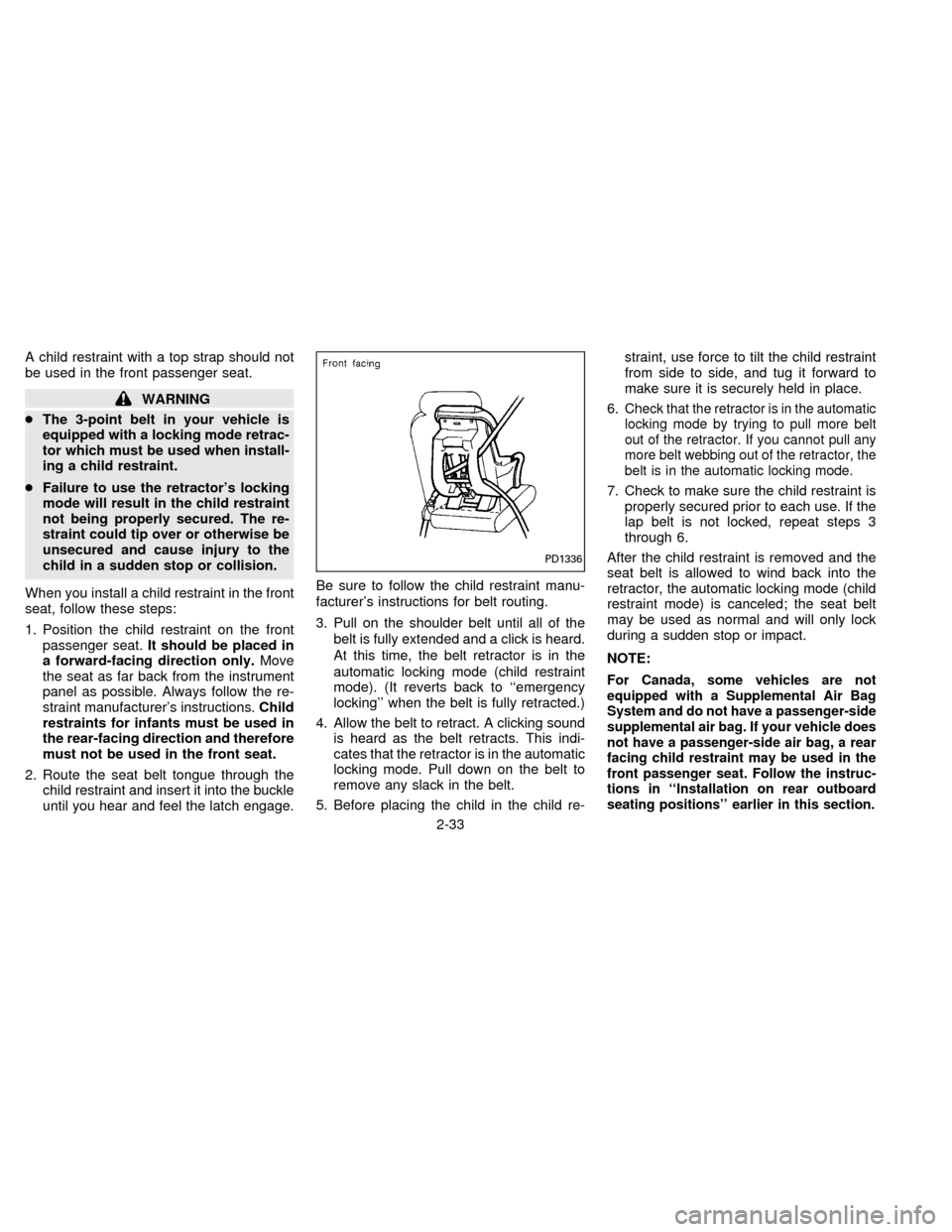
When you install a child restraint in the front
seat, follow these steps:
1. Position the child restraint on the front
passenger seat.It should be placed in
a forward-facing direction only.Move
the seat as far back from the instrument
panel as possible. Always follow the re-
straint manufacturer's instructions.Child
restraints for infants must be used in
the rear-facing direction and therefore
must not be used in the front seat.
2. Route the seat belt tongue through the
child restraint and insert it into the buckle
until you hear and feel the latch engage.Be sure to follow the child restraint manu-
facturer's instructions for belt routing.
3. Pull on the shoulder belt until all of the
belt is fully extended and a click is heard.
At this time, the belt retractor is in the
automatic locking mode (child restraint
mode). (It reverts back to ``emergency
locking'' when the belt is fully retracted.)
4. Allow the belt to retract. A clicking sound
is heard as the belt retracts. This indi-
cates that the retractor is in the automatic
locking mode. Pull down on the belt to
remove any slack in the belt.
5. Before placing the child in the child re-straint, use force to tilt the child restraint
from side to side, and tug it forward to
make sure it is securely held in place.
6.Check that the retractor is in the automatic
locking mode by trying to pull more belt
out of the retractor. If you cannot pull any
more belt webbing out of the retractor, the
belt is in the automatic locking mode.
7. Check to make sure the child restraint is
properly secured prior to each use. If the
lap belt is not locked, repeat steps 3
through 6.
After the child restraint is removed and the
seat belt is allowed to wind back into the
retractor, the automatic locking mode (child
restraint mode) is canceled; the seat belt
may be used as normal and will only lock
during a sudden stop or impact.
NOTE:
For Canada, some vehicles are not
equipped with a Supplemental Air Bag
System and do not have a passenger-side
supplemental air bag. If your vehicle does
not have a passenger-side air bag, a rear
facing child restraint may be used in the
front passenger seat. Follow the instruc-
tions in ``Installation on rear outboard
seating positions'' earlier in this section.
PD1336
2-33
ZX
Page 97 of 191

Freeing a frozen door lock
To prevent a door lock from freezing, apply
de-icer or glycerin to it through the key hole.
If the lock becomes frozen, heat the key
before inserting it into the key hole.
Anti-freeze
In the winter when it is anticipated that the
temperature will drop below 32ÉF (0ÉC),
check the anti-freeze (ethylene glycol base)
to assure proper winter protection. For de-
tails, see ``Engine cooling system'' in the
``Do-it-yourself operations'' section.
Battery
If the battery is not fully charged during
extremely cold weather conditions, the bat-
tery fluid may freeze and damage the bat-
tery. To maintain maximum efficiency, the
battery should be checked regularly. For
details, see ``Battery'' in the ``Do-it-yourself
operations'' section.
Draining of coolant water
If the vehicle is to be left outside without
anti-freeze, drain the cooling system by
opening the drain valves located under the
radiator and on the engine block. Refillbefore operating the vehicle. See ``Chang-
ing Engine Coolant'' in the ``Do-it-yourself
operations'' section.
Tire equipment
1. The SUMMER tires are of a tread design
to provide superior performance on dry
pavement. However, the performance of
these tires will be substantially reduced
in snowy and icy conditions. If you oper-
ate your vehicle on snowy or icy roads,
NISSAN recommends the use of MUD &
SNOW or ALL SEASON TIRES on all
four wheels. Please consult your NIS-
SAN dealer for the tire type, size, speed
rating and availability information.
2. For additional traction on icy roads, stud-
ded tires may be used. However, some
provinces and states prohibit their use.
Check local, state and provincial laws
before installing studded tires.
Skid and traction capabilities of studded
snow tires on wet or dry surfaces may be
poorer than that of non-studded snow
tires.
3. Snow chains may be used if desired.
Make sure they are of proper size for the
tires on your vehicle and are installedaccording to the chain manufacturer's
suggestions.
Use of tire chains may be prohibited
according to location. Check the local
laws before installing tire chains. When
installing tire chains, make sure they are
of proper size for the tires on your vehicle
and are installed according to the chain
manufacturer's suggestions.Use only
SAE Class ªSº chains.Use chain ten-
sioners when recommended by the tire
chain manufacturer to ensure a tight fit.
Loose end links of the tire chain must be
secured or removed to prevent the pos-
sibility of whipping action damage to the
fenders or underbody. If possible, avoid
fully loading your vehicle when using tire
chains. In addition, drive at a reduced
speed, otherwise, your vehicle may be
damaged and/or vehicle handling and
performance may be adversely affected.
Never install tire chains on T-type and
small size spare tires. Do not use the
chains on dry roads.
Special winter equipment
It is recommended that the following items
be carried in the vehicle during winter:
COLD WEATHER DRIVING
CAUTIONS
4-18
ZX