1996 NISSAN PATHFINDER brake
[x] Cancel search: brakePage 137 of 223
IMake sure the rod tip fits in the fitting
portion of the spare tire hanger and
turn the rod.
IBe sure to center the spare tire sus-
pending plate on the wheel and then
lift the spare tire.
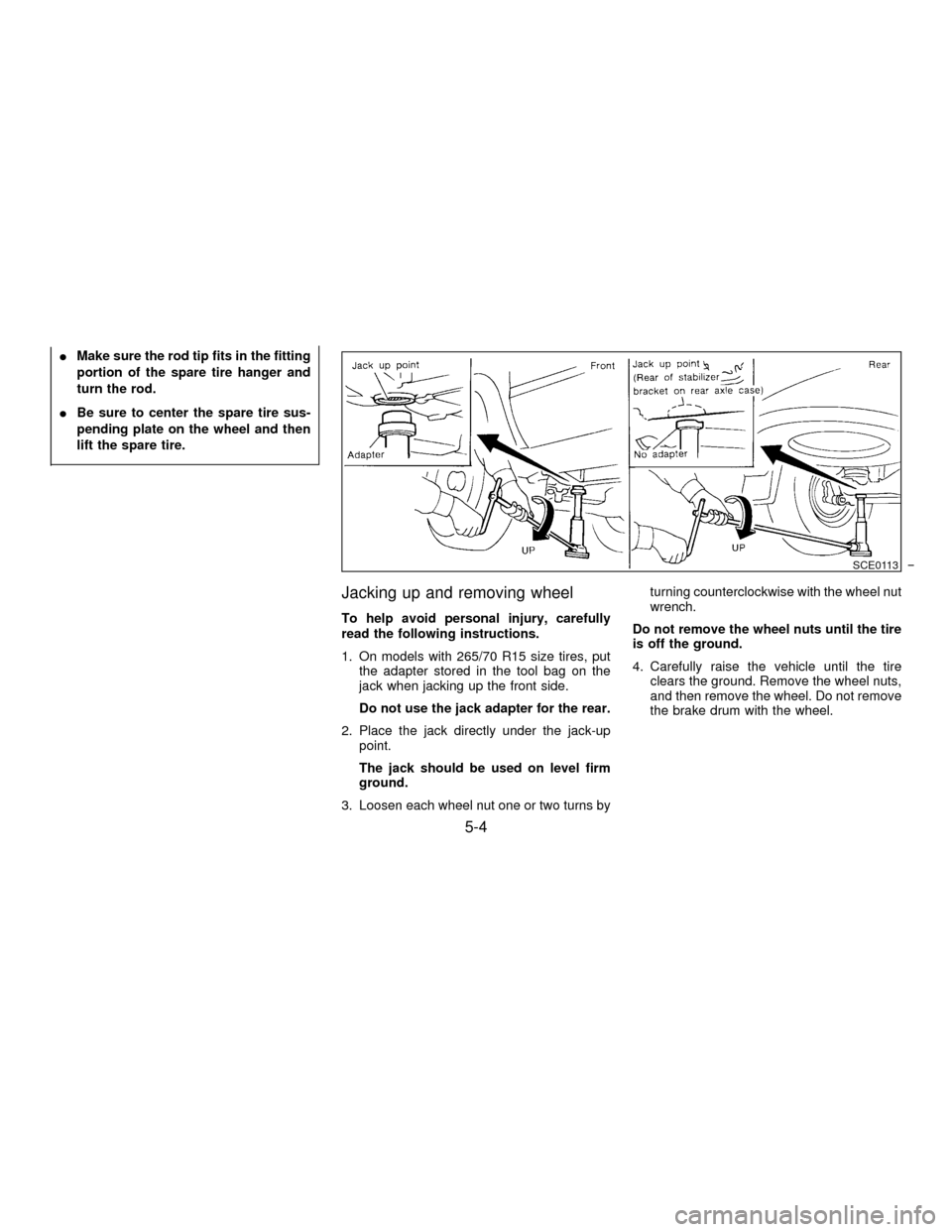
Jacking up and removing wheel
To help avoid personal injury, carefully
read the following instructions.
1. On models with 265/70 R15 size tires, put
the adapter stored in the tool bag on the
jack when jacking up the front side.
Do not use the jack adapter for the rear.
2. Place the jack directly under the jack-up
point.
The jack should be used on level firm
ground.
3. Loosen each wheel nut one or two turns byturning counterclockwise with the wheel nut
wrench.
Do not remove the wheel nuts until the tire
is off the ground.
4. Carefully raise the vehicle until the tire
clears the ground. Remove the wheel nuts,
and then remove the wheel. Do not remove
the brake drum with the wheel.
SCE0113
5-4
Z01.2.1/R50-DX
Page 140 of 223
If you try to start your engine with a booster
battery, follow the instructions and precautions
below:
IIf done incorrectly, jump starting can
be hazardous.
IExplosive hydrogen gas is always
present in the vicinity of the battery.
Keep all sparks and flames away from
it.
IDo not allow battery fluid to come
into contact with eyes, skin, cloth or
painted surfaces. Battery fluid is a
corrosive sulphuric acid solution
which can cause severe burns. If the
fluid should come into contact with
anything, immediately flush the con-
tacted area with water.
IA battery rated at above 12 volts
should not be used for a booster.
IWhenever working on or near a bat-
tery, always wear suitable eye protec-
tors (e.g., goggles or industrial safety
spectacles) and remove rings, metal
bands, or any other metal jewelry.IKeep battery out of the reach of
children.
Always follow the instructions below
exactly. Failure to do so could result in
damage to the charging system and
cause personal injury.
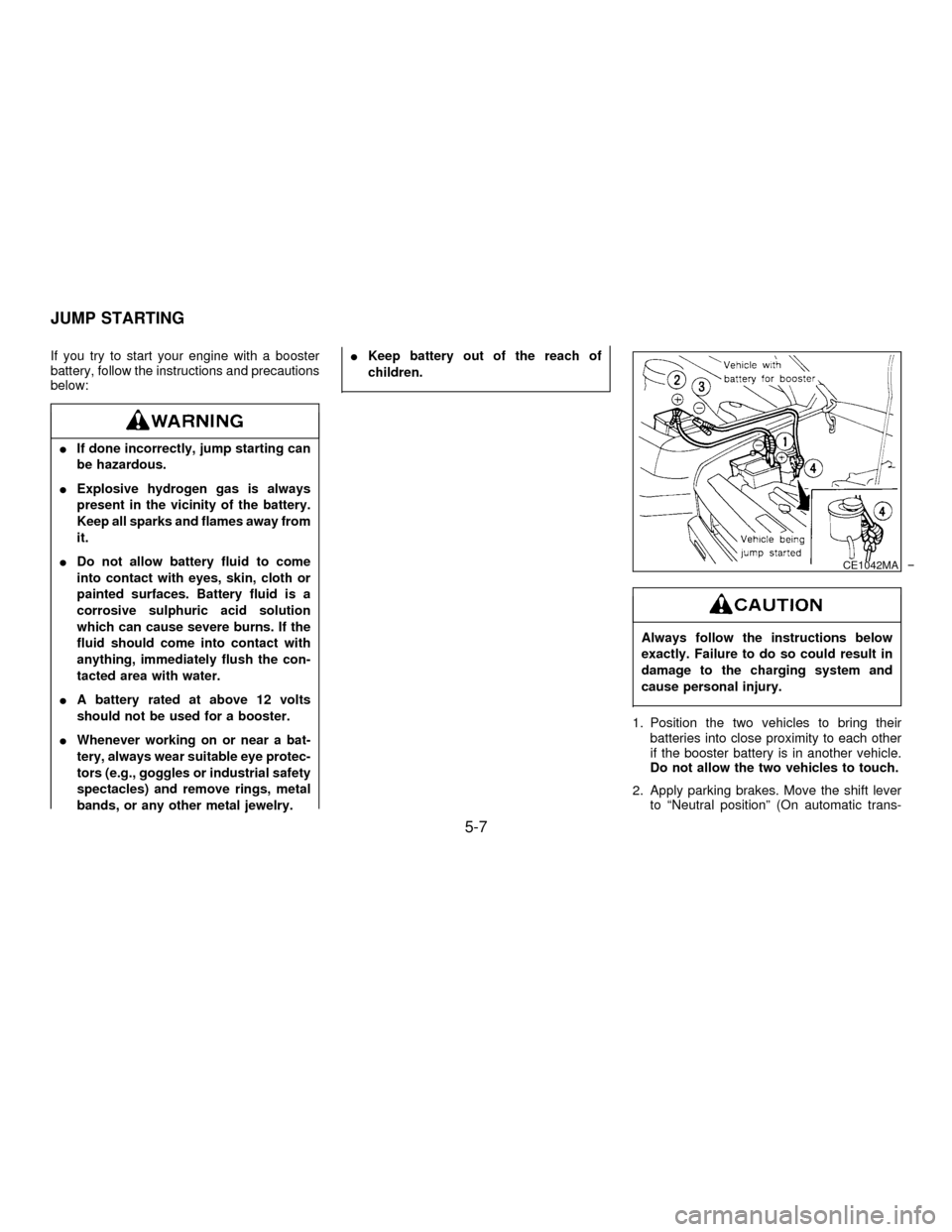
1. Position the two vehicles to bring their
batteries into close proximity to each other
if the booster battery is in another vehicle.
Do not allow the two vehicles to touch.
2. Apply parking brakes. Move the shift lever
to ªNeutral positionº (On automatic trans-
CE1042MA
JUMP STARTING
5-7
Z01.2.1/R50-DX
Page 142 of 223
If your vehicle is overheating indicated by an
extremely high temperature gauge reading, or
if you feel a lack of engine power, detect
abnormal noise, etc., take the following steps:
To avoid the danger of being burned,
never remove the radiator cap while the
engine is still hot. When the radiator cap
is removed, pressurized hot water will
spurt out, possibly causing serious
injury.
1. Move the vehicle safely off the road, apply
the parking brake and move the gearshift
lever to the neutral position (automatic
transmission to ªPº).
Do not stop the engine.
2. Turn off the air conditioner switch. Open all
the windows, move the heater or air condi-
tioner temperature control to ªmaximum
hotº and fan control to ªhigh speedº.
3. Get out of the vehicle. Look and listen for
steam or coolant escaping from the radiator
before opening the hood. Wait until no
steam or coolant can be seen before pro-
ceeding.4. Open the engine hood.
If steam or water is coming from the
engine, stand clear to prevent getting
burned.
5. If engine overheating is caused by climbing
a long hill on a hot day, run the engine at a
fast idle (approximately 1,500 rpm) until the
temperature gauge indication returns to
normal.
6. Visually check drive belts for damage or
looseness. Also check if the cooling fan is
running. The radiator hoses and radiator
should not leak water.
IBe careful not to allow your hands,
hair or clothing to come into contact
with, or to get caught in, the running
fan or belts.
IIf coolant is leaking, the cooling fan
belt is missing or loose or the cooling
fan does not run, stop the engine.
7. After the engine cools down, check the
coolant level in the reservoir tank with the
engine running. Add coolant to the reservoir
tank if necessary. Have your vehicle re-
paired at the nearest NISSAN dealer.
IF YOUR VEHICLE OVERHEATS
5-9
Z01.2.1/R50-DX
Page 143 of 223
When towing your vehicle, all State (Provincial
in Canada) and local regulations for towing
must be followed. Incorrect towing equipment
could damage your vehicle. Towing instruc-
tions are available from your NISSAN dealer.
Local service operators will generally be famil-
iar with the applicable laws and procedures for
towing. To assure proper towing and to pre-
vent accidental damage to your vehicle, NIS-
SAN recommends that you have a service
operator tow your vehicle. It is advisable to
have the service operator carefully read the
following precautions.
IWhen towing, make sure that the
transmission, axles, steering system
and power train are in good order. If
any unit is damaged, a dolly must be
used.
IWhen towing with the front wheels on
the ground:
Turn the ignition key to the ªOFFº
position and secure the steering
wheel in a straight-ahead position
with a rope or similar device. Never
place the ignition key in the ªLOCKºposition. This will result in damage to
the steering lock mechanism.
IWhen towing manual transmission
models with the rear wheels on the
ground, release the parking brake
and move the gearshift lever to the
neutral position.
IFor 4-wheel drive model:
Move the transfer case shift lever into
the ª2Hº position and the transmis-
sion shift lever into the neutral (ªNº)
position.
IAttach safety chains for all towing.2-WHEEL DRIVE MODELS
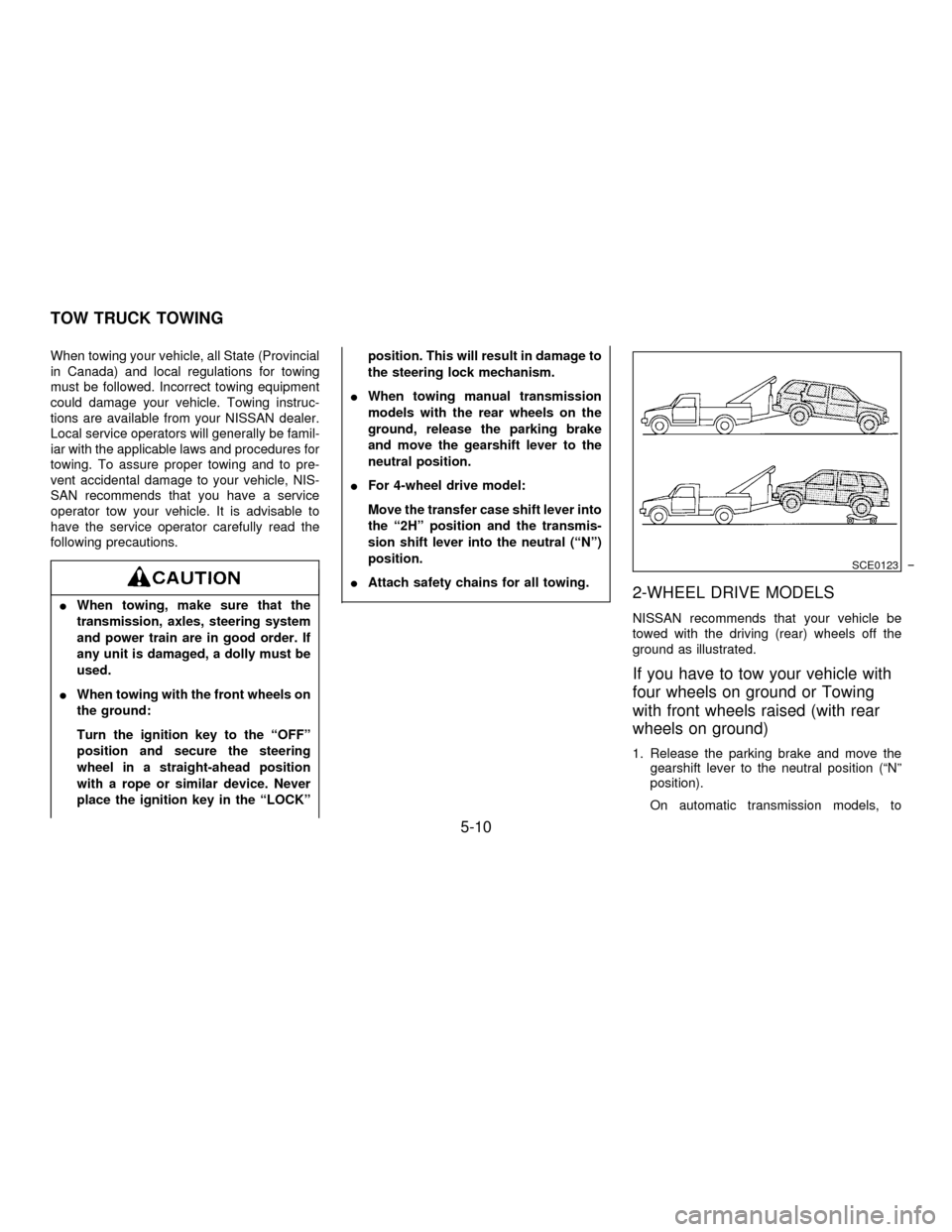
NISSAN recommends that your vehicle be
towed with the driving (rear) wheels off the
ground as illustrated.
If you have to tow your vehicle with
four wheels on ground or Towing
with front wheels raised (with rear
wheels on ground)
1. Release the parking brake and move the
gearshift lever to the neutral position (ªNº
position).
On automatic transmission models, to
SCE0123
TOW TRUCK TOWING
5-10
Z01.2.1/R50-DX
Page 145 of 223
If you have to tow your vehicle with
four wheels on ground or Towing
with front or rear wheels raised
1. Release the parking brake and move the
gearshift lever to the neutral position (ªNº
position).
On automatic transmission models, to
move the shift lever to neutral (ªNº position),
turn the ignition key to the ªACCº position.
After moving the shift lever to neutral (ªNº
position), be sure to turn the ignition key to
the ªOFFº position.
2. Observe the following restricted towing
speeds and distances.
Automatic transmission model:
ISpeed: Below 30 MPH (50 km/h)
IDistance: Less than 40 miles (65 km)
Manual transmission model:
ISpeed: Below 60 MPH (95 km/h)
IDistance: Less than 500 miles (800 km)
If the speed or distance must necessarily be
greater, remove the front and rear propeller
shafts beforehand to prevent damage to the
transmission.
INever tow your vehicle from the rear
(i.e., backward) with four wheels on
the ground as this may cause serious
and expensive damage to the trans-
mission.
IBe sure to place the transfer case
shift lever into the ª2Hº position and
the transmission shift lever into the
neutral (ªNº) position.
VEHICLE RECOVERY (Freeing a
stuck vehicle)
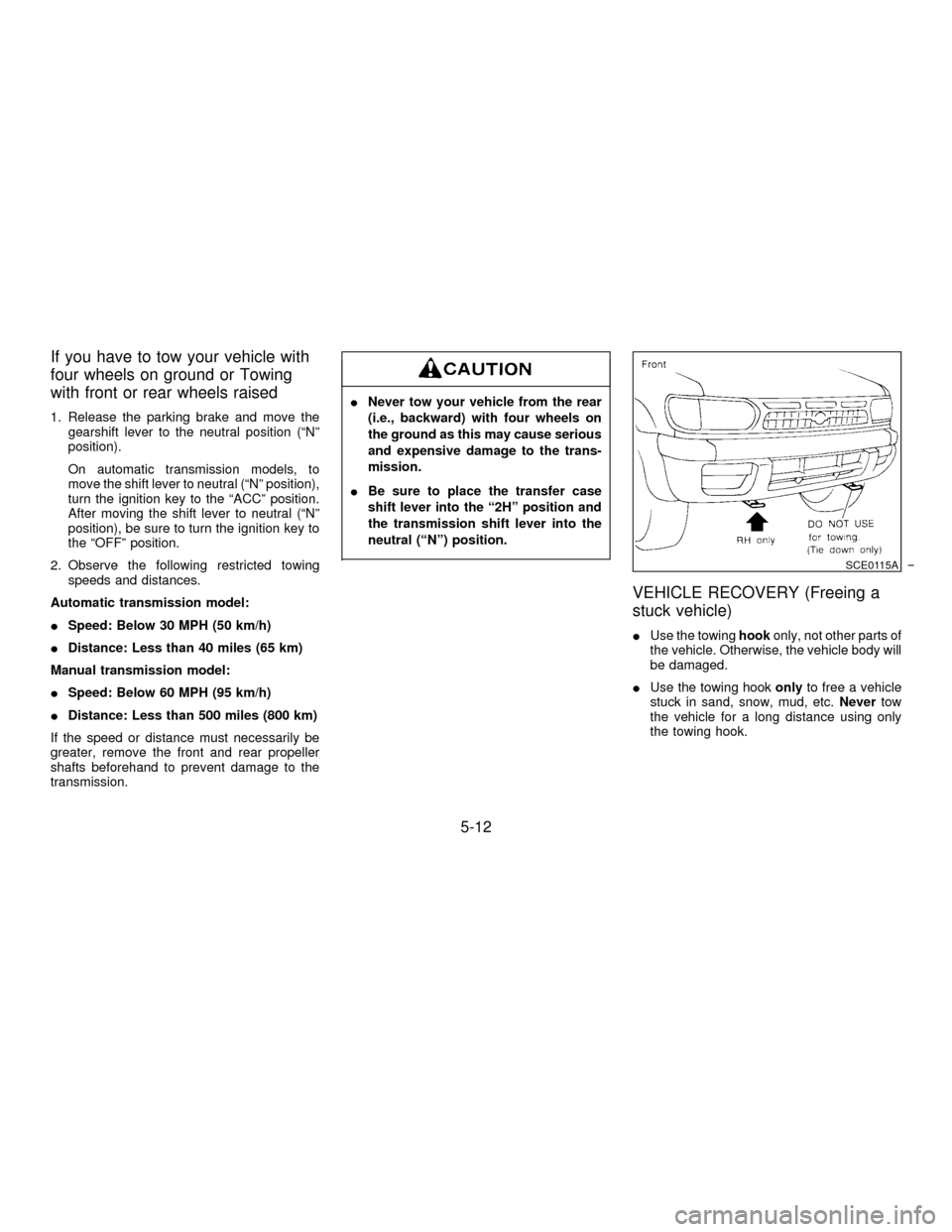
IUse the towinghookonly, not other parts of
the vehicle. Otherwise, the vehicle body will
be damaged.
IUse the towing hookonlyto free a vehicle
stuck in sand, snow, mud, etc.Nevertow
the vehicle for a long distance using only
the towing hook.
SCE0115A
5-12
Z01.2.1/R50-DX
Page 154 of 223
7 Do-it-yourself operations
Precautions ............................................................ 7-2
Engine cooling system ........................................... 7-4
Engine oil ............................................................... 7-7
Automatic transmission fluid .................................. 7-9
Power steering fluid ............................................. 7-11
Brake and clutch fluid .......................................... 7-11
Window washer fluid ............................................ 7-12
Battery .................................................................. 7-13
Drive belts ............................................................ 7-14
Spark plug replacement ....................................... 7-14
Air cleaner filter .................................................... 7-16
Wiper blade .......................................................... 7-17
Parking brake ....................................................... 7-18
Brake pedal .......................................................... 7-19
Brake booster ....................................................... 7-20
Clutch pedal ......................................................... 7-20
Fuses ................................................................... 7-20
Light bulbs ............................................................ 7-22
Wheels and tires .................................................. 7-26
Clutch housing ........................................... 7-30
Z01.2.1/R50-DX
Page 155 of 223
When performing any inspection or mainte-
nance work on your vehicle, always take care
to prevent serious accidental injury to yourself
or damage to the vehicle. The following are
general precautions which should be closely
observed.
IPark the vehicle on a level surface, apply
the parking brake securely and block the
wheels to prevent the vehicle from mov-
ing. For a manual transmission, move
the shift lever to Neutral. For an auto-
matic transmission, move the shift lever
to ªPº (Park).
IBe sure the ignition key is in the ªOFFº
or ªLOCKº position when performing
any replacement or repair.
IDo not work under the engine hood
while it is hot. Always turn off the engine
and wait until it cools down.
IIf you must work with the engine run-
ning, keep your hands, clothing, hair
and tools away from moving fans and
fan belts.
IIt is advisable to remove necktie and any
jewelry, such as rings, watch, etc. before
working on your vehicle.
IIf you must run the engine in an en-
closed space such as a garage, be surethere is proper ventilation for exhaust
gases.
INever get under the vehicle while it is
supported only by a jack. If it is neces-
sary to work under the vehicle, support
it with safety stands.
IKeep smoking materials, flame and
sparks away from fuel and battery.
INever connect or disconnect either the
battery or any transistorized component
connector while the ignition key is on.
IAlways apply the parking brake and
block the wheels to prevent the vehicle
from moving.
IThe fuel filter or fuel lines should be
serviced by a NISSAN dealer because
the fuel lines are under high pressure
even when the engine is off.
IFailure to follow these or other common
sense guidelines may lead to serious
injury or vehicle damage.
IImproperly disposed motor oil and/or
other vehicle fluids can hurt the environ-
ment. Always conform to local regula-
tions for disposal of vehicle fluid.
IAvoid direct contact with used engine
oil.This ªDo-it-yourself operationsº section gives
instructions regarding only those items which
are relatively easy for an owner to perform.
You should be aware that incomplete or im-
proper servicing may result in operating diffi-
culties or excessive emissions, and could af-
fect your warranty coverage.If in doubt about
any servicing, have it done by your NISSAN
dealer.
PRECAUTIONS
7-2
Z01.2.1/R50-DX
Page 160 of 223
CHECKING ENGINE OIL LEVEL
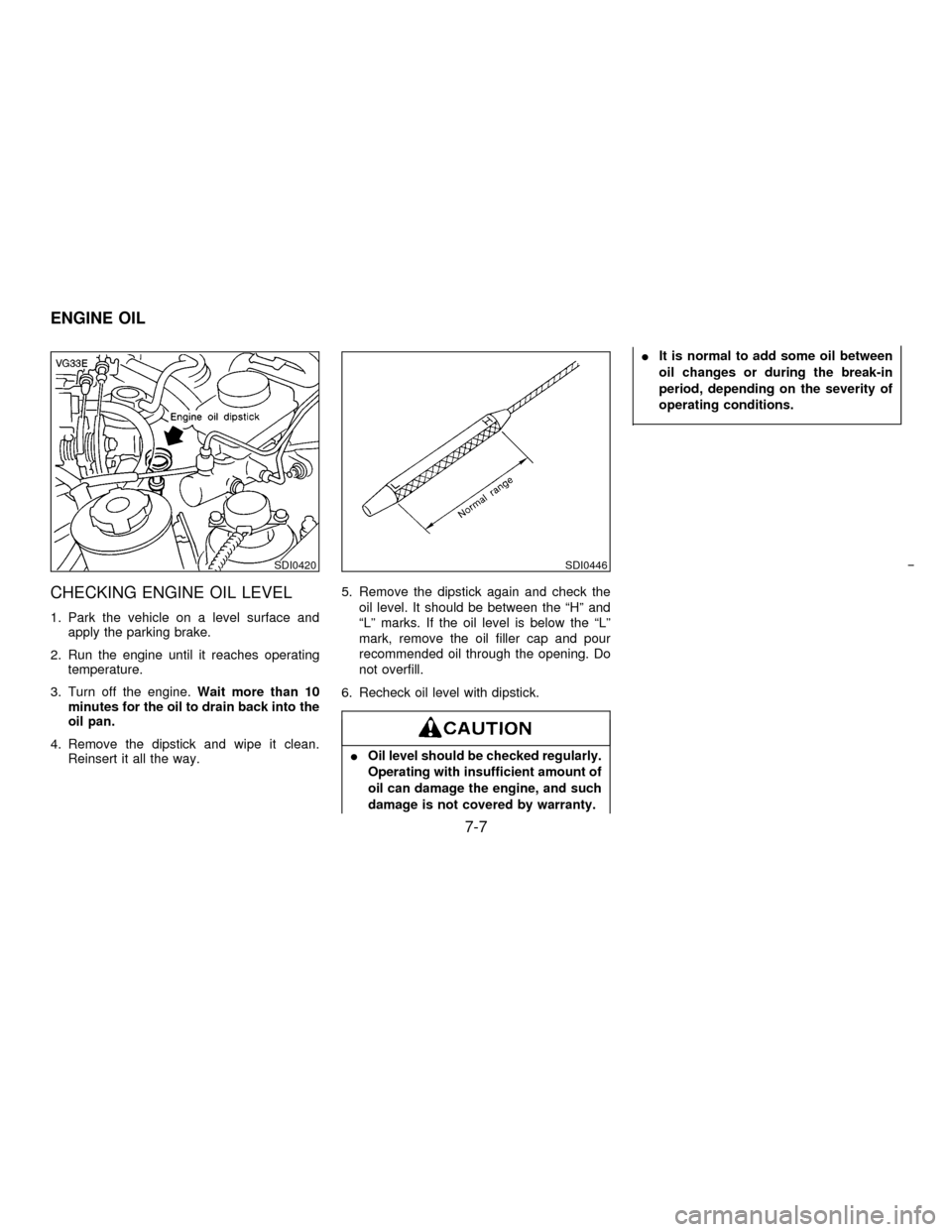
1. Park the vehicle on a level surface and
apply the parking brake.
2. Run the engine until it reaches operating
temperature.
3. Turn off the engine.Wait more than 10
minutes for the oil to drain back into the
oil pan.
4. Remove the dipstick and wipe it clean.
Reinsert it all the way.5. Remove the dipstick again and check the
oil level. It should be between the ªHº and
ªLº marks. If the oil level is below the ªLº
mark, remove the oil filler cap and pour
recommended oil through the opening. Do
not overfill.
6. Recheck oil level with dipstick.
IOil level should be checked regularly.
Operating with insufficient amount of
oil can damage the engine, and such
damage is not covered by warranty.IIt is normal to add some oil between
oil changes or during the break-in
period, depending on the severity of
operating conditions.
SDI0420SDI0446
ENGINE OIL
7-7
Z01.2.1/R50-DX