Page 149 of 320
The operator verbally obtains details of Your
situation and, if necessary, ties your vehicle into a
three-way phone call with the United States Auto
Club or local 911 or other emergency services to
dispatch the appropriate assistance to your
location. Once the situation has been appropriately
handled, the operator will terminate the call, the
system warning light will stop flashing and the
system will be reset. In most situations, ONLY
the response center can terminate an assistance
request.
General Description
Lincoln's Remote Emergency Satellite Cellular
Unit (RESCU) is designed to expedite roadside or
emergency assistance to distressed motorists who
are uncertain of their location and/or are uncertain
of who to contact for assistance.
The Lincoln RESCU System utilizes Global
Positioning System (GPS) technology and the
146nation's cellular phone network to track vehicle
location and, at the touch of a button, put you in
voice contact with the Lincoln Security
Response Center.
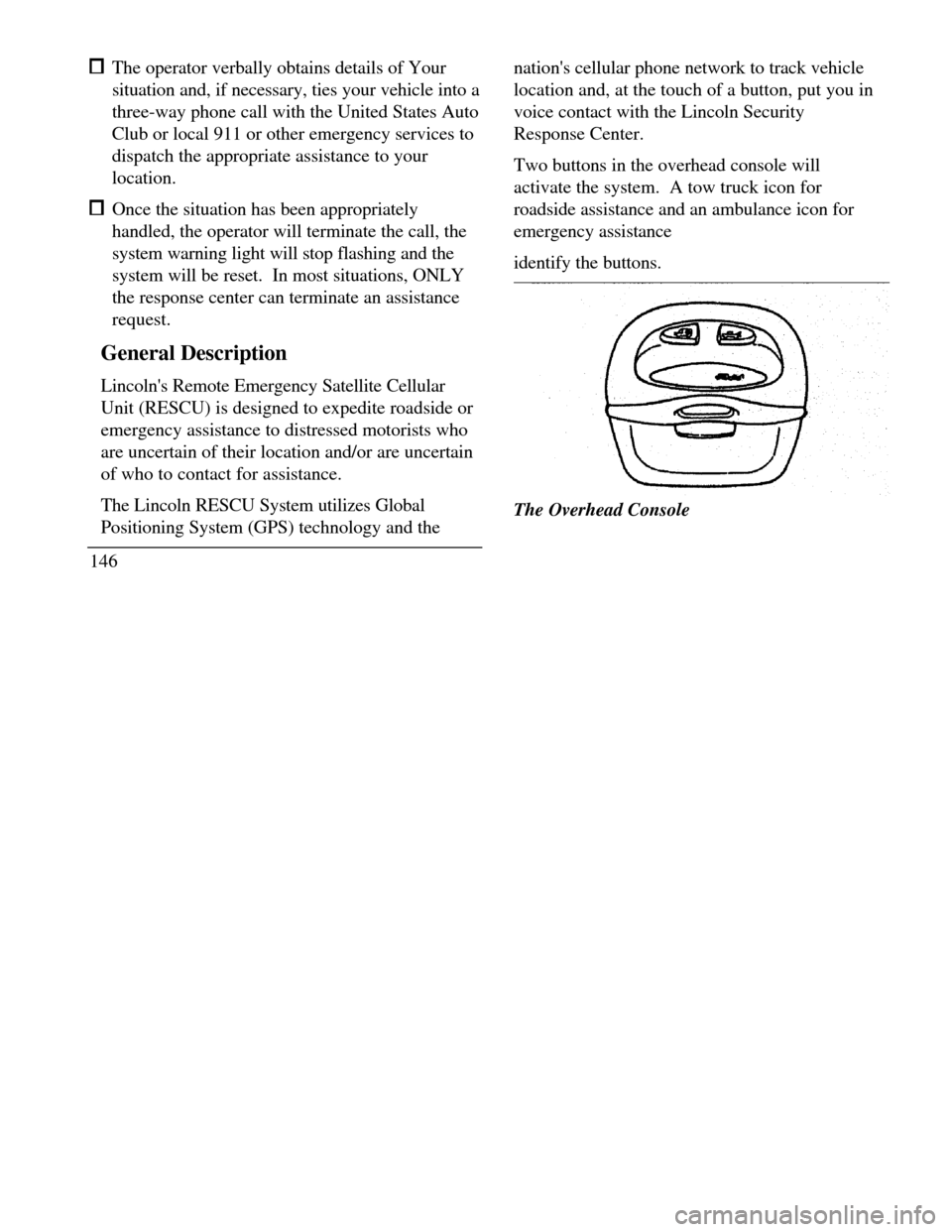
Two buttons in the overhead console will
activate the system. A tow truck icon for
roadside assistance and an ambulance icon for
emergency assistance
identify the buttons.The Overhead Console
Page 152 of 320

when appropriate, stay in direct phone contact
with you until emergency help arrives notify pre-designated family contacts or friends
of the emergency situation, if requested, or if no
response is received from the vehicle.
NOTE: If You are certain of your location, a direct
phone call to 911 or other emergency services may
provide a faster response.
Activation and Deactivation
When either of the two Lincoln RESCU buttons is
pressed, a warning light, located in the overhead
console, will begin to flash and status messages will
be displayed on the vehicle's message center,
confirming an assistance request has been made.
The warning light will continue to flash throughout
the activation.The RESCU Warning light
The system can be activated whenever your
ignition key is in the RUN/START Position and
for two Minutes after your vehicle is turned off.
In most situations, the assistance request can
ONLY be terminated and the system reset when
a special tone is sent to the vehicle by the
Lincoln Security Response Center. (See
Automatic Redial later in this chapter for
exceptions.) Operation will continue even if the
vehicle is turned off during an activation
(although visual feedback via the Message
Center will not be available in this situation).
149
Page 177 of 320
How to take care of and clean the CD Changer and
discs
To ensure the continued performance of your CD
Changer carefully read the following precautions: Always handle a disc by the edge. Never
touch the playing surface. Before playing, inspect all discs for any
contamination. If needed, clean discs with an
approved disc cleaner, such as the
DiscwasherÒ Compact Disc Cleaner or the
AllsopÒ 3 Compact Disc Cleaner, by wiping
from the center out to the edges. Do not use
a circular motion to clean. Do not clean discs with solvents such as
benzine, thinner, commercially available
cleaners or antistatic spray intended for analog
records. Do not expose the discs to direct sunlight or
heat sources for an extended period of time.
174 Do not insert more than one disc into
each disc slot of the disc magazine.
Doing so may damage the discs, disc
magazine or the disc changer. Do not insert anything other than discs
into the disc magazine./! WARNINGThe laser beam used in the compact discplayer is harmful to the eyes. Do notattempt to disassemble the case.CD Error Messages
Your system is equipped to diagnose
certain problems you may experience.
The error codes are:
-CD El - Mechanism error.
-CD E2 - Focus error.
-BAD CD - Disc unreadable.
Page 190 of 320

Brakes
Applying the Brakes
Your vehicle has anti-lock disc brakes on all four
wheels. They adjust automatically as the brake pads
wear down.
When you press down hard on the brake pedal, the
wheels will not lock and slide. The Anti-lock Brake
System (ABS) automatically starts releasing and
reapplying the front brakes independently and the
rear brakes together whenever your wheels start to
lock. When this happens, you will feel the brake
pedal pulsate. This is an indication that the ABS
system is working correctly and is normal.
Each time you turn the ignition key to the ON
position, the anti-lock brake system will function
through one test cycle. When this happens, the ANTI-
LOCK light will come on for up to five seconds and a
clunk may be felt in the pedal. If the light stays on
longer than five seconds, shut off theengine and restart. If it remains on, it means the
anti-lock brake system is disabled and should be
serviced immediately to restore the benefits of
the anti-lock feature. Normal braking is not
affected unless the brake warning light is also lit.
The And-lock Brake System has self-check
capabilities. As described above, the system
turns on the ANTI-LOCK light each time you
start your engine. After the engine is started
and the ANTI-LOCK light turns off, the system
performs another test the first time the vehicle
reaches 14 m.p.h. (22 km/h). The system turns
on the ABS pump motor for approximately 1/2
second. At this time, a mechanical noise may
be heard. This is a normal part of the self-
check feature. If a malfunction is found during
this check the ANTI-LOCK light will come on.
Do not drive with your foot resting on the
brake pedal; you will wear out the linings and
increase your vehicle's stopping distance.
Brake rotor damage may also eventually occur.
187
Page 192 of 320
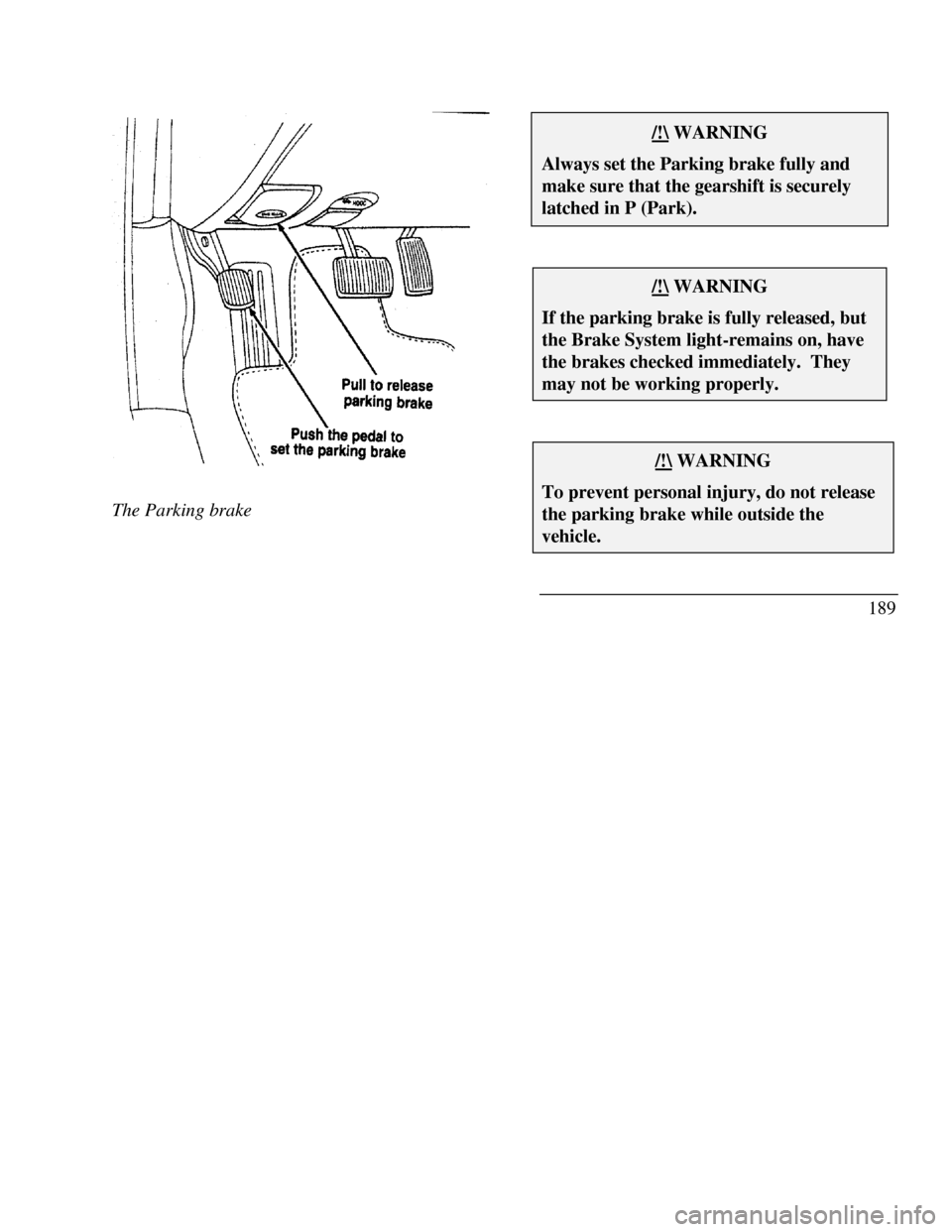
The Parking brake/!\ WARNINGAlways set the Parking brake fully andmake sure that the gearshift is securelylatched in P (Park)./!\ WARNINGIf the parking brake is fully released, butthe Brake System light-remains on, havethe brakes checked immediately. Theymay not be working properly./!\ WARNINGTo prevent personal injury, do not releasethe parking brake while outside thevehicle.189
Page 193 of 320

You have an automatic release for the parking brake.
The parking brake should automatically unlock when
you move the gearshift to any forward gear while the
engine is running. However, the automatic release
does not work when the gearshift is in reverse,
neutral or park.
To manually release the parking brake, pull the
BRAKE RELEASE handle located on the lower left
comer of the instrument panel. The Brake Warning
Light will illuminate if the parking brake is not fully
released when the engine is running.
The parking brake is not designed to stop a moving
vehicle, but you can use the parking brake to stop
your vehicle in an emergency if the normal brakes
fail. However, since the parking brake applies only
the rear brakes, the stopping distance will increase
greatly and the handling of your vehicle will be
adversely affected.
190Always check the Brake Warning light each
time you start your engine. Driving with the
parking brake on will cause the brakes to wear
out quickly and will reduce the fuel economy.
Driving Under Special Conditions
Tips for Safe Driving
As with any new vehicle, yours may drive and
handle differently from your previous vehicle.
Use care until you become accustomed to its
various features and driving characteristics.
Operate your vehicle within reasonable limits.
Sudden acceleration, deceleration, turning, or
combinations of these maneuvers can cause a
vehicle to behave differently than anticipated.
Page 194 of 320
Driving in Bad Weather
Slippery roads
On some slippery road surfaces, front-wheel drive
may provide better acceleration than rear-wheel
drive. However, this does not mean that your
vehicle can stop any faster or any better than a
vehicle with rear-wheel drive. Exercise the same
caution while driving on slippery roads with your
front-wheel drive vehicle as you would with a rear-
wheel drive vehicle. Do not quickly move the steering wheel unless
necessary. Drive slower than you normally would. Give your vehicle more distance to stop./!\ WARNINGTo avoid skidding and losing control onslippery roads, do not downshift into First(1) when you are moving faster than 20mph (32 km/h)./!\ WARNINGIf your vehicle has speed control, do notuse it on slippery roads. You could losecontrol of your vehicle and could injuresomeone.If your vehicle gets stuck (for example, in mud
or snow), you may try to "rock" it out of the
spot. Shift, in a steady rhythm, between
forward and reverse gears. While in each gear,
press lightly on the accelerator and release.
191
Page 200 of 320

To connect the trailer's safety chains:
1. Cross the chains under the trailer tongue and
attach them to your vehicle's frame or hook
retainers. Never attach the safety chains to your
vehicle's bumper. The bumper is not designed to
bear the weight of a trailer.
2. Make sure that you leave enough slack in the
chains to allow you to turn corners.
If you use a rental trailer, follow the instructions that
the rental agency gives you.
Connecting the trailer's brakes
Electric brakes and manual, automatic, or surge-type
hydraulic brakes are safe if you install them properly
and adjust them according to the manufacturer's
instructions. Be sure that your trailer's brakes meet
local and federal regulations.
Separate trailer brakes of adequate size should be
used for trailers weighing over 1.000 lbs. (454 kg)
loaded weight./!\ WARNINGDo not connect a trailer's hydraulicbrake system directly to your vehicle'sbrake system. Your vehicle may nothave enough braking power and yourchances of having a collision greatlyincrease.Connecting the trailer's lights
Do not connect a trailer's fighting system
wiring directly to your vehicle's fighting
system wiring. To get the proper equipment
for hooking up your trailer's lights, see your
local trailer dealer and your Ford dealer. Be
sure to follow their instructions carefully.
If you do not install trailer lights correctly, you
may cause damage to the vehicle's hghting
system.
197