1996 HONDA CIVIC Can
[x] Cancel search: CanPage 1899 of 2189
PGM-FI (All '9$"q) Models except D16Y5 with M/T and D1685) (cont'd)
@@
i-l;;--
----1-:::=*"---l
!,8,:"ff
| )'rEnsuorr ( tu seo Power I hEiiY
'r9,1%, 'r F,1%,wHr/FEo I v/El/v 34 'HT/FED s€e power w111,6s1 | vtew zz
a 1 oistribution, ll wrlcnr See power
wrr neo I pa$iGio. OF+ DstnbJtron.
t I tn"to"n ! Pa9o 1s13'
oAra LINK z llCONN-ECTOR (DLC) (with cruise controt 4) A
vtEw 48 t?e1 BRAKE SWTTCH
isT-rrT ltf !1.l'".e'.l;'[3J:5:
""[ ":T-:"C-l:.Frd*Fl
lll,
"""f "",T
""U]-t-.,-t-..*.",,""*^i:# [*iu'r;i:;r.';
'""o1""1 ""l
l ;f=:&ri'n"*,,.,0r
[
.---+_s,:.;-,
"*,**il [ff'ftrs,llr,
*,.!. ^* IA2r |' A32 A
: {r(LlN€) €KSW} |I Data Braksfleu.rt} ft svyl IData Braksinpuv switch Ioutput inpd \\' wEC VTEC PSP
I PHaro 123lcvr) D16y5/Dr6y8/ : : PHoro 123lcw)
---'- ei6A2'"noin"i ---- "--- usA
;
L
Dr€ssure vaNesrlitoh input conkol(Vnr) 0rs)
*{
---
"::l
fTlxlE8,u,. I
lc-- ll#il?i,",,*, I
"il
II see crouno
! Fi"frW """,*f,f,',11,r,",.*,
-'l
I
""""iJ,,.lff*u"'"
yi qr;;;i6;;o,E.6A',
: PHOTO 33
sYvltctlinDut
---u-r----
can I
s I crer
"Tl t#ffl","
I-'I-I POWER STEERINGI ' I PRESSURE (PSP)
lc_.ltg+I9i
,
f ff&G{lfd Drsribution,
""L----i
F*i,""," I.----a- -r*ro_*
|"," I vtEw 39
Lr----J
: PHATO 33
\
I
I
pag€ 142.
24-4
Page 1902 of 2189
![HONDA CIVIC 1996 6.G Workshop Manual POWERTRAINCONTFOLMODULE(PCM)PHOTO 86
FUSE 15AIEiIIATOR3F S€txsoe?.5A
c10t
vtEw 28
See Pow€rDisltbution,page 10"5.
UNDER-DASHFUSE/RELAYBOXPhoTo 58
r
)
BLXAVTIT
IBLK]YEL
cl15
ffiru
fiE$-i-fi,#*,ry](/manual-img/13/6068/w960_6068-1901.png "HONDA CIVIC 1996 6.G Workshop Manual POWERTRAINCONTFOLMODULE(PCM)PHOTO 86
FUSE 15AIEiIIATOR3F S€txsoe?.5A
c10t
vtEw 28
See Pow€rDisltbution,page 10\"5.
UNDER-DASHFUSE/RELAYBOXPhoTo 58
r
)
BLXAVTIT
IBLK]YEL
cl15
ffiru
fiE$-i-fi,#*,ry")
POWERTRAINCONTFOLMODULE(PCM)PHOTO 86
FUSE 15AI'EiIIATOR3F S€txsoe?.5A
c10t
vtEw 28
See Pow€rDisltbution,page 10"5.
UNDER-DASHFUSE/RELAYBOXPhoTo 58
r
)
BLXAVTIT
IBLK]YEL
cl15
ffiru
fiE$'-i-fi,#*,ryffi#
liltilf
*-"';
.,"Ht-tll3::l L# ;FiiJshf# !,n$f*'"., I
Pca''' v/
$1-
{-r j,=1#:llx
vtEw 59
: (Pa2grTG)I Primary
I HO2S
{s!2sHTC) {PCS) (VSV) (2\4AS) : ap.ip-"0"'y evnF -pirge Evni'&mrot evrF biitass I l$lf"o.HO2S conlrol canister venl solenoid | :.^^... -| [&? heator solenoid shut valve vatue cdntrol I lil9P-uLE
i lffitsr conuot varv€ controt conaor ---
| !:3,T),.
LJ---------J'" Y F;o""L*ELKArrHr I v/El, so
24-7
Page 1906 of 2189
--.I POWERTRAt lor I I rusers i oasx
I ! EtR'+[i. i ) el'stwg^ seepower i[EiFi
*'tr
_____:l*.'
#l:_l::i\--
$11*"1
;f;,_,
,, lhtEffe. i l giTr**- Bi:,ffiilsr iI Secondary
i- - - - - - - - :84 - - - i fis"'!r"'**,,i *#i5
-''!
lil$iiiE- ilt5t--- -oii,ib"t;". lEb;I S.econdary | iFCrrr-o, eCn11l I - page 1O-5. I Fa6io sa
_,a"3,____ j ",E"-o t" y;rjrt...
A23 Y BLKrt!/Hr I v4d5o
[t] |
:iT[r""-l
*.--il''""'
:xl f''i-'l !trLw18 I .Ar*
Seecround : GRNBLKI BLK\"HI I FEoYELI LT GRN wttr
ii.ir'r;U: !
1 [
*"=[:-{r**,,"'^"'l
Fi{f},ff' ".**n,t
"-#::"""_
! 1""'"*..!.--":i^."^ I I lfuri+ta:"
| * | ,"",1*--".Jrr*,, ,l ,l LSn*ur,"
Ll _, ffii** $
w**-
ry
*il
I
*i{tu
Page143. : It I I i - Yi',,,u,
[!l
",,,
,F"
|
"."":.tun't
+ F,'"%*
----, (sO2sHTc) (PCS) (vSV) L2WBS)i Secondary EVAP pufge EVAP control EVAP bypass !r. HO2S control canister venl solenoid Itt heater solenoid shut valve valve control I! control valve control controli *'-- |.E------ ----J
13 g c401
POWER.TRAIN orENGINECONTROLMODULE(PCM orECM)
vtEW 70
24-11
Page 1907 of 2189
Programmed Fuel Injection System (PGM-F|) (D1685)
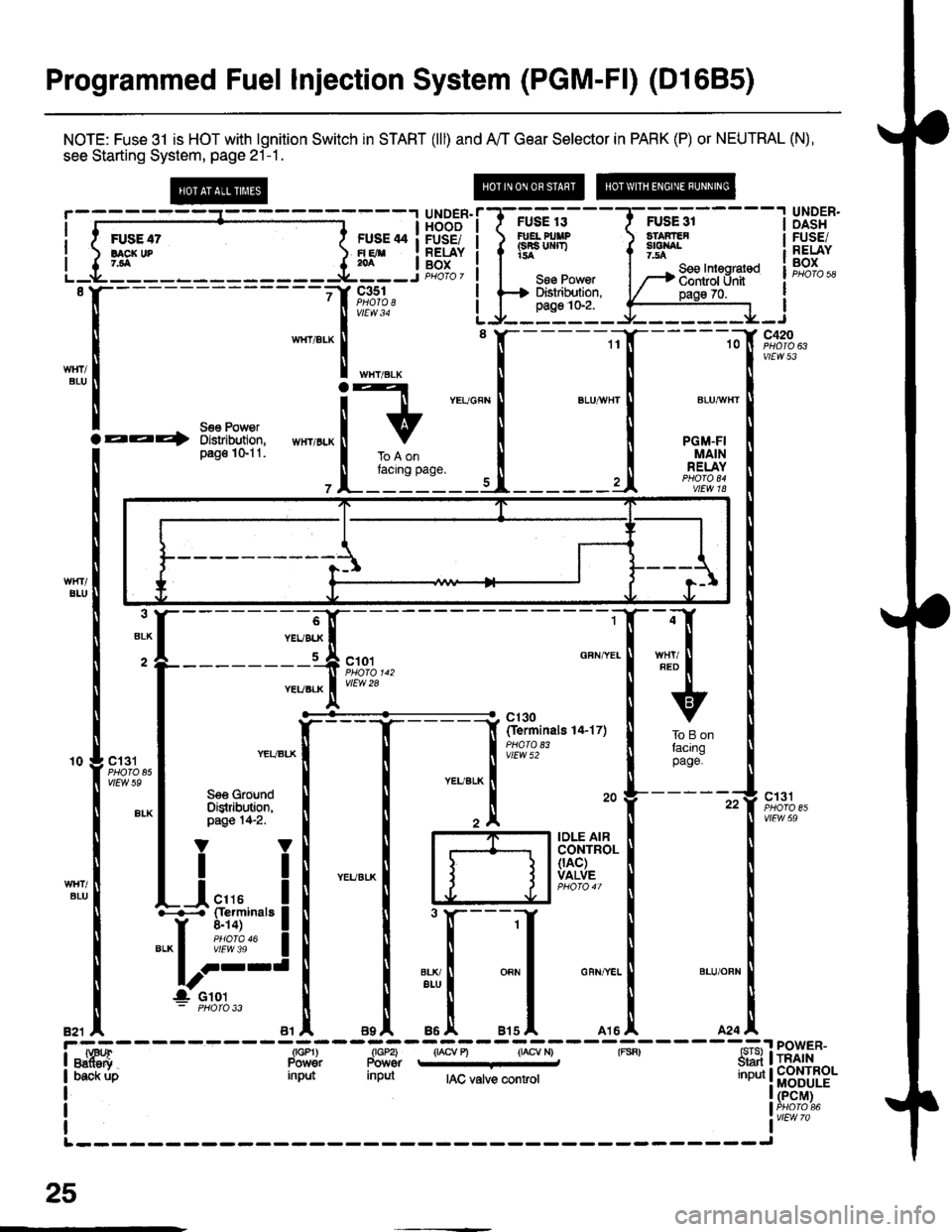
NOTE: Fuse 31 is HOT with lgnition Switch in START (lll) and A'/T Gear Selector in PARK (P) or NEUTRAL (N),
see Starting System, page 21-1 .
@
ii6iir-
- -TFU'E;--- - -
I gI3'5"
y#*i[HtF{,iiH.frIHHi Jiffi" !['.iF{,$SNALr5a Y 7.54| - See Inleqrat€dSse Pow€r | --+ ffii;l'i; -- | Phoro 58i ffi ffi:- |EHF? i I
p--',b"
I iffij*,**.,* iFE^l
SACI( UP7,ta
'[-------------'[&T:1,
L.[E"Jj!i_.f;ff:]_j
*L:*
ilTrr,*ii "",""[*=
{ {-
--
;[n*n-
--ftr-'lf
tlGFNYEI
T HI I
rv
J &l?3.,"","'o-,rr ! ,o"on
! #""?,* I
'rT#
*"ll
'fi-----n
h,T5$B.I
J J lvA!::, !
[--iI I
!tl
I onr I can ver- | er-u onn
Itt
A arsl rrsl a24
;t--7;,i----&;-----{IAC valve mnt.ol
;YN
IT/U
ll
v
ToBonlaclngpage
4
FED
I T------i:il;
,oln,.r I """-f-T:
-l-Lri | |d
l
wtl
Iil
i-,"ffifi
- - - - - - -- - -;s,nl - -ffi'J -.'"-
I Oac* rjp input input A
I
I
I|.-------
{F;H:{"
I
I
-"1
,,..!.'-^-*'! PowER-
f,mihHin.
I (PCM)
lif''?;"
25
BIU
Page 1922 of 2189
Gruise Control (cont'd)
- How the Circuit Works
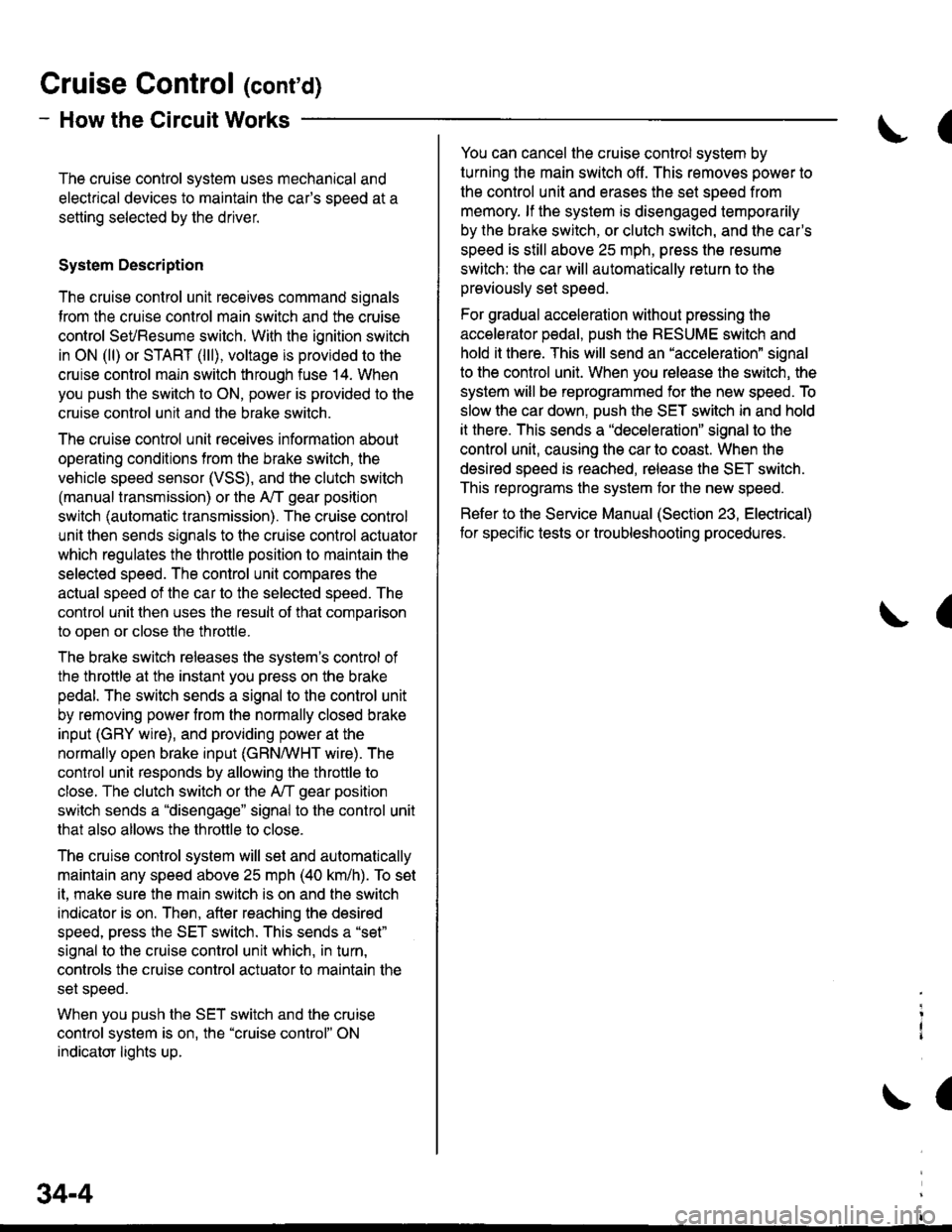
The cruise control system uses mechanical and
electrical devices to maintain the car's sDeed at a
setting selected by the driver.
System Description
The cruise control unit receives command signals
from the crurse control main switch and the cruise
control SeVResume switch. With the ignition switch
in ON (ll) or START (lll), voltage is provided to the
cruise control main switch through fuse 14. When
you push the switch to ON, power is provided to the
cruise control unit and the brake switch.
The cruise control unit receives information about
operating conditions from the brake switch, the
vehicle speed sensor (VSS), and the clutch switch
(manual transmission) or the A,/T gear position
switch (automatic transmission). The cruise control
unit then sends signals to the cruise control actuator
which regulates the throttle position to maintain the
selected speed. The conlrol unit compares the
actual speed of the car to the selected speed. The
control unit then uses the result of that comoarison
to open or close the throttle.
The brake switch releases the system's control of
the throttle at the instant you press on the brake
pedal. The switch sends a signal to the control unit
by removing power from the normally closed brake
input (GRY wire), and providing power at the
normally open brake input (GRN/vVHT wire). The
control unit responds by allowing the throttle to
close. The clutch switch or the A,/T gear position
switch sends a "disengage" signal to the control unit
that also allows the throttle to close.
The cruise control system will set and automatically
maintain any speed above 25 mph (40 km/h). To set
it, make sure the main switch is on and the switch
indicator is on. Then, after reaching the desired
speed, press the SET switch. This sends a "set"
signal to the cruise control unit which, in turn,
controls the cruise control actuator to maintain the
set speed.
When you push the SET switch and the cruise
control system is on, the "cruise control" ON
indicator lights up.
34-4
(
You can cancel the cruise control system by
turning the main switch off . This removes power to
the control unit and erases the set speed from
memory. lf the system is disengaged temporarily
by the brake switch, or clutch switch, and the car's
speed is still above 25 mph, press the resume
switch: the car will automatically return to the
previously set speed.
For gradual acceleration without pressing the
accelerator pedal, push the RESUME switch and
hold it there. This will send an "acceleration" signal
to the control unit. When you release the switch, the
system will be reprogrammed for the new speed. To
slow the car down. oush the SET switch in and hold
it there. This sends a "deceleration" signal to the
control unit, causing the car to coast. When the
desired speed is reached, release the SET switch.
This reprograms the system tor the new speed.
Refer to the Service Manual (Section 23, Electrical)
tor specific tests or troubleshooting procedures.
(
a
Page 1945 of 2189
- How the Circuit Works
The anti-lock brake system (ABS) prevents locking
of the wheels as a result of heavy braking and/or
poor lraction. A vehicle with locked wheels cannot
be steered. The anti-lock brake system controls the
application of the brakes, allowing the driver to
maintain control of the steering.
Under anti-lock conditions, the antilock brake
system (ABS) modulates the pressure of the brake
tluid to each brake caliper. This system is a four
channel system: the pressure at each caliper is
controlled independently of the pressure al any
other caliper. Whenever a wheel is likely to lock
dunng braking, the anti-lock brake system
modulates the brake oressure at that wheel. When
the brake pressure is reduced to the point where
there is no longer any possibility of wheel locking,
the system returns to the conventional braking
system mode of operation.
Battery voltage is applied at all times through fuse
63 to the ABS control unit. When the ignition switch
is in ON (ll), battery voltage is supplied to the
control unit through fuse 16. The control unit is case
grounded. Inputs are received from the brake switch
and the individual wheel sensors located at each
wheel. The ABS control unit uses these inputs to
control the modulator solenoid unit. The solenoids
adjust the hydraulic pressure applied to each
calioer.
The ABS control unit has a self-diagnosis function.
When the control unit detects a fault, it turns on the"ABS" indicator and disables the anti-lock brake
system. lf the fault is not in the conventional braking
system, the brakes will continue to operate normally
but without the anti-lock feature.
Refer to the Service Manual (Section '19,
Anti-Lock Brake System) for specific tests or
troubleshooting procedures.
44-3
Page 1953 of 2189
- How the Circuit Works
'96198 Models
The air delivery system directs the flow of air used
by the heater and air conditioner systems.
Mode Selection
Mode selection is controlled by the mode switches
in the heater control panel and the mode control
motor. When you select a specific mode, voltage is
applied through the dimming circuit to the LED,
which comes on, indicating the mode selected.
Ground is orovided to the mode control motor
though that mode switch. The motor then runs until
the air control door reaches the proper position.
Fresh/Recirculation 56lection
When you press the fresh or recirculation button, a
ground signal is sent from the heater control panel
to the recirculation control motor. The motor then
runs until the recirculation door reaches the proper
position. Battery voltage is also applied through the
dimming circuit to the corresponding LED, and the
LED comes on.
Refer to the Service Manual (Section 21, Heater) for
specitic tests or troubleshooting proc€dures.
'99J00 Models
The heater control panel receives battery voltage at
all times through fuse 47. With the ignition switch in
ON (ll), voltage is supplied to the heater control
panel through fuse 17. The control panel is
grounded at G402.
The heater control panel controls the air delivery
motors, and supplies a 5 VDC reterence voltage to
the air mixture control motor.
The air mixture and mode control motors each
receive inputs trom the heater control panel. The air
mix motor regulates the mixture of cold and hot air
by varying the position of the heater-evaporator doot
The mode control motor controls the direction and
volume of outlet air. The air flow can be directed to
the dashboard vents or the corner vents.
Both the air mixture control molor and mode control
motor are grounded by the h€aler control panel.
The recirculation control motor receives battery
voltage through fuso 17 when the ignition swilch is
in ON (ll). lt regulates the position of the fresh/recirc
door, and is controlled by two position inputs from
the heater control panel ("Recirc" and "Fresh").
Refer to the Service Manual (Section 21, Heater) tor
specific tests or troubleshooting procedures.
61-3
Page 1961 of 2189
- How the Circuit Works
Radiator Fan
Voltage is provided at all times to the radiator fan
relay (contacts) through fuse 57. With the ignition
swilch in ON (ll), voltage is provided to the coil of
the relay through luse 17.
The radiator tan relay can be grounded through
either the engine coolant temperature switch or the
engine control module (ECM) or powertrain control
module (PCM).
The engine coolant temperature switch grounds
the radiator fan relay (coil) when the engine
coolant temperature exceeds 199'F (83'C). The
switch opens when coolanl temperature
decreases 3'- 8'C.
Condenser Fan
Voltage is provided at all times to the condenser fan
relay (contacts) through fuse 56. With the ignition
switch in ON (ll), voltage is provided to the coil of
the relay through fuse 17. When you push the A'lC
switch and put the heater fan switch in 1, 2,3, o( 4
position, the ly'C thermostat comes on, the
condenser fan relay energizes, and the condenser
fan motor runs.
A,/C Thermostat
The A,/C thermostat is located on the evaporator
housing. The A,/C thermostat tums off the A/C
compressor clutch if the temperature at the
evaporator goes below 3'C (37'F). This prevents
condensation from freezing on the evaporator fins
and blocking the air delivery into the passenger
compartment. lf the temperature goes below 3'C
(37"F) tuming off the Ay'C thermostat, ground will be
removed from the condenser fan relay. This will
deenergize the relay and remove voltage from the
condenser fan motor causing the fan to stop running.
Reter to the Service Manual (Section 23, Eleckical)
for specific tests or troubleshooting procedures.
63-3