1996 GMC SIERRA warning light
[x] Cancel search: warning lightPage 7 of 404

Vehicle Symbols
These are some of the symbols you may find on your vehicle.
For example,
these symbols
are used on an
original battery:
POSSIBLE A
CAUTION
INJURY
PROTECT EYES BY
SHIELDING
CAUSTIC
ACID COULD BATTERY
CAUSE
BURNS
These symbols
are important
for you and
your passengers
whenever your
vehicle is
driven:
DOOR LOCK
UNLOCK
FASTEN SEAT
BELTS
These symbols
have
to do with
your lights:
SIGNALS e e3
TURN
WARNING
A
HAZARD
FLASHER
These symbols are
on some of
your controls:
WINDSHIELD
DEFROSTER
These symbols are used on
warning and
indicator lights:
COOLANT
TEMP
-
CHARGING I-1
BAllERY
SYSTEM
BRAKE
(0)
Here are some
other symbols
you may see:
FUSE
LIGHTER
AVOID
SPARKS
OR
FLAMES
SPARK
OR ,\I/,
COULD FLAME
EXPLODE BATTERY POWER
WINDOW RUNNING
0
DAYTIME -
LAMPS '*'
FOG LAMPS # 0
VENTILATING
FAN
1
-3
COOLANT a
ENGINE OIL e,
PRESSURE HORN
)tr
SPEAKER v
FUEL B
V
ProCarManuals.com
Page 87 of 404
Shifting from 4LO to 4HI or 2HI
To shift from 4LO to 4HI or 2H1, your vehicle must be
stopped or moving less than
3 mph (4.8 km/h) with the
transmission in NEUTRAL (N). The preferred method
for shifting
out of 4LO is to have your vehicle moving
1 to 2 mph (1.6 to 3.2 km/h). Press and release the 4HI
switch.
You must wait for the 4HI indicator light to stop
flashing and remain illuminated before shifting your
transmission
into gear.
If the 4HI switch is pressed when your vehicle is in
gear and/or moving, the 4HI indicator light will flash for
30 seconds but not complete the shift unless the vehicle
is moving slower than
3 mph (4.8 km/h) and the
transmission is in NEUTRAL (N).
Parking Brake
To set the parking brake, hold the regular brake pedal
down
with your right foot. Push down the parking brake
pedal with your left foot.
If the ignition is on, the brake system warning light will
come
on.
To release the parking brake, hold the regular brake
pedal down.
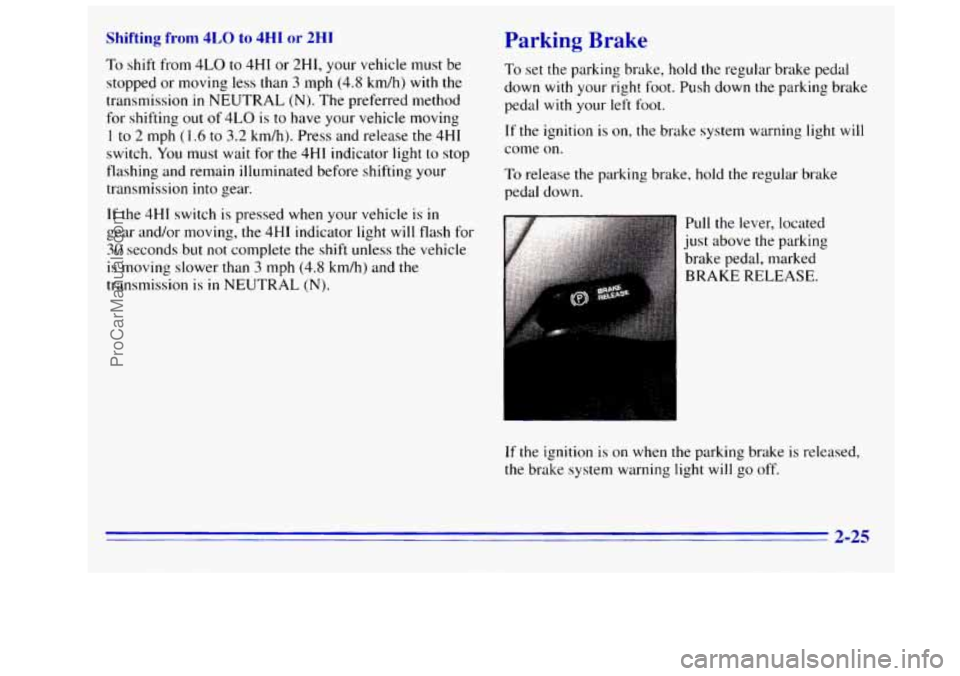
lull the lever, located
1st above the parking
rake pedal, marked
;RAKE RELEASE.
If the ignition is on when the parking brake is released,
the brake system warning light
will go off.
2-25
ProCarManuals.com
Page 120 of 404
Warning Lights, Gages and Indicators
This part describes the warning lights and gages that
may be on your vehicle. The pictures will help
you
locate them.
Warning lights and gages can signal
that something is
wrong before it becomes serious enough to cause an
expensive repair or replacement. Paying attention to
your warning lights and gages could also save
you or
others from injury.
Warning lights come on when there may be
or is a
problem with one of your vehicle’s functions.
As you
will see in the details on the next few pages, some
warning lights come
on briefly when you start the
engine just
to let you know they’re working. If you are
familiar with this section, you should not be alarmed
when this happens.
Gages can indicate when there may be or is a problem
with one
of your vehicle’s functions. Often gages and
warning lights work together
to let you know when
there’s a problem with your vehicle. When
one of the warning lights comes on and stays on
when
you are driving, or when one of the gages shows
there may be a problem, check the section that
tells you
what to do about it. Please follow this manual’s advice.
Waiting to do repairs can be costly
-- and even
dangerous.
So please get to know your warning lights
and gages. They’re a big help.
Safety Belt Reminder Light
When the key is turned to RUN or START, a tone will
come on for about eight seconds to remind people
to
fasten their safety belts, unless the driver’s safety belt is
already buckled.
-
The safety belt light will
on for about 20 seconds,
also
come
on and stay
then
it will flash for about
belt is already buckled,
55 seconds. If the driver’s
neither the tone nor
the
light will come on.
2-58
-
ProCarManuals.com
Page 123 of 404
Brake System Warning Light r
Your vehicle’s hydraulic brake system is divided into
two
parts. If one part isn’t working, the other part can
still work and stop you. For good braking, though, you
need both parts working well.
If the warning light comes on, there could be a brake
problem. Have your brake system inspected right away.
BRAKE
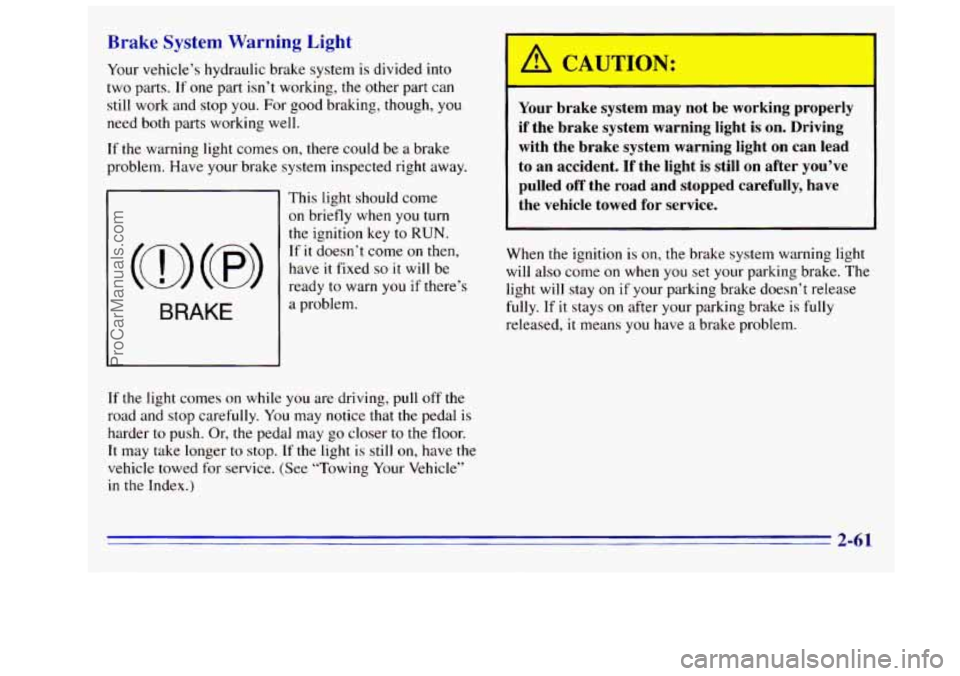
This light should come
on briefly when
you turn
the ignition key to
RUN.
If it doesn’t come on then,
have
it fixed so it will be
ready to
warn you if there’s
a problem.
If the light comes on while you are driving, pull off the
road and stop carefully. You may notice that the pedal is
harder to push. Or, the pedal may go closer to the floor.
It may take longer to stop. If
the light is still on, have the
vehicle towed for service. (See “Towing Your Vehicle”
in the Index.)
I! CAUTION:
Your brake system may not be working properly
if the brake system warning light is on. Driving
with the brake system warning light on can lead
to an accident. If the light
is still on after you’ve
pulled
off the road and stopped carefully, have
the vehicle towed for service.
When the ignition is on, the brake system warning light
will also come on when you set your parking brake. The
light will stay on if your parking brake doesn’t release
fully.
If it stays on after your parking brake is fully
released,
it means you have a brake problem.
2-61
ProCarManuals.com
Page 124 of 404
ANTI -
LOCK
Qnti-Lock Brake System Warning Light
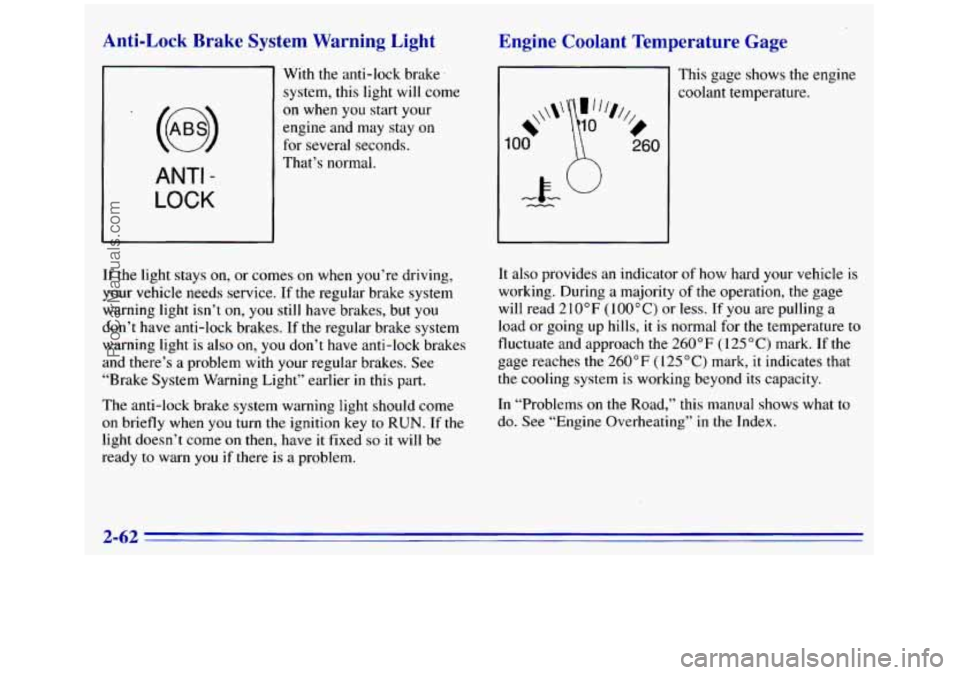
With the anti-lock brake.
system, this light will come
on when
you start your
engine and may stay on
for several seconds.
That’s normal.
If the light stays on, or comes on when you’re driving,
your vehicle needs service.
If the regular brake system
warning light isn’t on,
you still have brakes, but you
don’t have anti-lock brakes.
If the regular brake system
warning light is also on, you don’t have anti-lock brakes
and there’s
a problem with your regular brakes. See
“Brake System Warning Light” earlier
in this part.
The anti-lock brake system warning light should come
on briefly when you turn the ignition key to RUN. If the
light doesn’t come on then, have it fixed so it will be
ready to warn
you if there is a problem.
Engine Coolant Temperature Gage
I This gage shows the engine
~ coolant temperature.
It also provides an indicator of how hard your vehicle is
working. During a majority of the operation, the gage
will read 210°F
(100°C) or less. If you are pulling a
load or going up hills, it is normal for the temperature to
fluctuate and approach the 260°F ( 125 “C) mark. If the
gage reaches the 260°F
(I 25 “C) mark, it indicates that
the cooling system is working beyond its capacity.
In “Problems
on the Road,” this manual shows what to
do. See “Engine Overheating” in the Index.
2-62
ProCarManuals.com
Page 129 of 404
Daytime Running Lamps Indicator Light Check Gages Light
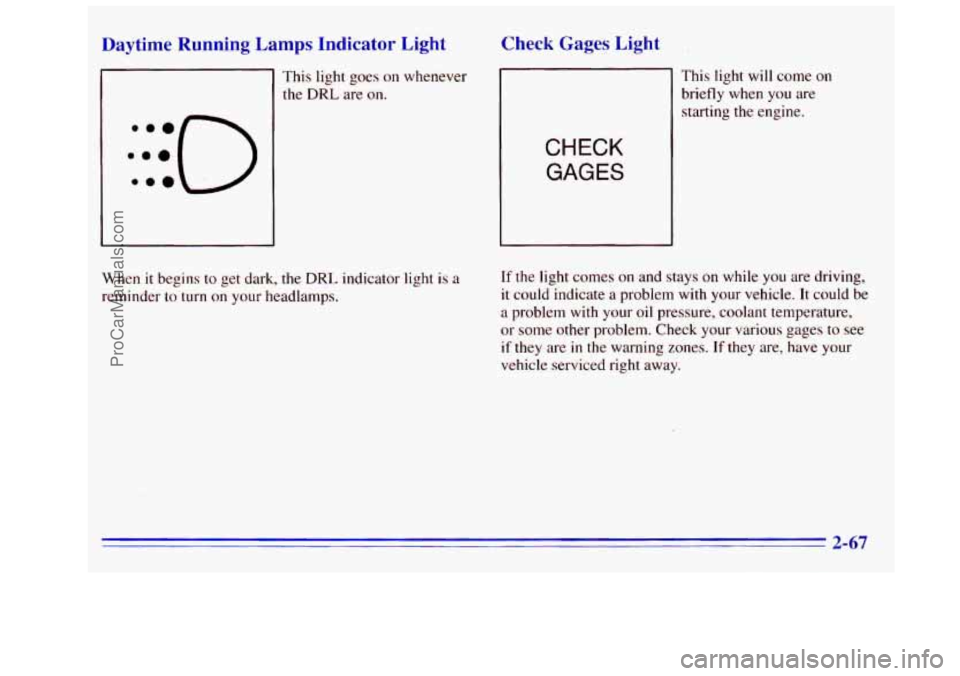
This light goes on whenever
the DRL are on.
CHECK
GAGES
This light will come on
briefly when you are
starting
the engine.
When
it begins to get dark, the DRL indicator light is a
reminder to turn
on your headlamps.
If the light comes on and stays on w.hile you are driving,
it could indicate a problem with your vehicle. It could be
a problem with your oil pressure, coolant temperature,
or some other problem. Check your various gages to see
if they are in the warning zones. If they are, have your
vehicle serviced right away.
2-67
ProCarManuals.com
Page 160 of 404
Avoid needless heavy braking. Some people drive in
spurts
-- heavy acceleration followed by heavy
braking
-- rather than keeping pace with traffic. This
is
a mistake. Your brakes may not have time to cool
between hard stops. Your brakes will wear
out much
faster
if you do a lot of heavy braking. If you keep pace
with the traffic and allow realistic following distances,
you will eliminate a lot of unnecessary braking. That
means better braking and longer brake life.
If your engine ever stops while you’re driving, brake
normally but don’t pump your brakes.
If you do, the
pedal may get harder to push down.
If your engine
stops, you will still have some power brake assist. But
you will use it when you brake. Once the power assist is
used up, it may take longer
to stop and the brake pedal
will be harder to push.
Anti-Lock Brakes
Your vehicle has anti-lock brakes (ABS). ABS is an
advanced electronic braking system that
will help
prevent
a braking skid.
When you start your engine and begin to drive away,
your anti-lock brake system will check itself. You may
hear
a momentary motor or clicking noise while this test
is going on. This is normal.
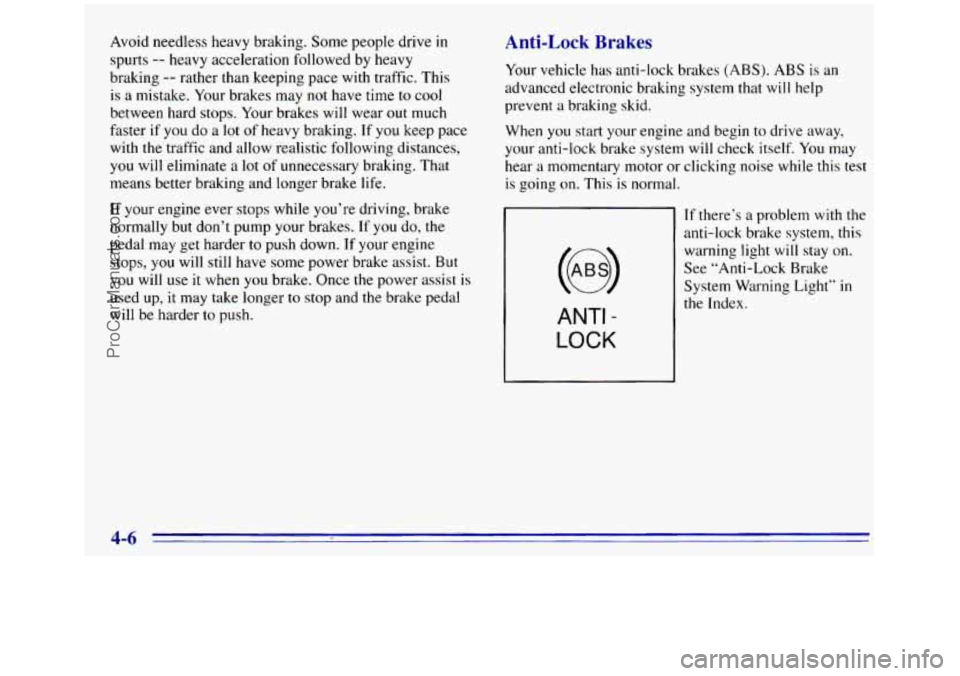
If there’s
a problem with the
anti-lock brake system,
this
warning light will stay on.
See “Anti-Lock Brake
System Warning Light’‘
in
ANTI -
LOCK
4-6
ProCarManuals.com
Page 187 of 404

City Driv---,
One of the biggest problems with city streets is the
amount
of traffic on them. You’ll want to watch out for
what the other drivers are doing and
pay attention to
traffic signals. Here are ways
to increase your safety
in city driving:
0
0
0
Know the best way to get to where you are
going. Get
a city map and plan your trip into an
unknown part of the city just as you would for a
cross-country trip.
Try
to use the freeways that rim and crisscross most
large cities. You’ll save time and energy. (See
the
next part, “Freeway Driving.”)
Treat
a green light as a warning signal. A traffic
light
is there because the corner is busy enough to
need it. When a light turns green, and just before
you start to move, check both ways for vehicles that
have
not cleared the intersection or may be running
the red light.
4-33
ProCarManuals.com