Page 206 of 404
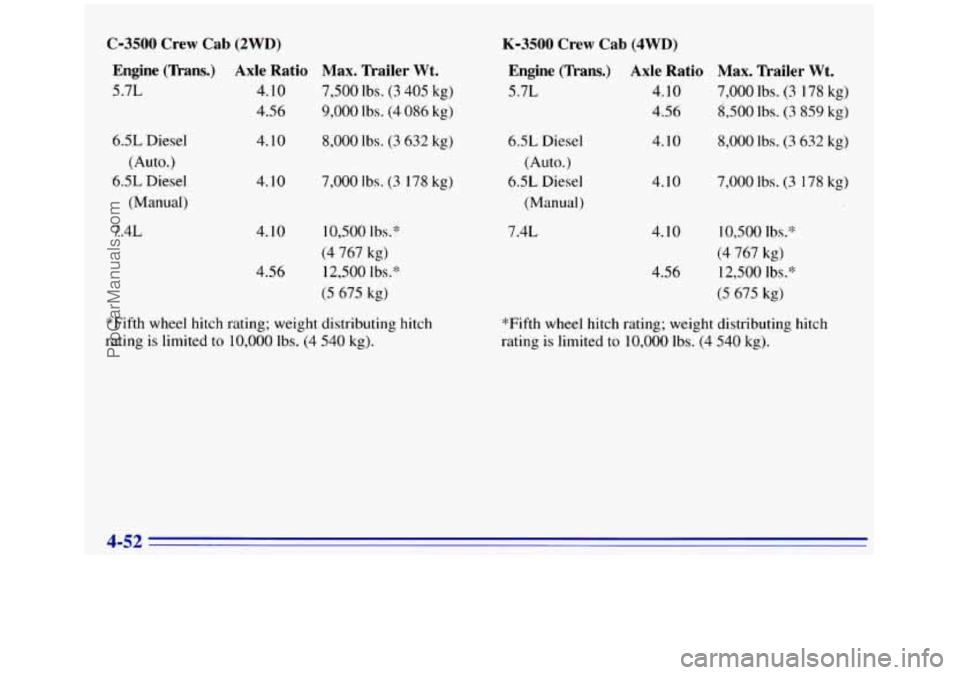
C-3500 Crew Cab (2WD)
Engine (Trans.) Axle Ratio Max. Trailer Wt.
5.7L 4.10 7,500 lbs. (3 405 kg)
4.56 9,000
Ibs. (4 086 kg)
6.5L Diesel
(Auto.)
6.5L Diesel
(Manual)
7.4L
4.10
4.10
4.10
4.56
8,000 lbs. (3 632 kg)
7,000
Ibs. (3 178 kg)
10,500 lbs.*
(4 767 kg)
12,500
Ibs.*
(5 675 kg)
*Fifth
wheel hitch rating.; weight distributing hitch
rating
is limited to 10,000 lbs. (4 540 kg).
K-3500 Crew Cab (4WD)
Engine (Tkans.) Axle Ratio Max. Trailer Wt.
5.7L 4.10 7,000 Ibs. (3 178 kg)
4.56 8,500
Ibs. (3 859 kg)
6% Diesel
(Auto.)
6.5L Diesel
(Manual)
7.4L 4.10
4.10
4.10
4.56
8,000 Ibs. (3 632 kg)
7,000
Ibs. (3 178 kg)
10,500
Ibs*
(4 767 kg)
12,500
Ibs?
(5 675 kg)
*Fifth wheel hitch rating; weight distributing hitch
rating
is limited to 10,000 Ibs. (4 540 kg).
4-52
ProCarManuals.com
Page 207 of 404

(2-3500 HDiChassis .Cab Engine (Trans.) Axle Ratio
Max. Trailer Wt.
5.7L 4.63 8,500 lbs. (3 859 kg)
5.13
8,500 lbs. (3 859 kg)
6% Diesel
(Auto.)
6.5L Diesel
(Manual)
7.4L 4.63
5.13
4.63 5.13
4.63
5.13
8,000 lbs. (3 632 kg)
10,500 lbs.*
(4 767 kg)
7,000 lbs. (3 178 kg)
8,500 lbs. (3 859 kg)
12,500 lbs.*
(5 675 kg)
12,500 lbs.*
(5 675 kg)
*Fifth wheel hitch rating; weight distributing hitch
rating is limited to 10,000 lbs. (4 540 kg). You
can ask your dealer for our trailering information or
advice, or you can write us at the addreis listed in your
Warranty and Owner Assistance Information Booklet.
In Canada, write to:
General Motors of Canada Limited
Customer Assistance Center
1908 Colonel Sam Drive
Oshawa, Ontario LlH 8P7
Weight of the Trailer Tongue
The tongue load (A) of any trailer is an important
weight to measure because it affects the total or gross
weight of your vehicle. The Gross Vehicle Weight
(GVW) includes the curb weight of the vehicle, any
cargo you may carry in it, and the people who will be
riding in the vehicle. And if you will tow a trailer, you
must add the tongue load to the GVW because your
vehicle will be carrying that weight, too. S&e “Loading
Your Vehicle” in the Index for more information about
your vehicle’s maximum load capacity.
4-53
ProCarManuals.com
Page 210 of 404
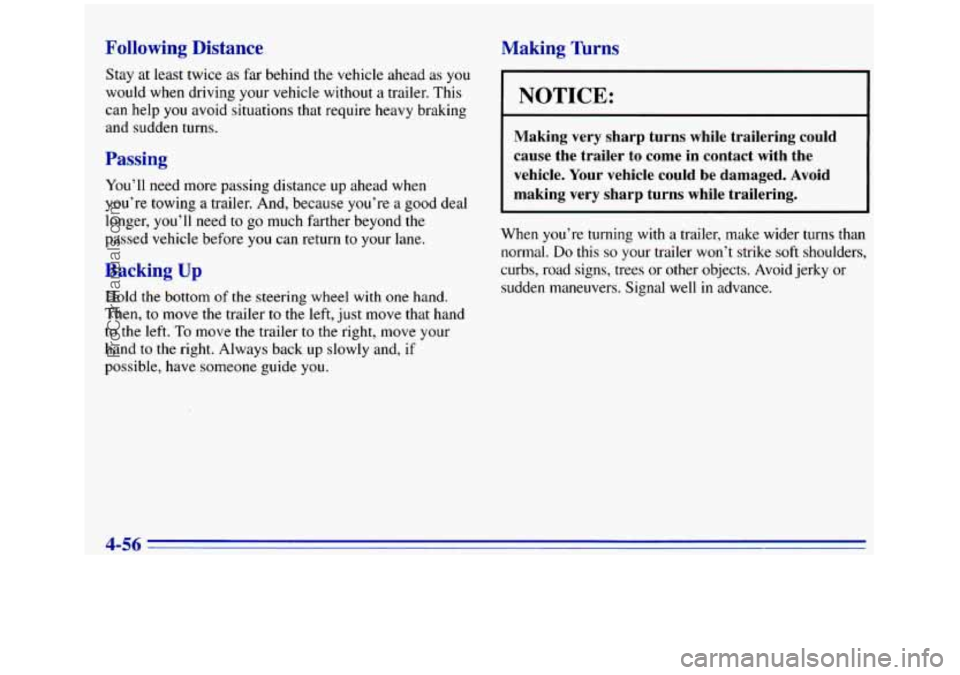
Following Distance
Stay at least twice as far behind the vehicle ahead as you
would when driving your vehicle without a trailer. This
can help
you avoid situations that require heavy braking
and sudden turns.
Passing
You’ll need more passing distance up ahead when
you’re towing
a trailer. And, because you’re a good deal
longer,
you’ll need to go much farther beyond the
passed vehicle before
you can return to your lane.
Backing Up
Hold the bottom of the steering wheel with one hand.
Then, to move the trailer
to the left, just move that hand
to the left.
To move the trailer to the right, move your
hand to the right. Always back up slowlv and.
if
possible, have someone guide you.
Making Turns
NOTICE:
Making very sharp turns while trailering could
cause the trailer to come in contact with the
vehicle. Your vehicle could be damaged. Avoid
making very sharp turns while trailering.
When you’re turning with a trailer, make wider turns than
normal.
Do this so your trailer won’t strike soft shoulders,
curbs, road signs, trees or other objects. Avoid jerky or
sudden maneuvers. Signal well
in advance.
4-56
-
ProCarManuals.com
Page 212 of 404
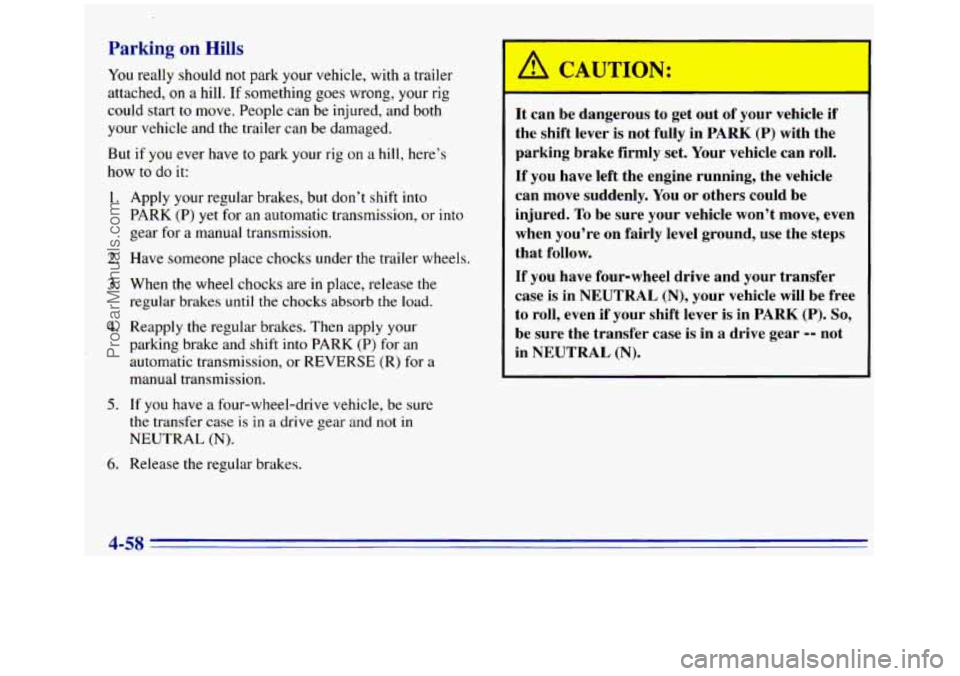
Parking on Hills
You really should not park your vehicle, with a trailer
attached,
on a hill. If something goes wrong, your rig
could start
to move. People can be injured, and both
your vehicle and the trailer can be damaged.
But if
you ever have to park your rig on a hill, here’s
how to do it:
1.
2.
3.
4.
5.
6.
Apply your regular brakes, but don’t shift into
PARK (P) yet for an automatic transmission, or into
gear for
a manual transmission.
Have someone place chocks under the trailer wheels.
When
the wheel chocks are in place, release the
regular brakes until the chocks absorb the load.
Reapply the regular brakes. Then apply your
parking brake and shift
into PARK (P) for an
automatic transmission, or REVERSE
(R) for a
manual transmission.
If you have a four-wheel-drive vehicle, be sure
the transfer case
is in a drive gear and not in
NEUTRAL
(N).
Release the regular brakes. It can
be dangerous to get out of your vehicle if
the shift lever
is not fully in PARK (P) with the
parking brake firmly set. Your vehicle can roll.
If you have left the engine running, the vehicle
can move suddenly. You or others could be
injured.
To be sure your vehicle won’t move, even
when you’re on fairly level ground, use the steps
that follow.
If you have four-wheel drive and your transfer
case is in
NEUTRAL (N), your vehicle will be free
to roll, even if your shift lever is in
PARK (P). So,
be sure the transfer case is in a drive gear -- not
in
NEUTRAL (N).
ProCarManuals.com
Page 214 of 404
-
DW * Winche- Power Take-Off (PTO)
IT you wish to use a power winch on your vehicle, only
use it when your vehicle
is stationary or anchored.
NOTICE:
Using a power winch with the transmission in
gear
may damage the transmission. When
operating
a power winch, always leave the
transmission in
NEUTRAL (N).
Use the regular brakes, set the parking brake, or block
the wheels to keep your vehicle from rolling.
NOTICE:
If you have a PTO that will exceed 35 hp installed
on your vehicle, it could damage the transfer
case or transmission. When having a
PTO
installed on your vehicle, make sure that it will
not exceed
35 hp.
Before using
a PTO, refer to the manufacturer’s or
installer’s instructions.
I NOTICE:
Using a PTO while operating in one place before
the vehicle has reached normal operating
temperature can damage the transfer case or
transmission.
If you will be using the PTO while
operating
in one place, drive and warm up the
vehicle before using the PTO.
ProCarManuals.com
Page 215 of 404

To engage a PTO:
1. Set the parking brake.
2. Shift the transmission into NEUTRAL (Nj.
3. Hold the clutch pedal down and engage the PTO.
NOTICE:
Using a PTO for more than four hours without
driving your vehicle can damage the transfer case
or transmission. If using a PTO for more than
four hours without driving your vehicle, drive
your vehicle for
a while to allow the transfer case
and transmission
to cool.
If you are going to drive the vehicle, shift the
transmission
into the gear you want. Then shift the
transfer case
into the range you want (if you have
four-wheel drive), apply the regular brakes and
release the parking brake.
4. Release the clutch (and the regular brakes) as you
normally would. When you release the clutch, the
PTO will start.
Using a Transfer Case Mounted Power
Take-Off
(Manual Transmission)
1. Set the parking brake,
2. Shift the transfer case into NEUTRAL (N).
3. Hold the clutch pedal down. If the vehicle will
remain
in the same place, shift the transmission into
the highest gear.
4. Engage the PTO.
If you are going to drive the vehicle, shift the
transmission into the gear
you want. Then shift the
transfer case
into the range you want, apply the
regular brakes and release the parking brake.
5. Release the clutch (and the regular brakes) as you
nor~nally would. When you release the clutch, the
PTO will start.
4-61
ProCarManuals.com
Page 219 of 404
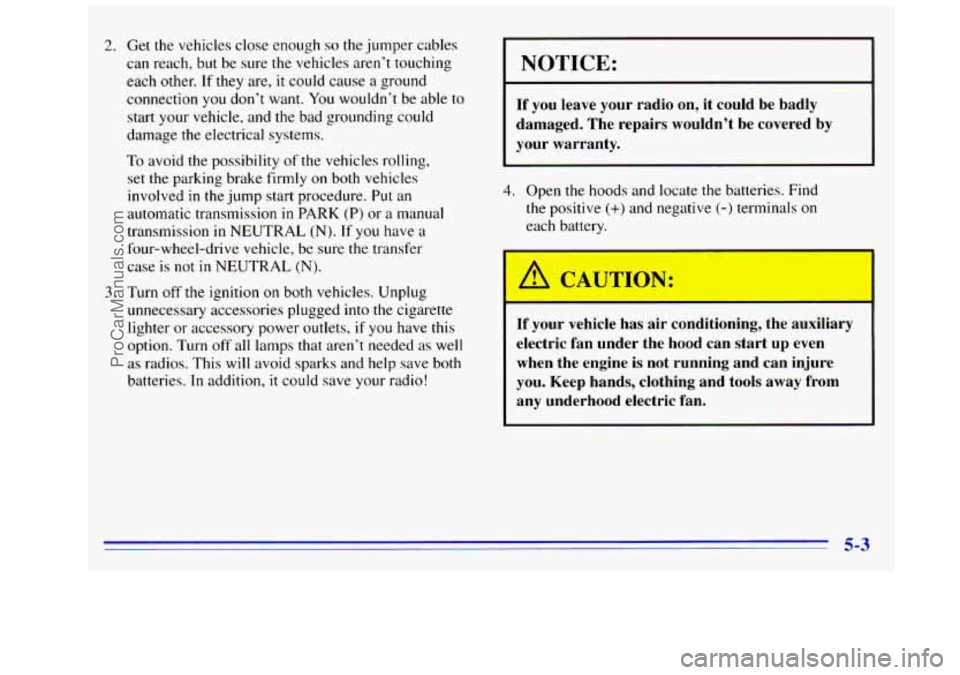
2. Get the vehicles close enough so the jumper cables
can reach, but be sure the ve.hicles aren’t touching
each other.
If they are, it could cause a ground
connection you don’t want. You wouldn’t be able to
start
your vehicle, and the bad grounding could
damage the electrical systems.
To avoid the possibility
of the vehicles rolling,
set the parking brake firmly on both vehicles
involved
in the jump start procedure. Put an
automatic transmission
in PARK (P) or a manual
transmission
in NEUTRAL (N). If you have a
four-wheel-drive vehicle, be sure the transfer
case is not in NEUTRAL
(N).
3. Turn off the ignition on both vehicles. Unplug
unnecessary accessories plugged into the cigarette
lighter or accessory power outlets,
if you have this
option. Turn
off all lamps that aren’t needed as well
as radios. This will avoid sparks and help save both
batteries.
In addition, it could save your radio!
NOTICE:
I
~~~ ~
If you leave your radio on, it could be badly
damaged. The repairs wouldn’t be covered by
your warranty.
4. Open the hoods and locate the batteries. Find
the positive
(+) and negative (-) terminals 011
each battery.
A CAUTION:
If your vehicle has air conditioning, the auxiliary
electric fan under the hood can start up even
when the engine
is not running and can injure
you. Keep hands, clothing and tools
away from
any underhood electric fan.
5-3
ProCarManuals.com
Page 223 of 404

12. Remove the cables in reverse order to prevent
electrical shorting. Take care that they don’t touch
each other or any other metal.
I
A. Heavy Metal Engine Part
B. Good Battery
C. Dead Battery
Towing Your Vehicle
Try to have your GM dealer or a professional towing
service tow your vehicle. See “Roadside Assistance”
in the Index.
If your vehicle has been changed since it was
factory-new, by adding such things as fog lamps,
aero skirting, or special tires and wheels, these’
instructions may not be correct.
Before you do anything, turn on the hazard
warning flashers.
When you call, tell the towing service:
That your vehicle .has rear-wheel drive, or that it has
The make, model and year of your vehicle.
Whether you can move the shift lever for the
If there was an accident, what was damaged.
When the towing service arrives, let the tow operator
know that this manual contains detailed towing
instructions and illustrations. The operator may want to
see them.
the four-wheel-drive
option.
transmission
and transfer case, if you have one.
5-7
ProCarManuals.com