1996 GMC SIERRA oil
[x] Cancel search: oilPage 277 of 404
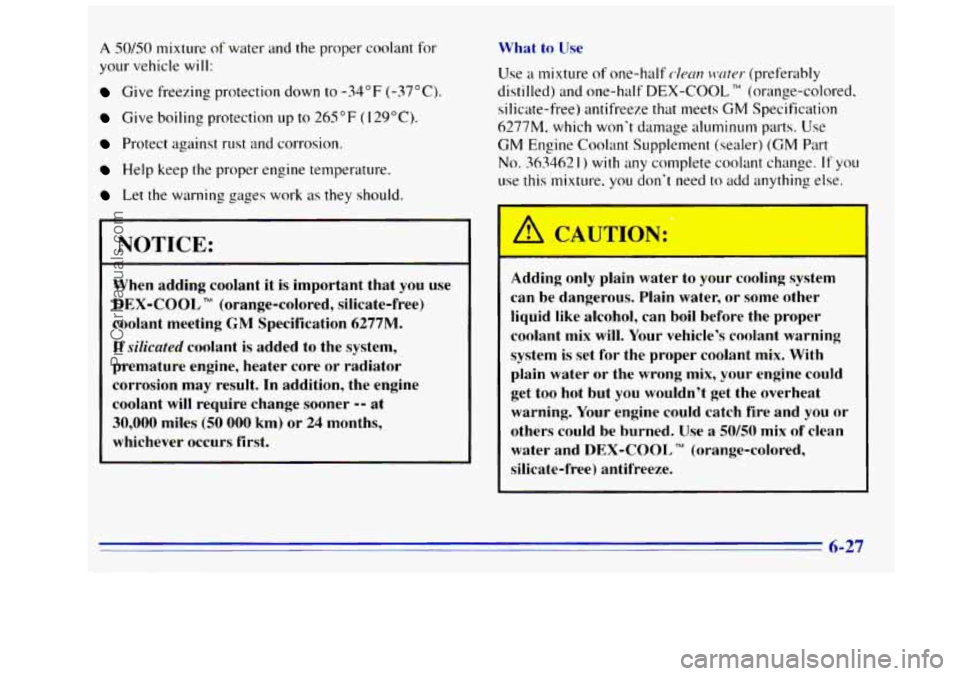
A 50/50 mixture of water and the proper coolant for
your vehicle
will:
Give freezing prorecrlon down to -34°F (-37°C).
Give boiling protection up to 265°F (129°C).
Protect against rust and corrosion.
Help keep the proper engine temperature.
Let the warning gages work as they should.
NOTICE:
When adding coolant it is important that you use
DEX-COOL TM (orange-colored, silicate-free)
coolant meeting
GM Specification 6277M.
If silicated coolant is added to the system,
premature engine, heater core or radiator
corrosion may result.
In addition, the engine
coolant will require change sooner
-- at
30,000 miles (50 000 km) or 24 months,
whichever occurs first. use
a mixture
of one-half dum wwter (preferably
distilled) and one-half
DEX-COOL” (orange-colored.
silicate-free) antifreeze that meets
GM Specification
6277M. which
won‘t damage aluminum parts. Use
GM Engine Coolant Supplement (sealer) (GM Part
No. 363462 1 ) with any complete coolant change. If you
use this mixture.
you don’t need to add anything else.
Adding only plain water to your cooling system
can be dangerous. Plain water, or some other
liquid like alcohol, can boil before the proper
coolant mix will. Your vehicle’s coolant warning
system
is set for the proper coolant mix. With
plain water or the wrong mix, your engine could
get
too hot but you wouldn’t get the overheat
warning. Your engine could catch fire and you or
others could be burned. Use a
50150 mix of clean
water and
DEX-COOL TM (orange-colored,
silicate-free) antifreeze.
f 27
ProCarManuals.com
Page 285 of 404
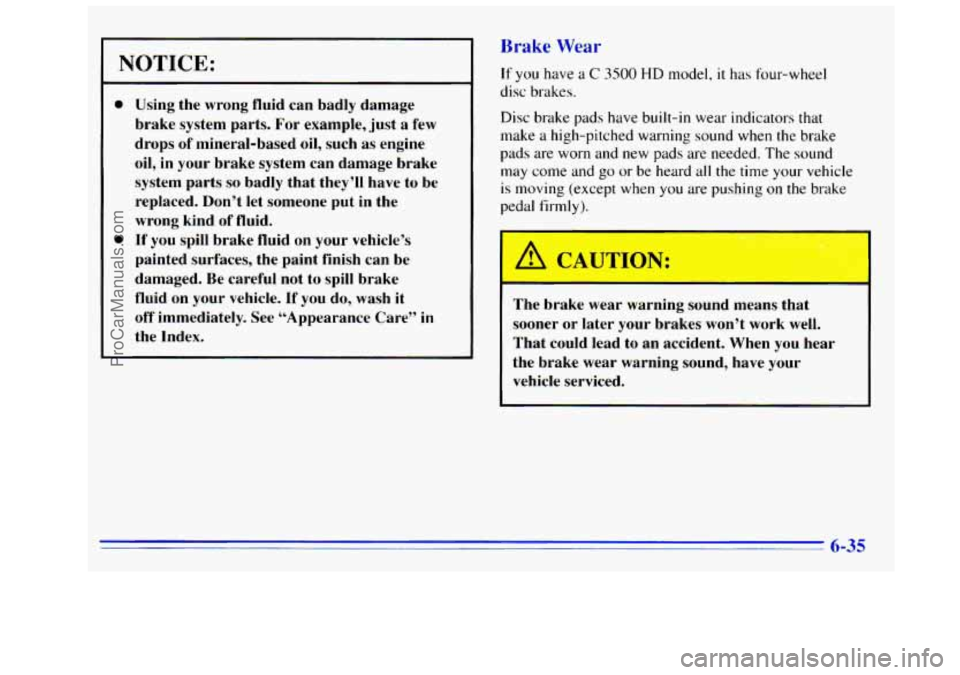
NOTICE:
0
0
Using the wrong fluid can badly damage
brake system parts. For example,.just a few
drops of mineral-based oil, such
as engine
oil,
in your brake system can damage brake
system parts
so badly that they’ll have to be
replaced. Don’t let someone put in the
wrong kind of fluid.
If you spill brake fluid on your vehicle’s
painted surfaces, the paint finish can be
damaged. Be careful not to spill brake
fluid on your vehicle.
If you do, wash it
off immediately. See &‘Appearance Care”
in
the Index.
Brake Wear
If you have a C 3500 HD model, it has four-wheel
disc brakes.
Disc brake pads have built-in wear indicators that
make a high-pitched warning sound when the brake
pads are worn and
new pads are needed. The sound
may come and
go or be heard all the time your vehicle
is moving (except when you are pushing on the brake
pedal firmly).
A’ CAUTION:
I
The brake wear warning sound means that
sooner or later your brakes won’t work well.
That could lead to an accident. When you hear
the brake wear warning sound, have your vehicle serviced.
6-35
ProCarManuals.com
Page 309 of 404

Using Foam-Type Cleaner T I ~. ~. .
1. Vacuum and brush the area to remove any loose
dirt.
2. Always clean a whole trim panel or section. Ma *
3. Mix Multi-Purpose Powdered Cleaner following
surrounding
trim along stitch or welt lines.
the directions on the container label.
4. Use suds only and apply with
a clean sponge.
5. Don’t saturate the material.
6. Don’t rub it roughly.
7. As soon as you’ve cleaned the section, use a sponge
to remove the suds.
8. Rinse the section with a clean, wet sponge.
9. Wipe off what’s left with a slightly damp paper
towel or cloth.
10. Then dry it immediately with a blow dryer.
Using Solvent-Type Cleaner on Fabric
First, see if you have to use solvent-type cleaner at all.
Some spots and stains will clean off better with just
water and mild soap.
If you need to use a solvent:
Gently scrape excess soil from the trim material with
a clean, dull knife or scraper. Use very little cleaner,
light pressure and clean cloths (preferably
cheesecloth). Cleaning should start at the outside of
the stain, “feathering” toward
the center. Keep
changing to a clean section
of the cloth.
When you clean a stain from fabric, immediately
dry the area
with a blow dryer to help prevent a
cleaning ring.
Fabric Protection
Your vehicle has upholstery and carpet that has been
treated with Scotchgard’” Fabric Protector, a
3M
product. It protects fabrics by repelling oil and water,
which are the carriers
of most stains. Even with this
protection, you still need to clean your upholstery and
carpet often to keep
it looking new.
11. Wipe with a clean cloth.
Further information
on cleaning is available by calling
1-800-433-3296 (in Minnesota, 1-800-642-61 67).
ProCarManuals.com
Page 310 of 404

Special Cleaning Problems
Greasy or Oily Stains
Stains caused by grease, oil, butter, margarine, shoe
polish, coffee
with cream, chewing gum, cosmetic
creams, vegetable oils, wax crayon, tar and asphalt can
be removed
as follows:
1. Carefully scrape off excess stain.
2. Follow the solvent-type instructions described earlier.
3. Shoe polish, wax crayon, tar and asphalt will stain if
left on a vehicle’s seat fabric. They should be removed
as soon
as possible. Be careful, because the cleaner
will dissolve them and may cause them to spread.
Non-Greasy Stains
Stains caused by catsup, coffee (.black), egg, fruit, fruit
juice, milk, soft drinks, wine, vomit, urine and blood can
be removed
as follows:
1. Carefully scrape off excess stain, then sponge the
soiled area with cool water.
2. If a stain remains, follow the foam-type instructions
described earlier.
3. If an odor lingers after cleaning vomit or urine, treat
the area with
a waterhaking soda solution:
I teaspoon (5 ml) of baking soda to 1 cup (250 ml)
of lukewarm water.
4. If needed, clean lightly with solvent-type cleaner.
Combination Stains
Stains caused by candy, ice cream, mayonnaise, chili
sauce and
unknown stains can be removed as follows:
0 Carefully scrape off excess stain, then clean with
cool water and allow to dry.
0 If a stain remains, clean it with solvent-type cleaner.
Cleaning Vinyl
Use warm water and a clean cloth.
Rub with a clean, damp cloth to remove dirt. You
may have to do it more than once.
Things like tar, asphalt and shoe polish will stain if
you don’t get them off quickly. Use a clean cloth and
a GM VinyVLeather Cleaner or equivalent product.
6-60
ProCarManuals.com
Page 311 of 404
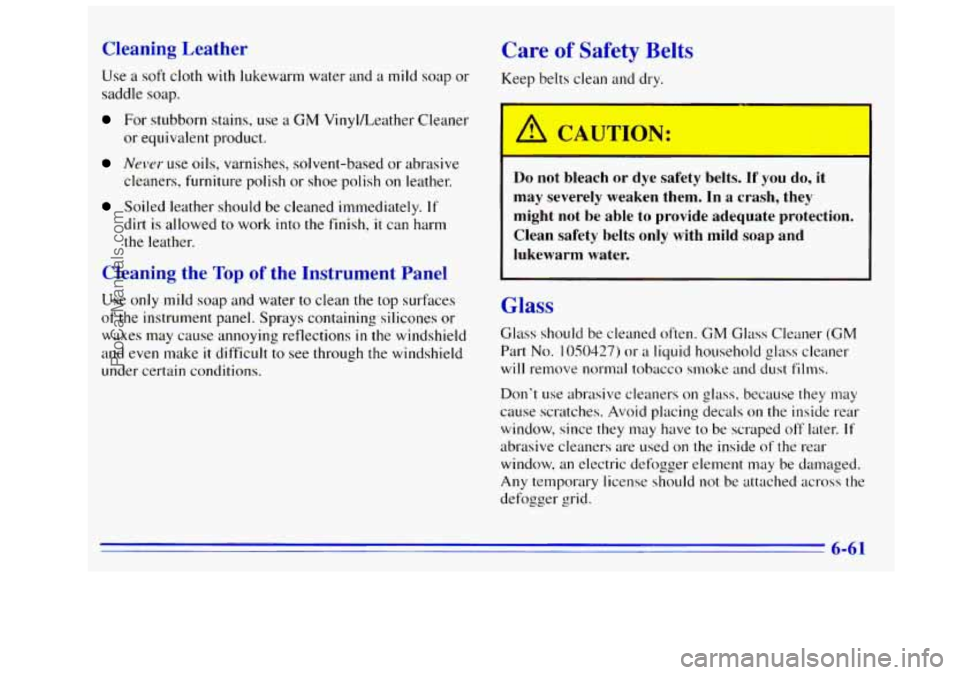
Cleaning Leather
Use a soft cloth with lukewarm water and a mild soap or
saddle
soap.
For stubborn stains, use a GM VinyVLeather Cleaner
or equivalent product.
Never use oils, varnishes, solvent-based or abrasive
cleaners, furniture polish or shoe polish
on leather.
Soiled leather should be cleaned immediately. If
dirt is allowed to work into the finish, it can harm
the leather.
Cleaning the Top of the Instrument Panel
Use only mild soap and water to clean the top surfxes
of the instrument panel. Sprays containing silicones or
waxes
may cause annoying reflections in the windshield
and even make
it difficult to see through the windshield
under certain conditions.
Care of Safety Belts
Keep belts clean and dry.
-. '4 -
Do not bleach or dye safety belts. If you do, it
may severely weaken them. In a crash, they
might not
be able to provide adequate protection.
Clean safety belts only with mild soap and
lukewarm water.
Glass
Glass should be cleaned often. GM Glass Cleaner (GM
Part No. 1050427) or a liquid household glass cleaner
will remove normal tobacco smoke and dust films.
Don't use abrasive cleaners
on glass, because they may
cause scratches. Avoid placing decals
on the inside rear
window, since they may have to be scraped off later.
If
abrasive cleaners are used on the inside of the rear
window, an electric defogger element may be damaged.
Any temporary license should not be attached across the
defogger grid.
6-61
ProCarManuals.com
Page 313 of 404

Finish Care
Occasional waxing or mild polishing of your vehicle by
hand may be necessary
to remove residue from the paint
finish. You can get GM-approved cleaning products
from your dealer. (See “Appearance Care and Materials”
in the Index.)
Your
GM manufactured vehicle may have a
“basecoat/clearcoat” paint finish. The clearcoat gives
more depth and
gloss to the colored basecoat. Always
use waxes and polishes that are non-abrasive and made
for a basecoat/clearcoat paint finish.
NOTICE:
Machine compounding or aggressive polishing on
a basecoatlclearcoat paint finish may dull the
finish or leave swirl marks.
Foreign materials such as calcium chloride and other
salts, ice melting agents, road oil and tar, tree sap, bird
droppings, chemicals from industrial chimneys, etc., can
damage your vehicle’s finish
if they remain on painted
surfaces. Wash
the vehicle as soon as possible. If
necessary, use non-abrasive cleaners that are marked
safe for painted surfaces to remove foreign matter.
Exterior painted surfaces are subject to aging, weather
and chemical fallout that can take their toll over a period
of years. You can help to keep the paint finish looking
new by keeping your vehicle garaged or covered
whenever possible.
Protecting Exterior Bright Metal Parts
Bright metal parts should be cleaned regularly to keep
their luster. Washing with water is all that
is usually
needed. However,
you may use GM Chrome Polish on
chrome
or stainless steel trim, if necessary.
Use special care with aluminum trim.
To avoid
damaging protective trim, never
use auto or chrome
polish, steam or caustic soap to clean aluminum. A
coating
of wax, rubbed to high polish, is recommended
for all bright metal parts.
ProCarManuals.com
Page 316 of 404
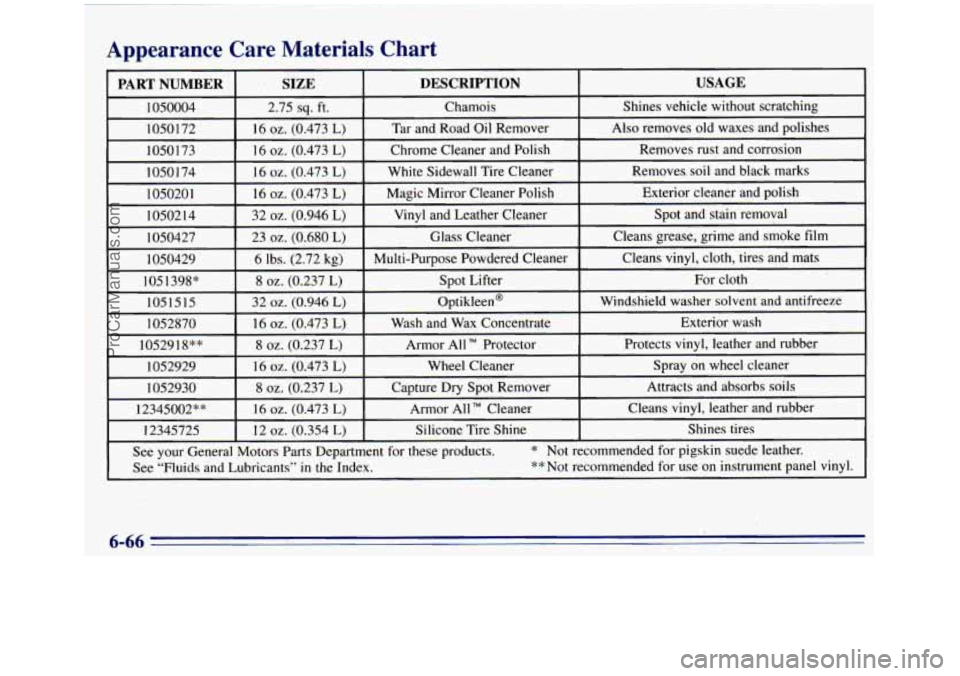
Appearance Care Materials Chart
PART NUMBER ’ SIZE DESCRIPTION USAGE
1050004 2.75 sq. ft. Chamois Shines vehicle without scratching
1050 172
16 oz. (0.473 L) Tar and Road Oil Remover Also removes old waxes and polishes
10501 73 16
oz. (0.473 L) Chrome Cleaner and Polish Removes rust and corrosion I I
I 1050174 I 16 oz. (0.473 L) I White Sidewall Tire Cleaner I Removes. soil and black marks I
See “Fluids and Lubricants” in the Index.
6-66 m
ProCarManuals.com
Page 322 of 404
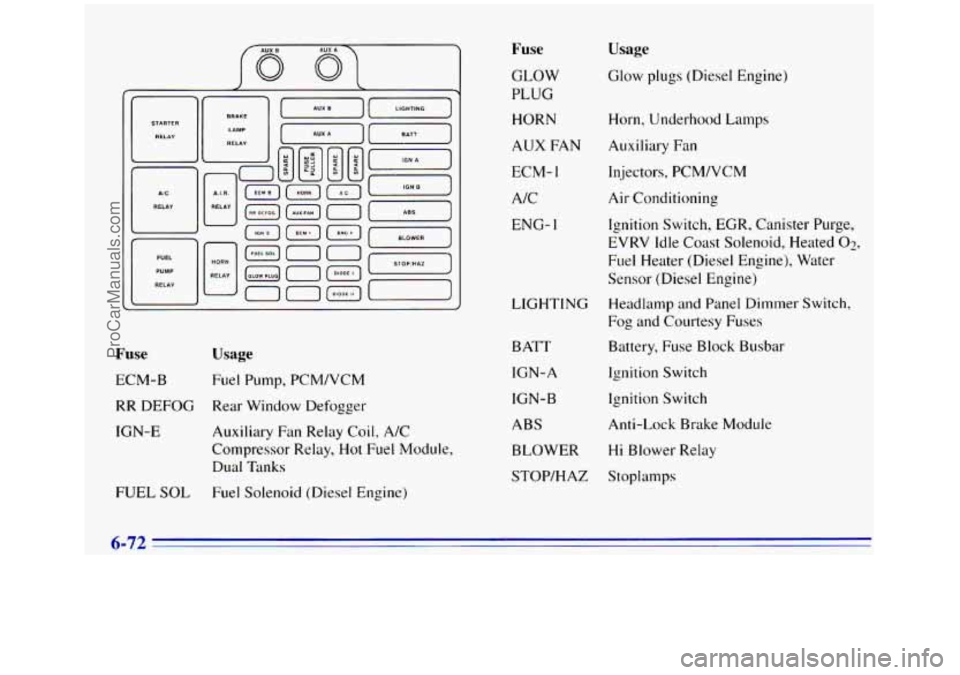
Fuse
ECM-B
Usage
Fuel Pump, PCM/VCM
RR DEFOG Rear Window Defogger
IGN-E Auxiliary Fan Relay Coil, A/C
Compressor Relay, Hot Fuel Module,
Dual Tanks
FUEL SOL Fuel Solenoid (Diesel Engine)
Fuse
GLOW
PLUG
HORN
AUX FAN
ECM-
1
A/C
ENG-
1
Usage
Glow plugs (Diesel Engine)
Horn, Underhood Lamps Auxiliary Fan
Injectors, PCM/VCM
Air Conditioning
Ignition Switch, EGR, Canister Purge,
EVRV Idle Coast Solenoid, Heated
02,
Fuel Heater (Diesel Engine), Water
Sensor (Diesel Engine)
LIGHTING Headlamp and Panel Dimmer Switch,
Fog and Courtesy Fuses
Battery,
Fuse Block Busbar
BATT
IGN-A
IGN-B
ABS Ignition Switch
Ignition Switch
Anti-Lock Brake Module
BLOWER
Hi Blower Relay
STOP/HAZ Stoplamps
ProCarManuals.com