1996 GMC SAVANA flat tire
[x] Cancel search: flat tirePage 3 of 372

The 1996 GMC Savana Owner’s Manual
Seats and Restraint Systems .............................................................
FeaturesandControls ..................................................................
Comfort Controls and Audio Systems .....................................................
This section tells you how to use your seats and safety belts\
properly. It also explains the “SIR’ system.
This section explains how to start and operate your vehicle.
This section tells you how to adjust the ventilation and comfo\
rt controls and how to operate your audio system.
YourDrivingandtheRoad ..............................................................
Here you’ll find helpful information and tips about the road\
and how to drive under different conditions.
ProblemsontheRoad ..................................................................
This section tells you what to do if you have a problem while driving, such as a flat tire or overheated
engine, etc.
ServiceandAppearanceCare ............................................................
Here the manual tells you how to keep your vehicle running pr\
operly and looking good.
Maintenanceschedule ..................................................................
This section tells you when to perform vehicle maintenance and \
what fluids and lubricants to use.
Customer Assistance Information ........................................................
This section tells you how to contact GMC Truck for assistance and how to get service and owner
publications.
It also gives you information on ”Reporting Safety Defects” on page 8-8.
Here‘s an alphabetical listing of almost every subject in this manual. You can use it to quickly find
something you want to read.
Index ........................................................................\
........
1-1
2- 1
3-1
4- 1
5-1
6-1
7-1
8- 1
9-1
i
ProCarManuals.com
Page 168 of 372

Once you are moving on the freeway, make certain
you allow a reasonable following distance. Expect to
move slightly slower at night.
When you want to leave
the freeway, move to the
proper lane well
in advance. If YOLI miss your exit, do
not, under any circumstances, stop and back up. Drive
on
to the next exit.
The exit ramp can be curved, sometimes quite sharply.
The exit speed is usually posted. Reduce your speed according
to your speedometer, not
to your sense of motion. After driving for any distance
at higher speeds,
you may tend to think you are going
slower than you actually are.
Before Leaving on a Long Trip
Make sure you’re ready. Try to be well rested. If you
must start when you’re not fresh
-- such as after a day’s
work
-- don’t plan to make too many miles that first part
of
the journey. Wear comfortable clothing and shoes you
can easily drive
in.
Is your vehicle ready for a long trip? If you keep it
serviced and maintained, it’s ready to go. If it needs
service, have it done before starting
out. Of course,
you’ll find experienced and able service experts
in GM
dealers
all across North America. They’ll be ready and
willing to help
if you need it.
Here are some things you can check before a trip:
0
0
0
0
0
0
0
Windshield Wclsher Fluid: Is the reservoir full? Are
all windows clean inside and outside?
Wiper- Blcrdes: Are they in good shape?
Fuel, Engine Oil, Other FlLtids: Have you checked
all levels?
Lnlnps: Are they all working? Are the lenses clean?
Tires: They are vitally important to a safe,
trouble-free trip.
Is the tread good enough for
long-distance driving? Are
the tires all inflated to the
recommended pressure?
Weather Forecasts: What’s the weather outlook
along your route‘? Should you delay your trip a short
time
to avoid a major storm system?
Maps: Do you have up-to-date maps‘?
4-20
ProCarManuals.com
Page 169 of 372

Highway Hypnosis
Is there actually such a condition as “highway
hypnosis”? Or is
it just plain falling asleep at the
wheel? Call
it highway hypnosis, lack of awareness,
or whatever.
There
is something about an easy stretch of road with
the same scenery, along with the hum of the tires on
the road,
the drone of the engine, and the rush of the
wind against the vehicle that can make you sleepy.
Don’t let
it happen to you! If it does, your vehicle can
leave the road
in less flzan u secord, and you could
crash and be injured.
What can you do about highway hypnosis‘? First, be
aware that
it can happen.
Then here are some tips:
Make sure your vehicle is well ventilated, with a
comfortably cool interior.
Keep your eyes moving. Scan the road ahead and
to the sides, Check your mirrors and your
instruments frequently.
If you get sleepy, pull off the road into a rest, service
or parking area and take a nap, get some exercise, or
both. For safety, treat drowsiness
on the highway as
an emergency.
Hill and Mountain Roads
Driving on steep hills or mountains is different from
driving
in flat or rolling terrain.
If you drive re.gularly in steep country, or if you’re
planning to visit there, here are some tips that can make
your trips safer and more enjoyable.
4-21
ProCarManuals.com
Page 174 of 372

Run your engine only as long as you must. This saves
fuel. When you run the engine, make
it go a little fdster
than just idle. That
is, push the accelerator slightly.
This uses
less fuel for the heat that you get and it
keeps the battery (or batteries) charged. You will need
a well-charged battery (or batteries) to restart the
vehicle, and possibly for signaling later on with your
headlamps. Let the heater
run for awhile.
If you have a diesel engine, you may have to run it at a
higher speed to get enough heat. Then, shut the engine
off and close the window almost all the way to preserve
the heat. Start the engine again and repeat this only
when you feel really uncomfortable from the cold.
But
do it as little as possible. Preserve the fuel as long as you
can. To help keep warm, you can get out of the vehicle
and
do some fairly vigorous exercises every half hour or
so until help comes.
Loading Your T hicle
on
GAWR FRT
RIM COLD TIRE PRI
EE ~ENERS MANUAL FOR ADDITIONAL INFORMATION. -1
The CertificationRire label is found on the rear edge
of the driver’s door. The label shows the size
of your
original tires and the inflation pressures needed to obtain the gross weight capacity your vehicle. This is called
GVWR (Gross Vehicle Weight Rating). The GVWR
includes the weight of the vehicle, all occupants, fuel
and cargo.
4-26
ProCarManuals.com
Page 180 of 372

If you’re using your platform hitch as a weight-carrying
hitch, the trailer tongue
(A) should weigh 10 percent of
the total loaded trailer weight
(B). If you’re using your
platform hitch as a weight-distributing hitch, the trailer
tongue
(A) should weigh 12 percent of the total loaded
trailer weight
(B).
After you’ve loaded your trailer, weigh the trailer and
then the tongue, separately, to see
if the weights are
proper. If they aren’t, you may be able to get them right
simply by moving some items around
in the trailer.
Total Weight on Your Vehicle’s Tires
Be sure your vehicle’s tires are inflated to the limit for
cold tires. You’ll find these numbers
on the Certification
label at the rear edge
of the driver’s door or see “Tire
Loading”
in the Index. Then be sure you don’t go over
the
GVW limit for your vehicle, including the weight of
the trailer tongue.
Hitches
It‘s important to have the correct hitch equipment.
Crosswinds, large trucks going by and rough roads are
a
few reasons why you’ll need the right hitch. Here are
some rules to follow:
0
0
The bumpers on your vehicle are not intended for
hitches.
Do not attach rental hitches or other
bumper-type hitches to them. Use only a
frame-mounted hitch that does not attach to the.
bumper.
Do not use a ball hitch, because it could pull
the bumper loose.
If you’ll be pulling a trailer that, when loaded, will
weigh more than
4,000 Ibs. (1 800 kg), be sure to use
a properly mounted, weight-distributing hitch and
sway control of the proper
size. This equipment is
very important for proper vehicle loading and good
handling when you’re driving.
4-32
ProCarManuals.com
Page 208 of 372
If a Tire Goes Flat
It’s unusual for a tire to “blow out” while you’re driving,
especially
if you maintain your tires properly. If air goes
out of a tire, it’s much more likely
to leak out slowly.
But
if you should ever have a “blowout,” here are a few
tips about what to expect and what to do:
If a front tire fails, the flat tire will create a drag that
pulls the vehicle toward that side. Take
your foot off the
accelerator pedal and grip the st.eering wheel firmly.
Steer to maintain lane position, and then gently brake to
a stop well out of the traffic lane.
A rear blowout, particularly on a curve, acts much like a
skid and may require the same correction you’d use in a
skid.
In any rear blowout, remove your foot from the
accelerator pedal. Get the vehicle under control
by
steering the way you want the vehicle to go. It may be
very bumpy and noisy, but you can still steer. Gently
brake to
a stop -- well off the road if possible.
If a tire goes flat, the next part shows how to use your
jacking equipment to change a
flat tire safely.
Changing a Flat Tire
If a tire goes flat, avoid further tire and wheel damage
by driving slowly to
a level place. Turn on your hazard
warning flashers.
Changing a tire can cause an injury. The vehicle
can slip off the jack and roll over you or other
people. You and they could be badly injured.
Find a level place
to change your tire. To help
prevent the vehicle from moving:
1. Set the parking brake firmly.
2. Put the shift lever in PARK (P).
3. Turn off the engine.
To be even more certain the vehicle won’t move,
you can put blocks at the front and rear of the
tire farthest away from the one being changed.
That would be the tire on the other side of the
vehicle, at the opposite end.
5-20
ProCarManuals.com
Page 210 of 372
NOTICE:
Never remove or restore a tire frodto a stowage
position under the vehicle while the vehicle
is
supported by a jack. Always tighten the tire
fully against the underside of the vehicle
when restowing
If you have a vehicle which was completed from a cab
.
L
A flat rear tire reduces clearance to remove the spare
tire. If there is less than 12 inches
(30.48 cm) between
the ground and
the rear bumper or any trailer hitch, jack
up the vehicle until the flat tire is off the ground.
(See “Removing the Flat Tire” and “Installing the
Spare Tire,” Steps
4 through 8, in this section.)
Unless your vehicle has a flat rear tire,
do not remove or
restore a tire from/to
a stowage position under the
vehicle while the vehicle is supported by a jack. Always
tighten the tire
fully against the underside of the vehicle
when restowing. and
chassis, refer
to the information from the body
supplier/installer.
The spare tire is
a full size tire, like the other tires on
your vehicle.
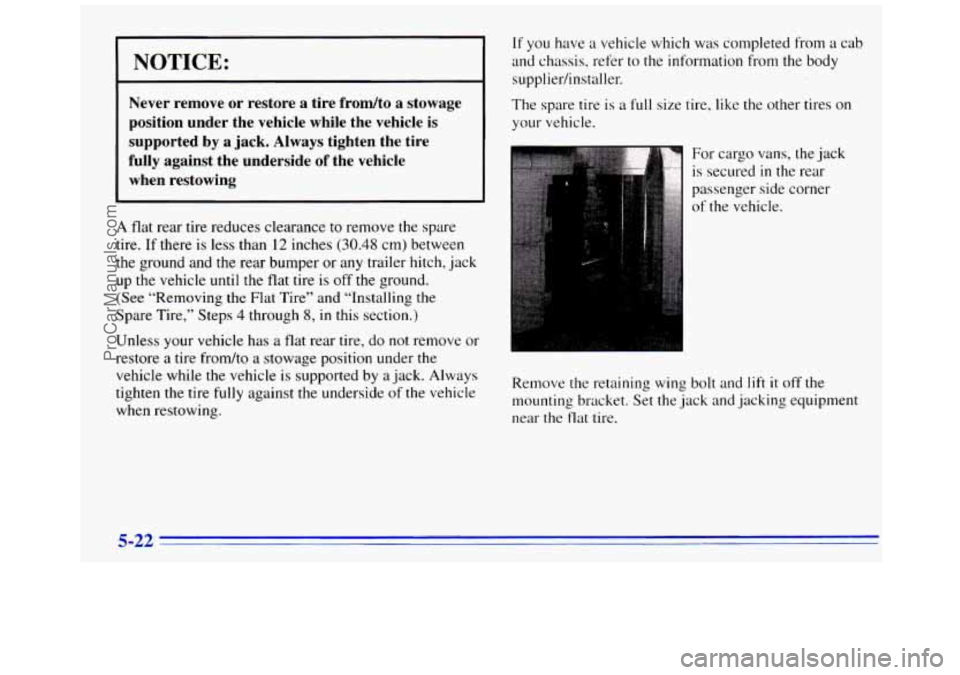
For cargo vans, the jack
is secured
in the rear
passenger side corner
of the vehicle.
Remove the retaining wing bolt and
lift it off the
mounting bracket. Set the jack and jacking equipment
near the
flat tire.
5-22
ProCarManuals.com
Page 212 of 372
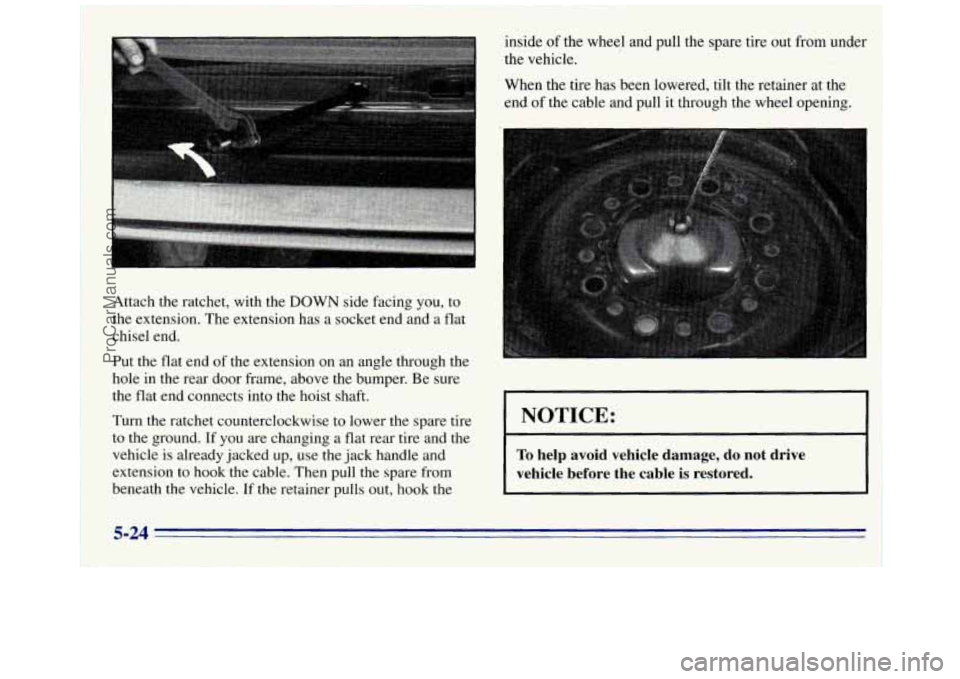
Attach the ratchet, with the DOWN side facing you, to
the extension. The extension has a socket end and a flat
chisel end.
Put the flat end of the extension on an angle through the
hole in the rear door frame, above the bumper. Be sure
the flat end connects into the hoist shaft.
Turn the ratchet counterclockwise to lower the spare tire
to the ground.
If you are changing a flat rear tire and the
vehicle is already jacked up, use the jack handle and
extension to hook the cable. Then pull the spare from
beneath the vehicle.
If the retainer pulls out, hook the inside
of the wheel and pull the
spare tire out from under
the vehicle.
When the tire has been lowered, tilt the retainer at the end
of the cable and pull it through the wheel opening.
NOTICE:
To help avoid vehicle damage, do not drive
vehicle before the cable is restored.
5-24 i
t
ProCarManuals.com