Page 208 of 372
If a Tire Goes Flat
It’s unusual for a tire to “blow out” while you’re driving,
especially
if you maintain your tires properly. If air goes
out of a tire, it’s much more likely
to leak out slowly.
But
if you should ever have a “blowout,” here are a few
tips about what to expect and what to do:
If a front tire fails, the flat tire will create a drag that
pulls the vehicle toward that side. Take
your foot off the
accelerator pedal and grip the st.eering wheel firmly.
Steer to maintain lane position, and then gently brake to
a stop well out of the traffic lane.
A rear blowout, particularly on a curve, acts much like a
skid and may require the same correction you’d use in a
skid.
In any rear blowout, remove your foot from the
accelerator pedal. Get the vehicle under control
by
steering the way you want the vehicle to go. It may be
very bumpy and noisy, but you can still steer. Gently
brake to
a stop -- well off the road if possible.
If a tire goes flat, the next part shows how to use your
jacking equipment to change a
flat tire safely.
Changing a Flat Tire
If a tire goes flat, avoid further tire and wheel damage
by driving slowly to
a level place. Turn on your hazard
warning flashers.
Changing a tire can cause an injury. The vehicle
can slip off the jack and roll over you or other
people. You and they could be badly injured.
Find a level place
to change your tire. To help
prevent the vehicle from moving:
1. Set the parking brake firmly.
2. Put the shift lever in PARK (P).
3. Turn off the engine.
To be even more certain the vehicle won’t move,
you can put blocks at the front and rear of the
tire farthest away from the one being changed.
That would be the tire on the other side of the
vehicle, at the opposite end.
5-20
ProCarManuals.com
Page 220 of 372
A CAUTION:
Incorrect wheel nuts or improperly tightenea
wheel nuts can cause the wheel to become loose
and even come off. This could lead to an accident.
Be sure to use the correct wheel nuts.
If you have
to replace them, be sure to get new
GM original
equipment wheel nuts.
Stop, somewhere
as soon as you can and have
the nuts tightened with a torque wrench to
122 lb-ft (165 N-m).
NOTICE:
Improperly tightened wheel nuts can lead to
brake pulsation and rotor damage.
To avoid
expensive brake repairs, evenly tighten the wheel
nuts in the proper sequence and to the proper'
torque specification.
11. Put the wheel cover back on, if you have one.
Remove any wheel blocks.'
Remember that the jack, jacking equipment and tire
must
be properly stored in their original storage
position before you begin driving again. The next
part will show you how.
5-32
ProCarManuals.com
Page 232 of 372
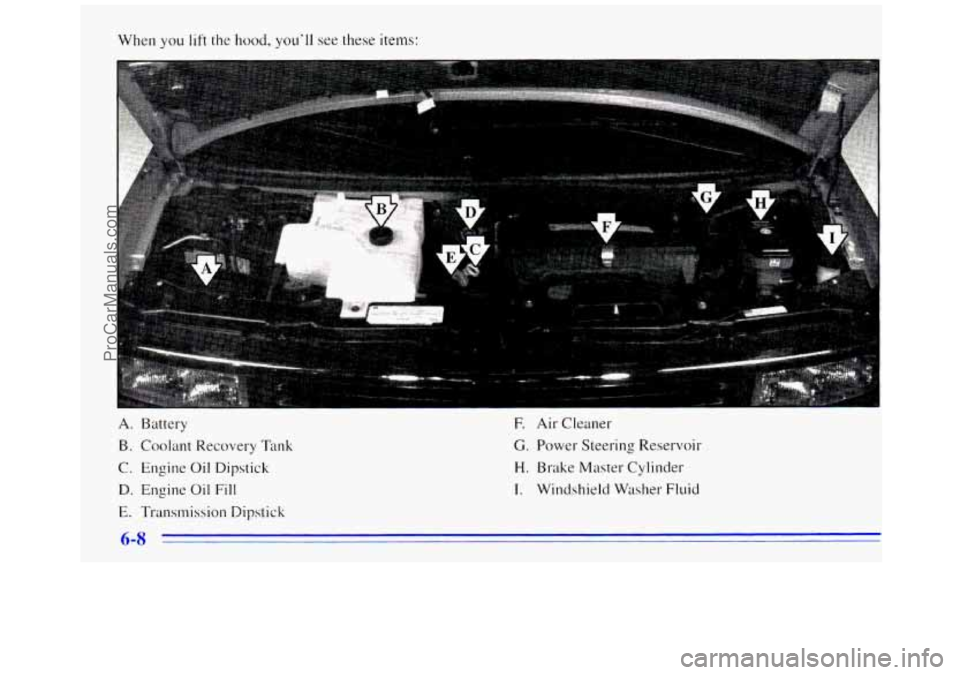
When you lift the hood, ~011’11 see these items:
A. Battery
B. Coolant Recovery Tank
C. Engine Oil Dipstick
D. Engine Oil Fill
E. Transmission Dipstick
F. Air Cleaner
G. Power Steering Reservoir
H. Brake Master Cylinder
I. Windshield Washer Fluid
ProCarManuals.com
Page 233 of 372
If your vehicle has a 7.4L engine and air conditioning,
your vehicle will have a auxiliary engine fan
in addition
to the belt driven
fdn.
If your vehicle has air conditioning, the auxiliary
engine fan under the hood can start up and
injure you even when the engine is not running.
Keep hands, clothing and tools away from any
underhood electric fan.
~ Things that burn can get on hot engine parts and
start a
fire. These include liquids like gasoline,
~ oil, coolant, brake fluid, windshield washer and
~ other fluids, and plastic or rubber. You or others
could be burned. Be careful not to drop or spill
things that
will burn onto a hot engine. Before closing
the hood, be sure
all the filler caps are
on properly.
Then
lift the hood to relieve pressure on the hood prop.
Remove the hood prop from the slot
in the hood and
return the prop to
its retainer. Then just let the hood
down and close
it firmly.
Noise Control System
The following information relates to compliance with
Federal noise emission standards for vehicles with a
Gross Vehicle Weight Rating (GVWR) of more than
10,000 lbs. (4 536 kg). The Maintenance Schedule
booklet provides information on maintaining the noise
control system to minimize degradation of the noise
emission control system during the life of your vehicle.
The noise control system warranty is given
in your
Warranty booklet.
These standards apply only
to vehicles sold in the
United States.
6-9
ProCarManuals.com
Page 241 of 372

Wait at least 30 minutes before checking the
transmission fluid level if you have been driving:
0 When outside temperatures are above 90°F (32°C).
At high speed for quite a while.
In heavy traffic -- especially in hot weather.
While pulling a trailer.
To get the right reading, the fluid should be at normal
operating temperature, which is
180°F to 200°F
(82°C to 93°C).
--- -king "ran:- ---. .ion Fluid Hot
bet the vehicle warmed up by driving about 15 miles
(24 km) when outside temperatures are above 50°F
(10°C). If it's colder than 50°F (lO"C), drive the
vehicle
in DRIVE (D) until the engine temperature
gage moves and then remains steady for
10 minutes.
Then follow the hot check procedures.
Checking Transmission Fluid Cold
A cold check is made after the vehicle has been sitting
for eight hours or more with
the engine off and is
used only
as a reference. Let the engine run at idle for
five minutes
if outside temperatures are 50°F (10°C) or
more. If it's colder than 50°F (IOOC), you may have to
idle the engine longer. Should the fluid level be low
during
a cold check, you 17zusr perform a hot check
before adding fluid. This will give you a more accurate
reading
of the fluid level.
Checking the Fluid Hot or Cold
Park your vehicle on a level place. Keep the
engine running.
With the parking brake applied, place the shift lever
in PARK (P).
With your foot on the brake pedal, move the shift
lever through each gear range, pausing for about
three seconds
in each range. Then, position the shift
lever
in PARK (P).
0 Let the engine run at idle for three minutes or more.
6-17
ProCarManuals.com
Page 248 of 372

Thermostat
Engine coolant temperature is controlled by a thermostat
in the engine cooling system. The thermoskt stops the
tlow of coolant through the radiator until the coolant
reaches
a preset temperature.
When you replace your thermostat,
an AC@ thermostat
is recommended.
Power Steering Fluid
When to Check Power Steering Fluid
It is not necessary to regularly check power steering
tluid unless you suspect there
is a leak in the system or
you hear an unusual noise.
A fluid loss in this system
could indicate a problem. Have the system inspected
and repaired.
How To Check Power Steering Fluid
When the engine compartment is cool, unscrew the cap
and wipe the dipstick with a clean rag. Replace the cap
and completely tighten
it. Then remove the cap again
and
look at the fluid level on the dipstick.
The level should be at the FULL COLD mark. If
necessary, add only enough fluid to bring
the level up to
the mark.
To prevent brake fluid contamination, never check or
fill
the power steering reservoir with the master cylinder
cover off.
What to Use
Refer to the Maintenance Schedule to determine what
kind
of fluid to use. See “Recommended Fluids and
Lubricants”
in the Index. Always use the proper fluid.
Failure to use the proper fluid can cause leaks and
damage hoses and seals.
ProCarManuals.com
Page 250 of 372

Brakes
Brake Fluid
Your brake master cylinder reservoir is here. It is filled
with DOT-3 brake fluid.
There
are only two reasons why the brake fluid level in the
reservoir might
go down. The first is that the brake fluid
lining wear. When new linings are put in, thc tluid levcl
2 wes down to an acceptable level during nonnal brake
c qoes back up. The other reason is that fluid is leaking out
of the brake system. If it is, you should have your brake
system fixed, since
a leak means that sooner or later your
brakes won't work well, or
won't work at all.
So, it isn't a good idea to "top off' your brake tluid.
Adding brake fluid won't correct a leak. If you add fluid
when your linings are worn, then
you'll have too much
fluid when you get new brake linings.
You should add
(or remove) brake fluid, as necessary, only when work is
done
on the brake hydraulic system.
A CAUTION
If you have too much brake fluid, it can spill on the
engine. The fluid
will burn if the engine is hot
enough. You
or others could be burned, and your
vehicle could
be damaged. Add brake fluid only
when work
is done on the brake hydraulic system.
Refer to the Maintenance Schedule to determine when to
check your brake fluid. See "Periodic Maintenance
Inspections"
in the Index.
6-26
ProCarManuals.com
Page 251 of 372
Checking Brake Fluid
You can check the brake fluid without taking off the cap.
Just
look at the windows on the brake fluid reservoir.
The
fluid levels should be above MIN. If they aren’t,
have your brake system checked
to see if there is a leak.
After work
is done on the brake hydraulic system,
make sure the levels are above
MIN and below the top
of each window.
What to I
When you do need brake fluid, use only DOT-3 brake
fluid
-- such as Delco Supreme 11 @ (GM Part
No. 1052535). Use new brake fluid from a sealed
container only, and always clean the brake fluid
reservoir cap before removing it.
With the wrong kind of fluid in your brake
system, your brakes may not work well, or they
may not even work
at all. This could cause a
crash. Always use the proper brake fluid.
6-27
ProCarManuals.com