1996 GMC SAVANA trailer
[x] Cancel search: trailerPage 185 of 372

When You Are Ready to Leave After
Parking
on a Hill
1. Apply your regular brakes and hold the pedal down
while you:
Start your engine:
Shift into a gear: and
Release the parking brake.
2. Let up on the brake pedal.
3. Drive slowly until the trailer is clear of the chocks.
4. Stop and have someone pick up and store the chocks.
Maintenance When Trailer Towing
Your vehicle will need service more often when you’re
pulling a trailer. See the Maintenance Schedule for more
on this. Things that are especially important
in trailer
operation are automatic transmission
fluid (don’t
overfill), engine oil, axle lubricant, belt, cooling system
and brake adjustment. Each
of these is covered in this
manual, and the Index will help
you find them quickly.
If you‘re trailering, it‘s a good idea to review these
sections before you start your trip.
Check periodically to see that
all hitch nuts and bolts
are tight.
Trailer Wiring Harness
The eight-wire harness, if you have one, is stored under
your vehicle along the rear frame crossmember.
It is
wrapped and bound with a plastic strap. The harness has
a 30-anlp battery feed and no connector, and you should
have a qualified electrical service person wire your
harness for you. Attach the harness
to the trailer, then
tape or strap
it to your vehicle’s frame rail. Be sure you
leave
it loose enough so the wiring doesn’t bend or
break, but not
so loose that it drags on the ground.
Store the harness
in its original place. Wrap the harness
together and tie
it neatly so it won’t be damaged.
The five-wire harness,
if you have one, is stored inside
the vehicle at the passenger side rear corner, behind the
jack. This should be wired by a qualified electrical
service person. It must be routed out
of your vehicle
between the rear door and the floor,
with enough of the
harness left on both sides
so that the trailer or the body
won’t pull
it.
Store the harness in its original place. Wrap the harness
together and tie
it neatly so it won’t be damaged.
4-37
ProCarManuals.com
Page 199 of 372

If No Steam Is Coming From Your Engine
If you get the overheat warning but see or hear no
steam, the problem may not be too serious. Sometimes
the engine can get a little too hot when you:
Climb a long hill on a hot day.
Stop after high-speed driving.
Idle for long periods in traffic.
Tow a trailer. See “Driving on Grades’’ in the Index.
If you get
the overheat warning with no sign of steam,
try this for a minute or
so:
1. If you have an air conditioner, turn it off.
2. Turn on your heater to full hot at the highest fan
speed and open the window as necessary.
3. If you’re in a traffic jam, shift to NEUTRAL (N);
otherwise, shift to the highest gear while
driving
-- DRIVE (D).
If you no longer have the overheat warning, you can
drive. Just to be safe, drive slower for about
10 minutes.
If the warning doesn’t come back on, you can
drive normally.
If the warning continues, pull over, stop, and park your
vehicle right away.
If there’s still no sign of steam, you can idle the engine
for two or three minutes while you’re parked, to push
the accelerator
until the engine speed is about twice as
fast as normal idle speed. Bring the engine speed back to
normal idle speed after two or three minutes. Now see if
the warning stops. But then, if you still have the
warning,
tLtrn off the engine atzd get everyone out ofthe
vehicle until it cools down.
You may decide not
to lift the hood but to get service
help right away.
5-11
ProCarManuals.com
Page 207 of 372

Under heavy vehicle loading, trailer towing andor high
outside temperatures, the fan speed increases as
the clutch
more fully engages.
So you may hear an increase in fan
noise. This is normal and should
not be mistaken as the
transmission slipping or making extra shifts. It is merely
the cooling system functioning properly. The fan will
the clutch partially disengages.
- slow down when additional cooling is not required and
8. Then replace the pressure cap. At any time during
this procedure
if coolant begins to flow out of the
filler neck, reinstall the pressure cap. Be sure the
arrows on
the pressure cap line up like this.
You may also hear this fan noise when you start
the engine.
It will go away as the fan clutch
partially disengages.
5-19
ProCarManuals.com
Page 210 of 372
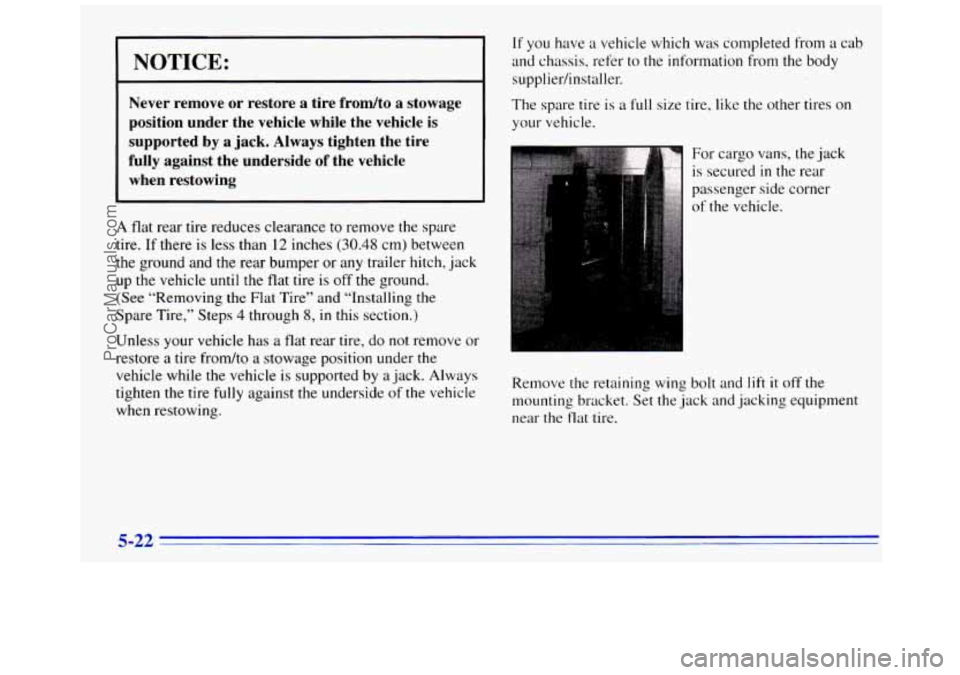
NOTICE:
Never remove or restore a tire frodto a stowage
position under the vehicle while the vehicle
is
supported by a jack. Always tighten the tire
fully against the underside of the vehicle
when restowing
If you have a vehicle which was completed from a cab
.
L
A flat rear tire reduces clearance to remove the spare
tire. If there is less than 12 inches
(30.48 cm) between
the ground and
the rear bumper or any trailer hitch, jack
up the vehicle until the flat tire is off the ground.
(See “Removing the Flat Tire” and “Installing the
Spare Tire,” Steps
4 through 8, in this section.)
Unless your vehicle has a flat rear tire,
do not remove or
restore a tire from/to
a stowage position under the
vehicle while the vehicle is supported by a jack. Always
tighten the tire
fully against the underside of the vehicle
when restowing. and
chassis, refer
to the information from the body
supplier/installer.
The spare tire is
a full size tire, like the other tires on
your vehicle.
For cargo vans, the jack
is secured
in the rear
passenger side corner
of the vehicle.
Remove the retaining wing bolt and
lift it off the
mounting bracket. Set the jack and jacking equipment
near the
flat tire.
5-22
ProCarManuals.com
Page 238 of 372
When to Change Engine Oil
See if any one of these is true for you:
0
0
0
0
0
Most trips are less than 5 to 10 miles (8 to 16 km).
This is particularly important when outside
temperatures are below freezing.
Most trips include extensive idling (such
as frequent
driving
in stop-and-go traffic).
Most trips are through dusty areas.
You frequently tow a trailer or use a carrier on top of
your vehicle.
The vehicle
is used for delivery service, police, taxi
or other commercial application.
Driving under these conditions causes engine oil to
break down sooner. If any one of these is true for your
vehicle, then you need to change your oil and filter
every
3,000 miles (5 000 km) or 3 months -- whichever
occurs first.
If none of them is true, change the oil and filter every
7,500 miles (1 2 SO0 km) or 12 months -- whichever
occurs first. Driving a vehicle
with a fully warnled
engine under highway conditions causes engine oil to
break down slower.
What to Do with Used Oil
Did you know that used engine oil contains certain
elements that may be unhealthy for your skin and could
even cause cancer'? Don't let used oil stay on your skin
for very long. Clean your skin and nails with soap and
water, or a
good hand cleaner. Wash or properly throw
away clothing or rags containing used engine
oil. (See
the manufacturer's warnings about the use and disposal
of oil products.)
Used oil can be a real threat to the environment. If you
change your own
oil, be sure to drain all free-flowing oil
from the filter before disposal. Don't ever dispose of oil
by putting it in the trash, pouring it on the ground, into
sewers, or into streams or bodies of water. Instead,
recycle
it by taking it to a place that collects used oil. If
you have a problem properly disposing of your used oil,
ask your dealer,
a service station or a local recycling
center for help.
6-14
ProCarManuals.com
Page 240 of 372

Automatic Transmission Fluid
7 ’ ~ n to Check and Change
A good time to check your automatic transmission fluid
level is when the engine oil is changed.
Change
both the fluid and filter every 50,000 miles
(83 000 km) if the vehicle’s GVWR is over 8,600 or
if
the vehicle is mainly driven under one or more of
these conditions:
0 In heavy city traffic where the outside temperature
0 In hilly or mountainous terrain.
0 When doing frequent trailer towing.
regularly
reaches
90°F (32°C) or higher.
0 Uses such as found in taxi, police or delivery service.
If your vehicle’s GVWR is not over 8,600 and you do
not use your vehicle under any of these conditions, the
fluid and filter do not require changing.
See “Scheduled Maintenance Services”
in the Index.
How to Check
Because this operation can be a little difficult, you
may choose to have this done at your GM dealer
Service Department.
If you do it yourself, be sure to follow all the
instructions here, or you could get
a false reading on
the dipstick.
NOTICE:
Too much or too little fluid can damage your
transmission.
Too much can mean that some of
the fluid could come out and fall on hot engine parts or exhaust system parts, starting a fire. Be
sure to get an accurate reading if you check your
transmission fluid.
ProCarManuals.com
Page 241 of 372

Wait at least 30 minutes before checking the
transmission fluid level if you have been driving:
0 When outside temperatures are above 90°F (32°C).
At high speed for quite a while.
In heavy traffic -- especially in hot weather.
While pulling a trailer.
To get the right reading, the fluid should be at normal
operating temperature, which is
180°F to 200°F
(82°C to 93°C).
--- -king "ran:- ---. .ion Fluid Hot
bet the vehicle warmed up by driving about 15 miles
(24 km) when outside temperatures are above 50°F
(10°C). If it's colder than 50°F (lO"C), drive the
vehicle
in DRIVE (D) until the engine temperature
gage moves and then remains steady for
10 minutes.
Then follow the hot check procedures.
Checking Transmission Fluid Cold
A cold check is made after the vehicle has been sitting
for eight hours or more with
the engine off and is
used only
as a reference. Let the engine run at idle for
five minutes
if outside temperatures are 50°F (10°C) or
more. If it's colder than 50°F (IOOC), you may have to
idle the engine longer. Should the fluid level be low
during
a cold check, you 17zusr perform a hot check
before adding fluid. This will give you a more accurate
reading
of the fluid level.
Checking the Fluid Hot or Cold
Park your vehicle on a level place. Keep the
engine running.
With the parking brake applied, place the shift lever
in PARK (P).
With your foot on the brake pedal, move the shift
lever through each gear range, pausing for about
three seconds
in each range. Then, position the shift
lever
in PARK (P).
0 Let the engine run at idle for three minutes or more.
6-17
ProCarManuals.com
Page 300 of 372

Maintenance Schedule
Short TripKity Definition -- Gasoline Engines i
Follow the Short Trip/City Maintenance Schedule if any
one of these conditions is true for your vehicle:
0
0
0
0
0
e
Most trips are less than 5 to 10 miles (8 to 16 km).
This is particularly important when outside
temperatures are below freezing.
Most trips include extensive idling (such as frequent
driving
in stop-and-go traffic j.
Most trips are through dusty areas.
You frequently tow
a trailer or use a carrier on top of
your vehicle.
You frequently tow
a trailer or us-e a carrier on top of
your vehicle. (With some models, you should never
tow
a trailer. See “Towing a Trailer” in the Index.)
If the vehicle is used for delivery service, police, taxi
or other commercial application.
Short Trip/City Intervals -- Gasoline Engines
Every 3,000 Miles (5 000 km): Engine Oil and Filter
Change (or
3 months, whichever occurs first). Chassis
Lubrication (or
3 months, whichever occurs first).
Drive Axle Service (or
3 months, whichever
occurs first).
At 6,000 Miles (10 000 km) -- Then Every
12,000 Miles (20
000 km): Tire Rotation.
Every 15,000 Miles (25 000 km): Air Cleaner Filter
Inspection,
if driving in dusty conditions. Shields and
Underhood Insulation Inspection (GVWR above
8,500 Ibs. only). Thermostatically Controlled Engine
Cooling Fan Check (or every
12 months, whichever
occurs first). Front Wheel Bearing Repack (or at each
brake relining, whichever occurs first).
Every 30,000 Miles (50 000 km): Air Cleaner Filter
Replacement. Fuel Filter Replacement.
Every 50,000 Miles (83 000 km): Automatic
Transmission Service (vehicles over
8600 GVWR
or driven under severe conditions only).
7-4
ProCarManuals.com