Page 195 of 372
A CAUTION: A CAUTION:
To help avoid injury to you or others:
0
0
0
0
0
Never let passengers ride in a vehicle that is
being towed.
Never tow faster than safe or posted speeds.
Never tow with damaged parts not
fully secured.
Never get under your vehicle after it has
been lifted by the tow truck.
Always use separate safety chains on each
side when towing
a vehicle.
When your vehicle is being towed, have the ignition
key’off. The steering wheel should be clamped in a
straight-ahead position, with a clamping device
designed
for towing service. Do not use the vehicle’s
steering column lock for this. The transmission should
be in
NEUTRAL (N) and the parking brake should
be released.
A vehicle can fall from a car carrier if it isn’t
adequately secured. This can cause
a collision,
serious personal injury and vehicle damage. The
vehicle should be tightly secured with chains or
steel cables before it is transported.
Don’t use substitutes (ropes, leather straps,
canvas webbing, etc.) that can be cut by sharp
edges underneath the towed vehicle.
5-7
ProCarManuals.com
Page 196 of 372
FroF Towing
A towlng dolly must be used under the drive wheels
when towing
from the front.
Tow Limits -- 35 mph (56 kh), SO miles (80 km)
NOTICE:
Do not tow with sling-type equipment or the
front bumper system will be damaged. Use
wheel-lift or car-carrier equipment. Additional
ramping may be required for car-carrier
equipment. Use safety chains and wheel straps.
Towing a vehicle over rough surfaces could
damage a vehicle or wheel-lift equipment.
To help avoid damage, install a towing dolly
and raise the vehicle until adequate clearance
is obtained between the ground and/or
wheel-lift equipment.
5-8
ProCarManuals.com
Page 197 of 372
Rear Towing
NOTICE:
Do not tow the vehicle from the rear with
loads approaching rated
GVW as the weight
transfer will cause the front suspension to
become overloaded.
NOTICE:
Do not tow with the sling-type equipment or the
rear bumper will be damaged. Use wheel-lift or
car-carrier equipment. Additional ramping may
be required for car-carrier equipment. Use safety
chains and wheel straps.
Towing
a vehicle over rough surfaces could
damage a vehicle.
To help avoid damage, install a
towing dolly and raise the vehicle until adequate
clearance is obtained between the ground and/or
wheel-lift equipment.
5-9
ProCarManuals.com
Page 207 of 372
Under heavy vehicle loading, trailer towing andor high
outside temperatures, the fan speed increases as
the clutch
more fully engages.
So you may hear an increase in fan
noise. This is normal and should
not be mistaken as the
transmission slipping or making extra shifts. It is merely
the cooling system functioning properly. The fan will
the clutch partially disengages.
- slow down when additional cooling is not required and
8. Then replace the pressure cap. At any time during
this procedure
if coolant begins to flow out of the
filler neck, reinstall the pressure cap. Be sure the
arrows on
the pressure cap line up like this.
You may also hear this fan noise when you start
the engine.
It will go away as the fan clutch
partially disengages.
5-19
ProCarManuals.com
Page 210 of 372
NOTICE:
Never remove or restore a tire frodto a stowage
position under the vehicle while the vehicle
is
supported by a jack. Always tighten the tire
fully against the underside of the vehicle
when restowing
If you have a vehicle which was completed from a cab
.
L
A flat rear tire reduces clearance to remove the spare
tire. If there is less than 12 inches
(30.48 cm) between
the ground and
the rear bumper or any trailer hitch, jack
up the vehicle until the flat tire is off the ground.
(See “Removing the Flat Tire” and “Installing the
Spare Tire,” Steps
4 through 8, in this section.)
Unless your vehicle has a flat rear tire,
do not remove or
restore a tire from/to
a stowage position under the
vehicle while the vehicle is supported by a jack. Always
tighten the tire
fully against the underside of the vehicle
when restowing. and
chassis, refer
to the information from the body
supplier/installer.
The spare tire is
a full size tire, like the other tires on
your vehicle.
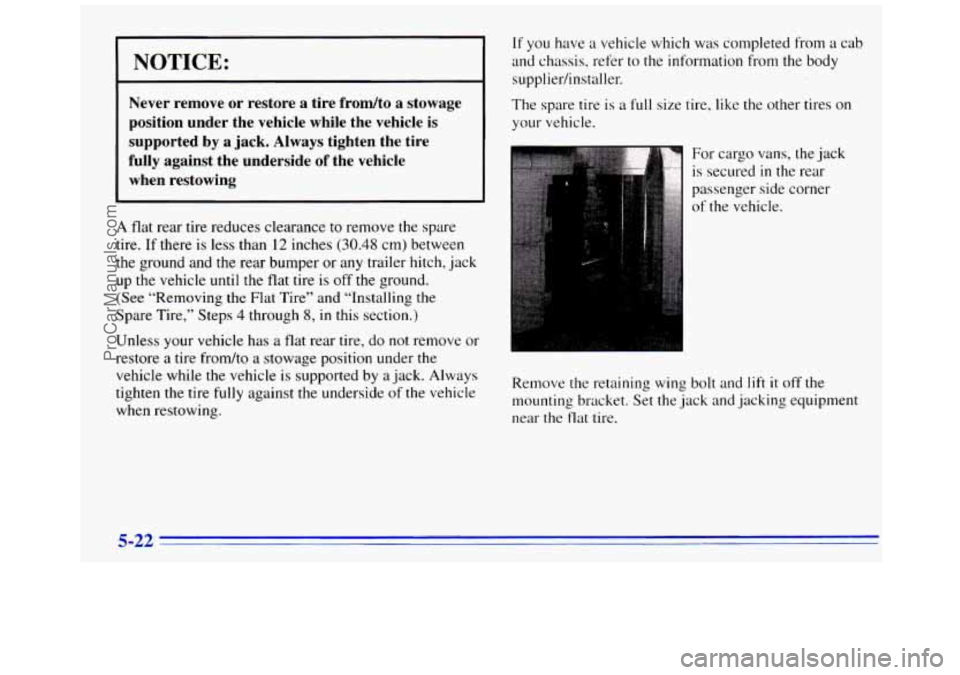
For cargo vans, the jack
is secured
in the rear
passenger side corner
of the vehicle.
Remove the retaining wing bolt and
lift it off the
mounting bracket. Set the jack and jacking equipment
near the
flat tire.
5-22
ProCarManuals.com
Page 224 of 372
NOTICE:
Spinning your wheels can destroy parts of your
vehicle as well as the tires.
If you spin the wheels
too fast while shifting your transmission back
and forth, you can destroy your transmission.
For information about using tire chains on your vehicle,
see “Tire Chains” in the Index.
Rocking your vehicle to get it out:
First, turn your steering wheel left and right. That will
clear
the area around your front wheels. Then shift back
and forth between
REVERSE (R) and a forward gear,
spinning the wheels as little as possible. Release the
accelerator pedal while
you shift, and press lightly on
the accelerator pedal when the transmission is in gear. If
that doesn’t get
you out after a few tries, you may need
to be towed out.
If you do need to be towed out, see
”Towing Your Vehicle”
in the Index.
5-36
ProCarManuals.com
Page 240 of 372

Automatic Transmission Fluid
7 ’ ~ n to Check and Change
A good time to check your automatic transmission fluid
level is when the engine oil is changed.
Change
both the fluid and filter every 50,000 miles
(83 000 km) if the vehicle’s GVWR is over 8,600 or
if
the vehicle is mainly driven under one or more of
these conditions:
0 In heavy city traffic where the outside temperature
0 In hilly or mountainous terrain.
0 When doing frequent trailer towing.
regularly
reaches
90°F (32°C) or higher.
0 Uses such as found in taxi, police or delivery service.
If your vehicle’s GVWR is not over 8,600 and you do
not use your vehicle under any of these conditions, the
fluid and filter do not require changing.
See “Scheduled Maintenance Services”
in the Index.
How to Check
Because this operation can be a little difficult, you
may choose to have this done at your GM dealer
Service Department.
If you do it yourself, be sure to follow all the
instructions here, or you could get
a false reading on
the dipstick.
NOTICE:
Too much or too little fluid can damage your
transmission.
Too much can mean that some of
the fluid could come out and fall on hot engine parts or exhaust system parts, starting a fire. Be
sure to get an accurate reading if you check your
transmission fluid.
ProCarManuals.com
Page 300 of 372

Maintenance Schedule
Short TripKity Definition -- Gasoline Engines i
Follow the Short Trip/City Maintenance Schedule if any
one of these conditions is true for your vehicle:
0
0
0
0
0
e
Most trips are less than 5 to 10 miles (8 to 16 km).
This is particularly important when outside
temperatures are below freezing.
Most trips include extensive idling (such as frequent
driving
in stop-and-go traffic j.
Most trips are through dusty areas.
You frequently tow
a trailer or use a carrier on top of
your vehicle.
You frequently tow
a trailer or us-e a carrier on top of
your vehicle. (With some models, you should never
tow
a trailer. See “Towing a Trailer” in the Index.)
If the vehicle is used for delivery service, police, taxi
or other commercial application.
Short Trip/City Intervals -- Gasoline Engines
Every 3,000 Miles (5 000 km): Engine Oil and Filter
Change (or
3 months, whichever occurs first). Chassis
Lubrication (or
3 months, whichever occurs first).
Drive Axle Service (or
3 months, whichever
occurs first).
At 6,000 Miles (10 000 km) -- Then Every
12,000 Miles (20
000 km): Tire Rotation.
Every 15,000 Miles (25 000 km): Air Cleaner Filter
Inspection,
if driving in dusty conditions. Shields and
Underhood Insulation Inspection (GVWR above
8,500 Ibs. only). Thermostatically Controlled Engine
Cooling Fan Check (or every
12 months, whichever
occurs first). Front Wheel Bearing Repack (or at each
brake relining, whichever occurs first).
Every 30,000 Miles (50 000 km): Air Cleaner Filter
Replacement. Fuel Filter Replacement.
Every 50,000 Miles (83 000 km): Automatic
Transmission Service (vehicles over
8600 GVWR
or driven under severe conditions only).
7-4
ProCarManuals.com


