1996 GMC SAVANA engine coolant
[x] Cancel search: engine coolantPage 246 of 372

NOTICE:
~~
If you use an improper coolant mix, your engine
could overheat and be badly damaged. The
repair cost wouldn’t be covered by your
warranty.
Too much water in the mix can freeze
and crack the engine, radiator, heater core and
other parts.
If you have to add coolant more than four times a year,
have your dealer check your cooling system.
I NOTICE:
If you use the proper coolant, you don’t have to
add extra inhibitors or additives which claim to
improve the system. These can be harmful.
Checking Coolant
When your engine is cold, the coolant level should be at
FULL COLD, or a little higher.
6-22
k
ProCarManuals.com
Page 247 of 372
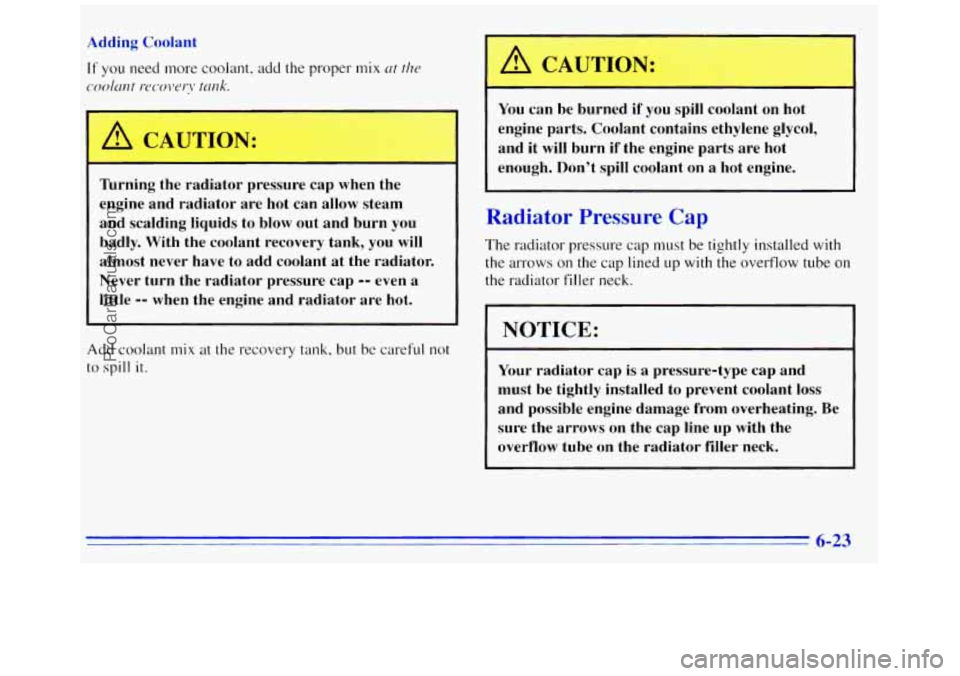
Adding Coolant
If you need more coolant, add the proper mix ut the
coolcrnt mcoveq* tmk.
A CAUTION:
Tbrning the radiator pressure cap when the
engine and radiator are hot can allow steam and scalding liquids to blow out and burn you
badly. With the coolant recovery tank, you will
almost never have to add coolant at the radiator.
Never turn the radiator pressure cap
-- even a
little
-- when the engine and radiator are hot.
Add coolant mix at the recovery tank. but be careful
not
to spill it.
A CAUTION:
You can be burned if' you spill coolant on hot
engine parts. Coolant contains ethylene glycol,
and it
will burn if the engine parts are hot
enough. Don't spill coolant on a hot engine.
Radiator Pressure Cap
The radiator pressure cap nust be tightly installed with
the arrows
on the cap lined up with the overflow tube on
the radiator filler neck.
NOTICE:
Your radiator cap is a pressure-type cap and
must be tightly installed to prevent coolant
loss
and possible engine damage from overheating. Be
sure the arrows on the cap line up with the
overflow tube on the radiator filler neck.
6-23
ProCarManuals.com
Page 248 of 372

Thermostat
Engine coolant temperature is controlled by a thermostat
in the engine cooling system. The thermoskt stops the
tlow of coolant through the radiator until the coolant
reaches
a preset temperature.
When you replace your thermostat,
an AC@ thermostat
is recommended.
Power Steering Fluid
When to Check Power Steering Fluid
It is not necessary to regularly check power steering
tluid unless you suspect there
is a leak in the system or
you hear an unusual noise.
A fluid loss in this system
could indicate a problem. Have the system inspected
and repaired.
How To Check Power Steering Fluid
When the engine compartment is cool, unscrew the cap
and wipe the dipstick with a clean rag. Replace the cap
and completely tighten
it. Then remove the cap again
and
look at the fluid level on the dipstick.
The level should be at the FULL COLD mark. If
necessary, add only enough fluid to bring
the level up to
the mark.
To prevent brake fluid contamination, never check or
fill
the power steering reservoir with the master cylinder
cover off.
What to Use
Refer to the Maintenance Schedule to determine what
kind
of fluid to use. See “Recommended Fluids and
Lubricants”
in the Index. Always use the proper fluid.
Failure to use the proper fluid can cause leaks and
damage hoses and seals.
ProCarManuals.com
Page 325 of 372

1 Short Trip/City Maintenance Schedule -- Gasoline Engines I
100,000 Miles (166 000 km)
0 Drain, flush and refill cooling system
(or every
60 months since last service
whichever occurs first). See “Engine
Coolant”
in the Index for what to use.
Inspect hoses. Clean radiator, condenser,
pressure cap and neck. Pressure test cooling
system and pressure cap.
AI1 Emission Control Service.
0 Inspect spark plug wires.
An Ernission Control Service.
0 Replace spark plugs.
0 Change automatic transmission fluid and
An Emission Colztrol Service.
filter if the vehicle’s GVWR is over
8600 lbs. or if the vehicle is mainly driven
under one
or more of these conditions:
- In heavy city traffic where the outside
temperature regularly reaches
90” F
(32°C) or higher.
- In hilly or mountainous terrain.
- When doing frequent trailer towing.
- Uses such as found in taxi, police or
delivery service.
If yxt do mt use yx.tr vehicle lmder- any of
thew conditio~~s, the flL.rici md,filt6>r do not
require dhnging.
0 Inspect Positive Crankcase Ventilation
(Pcv) valve. An Emission Cor~trol Service.
DATE SERVICED BY ACTUAL MILEAGE
7-29
ProCarManuals.com
Page 337 of 372

I
97,500 Miles (162 500 I;
Long Tripmighway Maintenance Sc‘-ed-de -- Gasoline Engines I ~~ -
0 Change engine oil and filter (or every
12 months, whichever occurs first).
An Emission Control Service.
0 Lubricate chassis components; see footnote ##
(or every 12 months, whichever occurs first).
El Check axle fluid level and add fluid
as needed. **
0 Rotate tires. See “Tire Inspection and
Rotation”
in the Index for proper rotation
pattern and additional information. During
tire rotation, check brake calipers for
freedom of movement. Refer to the
appropriate
GM service manual for proper
caliper service procedures.
100,000 Miles (166 000 km)
CI Drain, flush and refill cooling system
(or every
60 months since last service,
whichever occurs first). See “Engine
Coolant”
in the Index for what to use.
Inspect hoses. Clean radiator, condenser,
pressure cap and neck. Pressure test the
cooling system and pressure cap.
An Emissio~? Cor~trol Service. f
0 Inspect spark plug wires.
0 Replace spark plugs.
An Emissiorz Control Seriice.
Arz Emission Corztrol Sul-vice.
(Continued)
7-41
ProCarManuals.com
Page 339 of 372

Part €5: Owner Checks and Services
Listed below are owner checks and services which
should be performed at the intervals specified
to help
ensure the safety, dependability and emission control
performance of your vehicle.
Be sure any necessary repairs are completed at once.
Whenever any fluids or lubricants are added to
your
vehicle, make sure they are the proper ones, as shown
in Part D.
At the First 100, 1,000 and 6,000 Miles
(160,1600
and 10 000 km)
For vehicles with dual wheels, check dual wheel nut
torque. For proper torque, see “Wheel Nut Torque” in
the Index.
Engine Oil Level Check
Check the engine oil level and add the proper oil if
necessary. See “Engine Oil“
in the Index for
further details.
Engine Coolant Level Check
Check the engine coolant level and add the proper
coolant
mix if necessary. See “Engine Coolant” in the
Index
for further details.
Windshield Washer Fluid Level Check
Check the windshield washer fluid level in the
windshield washer tank and add the proper fluid if
necessary. See “Windshield Washer Fluid” in the Index
for further details.
7-43
ProCarManuals.com
Page 345 of 372
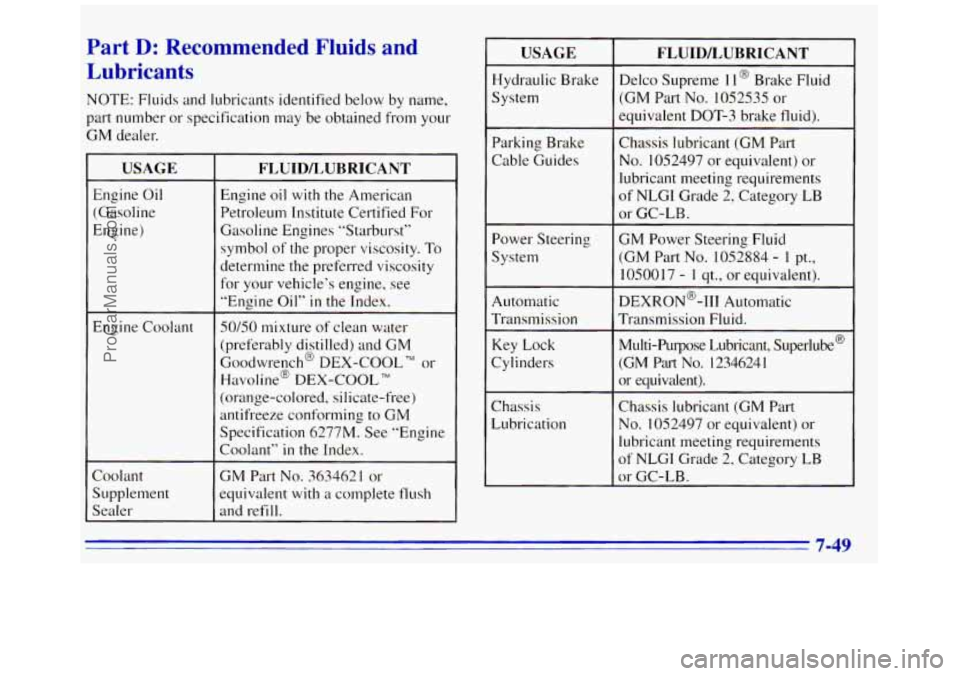
Part D: Recommended Fluids and
Lubricants
NOTE: Fluids and lubricants identified below by name,
part number or specification may be obtained from your
GM dealer.
USAGE
Engine Oil
(Gasoline
Engine)
Engine Coolant
Coolant
Supplement
Sealer
FLUID/LUBRICANT
~~ ~
~~
Engine oil with the American
Petroleum Institute Certified For
Gasoline Engines “Starburst“
symbol
of the proper viscosity. To
determine the preferred viscosity
for your vehicle’s engine, see
“Engine Oil”
in the Index.
50150 mixture of clean water
(preferably distilled) and GM
Goodwrench@ DEX-COOL
TM or
Havo line@
DEX-COOL TM
(orange-colored, silicate-free)
antifreeze conforming to GM
Specification 6277M. See “Engine
Coolant”
in the Index.
GM Part No. 3634621 or
equivalent with
a complete flush
and refill.
USAGE
Hydraulic Brake
System
Parking Brake
Cable Guides
~~
Power Steering
System
Automatic
Transmission
Key Lock
Cylinders
Chassis
Lubrication
FLUIDLUBRICANT
Delco Supreme 1 1 @ Brake Fluid
(GM Part No. 1052535 or
equivalent DOT-3 brake fluid).
Chassis lubricant (GM Part
No. 1052497 or equivalent) or
lubricant meeting requirements
of NLGI Grade 2, Category LB
or GC-LB.
GM Power Steering Fluid
(GM Part
No. 1052884 - 1 pt.,
1050017
- 1 qt., or equivalent).
DEXRON@-111 Automatic
Transmission
Fluid.
Multi-Purpose Lubricant, Superlube@
(GM
Pd-t No. 1234624 1
or equivalent).
Chassis lubricant
(GM Part
No. 1052497 or equivalent) or
lubricant meeting requirements
of NLGI Grade 2, Category
LB
or GC-LB.
7-49
ProCarManuals.com
Page 363 of 372

Climate Conlrol System ........................... 3- 1
Clock. Setting the ................................ 3-9
Comfort Controls
................................ 3- 1
Compact Disc Care ............................. 3-28
Compact Disc Player
....................... 3- 17. 3- I9
Console Storage ................................ 2-41
Control of
a Vehicle .............................. 4-5
Convex Outside Min-or
.......................... 2-40
Coolant
....................................... 6-20
Recovery
Tank ............................... 5- 13
Cooling System ................................ 5- 12
Courtesy Transportation
........................... 8-6
Cruise Control
................................. 2-32
Cupholders
.................................... 2-41
Customer Assistance for Text Telephone Users
......... 8-3
Customer Assistance Information ................... 8- 1
Customer Satisfaction Procedure .................... 8- 1
Damage . Finish ............................... 6-57
Darnage
. Sheet Metal ............................ 6-57
Daytime Running Lamps
......................... 2-36
Daytime Running Lamps Indicator Light
............ 2-49
Dead Battery
................................... 5-2
Defects. Reporting Safety ......................... 8-8
Defensive Driving
............................... 4- 1
Defogger. Rear Window .......................... 3-8
Defogging ................................. 3-2.3-4
Defrosting
................................. 3-2.3-4
Dome Lamps
.................................. 2-37
Door
Locks ....................................... 2-3
Sliding ...................................... 2-8
Storage
..................................... 2-41
Storagepocket
............................... 2-41
Swing-Out Side
............................... 2-7
Drive Position. Automatic Transmission
............. 2-19
Driver Position ................................. 1-13
Driving
City
........................................ 4-18
Defensive
.................................... 4-1
Drunken ..................................... 4-2
Freeway
.................................... 4-19
InaBlizzard
................................. 4-24
In Foreign Countries ........................... 6-4
TntheRain .................................. 4-15
Night
...................................... 4-13
OnCurves
................................... 4-8
On Grades While Towing a Trailer ............... 4-36
On Hill and Mountain Roads .................... 4-21
On Snow and Ice ............................. 4-23
Throughwater
............................... 4-17
WetRoads
.................................. 4-15
Winter
...................................... 4-23
With a Trailer
................................ 4-34
Drunken Driving
................................ 4-2
Dual Tire Operation
............................. 6-45
Electrical Equipment. Adding
.................... 6-61
Electrical System ............................... 6-61
Electronic Road Speed Governor (Gasoline Engines) ... 2-55
9-3
ProCarManuals.com