Page 243 of 372

How to Add Fluid Rear Axle
Refer to the Maintenance Schedule to determine what
kind of transmission fluid to use. See “Recommended
Fluids and Lubricants”
in the Index.
Add
tluid only after checking the transmission fluid
HOT. (A COLD check is used only as a reference.) If
the fluid level is low, add only enough of the proper
fluid to bring
the level up to the HOT area for a hot
check.
It doesn’t take much fluid, generally less than a
pint (0.5 L). DOLJ ’t overfill. We recommend you use only
fluid labeled DEXRON@-111, because fluid with that
label is made especially for your automatic transmission.
Damage caused by
fluid other than DEXRON-111 is not
covered by your new vehicle warranty.
After adding fluid, recheck the fluid level as
described under ”How to Check.”
When the correct fluid level is obtained, push the
dipstick back
in all the way; then flip the handle
down to lock
the dipstick in place.
When to Check and Change Lubricant
Refer to the Maintenance Schedule to determine how
often to check the lubricant and when to change
it. See
“Scheduled Maintenance Services” in the Index.
How to Check Lubricant
If the level is below the
bottom of the filler plug
hole,
you’ll need to add
some lubricant. Add
enough lubricant to raise
the level
to the bottom of
the filler plug hole.
What to Use
Refer to the Maintenance Schedule to determine what
kind
of lubricant to use. See “Recommended Fluids and
Lubricants”
in the Index.
6-19
ProCarManuals.com
Page 248 of 372

Thermostat
Engine coolant temperature is controlled by a thermostat
in the engine cooling system. The thermoskt stops the
tlow of coolant through the radiator until the coolant
reaches
a preset temperature.
When you replace your thermostat,
an AC@ thermostat
is recommended.
Power Steering Fluid
When to Check Power Steering Fluid
It is not necessary to regularly check power steering
tluid unless you suspect there
is a leak in the system or
you hear an unusual noise.
A fluid loss in this system
could indicate a problem. Have the system inspected
and repaired.
How To Check Power Steering Fluid
When the engine compartment is cool, unscrew the cap
and wipe the dipstick with a clean rag. Replace the cap
and completely tighten
it. Then remove the cap again
and
look at the fluid level on the dipstick.
The level should be at the FULL COLD mark. If
necessary, add only enough fluid to bring
the level up to
the mark.
To prevent brake fluid contamination, never check or
fill
the power steering reservoir with the master cylinder
cover off.
What to Use
Refer to the Maintenance Schedule to determine what
kind
of fluid to use. See “Recommended Fluids and
Lubricants”
in the Index. Always use the proper fluid.
Failure to use the proper fluid can cause leaks and
damage hoses and seals.
ProCarManuals.com
Page 250 of 372

Brakes
Brake Fluid
Your brake master cylinder reservoir is here. It is filled
with DOT-3 brake fluid.
There
are only two reasons why the brake fluid level in the
reservoir might
go down. The first is that the brake fluid
lining wear. When new linings are put in, thc tluid levcl
2 wes down to an acceptable level during nonnal brake
c qoes back up. The other reason is that fluid is leaking out
of the brake system. If it is, you should have your brake
system fixed, since
a leak means that sooner or later your
brakes won't work well, or
won't work at all.
So, it isn't a good idea to "top off' your brake tluid.
Adding brake fluid won't correct a leak. If you add fluid
when your linings are worn, then
you'll have too much
fluid when you get new brake linings.
You should add
(or remove) brake fluid, as necessary, only when work is
done
on the brake hydraulic system.
A CAUTION
If you have too much brake fluid, it can spill on the
engine. The fluid
will burn if the engine is hot
enough. You
or others could be burned, and your
vehicle could
be damaged. Add brake fluid only
when work
is done on the brake hydraulic system.
Refer to the Maintenance Schedule to determine when to
check your brake fluid. See "Periodic Maintenance
Inspections"
in the Index.
6-26
ProCarManuals.com
Page 263 of 372
7. With the door open, turn the bulb to the left to
remove it. Install the new bulb.
8. Reverse the above steps to reinstall the lamp.
Windshield Wiper Blade Replacement
See “Normal Maintenance Replacement Parts” in the
Index for the proper type
of replacement blade.
6-39
ProCarManuals.com
Page 267 of 372
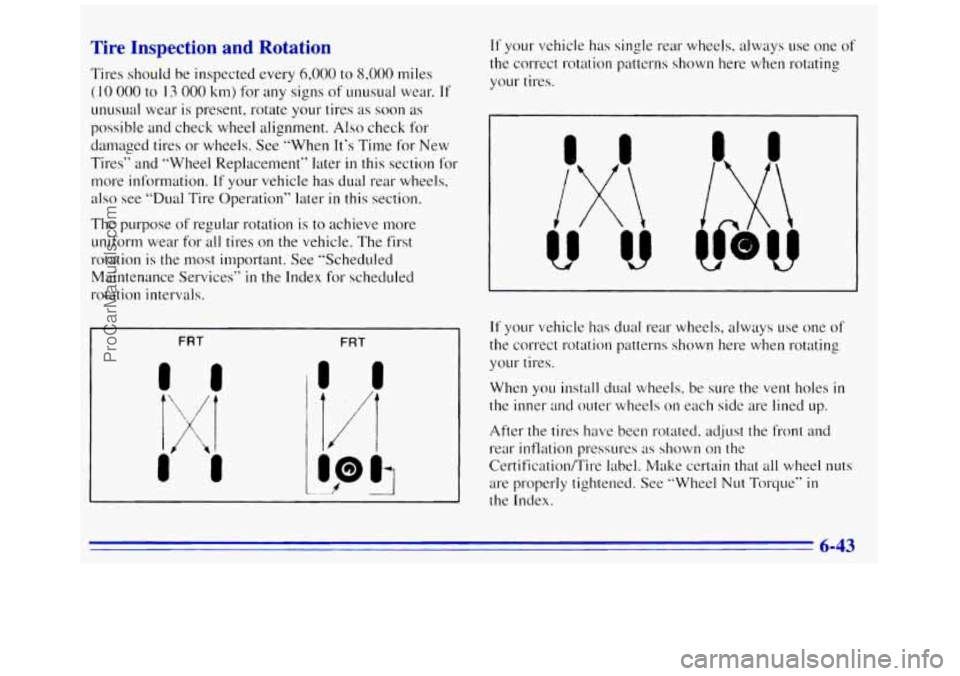
nspectior
1 Ires should be inspected every 6,000 to 8,000 miles
(I 0 000 to 13 000 km) for any signs of unusual wear. If
unusual wear is present, rotate your tires as soon as
possible and check wheel alignment. Also check for
damaged tires
or wheels. See “When It’s Time for New
Tires” and “Wheel Replacement” later
in this section for
more information.
If your vehicle has dual rear wheels,
also see “Dual Tire Operation“ later
in this section.
The purpose of regular rotation is to achieve more
uniform wear
for all tires on the vehicle. The first
rotation is the most important. See “Scheduled
Maintenance Services”
in the Index for scheduled
rotation intervals.
If your vehicle has single rear wheels, always use one of
the correct rotation patterns shown here when rotating
your tires.
If your vehicle has dual rear wheels, always use one of
FRT FRT the. correct rotation patterns shown here when rotating
KC
your tires.
When you install dual wheels, be sure the vent
holes in
the inner and outer wheels on each side are lined up.
After the tires have been rotated, adjust the front and
rear inflation pressures as shown on
the
CertificatidTire label. Make certain that all wheel nuts
are properly tightened. See “Wheel
Nut Torque” in
the Index.
6-43
ProCarManuals.com
Page 282 of 372

Underbody Maintenance
Chemicals used for ice and snow removal and dust control
can collect on
the underbody. If these are not removed,
accelerated corrosion (rust) can occur on
the underbody
parts such
as fuel lines, frame, floor pan and exhaust
system even though they have corrosion protection.
At least every spring,
flush these materials from the
underbody with plain water. Clean any areas where mud
and other debris can collect. Dirt packed in closed areas
of t.he frame should be loosened before being flushed.
Your dealer
or an underbody vehicle washing system
can do this for you.
Chemical Paint Spotting
Some weather and atmospheric conditions can create a
chemical fallout. Airborne pollutants can fall upon and
attack painted surfaces
on your vehicle. This damage
can take two forms: blotchy, ringlet-shaped
discolorations, and small irregular dark spots etched
into the paint surface.
Although no defect in
the paint job causes this, GM will
repair, at no charge to the owner, the surfaces of new
vehicles damaged by this fallout condition within
12 months or 12,000 miles (20 000 km) of purchase,
whichever occurs first.
This applies only to materials manufactured and sold by
General Motors. Bodies,
body conversions or equipment
not made or sold by General Motors are not covered.
ProCarManuals.com
Page 289 of 372
Capacities and Specifications
Normal Maintenance Replacement Parts
Replacement part numbers listed in this section are based on the latest information available at the time of printing,
and are subject
to change. If a part listed in this manual is not the same as the part used in your vehicle when it was
built, or if you have any questions, please contact your GM truck dealer.
These specifications are for information only.
If you have any questions, see the service manual for the chassis or
refer to the body manufacturer’s publications.
Engine Identification -- Gasoline Engines
Type V6 V8
Engine “VORTEC” 4300 ”VORTEC” 5000
VIN Code W M
Fuel System SFI 1 SFI 1
‘Sequential Central Port Fuel Injection
Wheel Nut Torque
MODEL TORQUE
All 122 ft-lb (165 Nem)
“VORTEC” 5700 “VORTEC” 7400
V8
V8
R J
SF1 I SFI’
? -Sequential Multi-Port Fuel Injection
ProCarManuals.com
Page 297 of 372

Section 7 Maintenance Schedule
IMPORTANT.
KEEP ENGINE OIL
AT THE PROPER
LEVEL AND CHANGE AS
RECOMMENDED
This section covers the maintenance required for your
vehicle. Your vehicle needs these services to retain its
safety, dependability and emission control performance.
Have you purchased the GM Protection Plan? The Plan
supple~nents your new vehicle warranties. See your
Warranty
and Owner Assistance hooklet, or your
GM deuler for detuils.
Introduction
Your Vehicle and the Environment
Proper vehicle maintenance not only helps to keep your
vehicle
in good working condition, but also helps the
environment. All recommended maintenance procedures
are important. Improper vehicle maintenance can even
affect the quality
of the air we breathe. Improper fluid
levels or the wrong tire inflation can increase
the level
of emissions from your vehicle. To help protect our
environment, and to keep your vehicle in good
condition, please maintain your vehicle properly.
7-1
ProCarManuals.com

