1996 CHRYSLER VOYAGER weight
[x] Cancel search: weightPage 78 of 1938

INSTALLATION
(1) For installation, reverse removal procedure.
Tighten bolts to 61 N´m (45 ft. lbs.).
STABILIZER BAR
REMOVAL
(1) Raise vehicle. Vehicle is to be raised and sup-
ported on jack stands or on a frame contact type
hoist. See Hoisting in the Lubrication and Mainte-
nance section of this service manual.
(2) Remove the 2 lower bolts which hold the stabi-
lizer bar to the link arm on each side of the vehicle.
(3) Loosen but do not fully remove the four bolts
that attach the stabilizer bar bushing retainers to
the rear axle brackets.
(4) While holding the stabilizer bar in place. Fully
remove the 4 bolts loosened in step 3.
(5) Remove the stabilizer bar from the vehicle.
(6) If the link arms need to be serviced, remove
the upper link arm to bracket bolt. Then remove link
arm from frame rail attaching bracket.
INSPECTION
Inspect for broken or distorted clamps, retainers,
and bushings. If bushing replacement is required, the
stabilizer bar to axle bushings can be removed from
the stabilizer bar by opening the split.
INSTALLATION
(1) Install the link arms onto the frame rail brack-
ets. DO NOT TIGHTEN.
(2) Position the axle to stabilizer bar bushings on
the stabilizer bar with the slit in the bushings facing
up.(3) Lift the stabilizer bar onto the rear axle and
install the retainers and the four mounting bolts. DO
NOT TIGHTEN.
(4) Install the two lower link arm bolts on the sta-
bilizer bar. DO NOT TIGHTEN.
(5) Lower the vehicle so that the full weight of the
vehicle is on all four tires. With the vehicle at its
curb height, tighten all attaching bolts to the torques
listed below.
²Stabilizer bar bushing to axle bracket bolts 61
N´m (45 ft. lbs.)
²Link arm to frame rail bracket 61 N´m (45 ft.
lbs.)
²Stabilizer bar to link arm 61 N´m (45 ft. lbs.)
²Frame rail bracket to frame rail 61 N´m (45 ft.
lbs.)
JOUNCE BUMPER
There are two types of jounce bumpers available
depending on which suspension option the vehicle is
equipped with.
REMOVAL-STANDARD
The jounce bumper is serviced as an assembly. The
jounce bumper mounts to the frame rail at a weld
nut located on the frame rail (Fig. 23).
(1) Using the proper tool, remove the bolt attach-
ing the jounce bumper to frame rail.
(2) Remove the jounce bumper from the frame rail.
INSTALLATION-STANDARD
(1) For installation, reverse the removal procedure.
Tighten the jounce bumper mounting bolt to a torque
of 33 N´m (290 in. lbs.).
Fig. 22 Track Bar Mount
Fig. 23 Jounce Bumper-Standard
2 - 46 SUSPENSIONNS
REMOVAL AND INSTALLATION (Continued)
Page 79 of 1938

REMOVAL-HEAVY DUTY
The jounce bumpers are serviced as an assembly.
The jounce bumpers screw into a weld nut located in
the frame rail (Fig. 24).
(1) Using slip-joint pliers grasp the base of the
jounce bumper. Turn the base counterclockwise (Fig.
25).
(2) Remove the jounce bumper from the frame rail.
INSTALLATION-HEAVY DUTY
(1) For installation, reverse the removal procedure.
Tighten the jounce bumper to a torque of 33 N´m
(290 in. lbs.).
LEAF SPRING FRONT MOUNT
REMOVE
(1) Loosen the pivot bolt attaching the front of the
leaf spring to the spring mount (Fig. 26).
(2) Install a jackstand under the side of the axle
having the leaf spring mount removed. Using thejackstand support the weight of the axle and leaf
spring.
(3) Remove the lower mounting bolt from the
shock absorber.
(4) Remove the bolts attaching the leaf spring
front mount (Fig. 26) to the body of the vehicle.
(5) Lower the leaf spring and remove the front
mount from the spring.
INSTALLATION
(1) For installation, reverse removal procedure. Do
not tighten front through bolt fully until vehicle is
lowered and the full vehicle weight is applied to the
rear wheels. Tighten leaf spring front mount bolts to
61 N´m (45 ft. lbs.). Tighten leaf spring front through
bolt to 156 N´m (115 ft. lbs.).
LEAF SPRING REAR MOUNT
REMOVE
(1) Remove the attaching nuts and bolts from the
leaf spring rear shackle (Fig. 27) and (Fig. 28).
Fig. 24 Jounce Bumper-Heavy Duty
Fig. 25 Bumper Replacement
Fig. 26 Leaf Spring Front Mount
Fig. 27 Leaf Spring Shackle Nuts (FWD)
NSSUSPENSION 2 - 47
REMOVAL AND INSTALLATION (Continued)
Page 80 of 1938

(2) Install a jackstand under the side of the axle
having the leaf spring mount removed. Using the
jackstand, support the weight of the axle and leaf
spring.
(3) Remove the lower mounting bolt from the
shock absorber.
(4) Remove the bolts attaching the leaf spring rear
mount to the body of the vehicle (Fig. 29).
(5) Lower the jackstand and the rear of the leaf
spring. Remove the shackle from the leaf spring
bushing.
INSTALL
CAUTION: The following sequence must be fol-
lowed when tightening the pin nuts on the rearhanger for the rear leaf spring. First the hanger pin
nuts must be tightened to the specified torque.
Then tighten the retaining bolts for the inner to
outer half of the spring hanger to the specified
torque. This sequence must be followed to avoid
bending the spring hanger.
(1) For installation, reverse removal procedure. Do
not tighten rear spring shackle nuts fully until vehi-
cle is lowered and the full vehicle weight is applied
to the rear wheels. Tighten rear spring mount bolts
to 61 N´m (45 ft. lbs.). Tighten shackle nuts to 61
N´m (45 ft. lbs.).
SPECIFICATIONS
REAR SUSPENSION FASTENER TORQUES
DESCRIPTION TORQUE
SHOCK ABSORBER MOUNTING BOLTS:
Standard Shock Absorber......101 N´m (75 ft. lbs.)
Self Load Leveling Shock
Absorber.................101 N´m (75 ft. lbs.)
JOUNCE BUMPER:
To Frame Rail..............33N´m(290 in. lbs.)
TRACK BAR:
To Axle And Mounting
Bracket Pivot Bolt..........95N´m(70ft.lbs.)
Bracket To Body Attaching......61N´m(45ft.lbs.)
LEAF SPRING:
Spring Plate To Axle
Attaching Bolts............108 N´m (80 ft. lbs.)
Rear Mount To Body Bolts......61N´m(45ft.lbs.)
Front Mount To Body Bolts......61N´m(45ft.lbs.)
To Front Hanger
Mounting Nut............156 N´m (115 ft. lbs.)
Shackle Plate Nuts............61N´m(45ft.lbs.)
STABILIZER BAR:
Bushing Retainer To Axle
Attaching Bolts.............61N´m(45ft.lbs.)
Attaching Link Nuts...........61N´m(45ft.lbs.)
Frame Rail Bracket
Mounting Bolts.............61N´m(45ft.lbs.)
Link Arm To Frame
Rail Bracket...............61N´m(45ft.lbs.)
HUB AND BEARING:
To Axle Mounting Bolts........129 N´m (95 ft. lbs.)
Stub Axle Nut..............224 N´m (180 ft. lbs.)
Wheel Mounting
LugNut...........110-135 N´m (85-115 ft. lbs.)
Fig. 28 Leaf Spring Shackle Nuts/Bolts (AWD)
Fig. 29 Rear Spring Mount
2 - 48 SUSPENSIONNS
REMOVAL AND INSTALLATION (Continued)
Page 110 of 1938

(3) Remove the 2 caliper to steering knuckle guide
pin bolts (Fig. 44).
(4) Remove caliper from steering knuckle, by first
rotating free end of caliper away from steering
knuckle. Then slide opposite end of caliper out from
under machined abutment on steering knuckle (Fig.
45).
(5) Support caliper firmly to prevent weight of cal-
iper from being supported by the brake fluid flex
hose. Supporting weight of caliper by the brake fluid
flex hose, can damage the flexible brake hose (Fig.
46).
INSTALL
(1) Lubricate both steering knuckle abutments
with a liberal amount of MopartMultipurpose Lubri-
cant, or equivalent.CAUTION: Use care when installing the caliper
assembly onto the steering knuckle, so the seals on
the caliper guide pin bushings do not get damaged
by the steering knuckle bosses.
(2) Carefully position caliper and brake pad
assemblies over brake rotor by hooking lower or
upper end of caliper over the machined abutment on
steering knuckle (Fig. 45). Then rotate caliper into
position at the top of the steering knuckle (Fig. 45).
Make sure that caliper guide pin bolts, bushings and
sleeves are clear of the steering knuckle bosses.
(3) Install the caliper guide pin bolts (Fig. 44) and
tighten to a torque of 41 N´m (40 ft. lbs.).Extreme
caution should be taken not to cross thread the
caliper guide pin bolts.
(4) Install the wheel and tire assembly.
(5) Using a torque wrench, tighten the wheel
mounting stud nuts in proper sequence until all nuts
are torqued to half specification. Then repeat the
tightening sequence to the full specified torque of 135
N´m (100 ft. lbs.).
(6) Remove jackstands or lower hoist.
(7)Before moving vehicle, pump the brake
pedal several times to insure the vehicle has a
firm brake pedal.
REAR DISC BRAKE CALIPER
During service procedures, grease or any other for-
eign material must be kept off brake shoe assem-
blies, and braking surfaces of rotor.
Handling of the rotor and caliper, must be done in
such a way as to avoid damage to the rotor and
scratching or nicking of lining on the brake shoes.
If inspection reveals that the caliper piston seal is
leaking, itMUSTbe replaced immediately.
During removal and installation of a wheel and
tire assembly, use care not to strike the caliper.
Fig. 44 Removing Caliper Guide Pin Bolts
Fig. 45 Caliper Assembly Mounting On Steering
Knuckle (Typical)
Fig. 46 Storing Front Disc Brake Caliper
5 - 28 BRAKESNS
REMOVAL AND INSTALLATION (Continued)
Page 111 of 1938
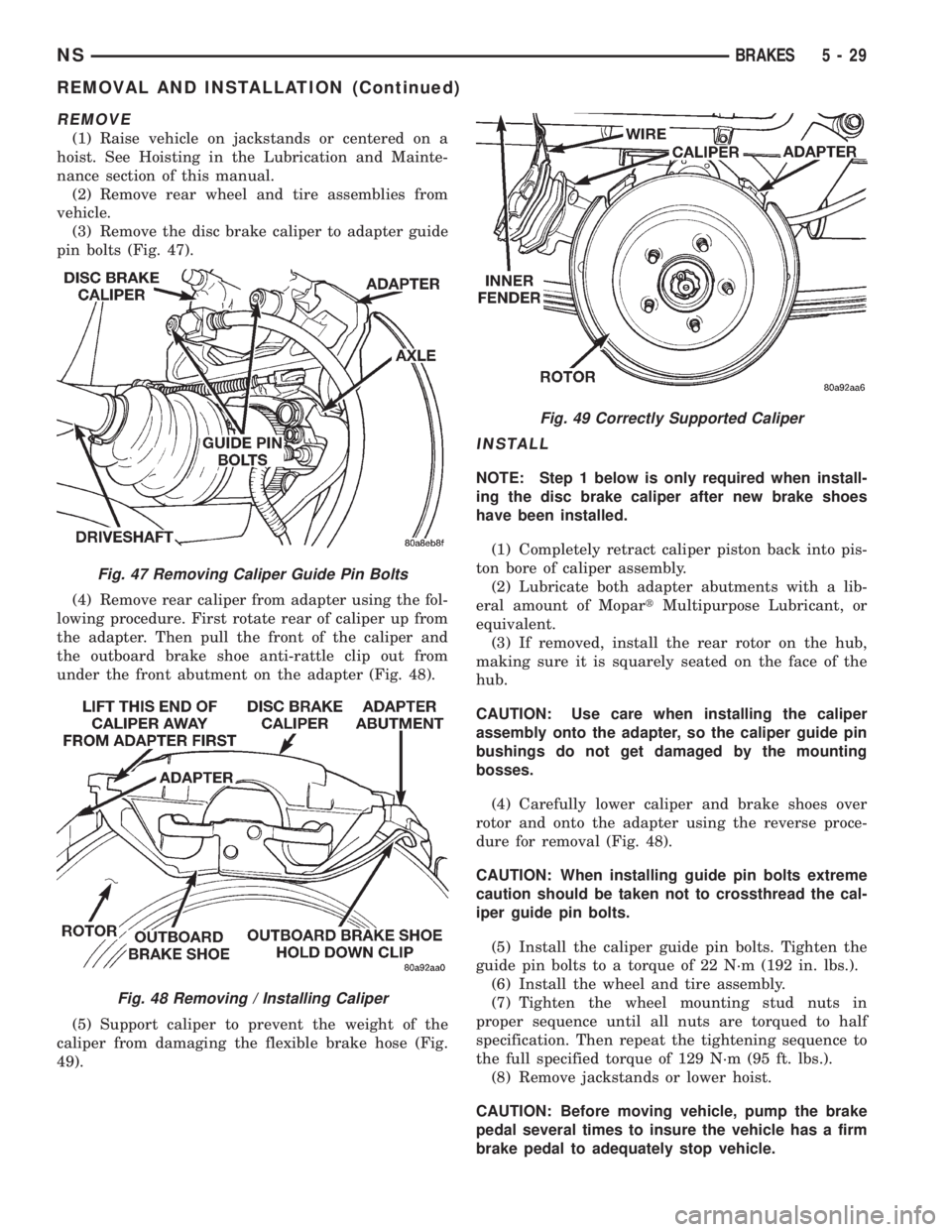
REMOVE
(1) Raise vehicle on jackstands or centered on a
hoist. See Hoisting in the Lubrication and Mainte-
nance section of this manual.
(2) Remove rear wheel and tire assemblies from
vehicle.
(3) Remove the disc brake caliper to adapter guide
pin bolts (Fig. 47).
(4) Remove rear caliper from adapter using the fol-
lowing procedure. First rotate rear of caliper up from
the adapter. Then pull the front of the caliper and
the outboard brake shoe anti-rattle clip out from
under the front abutment on the adapter (Fig. 48).
(5) Support caliper to prevent the weight of the
caliper from damaging the flexible brake hose (Fig.
49).
INSTALL
NOTE: Step 1 below is only required when install-
ing the disc brake caliper after new brake shoes
have been installed.
(1) Completely retract caliper piston back into pis-
ton bore of caliper assembly.
(2) Lubricate both adapter abutments with a lib-
eral amount of MopartMultipurpose Lubricant, or
equivalent.
(3) If removed, install the rear rotor on the hub,
making sure it is squarely seated on the face of the
hub.
CAUTION: Use care when installing the caliper
assembly onto the adapter, so the caliper guide pin
bushings do not get damaged by the mounting
bosses.
(4) Carefully lower caliper and brake shoes over
rotor and onto the adapter using the reverse proce-
dure for removal (Fig. 48).
CAUTION: When installing guide pin bolts extreme
caution should be taken not to crossthread the cal-
iper guide pin bolts.
(5) Install the caliper guide pin bolts. Tighten the
guide pin bolts to a torque of 22 N´m (192 in. lbs.).
(6) Install the wheel and tire assembly.
(7) Tighten the wheel mounting stud nuts in
proper sequence until all nuts are torqued to half
specification. Then repeat the tightening sequence to
the full specified torque of 129 N´m (95 ft. lbs.).
(8) Remove jackstands or lower hoist.
CAUTION: Before moving vehicle, pump the brake
pedal several times to insure the vehicle has a firm
brake pedal to adequately stop vehicle.
Fig. 47 Removing Caliper Guide Pin Bolts
Fig. 48 Removing / Installing Caliper
Fig. 49 Correctly Supported Caliper
NSBRAKES 5 - 29
REMOVAL AND INSTALLATION (Continued)
Page 113 of 1938
REAR DISC BRAKE SHOES
WARNING: ALTHOUGH FACTORY INSTALLED
BRAKELININGS ARE MADE FROM ASBESTOSFREE MATERIALS, SOME AFTER MARKET BRAKE-
LINING MAY CONTAIN ASBESTOS. THIS SHOULD
BE TAKEN INTO ACCOUNT WHEN SERVICING A
VEHICLE'S BRAKE SYSTEM, WHEN AFTERMARKET
BRAKELININGS MAY HAVE BEEN INSTALLED ON
THE VEHICLE. ALWAYS WEAR A RESPIRATOR
WHEN CLEANING BRAKE COMPONENTS AS
ASBESTOS CAN CAUSE SERIOUS BODILY HARM
SUCH AS ASBESTOSIS AND OR CANCER. NEVER
CLEAN BRAKE COMPONENTS BY USING COM-
PRESSED AIR, USE ONLY A VACUUM CLEANER
SPECIFICALLY DESIGNED FOR THE REMOVAL OF
BRAKE DUST. IF A VACUUM CLEANER IS NOT
AVAILABLE, CLEAN BRAKE PARTS USING ONLY
WATER DAMPENED SHOP TOWELS. DO NOT CRE-
ATE BRAKELINING DUST BY SANDING BRAKE LIN-
INGS WHEN SERVICING A VEHICLE. DISPOSE OF
ALL DUST AND DIRT SUSPECTED OF CONTAINING
ASBESTOS FIBERS USING ONLY SEALED AIR-
TIGHT BAGS OR CONTAINERS. FOLLOW ALL REC-
OMMENDED SAFETY PRACTICES PRESCRIBED BY
THE OCCUPATIONAL SAFETY AND HEALTH ADMIN-
ISTRATION (OSHA) AND THE ENVIRONMENTAL
PROTECTION AGENCY (EPA), FOR HANDLING AND
DISPOSAL OF PRODUCTS CONTAINING ASBES-
TOS.
During service procedures, grease or any other for-
eign material must be kept off brake shoe assem-
blies, and braking surfaces of brake drum and
external surfaces of hub/bearing assembly.
Handling of the braking disc and caliper is to be
done in such a way as to avoid deformation of the
disc and scratching or nicking of brake linings.
If inspection reveals that the square sectioned cal-
iper piston seal is worn or damaged, itMUSTbe
replaced immediately.
During removal and installation of a wheel and
tire assembly, use care not to strike the caliper.
REMOVE
(1) Raise vehicle on jackstands or centered on a
hoist. See Hoisting in the Lubrication and Mainte-
nance section of this manual.
(2) Remove rear wheel and tire assemblies from
vehicle.
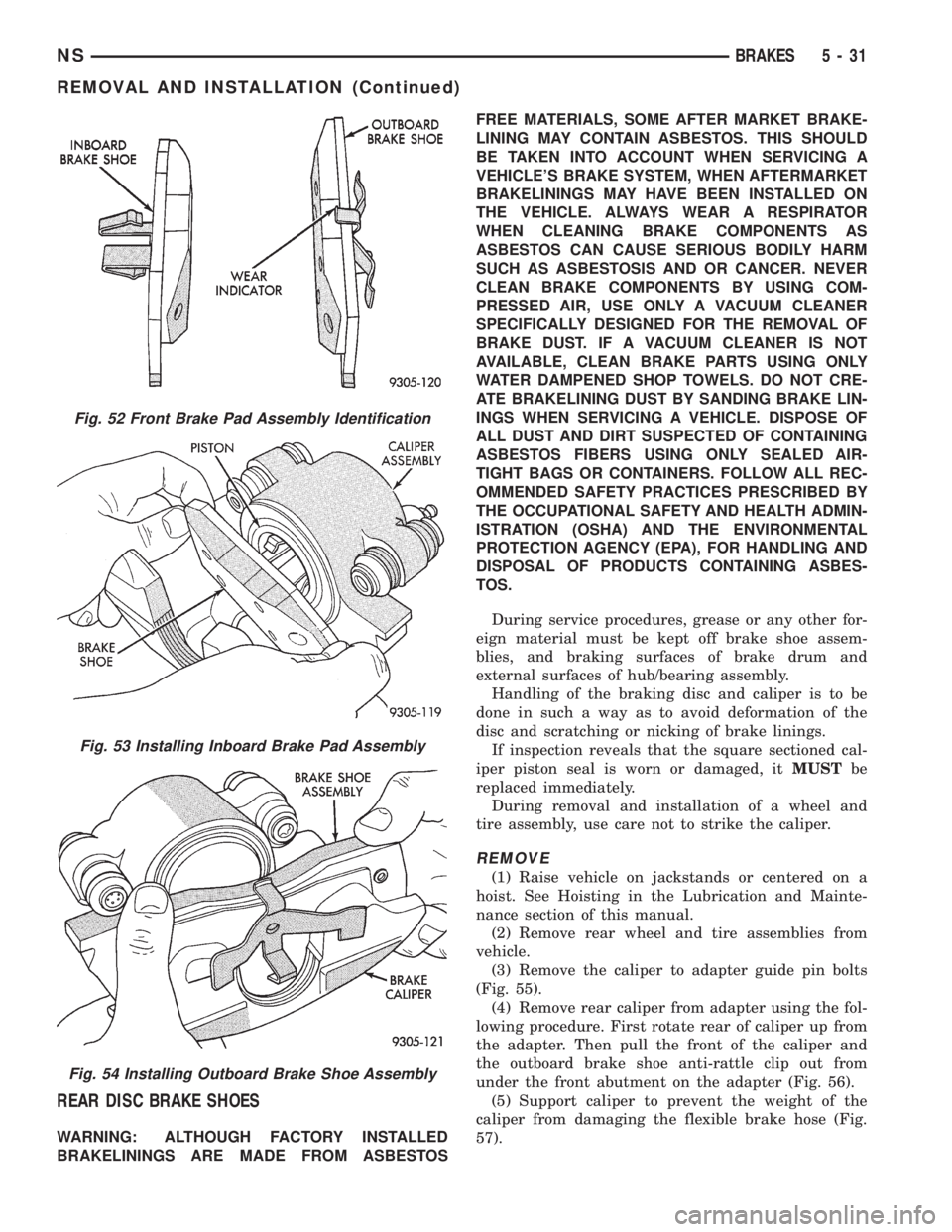
(3) Remove the caliper to adapter guide pin bolts
(Fig. 55).
(4) Remove rear caliper from adapter using the fol-
lowing procedure. First rotate rear of caliper up from
the adapter. Then pull the front of the caliper and
the outboard brake shoe anti-rattle clip out from
under the front abutment on the adapter (Fig. 56).
(5) Support caliper to prevent the weight of the
caliper from damaging the flexible brake hose (Fig.
57).
Fig. 52 Front Brake Pad Assembly Identification
Fig. 53 Installing Inboard Brake Pad Assembly
Fig. 54 Installing Outboard Brake Shoe Assembly
NSBRAKES 5 - 31
REMOVAL AND INSTALLATION (Continued)
Page 124 of 1938

from the adapter. Then pull the front of the caliper
and the outboard brake shoe anti-rattle clip out from
under the front abutment on the adapter (Fig. 92).(12) Support caliper to prevent the weight of the
caliper from damaging the flexible brake hose (Fig.
93).
(13) Remove the rotor from the hub/bearing.
Fig. 87 Spring Washer
Fig. 88 Hub Nut And Washer
Fig. 89 Driveshaft Attachment To Driveline Module
Fig. 90 Wheel Speed Sensor
Fig. 91 Caliper Guide Pin Bolts
Fig. 92 Removing / Installing Caliper
5 - 42 BRAKESNS
REMOVAL AND INSTALLATION (Continued)
Page 142 of 1938
(23) Install the negative (ground) cable on the bat-
tery.
(24) Cycle the park brake pedal one time. This will
seat the park brake cables and will allow the auto-
matic self adjuster to properly tension the park brake
cables.
PARK BRAKE SHOES (WITH REAR DISC BRAKES)
On this vehicle, the park brake shoes are removed
from the disc brake adapter with the disc brake
adapter removed from the vehicle.
REMOVE
(1) Set the parking brake.The parking brake is
set to keep the hub/bearing and axle shaft from
rotating when loosening the hub nut.
(2) Raise vehicle. Vehicle is to be raised and sup-
ported on jackstands or on a frame contact type
hoist. See Hoisting in the Lubrication And Mainte-
nance section of this service manual.
(3) Remove the wheel/tire.
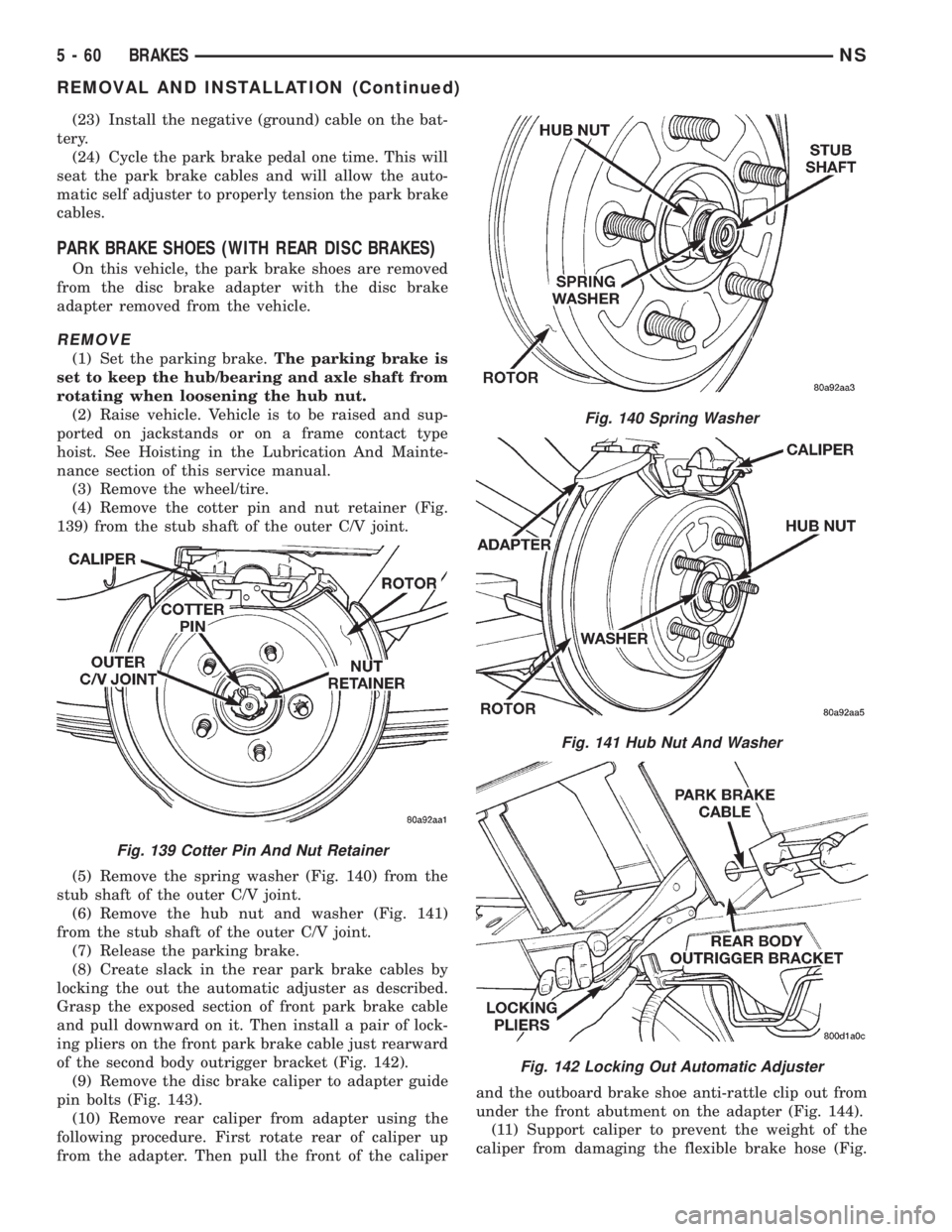
(4) Remove the cotter pin and nut retainer (Fig.
139) from the stub shaft of the outer C/V joint.
(5) Remove the spring washer (Fig. 140) from the
stub shaft of the outer C/V joint.
(6) Remove the hub nut and washer (Fig. 141)
from the stub shaft of the outer C/V joint.
(7) Release the parking brake.
(8) Create slack in the rear park brake cables by
locking the out the automatic adjuster as described.
Grasp the exposed section of front park brake cable
and pull downward on it. Then install a pair of lock-
ing pliers on the front park brake cable just rearward
of the second body outrigger bracket (Fig. 142).
(9) Remove the disc brake caliper to adapter guide
pin bolts (Fig. 143).
(10) Remove rear caliper from adapter using the
following procedure. First rotate rear of caliper up
from the adapter. Then pull the front of the caliperand the outboard brake shoe anti-rattle clip out from
under the front abutment on the adapter (Fig. 144).
(11) Support caliper to prevent the weight of the
caliper from damaging the flexible brake hose (Fig.
Fig. 139 Cotter Pin And Nut Retainer
Fig. 140 Spring Washer
Fig. 141 Hub Nut And Washer
Fig. 142 Locking Out Automatic Adjuster
5 - 60 BRAKESNS
REMOVAL AND INSTALLATION (Continued)