1996 CHRYSLER VOYAGER service
[x] Cancel search: servicePage 551 of 1938

OVERHEAD CONSOLE
CONTENTS
page page
DESCRIPTION AND OPERATION
COMPASS MINI-TRIP COMPUTER (CMTC).... 1
COMPASS/TEMPERATURE MINI TRIP
COMPUTER SELF-DIAGNOSTIC TEST....... 1
THERMOMETER AND COMPASS............ 2
UNIVERSAL TRANSMITTER................ 2
DIAGNOSIS AND TESTING
READING/DOME LAMP DIAGNOSIS......... 3
TRAVELER MESSAGES.................... 3
UNIVERSAL TRANSMITTER................ 3
SERVICE PROCEDURES
COMPASS CALIBRATION PROCEDURE (FAST
METHOD)............................. 4
COMPASS CALIBRATION PROCEDURE....... 4
DEMAGNETIZING PROCEDURE............. 4UNIVERSAL TRANSMITTER................ 5
REMOVAL AND INSTALLATION
AMBIENT TEMPERATURE SENSOR.......... 5
COMPASS MINI-TRIP COMPUTER (CMTC)
LAMP BULBS......................... 6
COMPASS MINI-TRIP COMPUTER (CMTC)
MODULE............................. 6
FRONT HEADER READING/COURTESY LAMP . . 6
OVERHEAD CONSOLE.................... 6
READING/COURTESY LAMP ASSEMBLY...... 7
READING/COURTESY LAMP............... 6
UNIVERSAL TRANSMITTER................ 7
SPECIAL TOOLS
SPECIAL TOOL.......................... 9
DESCRIPTION AND OPERATION
COMPASS/TEMPERATURE MINI TRIP COMPUTER
SELF-DIAGNOSTIC TEST
The CMTC is capable of performing a diagnostic
self check on many of its internal functions. CMTC
diagnostics may be performed using a scan tool
(DRB) and the proper Body Diagnostic Procedures
manual or by the following procedure.
(1) With the ignition switch in the OFF position,
press both the US/M and STEP button.
(2) Turn ignition switch to the ON position.
The CMTC will perform internal checks while
lighting all segments of the vacuum florescent dis-
play. Upon completion of the internal check, the
CMTC will display.
²PASS
²FAIL
²CCd
If any segment of the CMTC fails to light replace
the module.
If FAIL is displayed, replace the module.
If CCd is displayed, check the CCD and Body Con-
trol Module (BCM) for proper operation, refer to the
appropriate diagnostic test procedures manual If the
CCD and the BCM are OK, replace the CMTC mod-
ule.
For additional diagnostic information on the CMTC
and for identifying CMTC problems, refer to the
proper Body Diagnostic Procedures manual.
COMPASS MINI-TRIP COMPUTER (CMTC)
The Compass Mini-Trip Computer (CMTC) system
is located in the overhead console. CMTC consists of
a electronic control module with a vacuum fluores-
cent display (VFD) and function switches. The CMTC
consists of a electronic module that displays compass,
trip computer, and temperature features. Actuating
the STEP switch will cause the CMTC to change
mode of operation when ignition is ON. Example:
²Compass/Temperature
²Trip odometer (ODO)
²Average miles per gallon (ECO)
²Instant miles per gallon (ECO)
²Distance to empty (DTE)
²Elapsed time (ET)
²Off
The CMTC module in the overhead console has
three buttons used to select various functions. The
CMTC selector buttons will not operate until the
ignition is in the RUN position (Fig. 1).
When the ignition switch is first turned to the
RUN position the CMTC display;
²Blanks momentarily
²All segments of the VFD will light for one sec-
ond
²Blanks momentarily
²Returns to the last mode setting selected before
the ignition was last switched OFF.
NSOVERHEAD CONSOLE 8V - 1
Page 554 of 1938
²Rotate your hand-held transmitter end-over-end
and train again. For best results, place the end oppo-
site from the battery compartment against the uni-
versal transmitter while training.
²The frequency of the hand-held transmitter may
not be in the desired frequencies between 286MHz
and 399MHz set by FCC.
SERVICE PROCEDURES
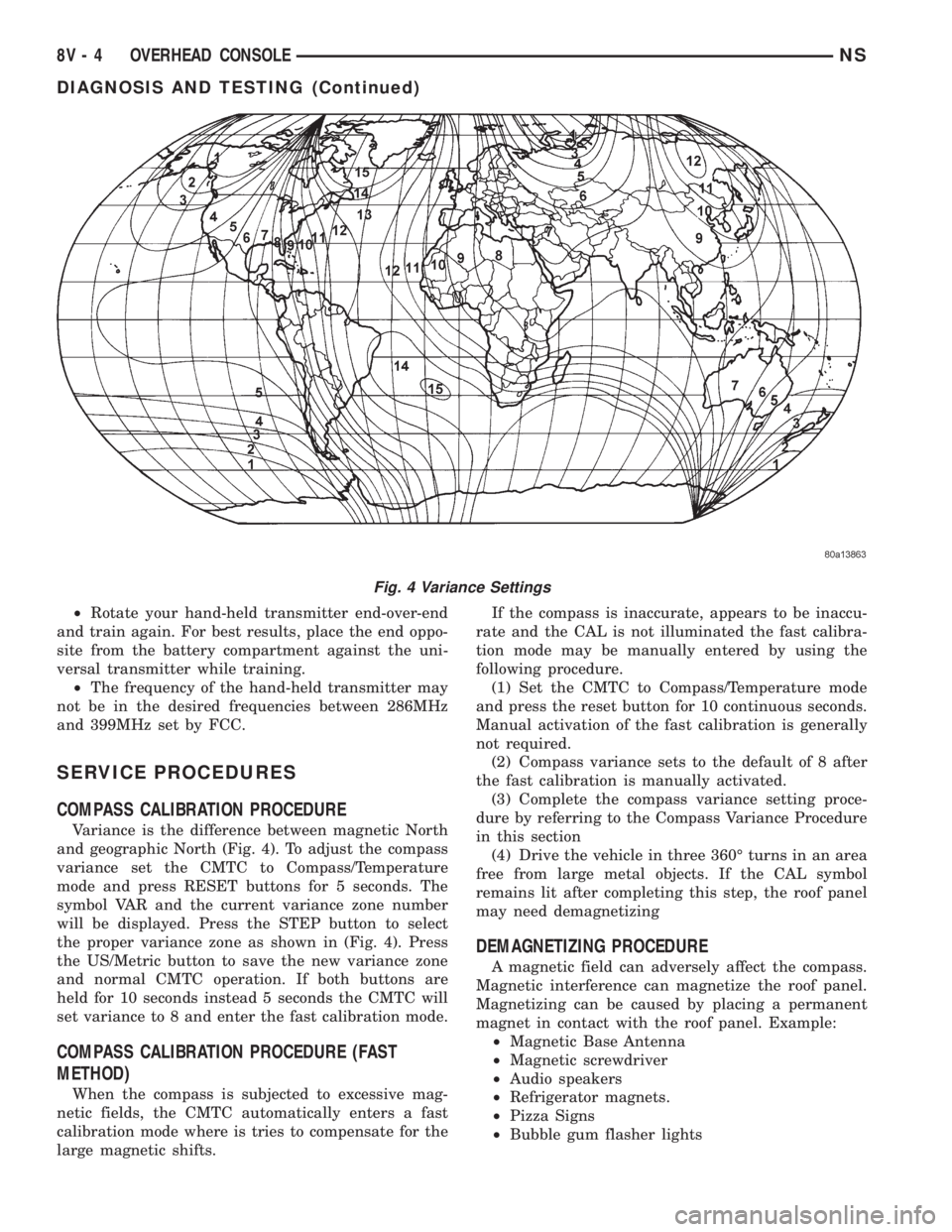
COMPASS CALIBRATION PROCEDURE
Variance is the difference between magnetic North
and geographic North (Fig. 4). To adjust the compass
variance set the CMTC to Compass/Temperature
mode and press RESET buttons for 5 seconds. The
symbol VAR and the current variance zone number
will be displayed. Press the STEP button to select
the proper variance zone as shown in (Fig. 4). Press
the US/Metric button to save the new variance zone
and normal CMTC operation. If both buttons are
held for 10 seconds instead 5 seconds the CMTC will
set variance to 8 and enter the fast calibration mode.
COMPASS CALIBRATION PROCEDURE (FAST
METHOD)
When the compass is subjected to excessive mag-
netic fields, the CMTC automatically enters a fast
calibration mode where is tries to compensate for the
large magnetic shifts.If the compass is inaccurate, appears to be inaccu-
rate and the CAL is not illuminated the fast calibra-
tion mode may be manually entered by using the
following procedure.
(1) Set the CMTC to Compass/Temperature mode
and press the reset button for 10 continuous seconds.
Manual activation of the fast calibration is generally
not required.
(2) Compass variance sets to the default of 8 after
the fast calibration is manually activated.
(3) Complete the compass variance setting proce-
dure by referring to the Compass Variance Procedure
in this section
(4) Drive the vehicle in three 360É turns in an area
free from large metal objects. If the CAL symbol
remains lit after completing this step, the roof panel
may need demagnetizing
DEMAGNETIZING PROCEDURE
A magnetic field can adversely affect the compass.
Magnetic interference can magnetize the roof panel.
Magnetizing can be caused by placing a permanent
magnet in contact with the roof panel. Example:
²Magnetic Base Antenna
²Magnetic screwdriver
²Audio speakers
²Refrigerator magnets.
²Pizza Signs
²Bubble gum flasher lights
Fig. 4 Variance Settings
8V - 4 OVERHEAD CONSOLENS
DIAGNOSIS AND TESTING (Continued)
Page 555 of 1938

Removing magnetic interfering objects will usually
restore normal compass operation. If the compass
display remains blank while the CAL label is illumi-
nated, then the roof panel requires demagnetizing. To
demagnetize use Special Tool 6029 for demagnetizing
the roof panel. The demagnetizing procedure will
demagnetize the roof and mounting screws in the
overhead console. It is important that you follow the
instructions below exactly. The mounting screws and
the mounting brackets around the compass area are
steel, and therefore aid in the demagnetizing of the
roof panel.
(1) Be sure the ignition switch is in the OFF posi-
tion before you begin the demagnetize procedure.
(2) Plug the demagnetizing tool into a standard
110/115 volt AC outlet, keeping the demagnetizing
tool at least 12 inches away from the compass area
when plugging it in.
(3) Slowly approach and contact the console
mounting screw with the plastic coated tip of the tool
for at least two seconds.
(4) With the demagnetizing tool still energized,
slowly back it away from the screw until the tip is at
least 12 inches from the screw head.
(5) Repeat the last step with all the console
mounting screws.
(6) After you have pulled at least 12 inches from
the last screw, remove the demagnetizing tool from
inside vehicle and disconnect it from the electrical
outlet.
(7) Place an 8 1/2 X 11 inch piece of paper length-
wise on the roof of vehicle directly above compass.
The purpose of the paper is to protect the roof panel
from scratches and define the area to be demagne-
tized.
(8) Plug in the demagnetizing tool, keeping it at
least two feet away from the compass unit.
(9) Slowly approach the center of the roof panel at
the windshield with the demagnetizing tool plugged
in.
(10) Contact the roof panel with the tip of the tool.
Using slow sweeping motions of 1/2 inch between
sweeps. Move the tool approximately four inches
either side of the center line and at least 11 inches
back from the windshield.
(11) With the demagnetizing tool still energized,
slowly back away from the roof panel until the tip is
at least two feet from the roof before unplugging the
tool.
(12) Recalibrate compass, refer to the compass cal-
ibration procedure in this section.
UNIVERSAL TRANSMITTER
TRAINING
(1) Turn off the engine.(2) Erase the factory test codes by pressing the
two outside buttons. Release the buttons when the
red light begins to flash (about 20 seconds).
(3) Choose one of the three buttons to train. Place
the hand-held transmitter within one inch of the uni-
versal transmitter and push the buttons on both
transmitters. The red light on the universal trans-
mitter will begin to flash slowly.
(4) When the red light on the universal transmit-
ter begins to flash rapidly (this may take as long as
60 seconds), release both buttons. Your universal
transmitter is now ªtrainedº. To train the other but-
tons, repeat Step 3 and Step 4. Be sure to keep your
hand-held transmitter in case you need to retrain the
universal transmitter.
ERASING
To erase the universal transmitter codes, simply
hold down the two outside buttons until the red LED
begins to flash.
NOTE: Individual channels cannot be erased. Eras-
ing the transmitter codes will erase ALL pro-
grammed codes.
REMOVAL AND INSTALLATION
AMBIENT TEMPERATURE SENSOR
REMOVAL
(1) Raise and support vehicle on safety stands.
(2) From behind front bumper fascia, remove
screw holding sensor to radiator closure panel.
(3) Remove sensor from vehicle.
INSTALLATION
For installation, reverse the above procedures.
Fig. 5 Universal Transmitter
NSOVERHEAD CONSOLE 8V - 5
SERVICE PROCEDURES (Continued)
Page 557 of 1938

Installation
For installation, reverse the above procedures.
When installing the lamp lens, first guide the switch
contact tab on the lens between the lamp switch
plunger and the lamp bezel. Then snap lens onto the
two lens pivots on the bezel.
READING/COURTESY LAMP ASSEMBLY
Removal
(1) Disconnect the battery negative cable.
(2) Remove the overhead console.
(3) Remove the screws holding the reading lamp to
the overhead console (Fig. 12).
(4) Remove the lamp from the overhead console.(5) Disconnect the wire connectors from the back
of the reading lamp (Fig. 13).
(6) Disconnect the reading lamp switch from the
keyhole slot in the reading lamp.
(7) Remove the reading lamp from the overhead
console.
Installation
For installation, reverse the above procedures.
UNIVERSAL TRANSMITTER
REMOVAL
The Universal Transmitter is serviced with the
transmitter bin door, in the overhead console.
Fig. 8 Lamp and Lens Removal
NSOVERHEAD CONSOLE 8V - 7
REMOVAL AND INSTALLATION (Continued)
Page 558 of 1938

(1) Disconnect and isolate negative battery cable.
(2) Open transmitter bin door in rear of overhead
console.(3) Gently pull towards rear of vehicle, releasing
transmitter bin door.
(4) Disconnect harness connector from Universal
Transmitter and remove bin door from vehicle.
INSTALLATION
For installation, reverse the above procedures. The
Universal Transmitter will need to be retrained.
Refer to SERVICE PROCEDURES in this section.
Fig. 9 Overhead Console
Fig. 10 Reading/Courtesy lamp lens
Fig. 11 Socket and Lamp
Fig. 12 Reading/Courtesy Lamp
Fig. 13 Connector and Switch
8V - 8 OVERHEAD CONSOLENS
REMOVAL AND INSTALLATION (Continued)
Page 563 of 1938
8W-01 GENERAL INFORMATION
INDEX
page page
DESCRIPTION AND OPERATION
CIRCUIT FUNCTIONS..................... 4
CIRCUIT INFORMATION................... 4
CONNECTOR INFORMATION............... 7
ELECTROSTATIC DISCHARGE (ESD)
SENSITIVE DEVICES.................... 8
INTRODUCTION......................... 1
NOTES, CAUTIONS, and WARNINGS......... 7
POSITIVE TEMPERATURE COEFFICIENT...... 8
SECTION IDENTIFICATION................. 5
SPLICE LOCATIONS...................... 7
SYMBOLS.............................. 5
TAKE OUTS............................. 8
TERMINOLOGY.......................... 7
DIAGNOSIS AND TESTING
INTERMITTENT AND POOR CONNECTIONS.... 9TROUBLESHOOTING TESTS................ 9
TROUBLESHOOTING TOOLS............... 8
TROUBLESHOOTING WIRING PROBLEMS.... 10
SERVICE PROCEDURES
CONNECTOR AND TERMINAL REPLACEMENT . 12
CONNECTOR REPLACEMENT.............. 11
DIODE REPLACEMENT................... 14
TERMINAL REPLACEMENT................ 13
TERMINAL/CONNECTOR REPAIR- AUGAT
CONNECTORS........................ 12
TERMINAL/CONNECTOR REPAIR-MOLEX
CONNECTORS........................ 11
WIRING REPAIR........................ 10
SPECIAL TOOLS
WIRING/TERMINAL...................... 14
DESCRIPTION AND OPERATION
INTRODUCTION
Chrysler wiring diagrams are designed to provide
information regarding the vehicles wiring content. In
order to effectively use Chrysler wiring diagrams to
diagnose and repair a Chrysler vehicle, it is impor-
tant to understand all of their features and charac-
teristics.
Diagrams are arranged such that the power (B+)
side of the circuit is placed near the top of the page,
and the ground (B-) side of the circuit is placed near
the bottom of the page.
All switches, components, and modules are shown
in the at rest position with the doors closed and the
key removed from the ignition.Components are shown two ways. A solid line
around a component indicates that the component is
complete. A dashed line around a component indi-
cates that the component being shown is not com-
plete. Incomplete components have a reference
number to indicate the page where the component is
shown complete.
It is important to realize that no attempt is made
on the diagrams to represent components and wiring
as they appear on the vehicle. For example, a short
piece of wire is treated the same as a long one. In
addition, switches and other components are shown
as simply as possible, with regard to function only.
NS/GS8W-01 GENERAL INFORMATION 8W - 01 - 1
Page 569 of 1938

TERMINOLOGY
This a list of terms with there definitions used in
the wiring diagrams.
Built-Up-Export.........Vehicles Built For Sale In
Markets Other Than North America
Except-Built-Up-Export.....Vehicles Built For Sale
In North America
LHD..................Left Hand Drive Vehicles
RHD.................Right Hand Drive Vehicles
ATX . . . .Automatic Transmission-Front Wheel Drive
MTX......Manual Transmission-Front Wheel Drive
AT......Automatic Transmission-Rear Wheel Drive
MT .......Manual Transmission-Rear Wheel Drive
SOHC.............Single Over Head Cam Engine
DOHC.............Dual Over Head Cam Engine
CONNECTOR INFORMATION
CAUTION: Not all connectors are serviced. Some
connectors are serviced only with a harness. A typ-
ical example might be the Supplemental Restraint
System connectors. Always check parts availability
before attempting a repair.
IDENTIFICATION
In-line connectors are identified by a number, as
follows:
²In-line connectors located on theengine com-
partment harnessareC100series numbers.
²Connectors located on theinstrument panel
harnessareC200series numbers.
²Connectors located on thebody harnessare
C300series numbers.
²Jumper harness connectorsareC400series
numbers.
²Grounds and ground connectorsare identi-
fied with aªGºand follow the same series number-
ing as the in-line connector.
Component connectors are identified by the compo-
nent name instead of a number (Fig. 2). Multiple
connectors on a component use a C1, C2, etc. identi-
fier (Fig. 3).
LOCATIONS
Section 8W-90 contains connector/ground location
illustrations. The illustrations contain the connector
name (or number)/ground number and component
identification. Connector/ground location charts in
Section 8W-90 reference the illustration number for
components and connectors.
Section 8W-80 shows each connector and the cir-
cuits involved with that connector. The connectors
are identified using the name/number on the Dia-
gram pages.
SPLICE LOCATIONS
Splice Location charts in Section 8W-70 show the
entire splice, and provide references to other sections
the splice serves.
Section 8W-95 contains illustrations that show the
general location of the splices in each harness. The
illustrations show the splice by number, and provide
a written location.
NOTES, CAUTIONS, and WARNINGS
Throughout this group additional important infor-
mation is presented in three ways; Notes, Cautions,
and Warnings.
NOTESare used to help describe how switches or
components operate to complete a particular circuit.
They are also used to indicate different conditions
that may appear on the vehicle. For example, an
up-to and after condition.
CAUTIONSare used to indicate information that
could prevent making an error that may damage the
vehicle.
WARNINGSprovide information to prevent per-
sonal injury and vehicle damage. Below is a list of
general warnings that should be followed any time a
vehicle is being serviced.
WARNING: ALWAYS WEAR SAFETY GLASSES FOR
EYE PROTECTION.
WARNING: USE SAFETY STANDS ANYTIME A PRO-
CEDURE REQUIRES BEING UNDER A VEHICLE.
Fig. 2 Component Identification
Fig. 3 Connector Identification
NS/GS8W-01 GENERAL INFORMATION 8W - 01 - 7
DESCRIPTION AND OPERATION (Continued)
Page 572 of 1938

(3) Starting at the fuse block, wiggle the wiring
harness about six to eight inches apart and watch
the voltmeter/test lamp.
(4) If the voltmeter registers voltage or the test
lamp glows, there is a short to ground in that gen-
eral area of the wiring harness.
TESTING FOR A SHORT TO GROUND ON
FUSES POWERING SEVERAL LOADS
(1) Refer to the wiring diagrams and disconnect or
isolate all items on the suspected fused circuits.
(2) Replace the blown fuse.
(3) Supply power to the fuse by turning ON the
ignition switch or re-connecting the battery.
(4) Start connecting the items in the fuse circuit
one at a time. When the fuse blows the circuit with
the short to ground has been isolated.
TESTING FOR A VOLTAGE DROP
(1) Connect the positive lead of the voltmeter to
the side of the circuit closest to the battery (Fig. 9).
(2) Connect the other lead of the voltmeter to the
other side of the switch or component.
(3) Operate the item.
(4) The voltmeter will show the difference in volt-
age between the two points.
TROUBLESHOOTING WIRING PROBLEMS
When troubleshooting wiring problems there are
six steps which can aid in the procedure. The steps
are listed and explained below. Always check for non-
factory items added to the vehicle before doing any
diagnosis. If the vehicle is equipped with these items,disconnect them to verify these add-on items are not
the cause of the problem.
(1) Verify the problem.
(2) Verify any related symptoms. Do this by per-
forming operational checks on components that are
in the same circuit. Refer to the wiring diagrams.
(3) Analyze the symptoms. Use the wiring dia-
grams to determine what the circuit is doing, where
the problem most likely is occurring and where the
diagnosis will continue.
(4) Isolate the problem area.
(5) Repair the problem.
(6) Verify proper operation. For this step check for
proper operation of all items on the repaired circuit.
Refer to the wiring diagrams.
SERVICE PROCEDURES
WIRING REPAIR
When replacing or repairing a wire, it is important
that the correct gage be used as shown in the wiring
diagrams. The wires must also be held securely in
place to prevent damage to the insulation.
(1) Disconnect battery negative cable
(2) Remove 1 inch of insulation from each end of
the wire.
(3) Place a piece of heat shrink tubing over one
side of the wire. Make sure the tubing will be long
enough to cover and seal the entire repair area.
(4) Spread the strands of the wire apart on each
part of the exposed wire (example 1). (Fig. 10)
Fig. 8 Testing for ContinuityFig. 9 Testing for Voltage Drop
8W - 01 - 10 8W-01 GENERAL INFORMATIONNS/GS
DIAGNOSIS AND TESTING (Continued)