1996 CHEVROLET TAHOE change time
[x] Cancel search: change timePage 175 of 403

Downloaded from www.Manualslib.com manuals search engine Controlling your vehicle is the key to successful
off-road driving. One of the best ways to control your
vehicle is to control
your speed. Here are some things to
keep in mind. At higher speeds:
you approach things faster and you have less time to
scan the terrain, for obstacles.
0 you have less time to react.
0 you have more vehicle bounce when you drive
over obstacles.
0 you’ll need more distance for braking, especially
since you’re on an unpaved surface.
Traveling to Remote Areas
It makes sense to plan your trip, especially when going
to
a remote area. Know the terrain and plan your route.
You
are much less likely to get bad surprises. Get
accurate maps of trails and terrain. Try
to learn of any
blocked or closed roads.
It’s also a good idea to travel with at least one other
vehicle. If something happens to one of them,
the other
can help quickly.
Does your vehicle have a winch? If
so, be sure to read
the winch instructions. In a remote area, a winch can be
handy
if you get stuck. But you’ll want to know how to
use it properly.
Getting Familiar with Off-Road Driving
It’s a good idea to practice in an area that’s safe and
close
to home before you go into the wilderness.
Off-road driving does require some new and different
driving skills. Here’s what we mean.
Tune your senses to different kinds
of signals. Your
eyes, for example, need
to constantly sweep the terrain
for unexpected obstacles, Your ears need to listen for
unusual tire or engine sounds. With your arms, hands,
feet and body, you’ll need
to respond to vibrations and
vehicle bounce.
4-16
When you’re driving off-road, bouncing and
quick changes in direction
can easily throw you
out
of position. This could cause you to lose
control and crash.
So, whether you’re driving on
or
off the road, you and your passengers should
wear safety belts.
Page 176 of 403
Downloaded from www.Manualslib.com manuals search engine Scanning the Terrain
Off-road driving can take you over many different kinds of terrain. You need to be familiar with
the terrain and its
many different features. Here are some things to consider.
Surfiuce Conditions. Off-roading can take you over
hard-packed
dirt, gravel, rocks, grass, sand, mud, snow or
ice. Each of these surfaces affectsthe steering, acceleration
and braking of your vehicle in different ways. Depending
upon the kind of surface
you are on, you may experience
slipping, sliding, wheel spinning, delayed acceleration,
poor traction and longer braking distances.
&$ace Obstacles. Unseen or hidden obstacles can be
hazardous.
-A rock, log, hole, rut or bump can startle you if
you’re not prepared for them. Often these obstacles are
hidden by grass, bushes, snow or even the rise and fall of
the terrain itself. Here are some things to consider:
0 Is the path ahead clear?
Will the surface texture change abruptly up ahead?
0 Does the travel take you uphill or downhill?
0 Will you have to stop suddenly or change
(There’s more
discussion
of these subjects later.)
direction quickly? When
you drive over obstacles or
rough terrain, keep a
firm grip on the steering wheel. Ruts, troughs or other
surface features can jerk the wheel out of your hands if
you’re not prepared.
When you drive over bumps, rocks, or other obstacles,
your wheels can leave the ground. If this happens, even
with
one or two wheels, you can’t control the vehicle as
well or at all.
Because
you will be on an unpaved surface, it’s
especially important to avoid sudden acceleration,
sudden turns or’ sudden braking.
In a way, off-road driving requires a different kind
of
alertness from driving on paved roads and highways.
There are no road signs, posted speed limits or signal
lights. You have
to use your own good judgment about
what is safe and what isn’t.
Drinking and driving can be very dangerous
on any
road. And this is certainly true for off-road driving. At
the very time
you need special alertness and driving
skills, your reflexes, perceptions and judgment can be
affected by even a small amount of alcohol.
You could
have a serious
-- or even fatal -- accident if you drink
and drive or ride with a driver who has been drinking.
See “Drunken Driving” in the Index.
4-17
Page 203 of 403
Downloaded from www.Manualslib.com manuals search engine NOTICE:
Pulling a trailer improperly can’ damage your
vehicle and result in costly repairs not covered by
your warranty.
TO pull a trailerr dorrectly, follow
the advice in this part, and see your
GM dealer
for important information about towing a trailer
with your vehicle.
Every vehicle is ready for some trailer towing. If yours
was built with trailering options, as many are, it’s ready
for heavier trailers. But trailering is different than just
driving your vehicle by itself, Trailering means changes
in handling, durability and fuel economy. Successful,
safe trailering takes correct equipment, and it has to be
used properly.
That’s the reason for this
part. In it are many
time-tested, important trailering tips and safety rules.
Many
of these are important for your safety and that of
your passengers.
So please read this section carefully ,
before you pull a trailer.
4-44
Page 243 of 403

Downloaded from www.Manualslib.com manuals search engine 4. With UP on the ratchet facing you, raise the vehicle
by rotating the ratchet and wheel wrench clockwise.
Raise the vehicle far mough
off the ground so there
is enough room for ,the spare tire to fit.
5. Remove all the wheel
nuts and take off the
flat tire. Remove any rust
or dirt
from the wheel
bolts,
mounting surfaces and
spare wheel.
&!+ CAUTION:
Rust or dirt on the wheel, or on the parts to
which it is fastened, can make the wheel nuts
become loose after a time. The wheel could come
off and cause an accident. When you change a
wheel, remove any rust or dirt from the places
where the wheel attaches to the vehicle.
In an
emergency, you can use a cloth
or a paper towel
to do this; but be sure to use a scraper or wire
brush later, if you need to, to get all the rust or
dirt off.
5-28
Page 271 of 403
Downloaded from www.Manualslib.com manuals search engine A ,CAUTION:
Operating the engine with the air cleaner off can
cause
you or others to be burned. The air cleaner
not only cleans the air, it stops flame
if the engine
backfires.
If it isn’t there, and the engine
backfires, you could be burned. Don’t drive with
it
off, and be careful working on the engine with
the air cleaner off.
I
NOTICE:
If the air cleaner is off, a backfire can cause a
damaging engine fire. And, dirt can easily get
into your engine, which will damage
it. Always
have the air cleaner in place when you’re driving.
Automatic Transmission Fluid
When to Check and Change
A good time to check your automatic transmission fluid
level
is when the engine oil is changed.
Change both the fluid and filter every
50,000 miles
(83 000 Ism) if the vehicle is mainly driven under one
or,more of these conditions:
0 In heavy city traffic where the outside temperature
regularly reaches
90” F (32 O C) or higher.
0 In hilly or mountainous terrain.
0 When doing frequent trailer towing.
0 Uses such as found in taxi, police or delivery service.
If you do not use your vehicle under any of these
conditions, the fluid and filter do not require changing.
See “Scheduled Maintenance Services” in
the Index.
6-18
Page 279 of 403
Downloaded from www.Manualslib.com manuals search engine What to Use
Use a mixture of one-half clean water (preferably
distilled) and one-half DEX-COOL
TM (orange-colored,
silicate-free) antifreeze that meets
GM Specification
6277M, which won’t damage aluminum parts. Use
GM Engine Coolant Supplement (sealer) (GM Part
No. 3634621) with any complete coolant change. If you
use this mixture, you don’t need
to add anything else.
Adding only plain water to your cooling system
can be dangerous. Plain water, or some other
liquid like alcohol, can boil before the proper
coolant mix will. Your vehicle’s coolant warning
system is set for ‘the proper coolant mix. With
plain water or the wrong mix, your engine could
get too hot but you wouldn’t get the overheat
warning. Your engine could catch fire and you or
others could be burned. Use
a 50/50 mix of clean
water and
DEX-COOL TM (orange-colored,
silicate-free) antifreeze.
NOTICE:
If you use an improper coolant mix, your engine
could overheat and be badly damaged. The
repair cost wouldn’t be covered by your
warranty.
Too much water in the mix can freeze
and crack the engine, radiator, heater core and
other parts.
[f you have to add coolant more than four times a year,
have your dealer check your cooling system.
NOTICE:
If you use the proper coolant, you don’t have to
add extra inhibitors
or additives which claim to
improve the system. These can be harmful.
6-26
Page 287 of 403
Downloaded from www.Manualslib.com manuals search engine Some driving conditions or climates may cause a brake
squeal when the brakes are first applied or lightly
applied. This does not mean something is wrong with
your brakes.
Free movement
of brake calipers and properly torqued
wheel nuts are necessary
to help prevent brake
pulsation. When tires are rotated, inspect brake calipers
for movement, brake pads for wear, and evenly torque
wheel nuts in the proper sequence to
GM specifications.
Your rear drum brakes don’t have wear indicators, but if
you ever hear a rear brake rubbing noise, have the rear
brake linings inspected. Also, the rear brake drums should
be removed and inspected each time the tires are removed
for rotation or changing. When you have the front brakes
replaced, have the rear brakes inspected, too.
Brake linings should always be replaced as complete
axle sets.
Brake Pedal Travel
See your dealer if the brake pedal does not return to
normal height, or
if there is a rapid increase in pedal
travel. This could be a sign of brake trouble.
Brake Adjustment
Every time you make a brake stop, your disc brakes
adjust for wear. If
your brake pedal goes down farther than normal, your
rear drum brakes may need adjustment. Adjust them by
backing up and firmly applying the brakes a few times.
Replacing Brake System Parts
The braking system on a modern vehicle is complex. Its
many parts have to be of top quality and work well
together if the vehicle is to have really good braking.
Vehicles we design and test have top-quality
GM brake
parts in them, as your vehicle does when it is new. When
you replace parts of your braking system
-- for example,
when your brake linings wear down and you have to
have new ones put in
-- be sure you get new genuine
GM replacement parts. If you don’t, your brakes may
no longer work properly. For example, if someone
puts in brake linings that are wrong for your vehicle,
the balance between your front and rear brakes can
change
-- for the worse. The braking performance
you’ve come to expect can change in many other ways if
someone puts in the wrong replacement brake parts.
Fluid Leak Check
After the vehicle has been parked for a while, inspect the
surface under the vehicle for water, oil, fuel or other fluids\
.
Water dripping from the air conditioning system after
it
has been used is normal. If you notice fuel leaks or fumes,
the causes should
be found and corrected at once.
6-34
Page 299 of 403
Downloaded from www.Manualslib.com manuals search engine After the tires have been rotated, adjust the front and rear inflation pressures as shown on the Certificatioflire label.
Make certain that all. wheel nuts are properly tightened. See “Wheel
Nut Torque” in the Index.
A
/! CAUTION:
Rust or dirt on a wheel, or on the parts to which
it is fastened, can make wheel nuts become
loose
after a time. The wheel could come off and cause
an accident. When you change a wheel, remove
any rust or dirt from places where the wheel
attaches
to the vehicle. In an emergency, you can
use
a cloth or a paper towel to do this; but be
sure to
use a scraper or wire brush later, if you
need to, to get all the rust or dirt
off. (See
“Changing a Flat Tire” in the Index.) When
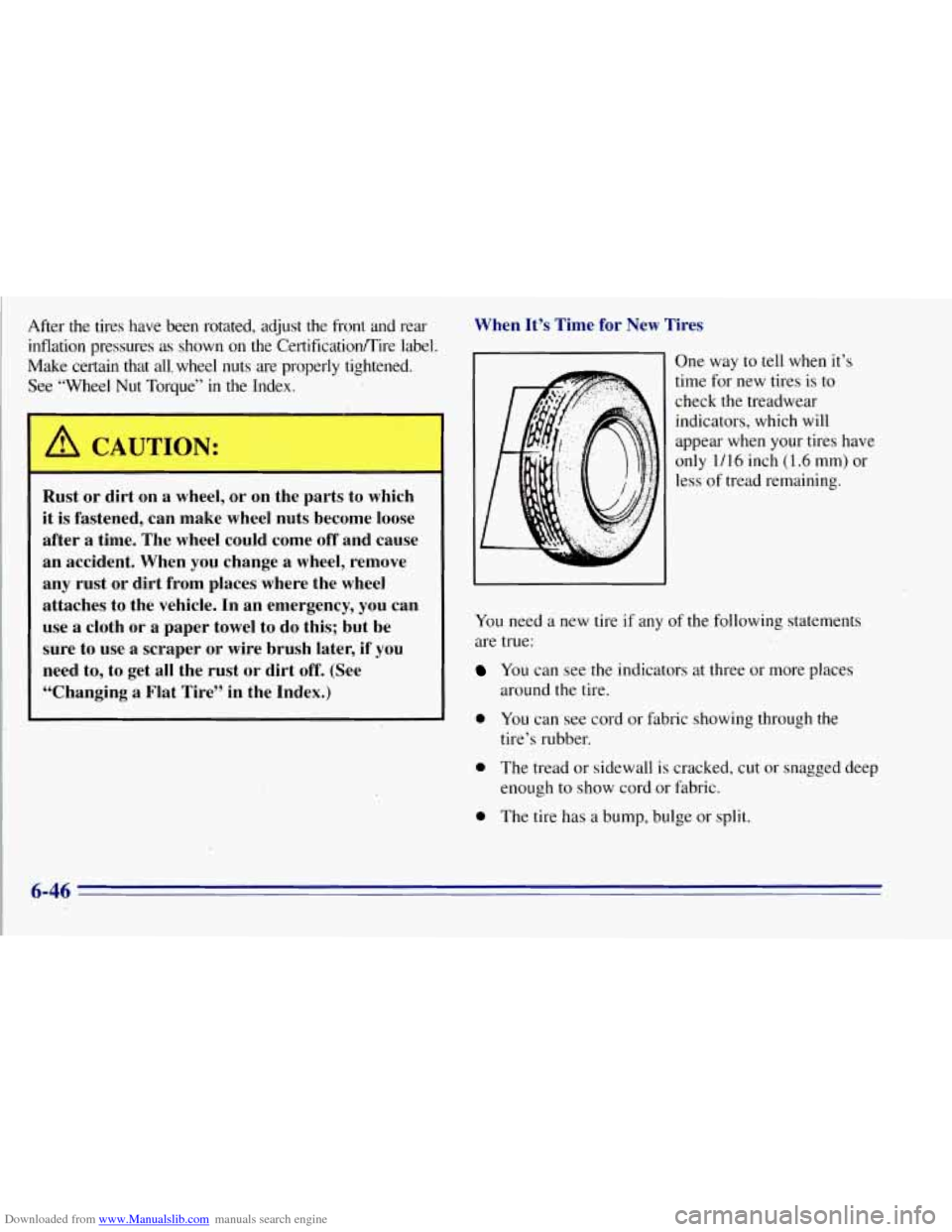
It’s Time for New Tires
You need a new tire if any o
are true: One
way to
tell when it’s
time for new tires is
to
check the treadwear
indicators, which will
appear when your tires have
only
1/16 inch (1.6 mm) or
less of tread remaining.
f rh Ile following statements
You can see the indicators at three or more places
around the tire.
0 You can see cord or fabric showing through the
tire’s rubber.
0 The tread or sidewall is cracked, cut or snagged deep
enough to show cord or fabric.
0 The tire has a bump, bulge or split.
6-46