1996 CHEVROLET SUBURBAN third
[x] Cancel search: thirdPage 22 of 486
Easy Entry Seat (Suburban Second Seat)
The right side of the rear 60/40 split folding bench seat, available in the
Suburban, has an easy entry feature. That makes it easy to get
in and out of
the third seat,
if you have one.
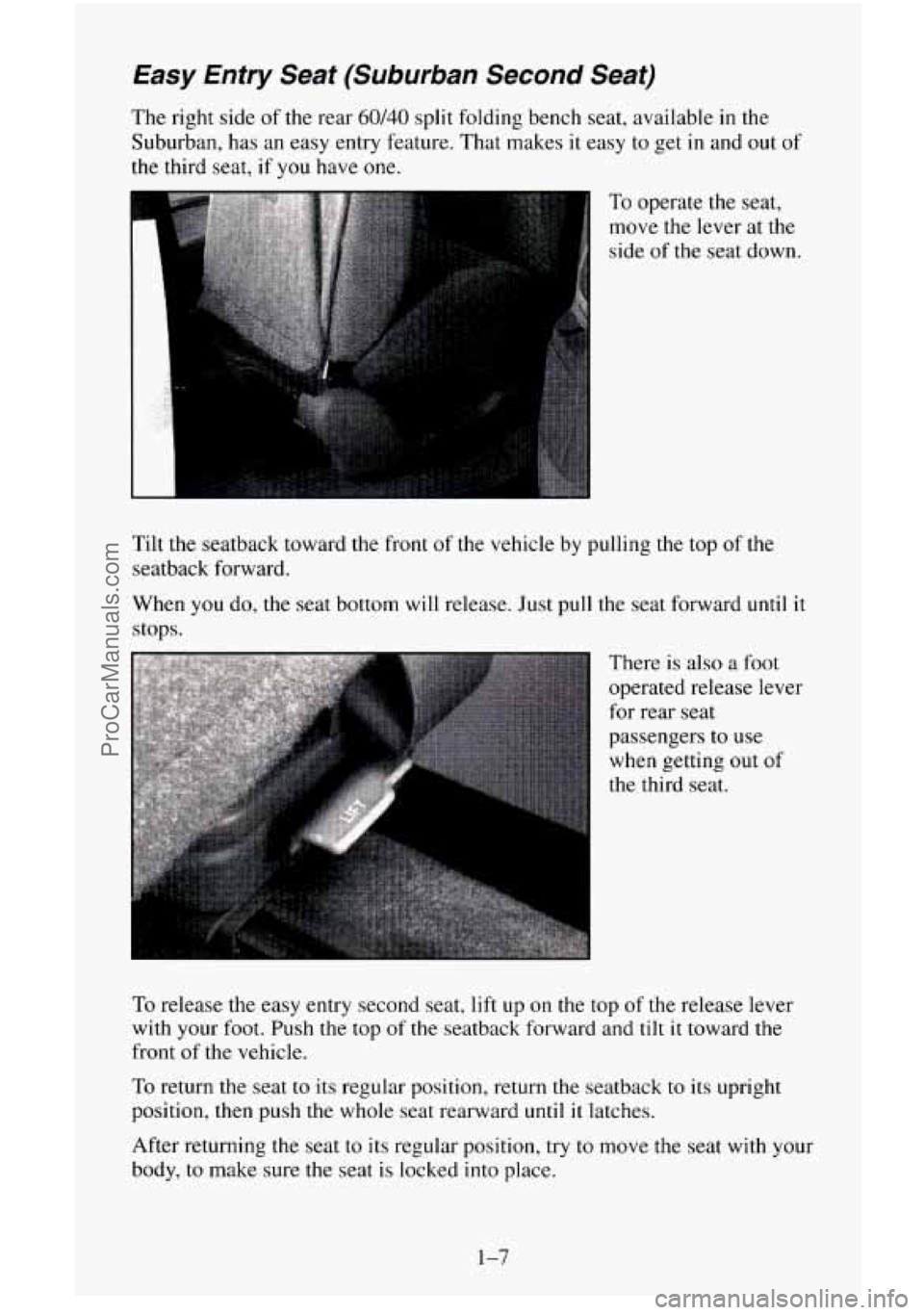
,, :: .... . To operate the seat,
move the lever at the
side of the seat down.
Tilt the seatback toward the front of
the vehicle by pulling the top of the
seatback forward.
When
you do, the seat bottom will release. Just pull the seat forward until it
stops.
There
is also a foot
operated release lever
for rear seat
passengers to use
when getting out of
the third seat.
To release the easy entry second seat,
lift up on the top of the release lever
with your foot. Push the top
of the seatback forward and tilt it toward the
front
of the vehicle.
To return the seat to its regular position, return the seatback to its upright
position, then push
the whole seat rearward until it latches.
After returning the seat
to its regular position, try to move the seat with your
body, to make sure the seat is locked into place.
1-7
ProCarManuals.com
Page 29 of 486
,
Then, stow the head restraints
by sliding
them into the rear
of
the seatback. Make
sure the posts go in all
the way.
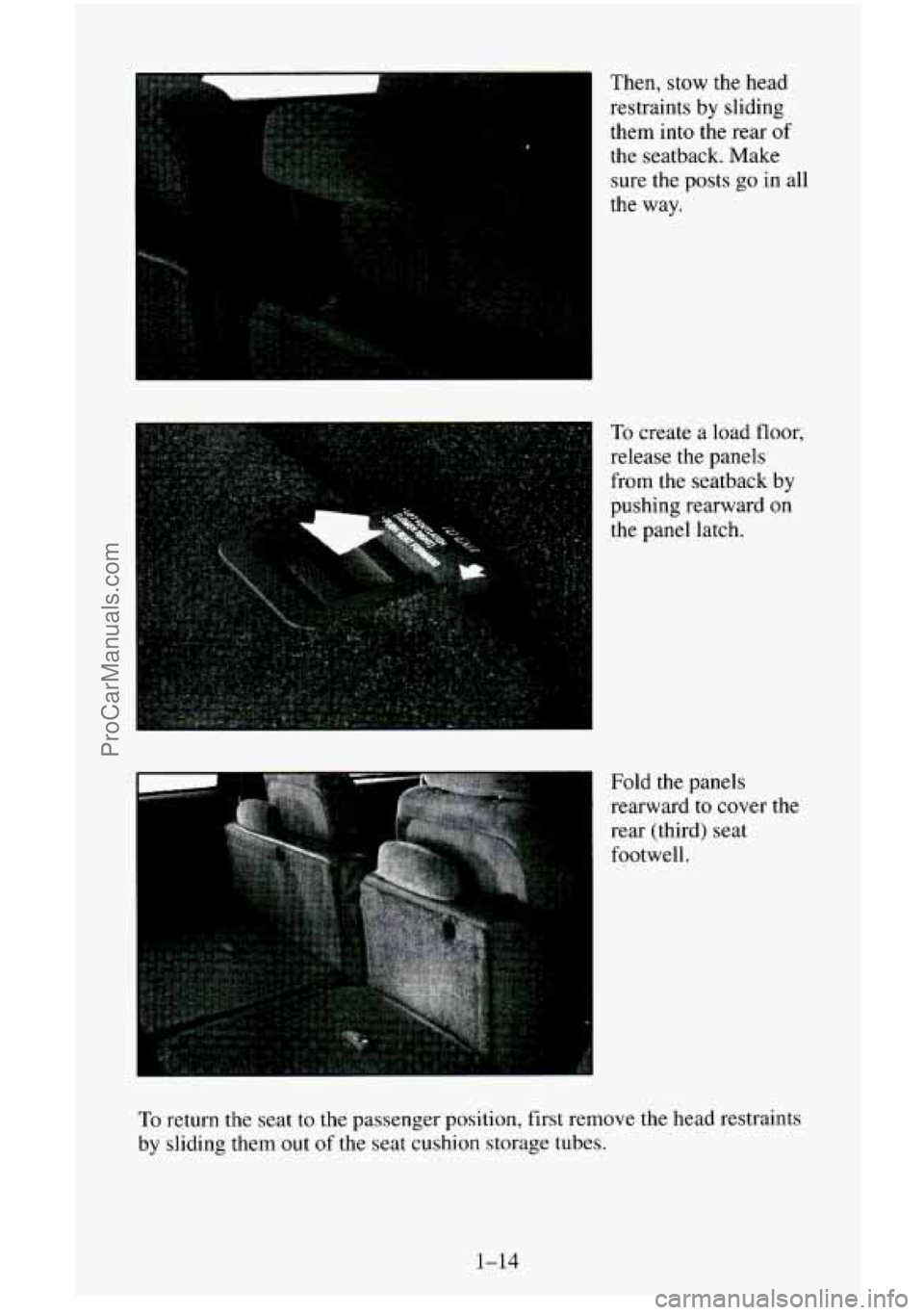
To create a load floor,
release the panels
from the seatback by
pushing rearward
on
the panel latch.
Fold the panels
rearward
to cover the
rear (third) seat
footwell.
To return the seat to the passenger position, first remove the head restraints
by sliding them out of the seat cushion storage tubes.
1-14
ProCarManuals.com
Page 30 of 486
Fold the load floor panels forward and latch them into the seatback. Lift the
seatback up and push rearward until
it latches. Then, lower the seat cushion
until it latches in position.
After returning the seat to the passenger position, return
the head restraints
to the top of each seatback. Pull forward on the seatback and up on the seat
cushion to make sure the seat
is securely in place.
Also, pull the safety belt buckles
out of the seat cushion pockets, so they
will be available for rear seat passengers to use.
Removable Rear (Third) Seat (Suburban)
If your vehicle has a rear seat, it can be taken out for more cargo space.
Before removing the seat, unlatch the outside passenger position safety belts
from the seat frame.
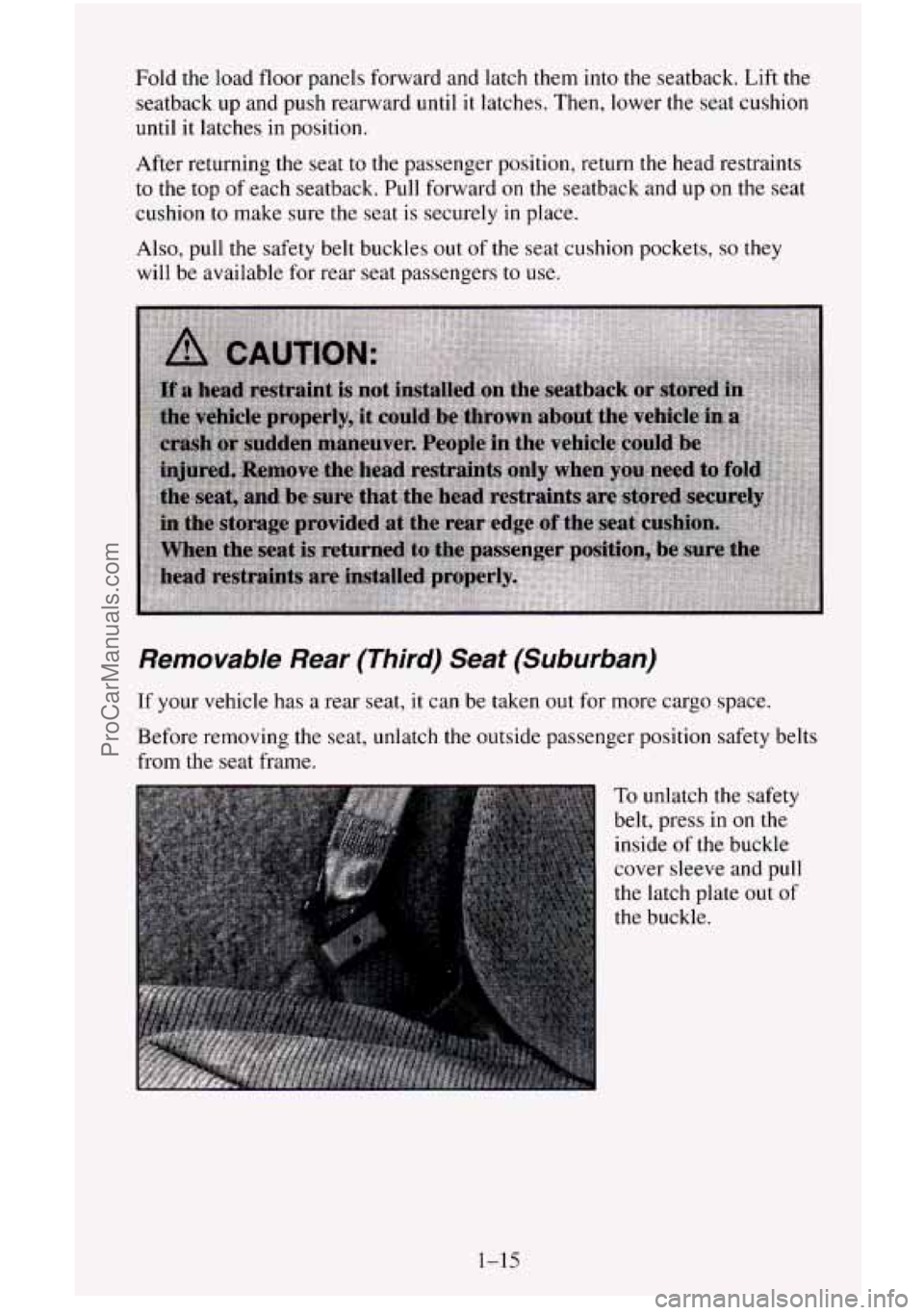
To unlatch the safety
belt, press
in on the
inside of the buckle
cover sleeve and pull
the latch plate out
of
the buckle.
1-15
ProCarManuals.com
Page 89 of 486
NOTICE:
Damage to your transmission caused by shifting out of PARK
(P) or NEUTRAL (N) with the engine racing isn’t covered by
your warranty.
0 AUTOMATIC OVERDRIVE (@) - This position is for normal
driving. If you need more power for passing, and you’re:
- Going less than about 35 mph (56 km/h), push your accelerator
pedal about halfway down.
- Going about 35 mph (56 km/h) or more, push the accelerator all
the way down.
You’ll shift down
to the next gear and have more power.
@ should not be used when towing a trailer, carrying a heavy load,
driving on steep hills, or for off-road driving. Select THIRD
GEAR
(3) when operating the vehicle under any of these
conditions.
0 THIRD GEAR (3) - This is like @, but you never go into Overdrive.
You should use THIRD GEAR (3) when towing a trailer, carrying a
heavy load, driving on steep hills, or for off-road driving.
0 SECOND GEAR (2) - This position gives you more power but lower
fuel economy. You can use SECOND GEAR (2) on hills. It can help
control your speed
as you go down steep mountain roads, but then you
would also want to use your brakes off and on.
If you manually select
SECOND GEAR (2), the transmission will drive
in second gear. You may use this feature for reducing torque to the rear
wheels when
you are trying to start your vehicle from a stop on
slippery road surfaces.
2-22
ProCarManuals.com
Page 91 of 486
0
0
0
0
THIRD GEAR (3), FOURTH GEAR (4) and FIFTH GEAR (5) -
Shift into THIRD GEAR (3), FOURTH GEAR (4) and FIFTH GEAR
(5) the same way you do for SECOND GEAR (2). Slowly let up on the
clutch pedal
as you press the accelerator pedal.
To Stop - Let up on the accelerator pedal and press the brake pedal.
Just before the vehicle stops, press the clutch pedal and the brake pedal,
and shift to NEUTRAL
(N).
NEUTRAL (N) - Use this position when you start or idle your
engine.
REVERSE (R) - To back up, first press down the clutch pedal. Wait
about
5 seconds for the internal parts to stop spinning and then, shift
into REVERSE (R). Let up on the clutch pedal slowly while pressing
the accelerator pedal.
NOTICE:
Shift to REVERSE (R) only after your vehicle is stopped.
Shifting to REVERSE
(R) while your vehicle is moving could
damage your transmission.
Also, use REVERSE (R), along with the parking brake, when turning
off your engine and parking your vehicle.
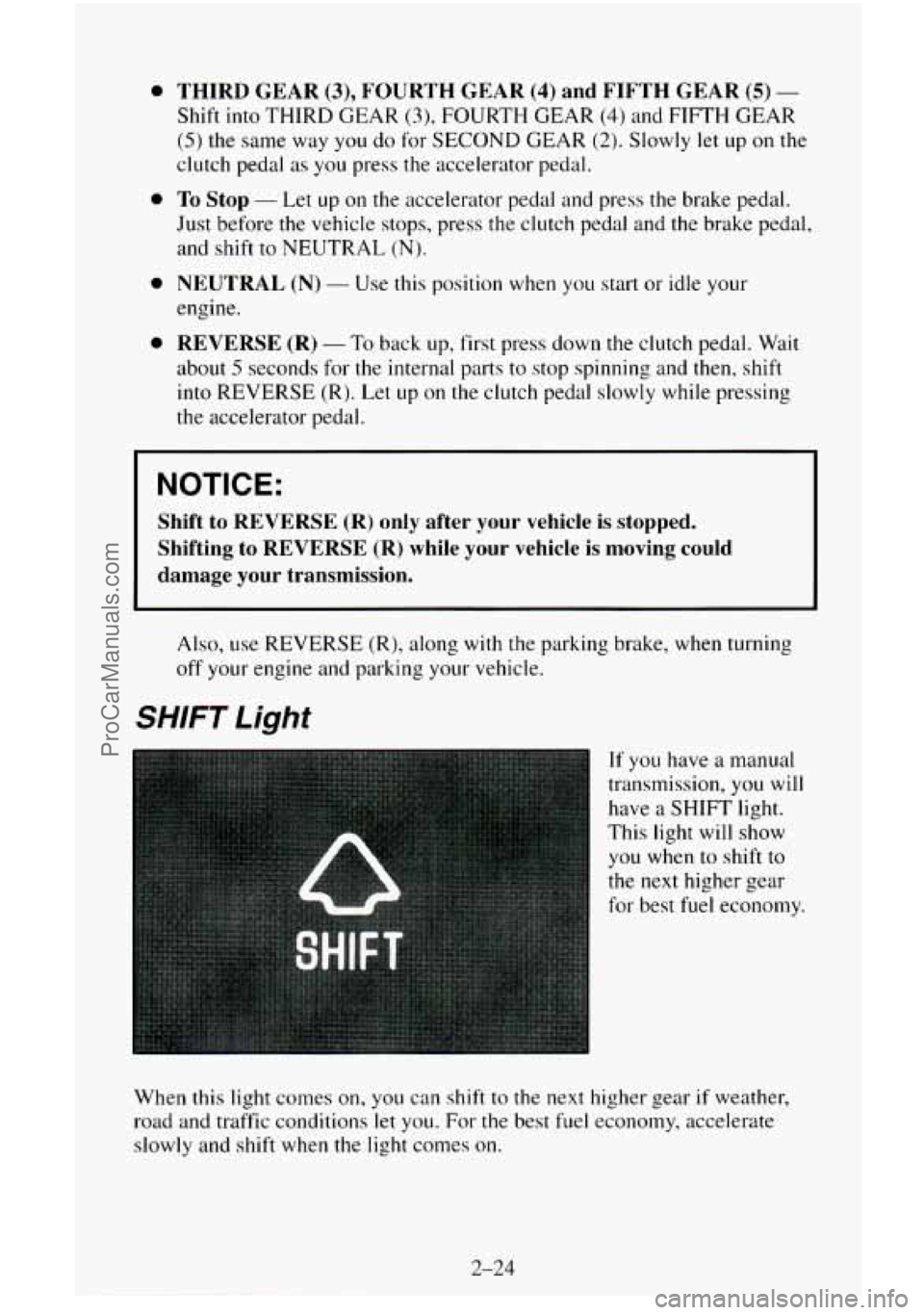
SHIFT Light
If you have a manual
transmission, you will
have a
SHIFT light.
This light will show
you when to shift to
the
next higher gear
for best fuel economy.
When
this light comes on, you can shift to the next higher gear if weather,
road and traffic conditions let you.
For the best fuel economy, accelerate
slowly and shift when the light comes on.
2-24
ProCarManuals.com
Page 468 of 486
Customer Assistance for the Hearing or
Speech lmpaired (TDD)
To assist customers who have hearing difficulties, Chevrolet has installed
special TDD (Telecommunication Devices for the Deaf) equipment at its
Customer Assistance Center. Any hearing or speech impaired customer who
has access to a TDD or
a conventional teletypewriter (TTY) can
communicate
with Chevrolet by dialing: 1 -800-TDD-CHEV
(1-800-833-2438). (TDD users in Canada can dial 1-800-263-3830.)
GM Participation in BBB AUTO LINE -
Alternative Dispute Resolution Program*
*This program may not be available in all states, depending on state law.
Canadian owners refer to your Warranty and Owner Assistance Information
booklet. General Motors reserves the right
to change eligibility limitations
and/or to discontinue
its participation in this program.
Both Chevrolet and your Chevrolet dealer are committed to making sure
you are completely satisfied
with your new vehicle. Our experience has
shown that,
if a situation arises where you feel your concern has not been
adequately addressed, the Customer Satisfaction Procedure described earlier
in this section is very successful.
There
may be instances where an impartial third-party can assist in arriving
at
a solution to a disagreement regarding vehicle repairs or interpretation of
the New Vehicle Limited Warranty.
To assist in resolving these
disagreements, Chevrolet voluntarily participates
in BBB AUTO LINE.
BBB AUTO LINE is an out-of-court program administered by the Better
Business Bureau system to settle disputes between customers and
automobile manufacturers. This program is available free of charge
to
customers who currently own or lease a GM vehicle.
If you are not satisfied after following the Customer Satisfaction Procedure,
you may contact the BBB using the toll-free telephone number, or write
them
at the following address:
BBB AUTO
LINE
Council of Better Business Bureaus
4200 Wilson Boulevard
Suite
800
Arlington, VA 22203
Telephone: 1-800-955-5
100
8-3
ProCarManuals.com
Page 469 of 486
‘To file a claim, you will be asked to provide your name and address, your
Vehicle Identification Number (VIN), and
a statement of the nature of your
complaint. Eligibility is limited by vehicle age and mileage, and other
factors.
We prefer you utilize the Customer Satisfaction Procedure before you resort
to AUTO LINE, but
you may contact the BBB at any time. The BBB will
attempt to resolve
the complaint serving as an intermediary between you
and Chevrolet. If this mediation is unsuccessful, an informal hearing will be
scheduled where eligible customers may present their case to an impartial
third-party arbitrator.
The arbitrator will make a decision which you may accept or reject. If you
accept the decision, GM will be bound by that decision. The entire dispute
resolution procedure should ordinarily take about forty days from the time
you file a claim until a decision is made.
Some state laws may require you
to use this program before filing a claim
with a state-run arbitration program or in the courts. For further
information, contact the BBB at
1-800-955-5 100 or the Chevrolet
Customer Assistance Center at 1-800-222-1
020.
REPORTING SAFETY DEFECTS TO THE
UNITED STATES GOVERNMENT
If you believe that your vehicle has a defect which could cause a crash or
could cause injury
or death, you should immediately inform the National
Highway Traffic
Safety Administration (NHTSA), in addition to notifying
General Motors.
If NHTSA receives similar complaints,
it may open an investigation, and if
it finds that
a safety defect exists in a group of vehicles, it may order a recall
and remedy campaign. However, NHTSA cannot become involved
in
individual problems between you, your dealer, or General Motors.
To contact NHTSA,
you may either call the Auto Safety Hotline toll-free at
1-800-424-9393 (or 366-0123 in
the Washington, D.C. area) or write to:
NHTSA, U.S. Department of Transportation
Washington, D.C. 20590
You can also obtain other information about motor vehicle safety from the
Hotline.
8-4
ProCarManuals.com
Page 482 of 486

Seats ........................................................... 1-1
Controls ...................................................... 1-1
Easy Entry Seat (Suburban Second Seat)
............................ 1-7
Easy Entry Seat (2-Door Utility Model)
............................ 1-5
Folding Second Seat (Suburban) ................................. 1-13
Head Restraints
................................................ 1-6
ManualFrontSeats
............................................. 1-1
Power Lumbar Adjustment
....................................... 1-3
Powerseats ................................................... 1-2
Rear Folding Seat (2-Door Utility Model) ........................... 1-8
Rear Folding Seat (&Door Utility Model)
.......................... 1-10
Reclining Front Seatback
........................................ 1-3
Removable Rear (Third Seat (Suburban))
.......................... 1-15
SeatbackLatches
............................................... 1-4
Doing Your Own Service Work ................................... 6-1
Parts Identification Label
....................................... 6-74
Publications
................................................... 8-8
Replacement Parts and Filter Recommendations
...... 676,677, 6-78, 6-79
Service
Service Engine Soon Light
(See “Lights”)
Servicing Your Air Bag-Equipped Vehicle (See “supplemental Inflatable Restraint
System (SIR)”)
Shift Indicator Light (See “Lights”)
Shifting Into Park (P)
............................................. 2-27
Shifting Out of Park (P)
........................................... 2-28
Shock Absorbers
................................................ 6-44
Specifications Chart (See “Service - Replacement Parts and Filter
Recommendations”) SpareTire
................................................. 5-26, 5-30
Speedometer and Odometer (See “Gages”)
Starting Your Engine (See “Engine-Starting”)
Steering
........................................................ 4-7
Column Shift Lever
............................................ 2-26
In Emergencies
................................................ 4-8
Tips
......................................................... 4-7
Step-BumperPad
................................................ 2-86
Storage Compartments
............................................ 2-58
Sunvisors ..................................................... 2-55
Supplemental Inflatable Restraint System (SIR)
........................ 1-29
How the Air Bag System Works
.................................. 1-30
Servicing Your Facial Air Bag-Equipped Vehicle
.................... 1-32
Surge Tank Pressure Cap
........................... , ............ 6-38
Adding Equipment to
Your Facial Air Bag-Equipped Vehicle
.......... 1-33
T
Tachometer (See “Gages”)
Theft
.......................................................... 2-10
Thermostat
..................................................... 6-38
Tilt Wheel (Option)
.............................................. 2-39
Tires
........................................................... 6-54
Balancing (See “Wheel Alignment and Tire Balance”)
Chains
...................................................... 6-62
Flat (See “Changing a Flat Tire”)
Inspection and Rotation
.........................
Loading (See “Loading Your Vehicle”)
.......... 6-56
ProCarManuals.com