Page 298 of 486
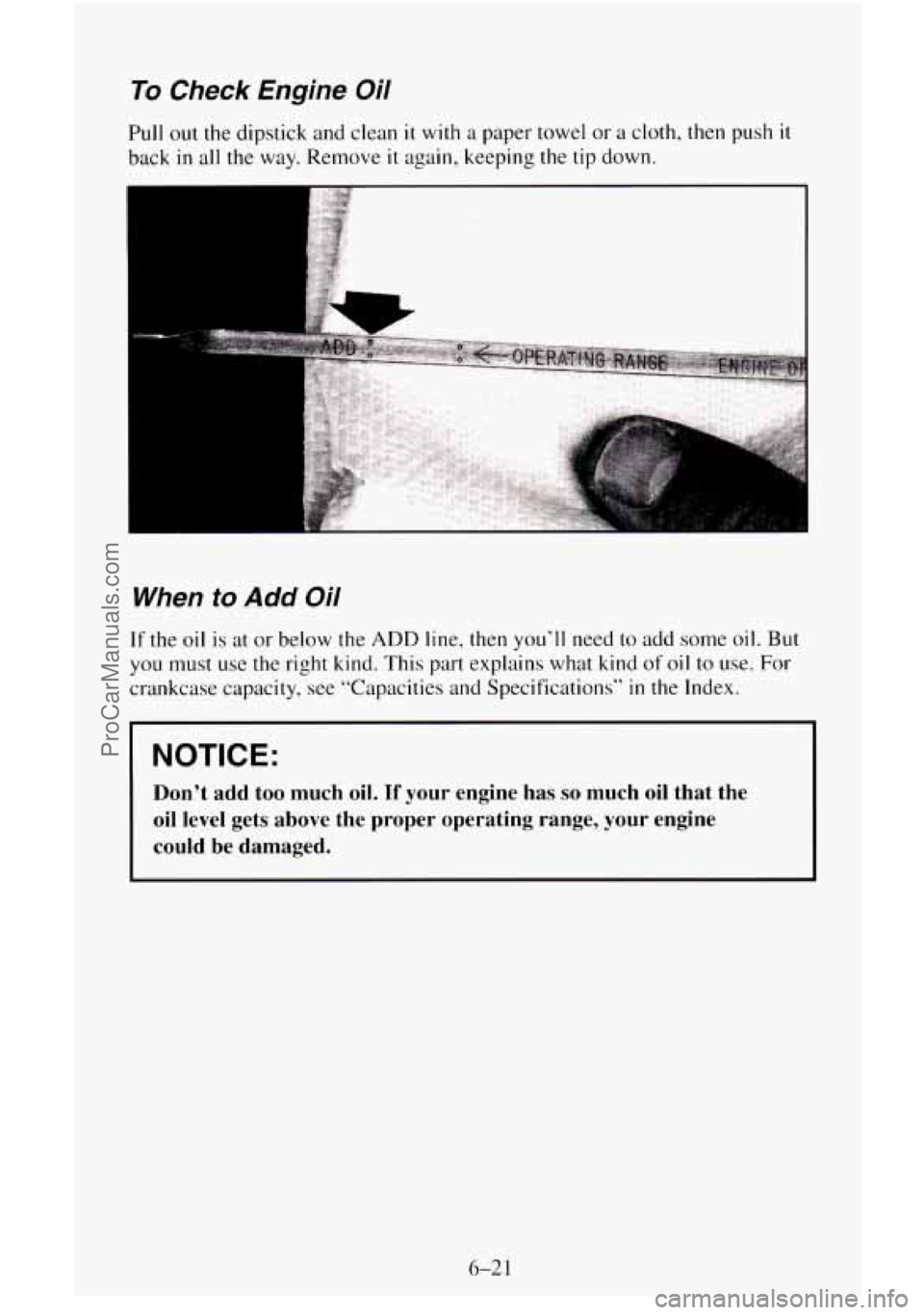
To Check Engine Oil
Pull out the dipstick and clean it with a paper towel or a cloth, then push it
back in all the way. Remove it again, keeping the tip down.
When to Add Oil
If the oil is at or below the ADD line, then you’ll need to add some oil. But
you must use
the right kind. This part explains what kind of oil to use. For
crankcase capacity, see “Capacities and Specifications” in the Index.
NOTICE:
Don’t add too much oil. If your engine has so much oil that the
oil level gets above the proper operating range, your engine
could be damaged.
6-21
ProCarManuals.com
Page 299 of 486
The engine oil filler cap is located on a filler tube at the front of the engine.
Just fill
it enough to put the level somewhere in the proper operating range.
Push the dipstick
all the way back in when you’re through.
Whaf Kind of Oil to Use
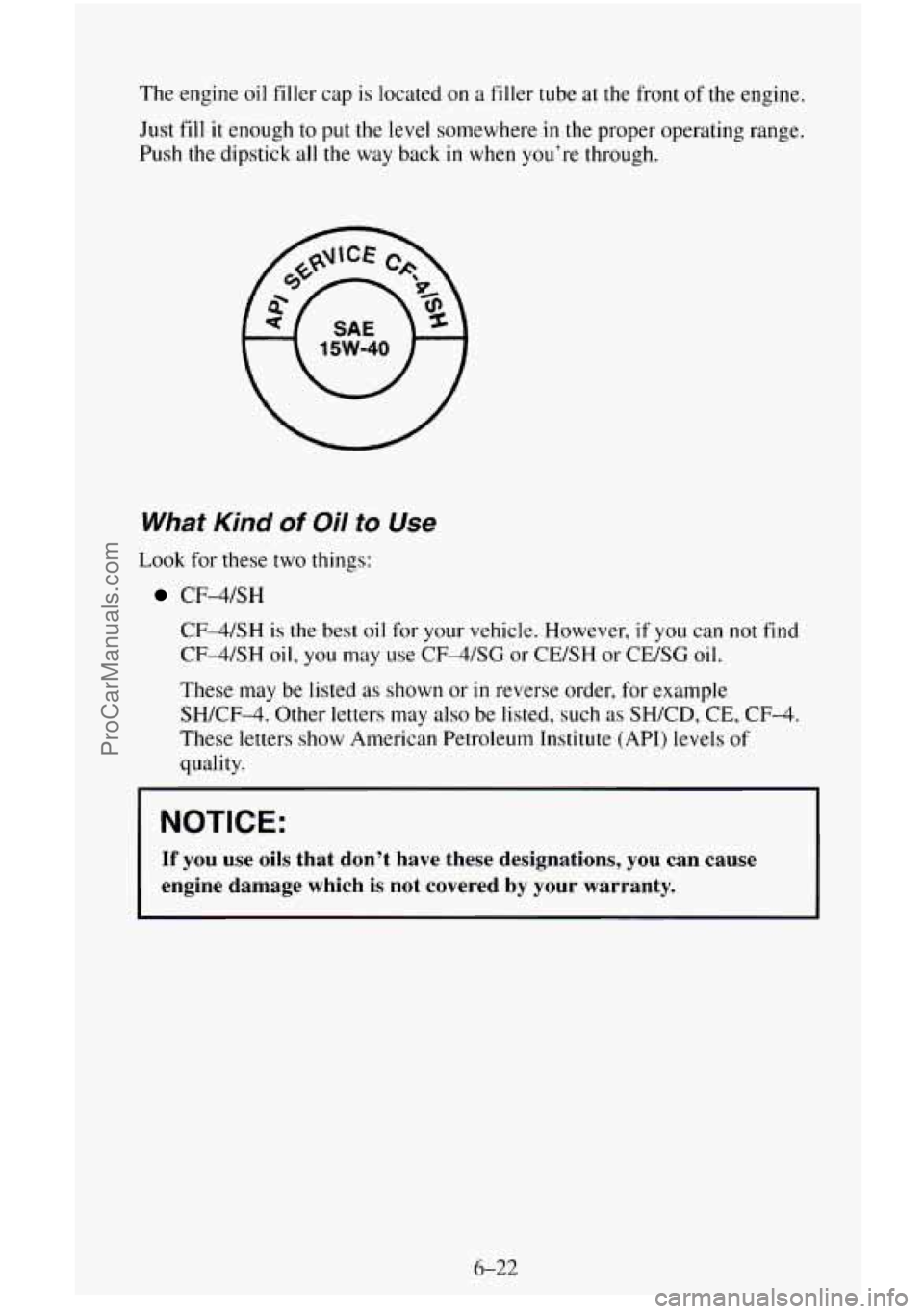
Look for these two things:
CF-LC/SH
CF-4/SH is the best oil for your vehicle. However, if you can not find
CF-4/SH oil, you may use CF-4/SG or CE/SH or CE/SG oil.
These may be listed as shown or in reverse order, for example
SHKF-4. Other letters may also be listed, such as SH/CD, CE, CF-4.
These letters show American Petroleum Institute
(API) levels of
quality.
NOTICE:
If you use oils that don’t have these designations, you can cause
engine damage which is not covered
by your warranty.
6-22
ProCarManuals.com
Page 303 of 486
To remove the air cleaner filter on a gasoline engine or a 6.5 liter naturally
aspirated diesel engine, turn the wing nuts
to the left. Remove the cover and
change
the filter.
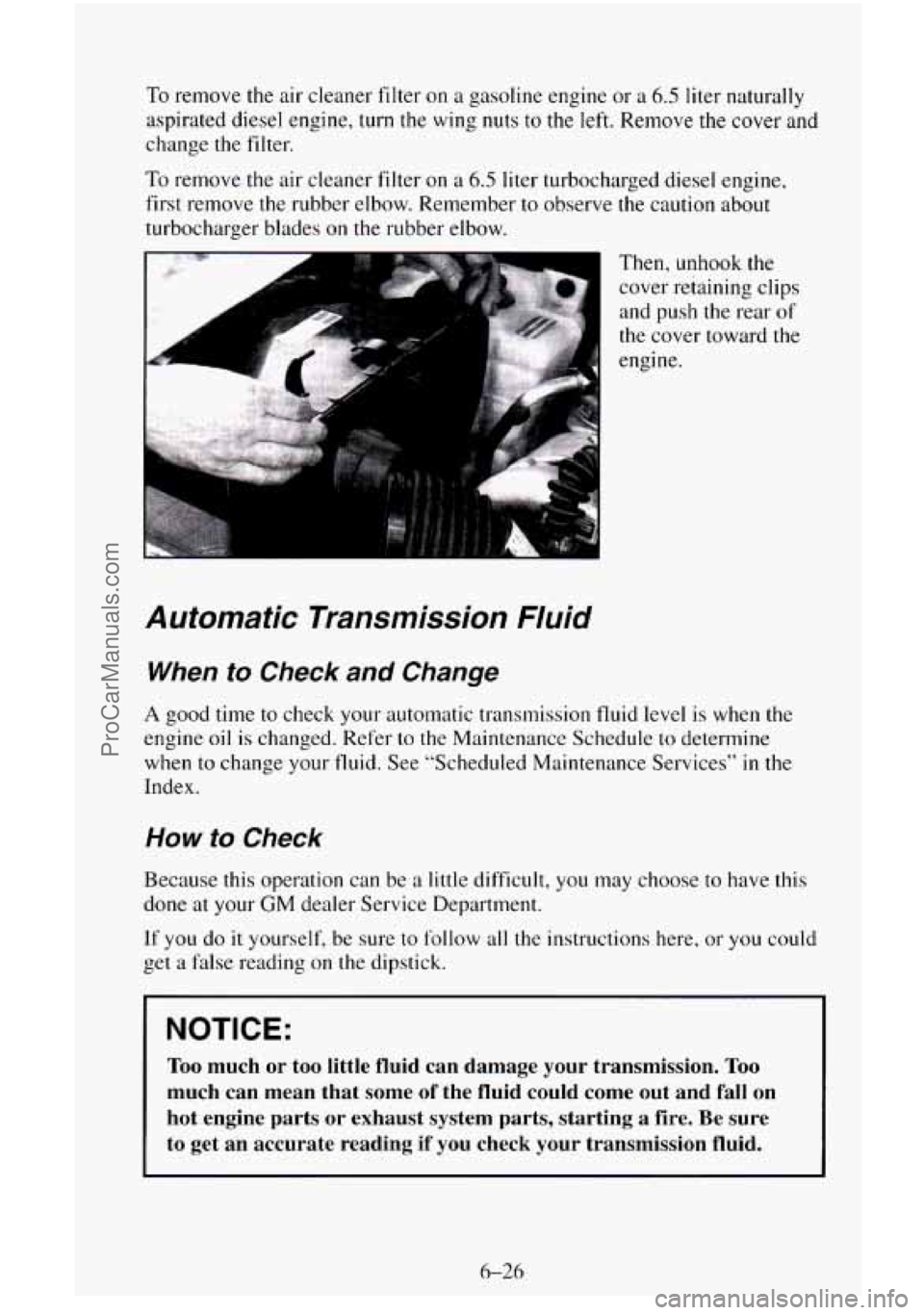
To remove the air cleaner filter on a 6.5 liter turbocharged diesel engine,
first remove the rubber elbow. Remember to observe the caution about
turbocharger blades
on the rubber elbow.
Then, unhook the cover retaining clips
and push the rear
of
the cover toward the
engine.
Automatic Transmission Nuid
When to Check and Change
A good time to check your automatic transmission fluid level is when the
engine
oil is changed. Refer to the Maintenance Schedule to determine
when to change your
fluid. See “Scheduled Maintenance Services” in the
Index.
How to Check
Because this operation can be a little difficult, you may choose to have this
done
at your GM dealer Service Department.
If you do
it yourself, be sure to follow all the instructions here, or you could
get a false reading on the dipstick.
NOTICE:
Too much or too little fluid can damage your transmission. Too
much can mean that some of the fluid could come out and fall on
hot engine parts or exhaust system parts, starting a fire. Be \
sure
to get an accurate reading
if you check your transmission fluid.
6-26
ProCarManuals.com
Page 306 of 486
How to Add Fluid
Refer to the Maintenance Schedule to determine what kind of transmission
fluid to use. See “Recommended Fluids and Lubricants”
in the Index.
Add fluid only after checking the transmission fluid HOT.
(A COLD check
is used
only as a reference.) If the fluid level is low, add only enough of the
proper fluid to bring the level up to the HOT area for a
hot check. It doesn’t
take much fluid, generally less than a
int. Don 7 overfill. We recommend
you
use only fluid labeled DEXRON -111, because fluid with that label is
made especially for your automatic transmission. Damage caused by fluid
other than DEXRON@-111
is not covered by your new vehicle warranty.
8
After adding fluid, recheck the fluid level as described under “How to
Check.”
When the correct fluid level is obtained, push the dipstick back in all
the way; then flip
the handle down to lock the dipstick in place.
Manual Transmission Fluid
When to Check
A good time to have it checked is when the engine oil is changed. However,
the fluid
in your manual transmission doesn’t require changing.
How to Check
Because this operation can be a little difficult, you may choose to have this
done at your
GM dealer Service Department.
If you do it yourself, be sure to follow all the instructions here, or you could
get a false reading.
I NOTICE:
Too much or too little fluid can damage your transmission. Too
much can mean that some of the fluid could come out and fall on
hot engine parts or exhaust system parts, starting a fire.
Be sure
to get an accurate reading if you check your transmission fluid.
Check the fluid level only when your engine is off, the vehicle is parked on
a level place and the transmission is cool enough for you to rest your fingers
on the transmission case.
6-29
ProCarManuals.com
Page 310 of 486
How to Check Lubricant
P
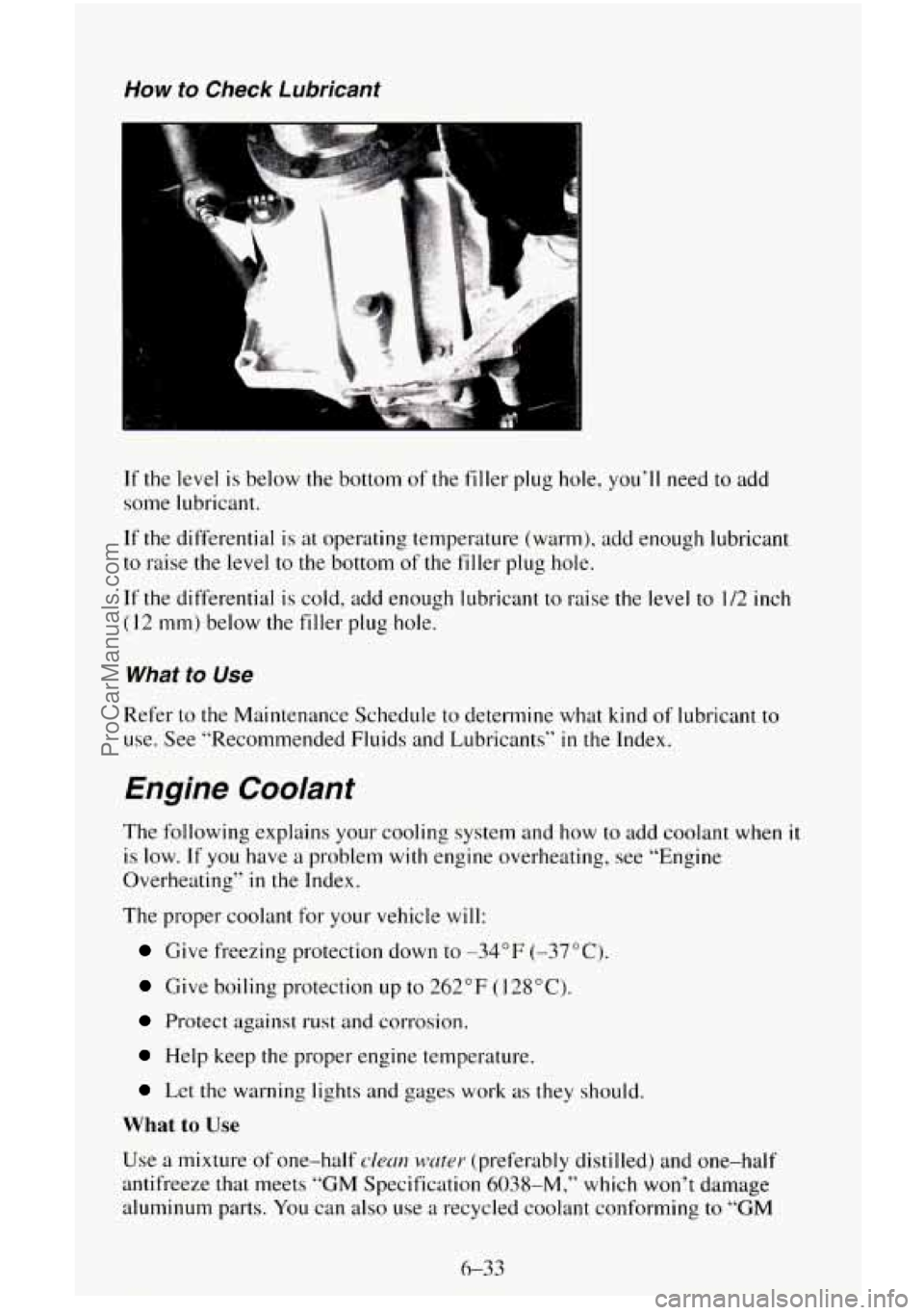
If the level is below the bottom of the filler plug hole, you’ll need to add
some lubricant.
If the differential is at operating temperature (warm), add enough lubricant
to raise the level to the bottom of the filler plug hole.
If the differential is cold, add enough lubricant to raise the level to 1/2 inch
(I 2 mm) below the filler plug hole.
What to Use
Refer to the Maintenance Schedule to determine what kind of lubricant to
use. See “Recommended Fluids and Lubricants” in the Index.
Engine Coolant
The following explains your cooling system and how to add coolant when it
is low. If you have a problem with engine overheating, see “Engine
Overheating”
in the Index.
The proper coolant for your vehicle will:
Give freezing protection down to -34°F (-37°C).
Give boiling protection up to 262°F (128°C).
Protect against rust and corrosion.
Help keep the proper engine temperature.
Let the warning lights and gages work as they should.
What to Use
Use a mixture of one-half chi? wcmr (preferably distilled) and one-half
antifreeze that meets
“GM Specification 6038-M,” which won’t damage
aluminum parts.
You can also use a recycled coolant conforming to “GM
6-33
ProCarManuals.com
Page 319 of 486
To Check Brake Fluid
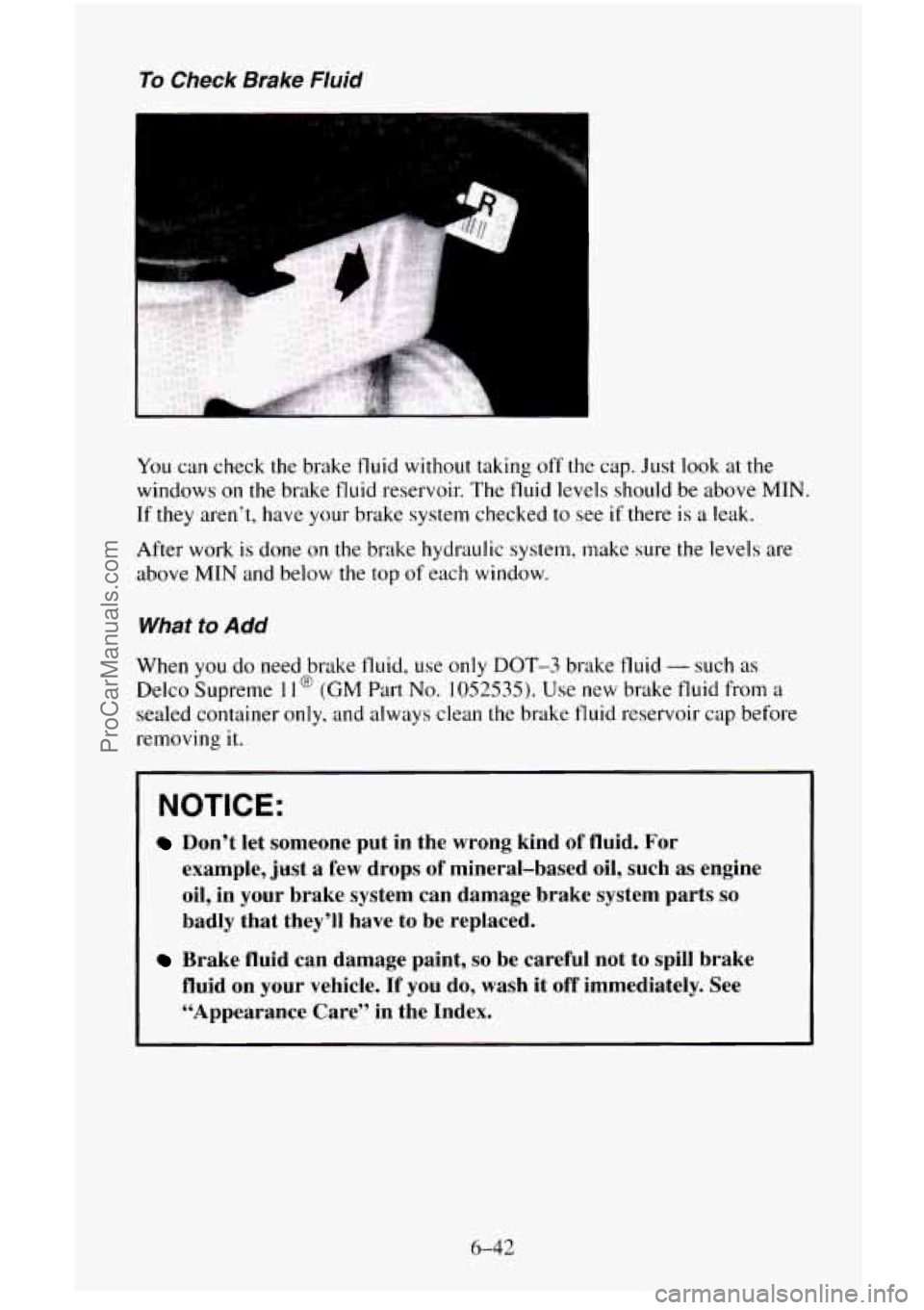
You can check the brake fluid without taking off the cap. Just look at the
windows
on the brake fluid reservoir. The fluid levels should be above MIN.
If
they aren’t, have your brake system checked to see if there is a leak.
After work
is done on the brake hydraulic system, make sure the levels are
above
MIN and below the top of each window.
What to Add
When you do need brake fluid, use only DOT-3 brake fluid - such as
Delco Supreme 1 1 @ (GM Part No. 1052535). Use new brake fluid from a
sealed container only, and always clean the brake fluid reservoir cap before
removing it.
NOTICE:
Don’t let someone put in the wrong kind of fluid. For
example, just a few drops of mineral-based oil, such
as engine
oil, in your brake system can damage brake system parts so
badly that they’ll have to be replaced.
Brake fluid can damage paint, so be careful not to spill brake
fluid on your vehicle. If you do, wash it off immediately. See
“Appearance Care” in the Index.
6-42
ProCarManuals.com
Page 355 of 486
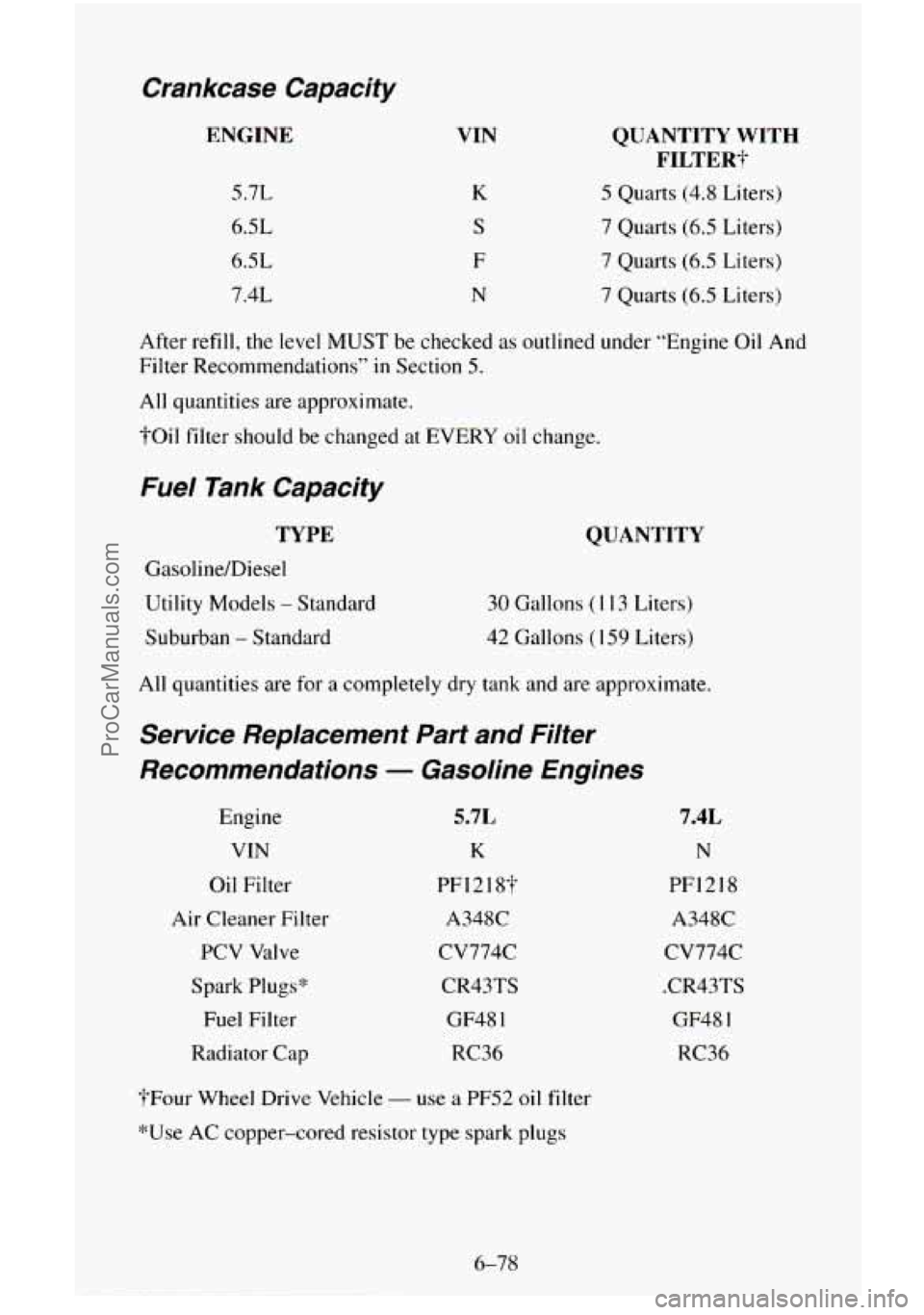
Crankcase Capacity
ENGINE
5.7L
6.5L
6.5L
7.4L
VIN
K
S
F
N
QUANTITY WITH
FILTER?
5 Quarts (4.8 Liters)
7 Quarts (6.5 Liters)
7 Quarts (6.5 Liters)
7 Quarts (6.5 Liters)
After refill, the level
MUST be checked as outlined under “Engine Oil And
Filter Recommendations”
in Section 5.
All quantities are approximate.
?Oil filter should be changed at EVERY oil change.
Fuel Tank Capacity
TYPE
Gasoline/Diesel
Utility Models - Standard
Suburban
- Standard
QUANTITY
30 Gallons ( I 1 3 Liters)
42 Gallons
( I59 Liters)
All quantities are for a completely dry tank and are approximate.
Service Replacement Part and Filter
Recommendations
- Gasoline Engines
Engine
VIN
Oil Filter
Air Cleaner Filter
PCV Valve
Spark Plugs”
Fuel Filter
Radiator Cap
5.7L
K
PF1218T A348C
cv774c
CR43TS
GF48 1
RC36
?Four Wheel Drive Vehicle
- use a PF52 oil filter
*Use AC copper-cored resistor type spark plugs
7.4L
N
PF1218
A348C
cv774c
.CR43TS GF48
1
RC36
ProCarManuals.com
Page 364 of 486
Scheduled Maintenance Services
IMPORTANT:
KEEP ENGINE OIL
AT THE PROPER
LEVELAND CHANGE
AS RECOMMENDED
Section
7
This section covers the maintenance required for your vehicle. Your vehicle
needs these services
to retain its safety, dependability and emission control
performance.
GM -
lo
Protection
Have you purchased the GM Protection Plun? The Plun supplements your
new vehicle warranties. See your GM dealer for detui1.s.
Introduction
Your Vehicle and the Environment
Proper vehicle maintenance not only helps to keep your vehicle in good
working condition, but also helps
the environment. All recommended
maintenance procedures are important. Improper vehicle maintenance or the
removal
of important components can significantly affect the quality of the
air we breathe. Improper fluid levels or even
the wrong tire inflation can
increase the level
of emissions from your vehicle. To help protect our
environment, and
to help keep your vehicle in good condition, please
maintain your vehicle properly.
7- 1
ProCarManuals.com