1996 CHEVROLET S10 check engine light
[x] Cancel search: check engine lightPage 165 of 375
Downloaded from www.Manualslib.com manuals search engine Once you are moving on the freeway, make certain you
allow
a reasonable following distance. Expect to move
slightly slower
at night.
When you want to leave the freeway, move to the proper
lane well in advance.
If you miss your exit, do not,
under any circumstances, stop and back
up. Drive on to
the
next exit.
The exit ramp can be curved, sometimes quite sharply.
The exit speed is usually posted.
Reduce your speed according to your speedometer, ‘not
to your sense of motion. After driving for
any distance
at higher speeds, you may tend to think you are going
slower than
you actually are.
Before Leaving on a Long Trip
Make sure you’re ready. Try to be well rested. If you
must start when you’re not fresh
-- such as after a day’s
work
-- don’t plan to make too many miles that first part
of the journey. Wear comfortable clothing and shoes you
can easily drive in.
Is your vehicle ready for a long trip? If you keep it
serviced and maintained,
it’s ready to go. If it needs
service, have it done before starting out. Of course,
you’ll find experienced and able service experts in
GM
dealers all across North America. They’ll be ready and
willing to help
if you need it.
Here are some things you can check before
a trip:
0
0
0
0
0
0
0
Windshield Washer Fluid: Is the reservoir full?
Are all windows clean inside and outside?
Wiper Blades: Are they in good shape?
Fuel, Engine Oil, Other Fluids: Have you checked
all levels?
Lamps: Are they all working? Are the lenses clean?
Tires: They are vitally important to a safe,
trouble-free trip.
Is the tread good enough for
long-distance driving? Are the tires all inflated to the
recommended pressure?
Weather Forecasts: What’s the weather outlook
along your route? Should you delay your trip a short
time to avoid a major storm system?
Maps: Do you have up-to-date maps?
4-34
Page 171 of 375
Downloaded from www.Manualslib.com manuals search engine -
Snow can trap exhaust gases under your vehicle.
This can cause deadly
CO (carbon monoxide) gas
to get inside.
CO could overcome you and kill
you. You can’t see it
or smell it, so you might not
know it is in your vehicle. Clear away snow from
around the base of your vehicle, especially any
that
is blocking your exhaust pipe. And check
around again from time to time to be sure snow
doesn’t collect there.
Open a window just a little on the side
of the
vehicle that’s away from the wind. This will help
keep
CO out.
Run your engine only as long as you must. This saves
fuel. When you
run the engine, make it go a little faster
than just idle. That
is, push the accelerator slightly. This
uses less fuel for the heat that you get and
it keeps the
battery charged.
You will need a well-charged battery to
restart the vehicle, and possibly for signaling later
on
with your headlamps. Let the heater run for awhile.
Then, shut the engine off and close the window almost
all the way
to preserve the heat. Start the engine again
and repeat this only when you feel really uncomfortable
from the cold.
But do it as little as possible. Preserve the
fuel as long as you can.
To help keep warm, you can get
out of the vehicle and
do some fairly vigorous exercises
every
half hour or so until help comes.
4-40
Page 187 of 375
Downloaded from www.Manualslib.com manuals search engine When You Are Ready to Leave After
Parking on a Hill
1. Apply your regular brakes and hold the pedal down
while
you:
Start your engine;
0 Shift into a gear; and
0 Release the parking brake.
2. Let up on the brake pedal.
3. Drive slowly until the trailer is clear of the chocks.
4. Stop and have someone pick up and store the chocks.
Maintenance When Trailer Towing
Your vehicle will need service more often when you’re
pulling a trailer. See the Maintenance Schedule for more
on this. Things that are especially important in trailer
operation are automatic transmission fluid (don’t
overfill), engine oil, axle lubricant, belt, cooling system
and brake adjustment. Each
of these is covered in this
manual, and the Index will help
you find them quickly.
If you’re trailering, it’s
a good idea to review these
sections before you start your trip.
Check periodically to see that all hitch nuts and bolts
are tight.
Trailer Wiring Harness
The eight-wire harness is stored under your vehicle
along
the rear frame crossmember. This harness has a
30-amp feed wire with an inline fuse located in the
instrument panel fuse block and no connector. It should
be wired by a qualified electrical technician. The
technician can use
the following color code chart when
connecting the wiring harness to your trailer.
0 DARK BLUE: Use for electric trailer brakes or
0 RED: Use for battery charging; it connects to the
LIGHT GREEN: Back-up lamps.
0 BROWN: Taillamps and parking lamps.
0 YELLOW Left stoplamp and turn signal.
0 DARK GREEN: Right stoplamp and turn signal.
0 WHITE (Heavy Gage): Ground wire.
0 WHITE (Light Gage): Auxiliary stoplamp.
Securely attach the harness to the trailer, then tape or
strap it to your vehicle’s frame rail. Be sure
you leave
it loose enough
so the wiring doesn’t bend or break,
but not so
loose that it drags on the ground. Store the
harness in its original place. Wrap the harness together
and tie
it neatly so it won’t be damaged.
auxiliary wiring.
starter solenoid.
4-56
Page 193 of 375
Downloaded from www.Manualslib.com manuals search engine 4. Open the hoods and locate the batteries. Find
the positive
(+) and negative (-) terminals on
each battery.
1 A CAUTION:
---
Using a match near a battery can cause battery
gas to explode. People have been hurt doing this,
and some have been blinded. Use
a flashlight if
you need more light.
Be sure the battery has enough water. You don’t
need to add water to the Delco Freedom@ battery
installed in every new
GM vehicle. But if a
battery has filler caps, be sure the right amount
of fluid is there. If it is low, add water to take
care
of that first. If you don’t, explosive gas could
be present.
Battery fluid contains acid that can burn you.
Don’t get it on
you. If you accidentally get it in
your eyes or on your skin, flush the place with
water and get medical help immediately.
5. Check that the jumper cables don’t have loose or
missing insulation.
If they do, you could get a shock.
The vehicles could be damaged too.
Before you connect the cables,
here are some basic
things you should know. Positive
(+) will go to
positive
(+) and negative (-) will go to negative (-)
or a metal engine part. Don’t connect positive (+) to
negative
(-) or you’ll get a short that would damage
the battery and maybe other parts
too.
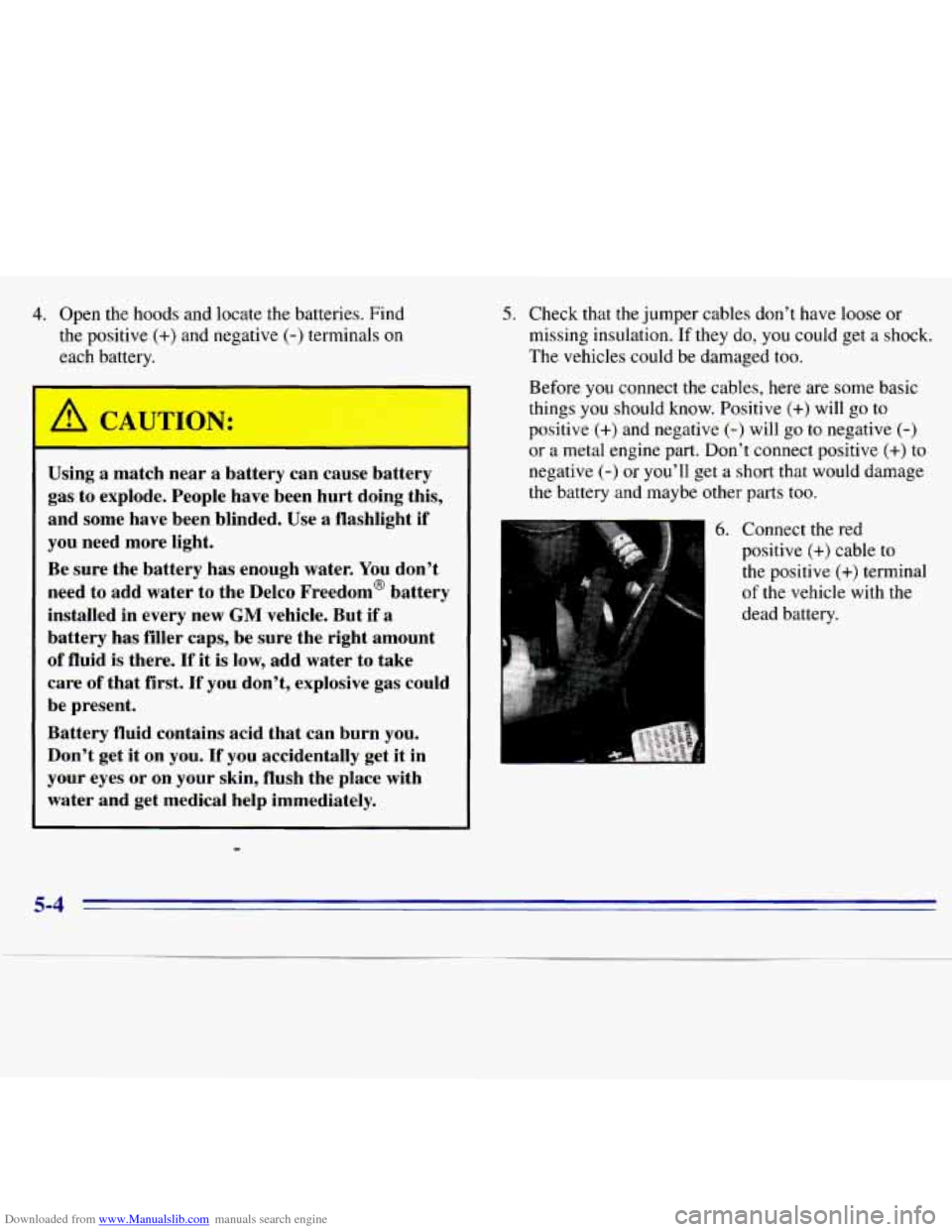
6. Connect the red
positive
(+) cable to
the positive
(+) terminal
of the vehicle with the
5-4
Page 246 of 375
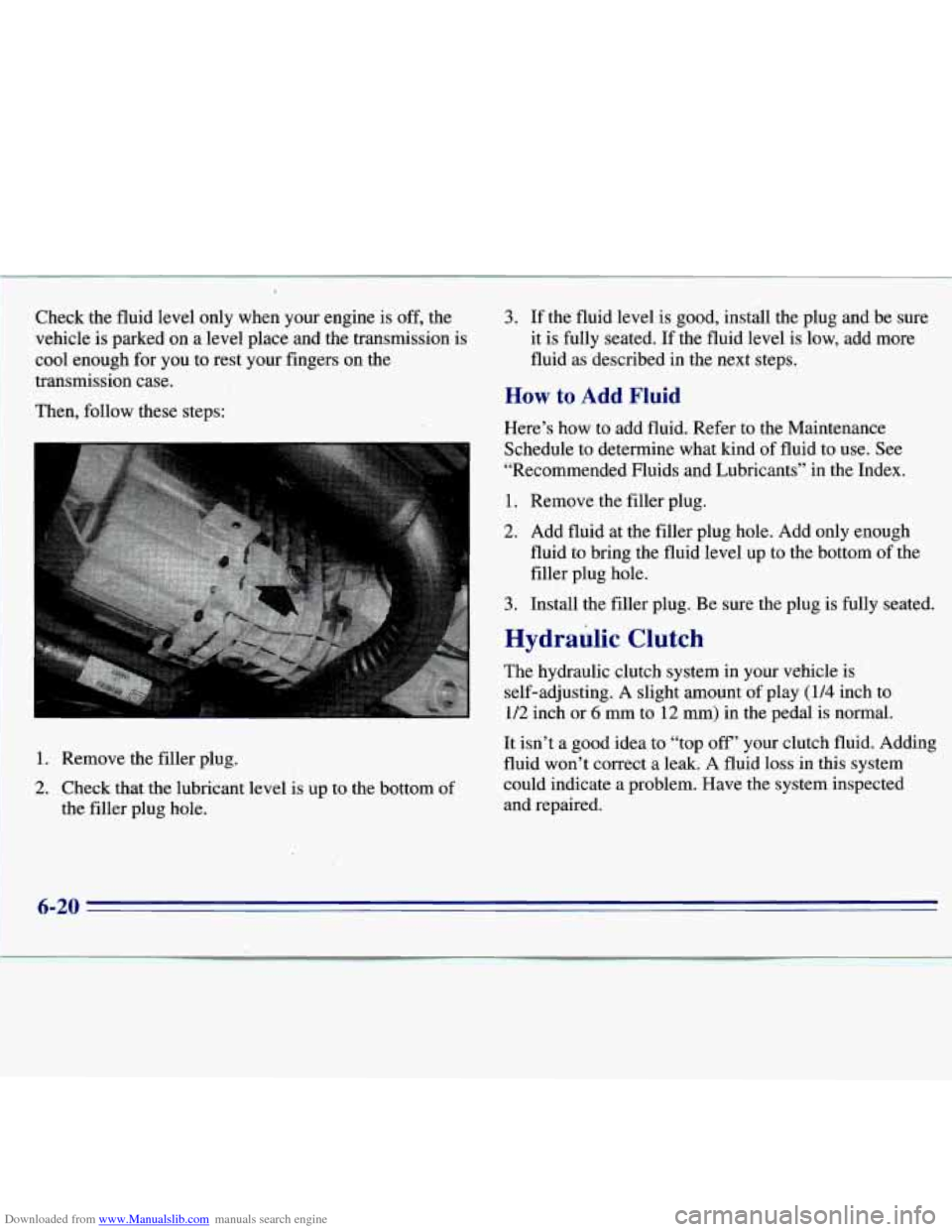
Downloaded from www.Manualslib.com manuals search engine Check the fluid level only when your engine is off, the
vehicle is parked on a level place and the transmission is
cool enough for you to rest your fingers on the
transmission case.
Then, follow these steps: 3. If the fluid level is good, install the plug and be sure
it is fully seated. If the fluid level is low, add more
fluid as described in the next steps.
How to Add Fluid
Here’s how to add fluid. Refer to the Maintenance
Schedule to determine what kind of fluid to use. See
“Recommended Fluids and Lubricants” in the Index.
1. Remove the filler plug.
2. Add fluid at the filler plug. hole. Add only enough
fluid to bring the fluid level up to the bottom of the
filler plug hole.
3. Install the filler plug. Be sure the plug is fully seated.
Hydraulic Clutch -
The hydraulic clutch system in your vehicle is
self-adjusting.
A slight amount of play (1/4 inch to
1/2 inch or 6 mm to 12 mm) in the pedal is normal.
1. Remove the filler plug.
2. Check that the lubricant level is up to the bottom of
the filler plug hole. It isn’t a
good idea to “top
off’ your clutch fluid. Adding
fluid won’t correct a leak. A fluid
loss in this system
could indicate a problem. Have the system inspected
and repaired.
6-20 I
Page 344 of 375
Downloaded from www.Manualslib.com manuals search engine At Least Twice a Year
Restraint System Check
Make sure the safety belt reminder light and all your
belts, buckles, latch plates, retractors and anchorages are
working properly. Look for any other loose or damaged
safety belt system parts. If you see anything that might
keep a safety belt system from doing its job, have it
repaired. Have any torn or frayed safety belts replaced.
Also look for any opened or broken air bag covers, and
have them repaired
or replaced. (The air bag system
does not need regular maintenance.)
Manual Transmission Check
Check the transmission fluid level; add if needed. See
“Manual Transmission” in the Index. A fluid
loss may
indicate a problem. Check the system and repair if needed.
Automatic Transmission Check
Check the transmission fluid level; add if needed. See
“Automatic Transmission” in the Index.
A fluid loss may
indicate a problem. Check the system and repair if needed.
Hydraulic Clutch System Check
At Least Four Times a Year
Tailgate Lubrication Service
Lubricate tailgate latch bolt, handle assembly pivot
points, and hinges with lubricant recommended in
Part
D. Lubricate every 3,000 miles (5 000 km) if
following schedule I or every
7,500 miles (12 500 km)
if following schedule 11.
At Least Once a Year
Key Lock Cylinders Service
Lubricate the key lock cylinders with the lubricant
specified in Part
D.
Body Lubrication Service
Lubricate all body door and fuel door hinges, latches
and locks including the glove box, console doors and the
body hood, and any moving seat hardware. Lubricate
the hood safety lever pivot and prop rod pivot. Part
D
tells you what to use. More frequent lubrication may be
required when exposed to a corrosive environment.
Check the fluid level in the clutch reservoir. See
“Hydraulic Clutch Fluid” in the Index.
A fluid loss in
this system could indicate a problem. Have the system
inspected and repaired at once.
7-48
Page 365 of 375
Downloaded from www.Manualslib.com manuals search engine Section 9 Index
Accessory Power Outlet ......................... 2-47
Adding Sound Equipment
........................ 3- 17
Add-on Equipment
............................. 4-44
AirBag
....................................... 1-18
Adding Equipment ............................ 1-24
How Does
it Restrain .......................... 1-21
How
it Works ................................ 1-20
Location
.................................... 1-20
Readiness Light
......................... 1-1 9. 2.54
Servicing
................................... 1-23
What Makes
it Inflate .......................... 1-2 I
What Will You See After it Inflates ............... 1-22
When Should
it Inflate ......................... 1-20
Aircleaner
............................... 6.14. 6.67
Air Conditioning/Heater Controls
................... 3-2
Air Conditioning Refrigerants
..................... 6-68
Alignment and Balance. Tire
...................... 6-50
Aluminum Wheels. Cleaning
...................... 6-58
Antenna. Fixed
................................. 3-18
Anti-Lock Brakes ............................... 4-6
Anti-Lock Brake System Warning Light
......... 2.56. 4.6
Appearancecare
............................... 6-52
Appearance Care Materials
....................... 6-60
Arbitration Program
.............................. 8-7
Armrest. Storage ............................... 2-45
Ashtrays
...................................... 2-46
Audio Systems
.................................. 3-5
Automatic Overdrive
............................ 2-16
Automatic Transmission
Check
...................................... 7-48
Fluid ................................... 6-16. 6-68
Operation
................................... 2-14
Park Mechanism Check
........................ 7-50
Shifting
..................................... 2-14
Front
....................................... 6-23
Rear
.................................. 2.19. 6.21
Axle
Battery
...................................... 6-35
Jump Starting ................................. 5-2
Replacement. Keyless Entry
..................... 2-5
Warnings
.................................... 5-2
BBB Auto Line
................................. 8-7
Better Business Bureau Mediation ................... 8-7
BrakeFluid .................................... 6-31
Brake. Parking
................................. 2-25
Brake System Warning Light
...................... 2-55
ChargeLight
................................ 2-54
9-1
Page 366 of 375
Downloaded from www.Manualslib.com manuals search engine I
Brakes Adjustment ........... ....................... '6-34
qMager Cylinder ............................... 6-31 Anti-Lock .................................... 4-6
Pedal Travel- ................................. 6-34
Replading System Parts ......................... 6-34
Trailer 4-52
Wear ....................................... 6-33
Brake-Transmission' Shift Interlock Check ........... 7-49
Braking ......................................... 4-5
......................................
BTaking in Emergencies ........................... 4-8
Break-In, New Vehicle ............................ 2-8
BTSI Check .................................... 7-49
Bulb Replacement .......................... 6-35., 6-66
Brightness Control ............................. ; 2-42
Canadian Roadside Assistance .................... 8-6
Capacities and Specifications ................. 6-66. 6-68
Cassette Tape Player ......................... 3.7. 3.9
Center High-Mounted Stoplamp Bulb Replacement .... 6-39
Center Passenger Position ........................ 1-25
Certif?cation/Tire Label ............... , ........... 4-42
Chains
Carbon Manoxide .......................... 2.30. 4.40
Care ....................................... 3-18
Safety ...................................... 4-51
Tire ......................................... 6-52 Changing a Flat Tire ............................. 5-22
Charging System Light .......................... 2-54
Check Gages Light ' ' ... ' .. 2-62 ............... ..........
Checking Your Restraint Systems .................... 1-38 Chemical Paint Spotting .......................... 6-59
ChiSd-ReStraints ........................... 1 .... 1-30
Securing in the Center Seat Position (Except W40) . . 1-31
Securing in the Right FTont Seat Position .......... 1-33
Where Not to Put
Top
Strap
................................... : 1-30.
......................... 1-32. 1-33
Cleaner, Air .............................. 6-14, 6-67
Aluminum Wheels ............................ 6-58
Inside of Your Vehicle ......................... 6-53
.
Cigarette Lighter ................................ 2-46
Circuit Breakers and Fuses ......................... 6-63
Cleaning
Fabric
........................................ 6-53
Glass 6-56
Instrument Panel ................ .'. ....... 1 ... 6-55
Leather .................. : ..................... 6-55
Outside of Your Vehicle' ........................ 6-57
Safety Belts ................................... 6-56
Stains ...................................... 6-54
Tires 6-58
.Vinyl ....................................... 6-55
Weatherstrips .................... : ............ 6-56
.......................................
........................................
Wheels ...................................... 6-58
Windshield and Wiper Blades ................... 6-56
Climate Control System ........................... 3-1
Clock, Setting ................................... 3-5
Comfort Controls ................................ 3-1 Clutch, Hydraulic ................................ 6-20
Compact Disc Care ......... I. .................... 3-18
9-2