1996 CHEVROLET S10 mirror
[x] Cancel search: mirrorPage 164 of 375
Downloaded from www.Manualslib.com manuals search engine Freeway Driving
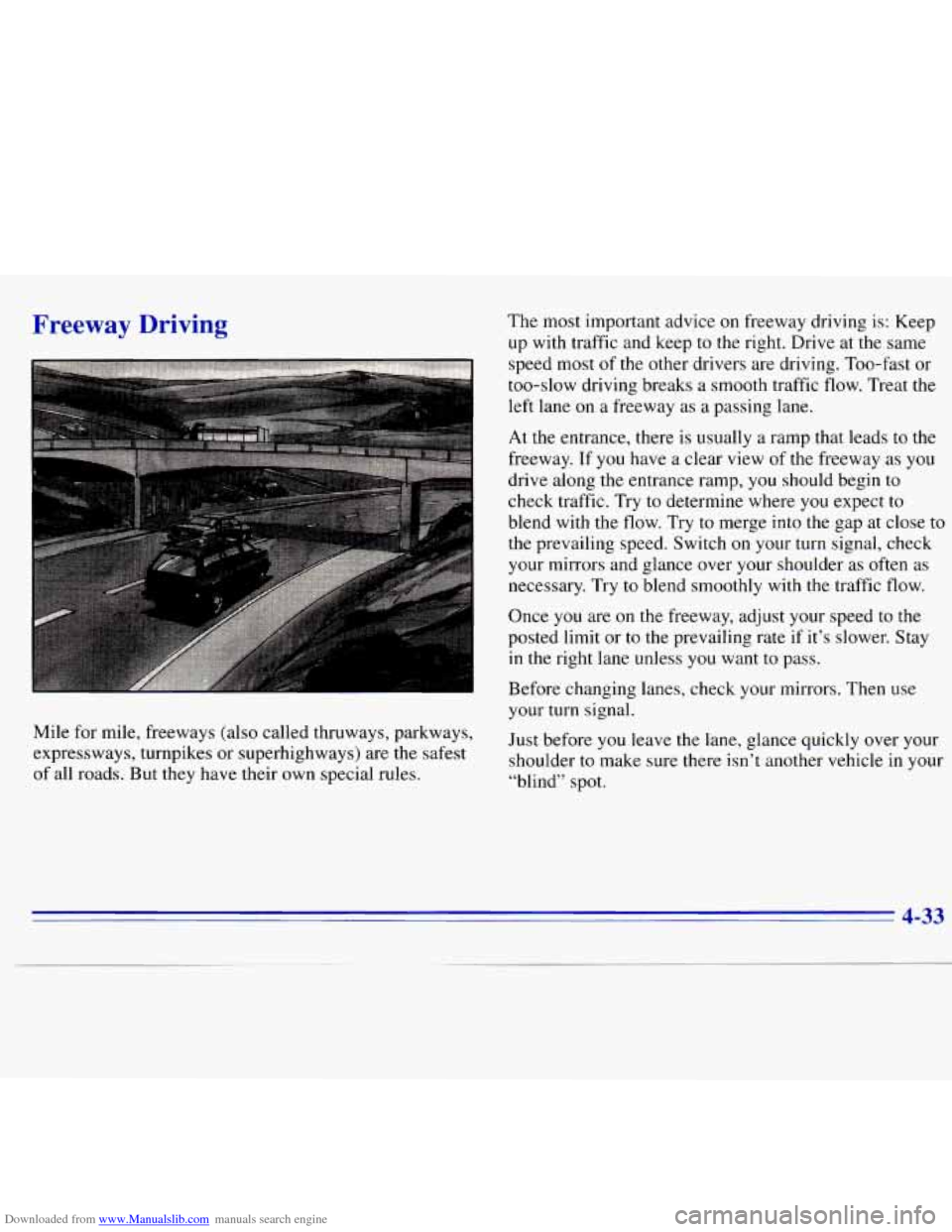
Mile for mile, freeways (also called thruways, parkways,
expressways, turnpikes or superhighways) are the safest
of all roads. But they have their own special rules. The
most important advice
on freeway driving is: Keep
up with traffic and keep to the right. Drive at the same
speed most
of the other drivers are driving. Too-fast or
too-slow driving breaks a smooth traffic flow. Treat
the
left lane on a freeway as a passing lane.
At the entrance, there is usually
a ramp that leads to the
freeway. If
you have a clear view of the freeway as you
drive along the entrance ramp, you should begin to
check traffic. Try to determine where
you expect to
blend with the flow. Try
to merge into the gap at close to
the prevailing speed. Switch on your turn signal, check
your mirrors and glance over your shoulder as often as
necessary. Try to blend smoothly with
the traffic flow.
Once you are on
the freeway, adjust your speed to the
posted limit or to the prevailing rate if it’s slower. Stay
in the right lane unless you want to pass.
Before changing lanes, check your mirrors. Then use
your turn signal.
Just before you leave the lane, glance quickly over your
shoulder
to make sure there isn’t another vehicle in your
“blind” spot.
4-33
Page 166 of 375
Downloaded from www.Manualslib.com manuals search engine Highway Hypnosis
Is there actually such a condition as “highway
hypnosis”?
Or is it just plain falling asleep at the wheel?
Call it highway hypnosis, lack of awareness, or
whatever.
There
is something about an easy stretch of road with the
same scenery, along with the hum of the tires
on the road,
the drone
of the engine, and the rush of the wind against
the
vehicle that can make you sleepy. Don’t let it happen
to
you! If it does, your vehicle can leave the road in less
than a second, and you could crash and be injured.
What can you do about highway hypnosis? First, be
aware that
it can happen.
Then here are some tips:
Make sure your vehicle is well ventilated, with a
comfortably cool interior.
Keep your eyes moving. Scan the road ahead and
to the sides. Check your mirrors and your
instruments frequently.
0 If you get sleepy, pull off the road into a rest, service
or parking area and take a nap, get some exercise, or
both. For safety, treat drowsiness
on the highway as
an emergency.
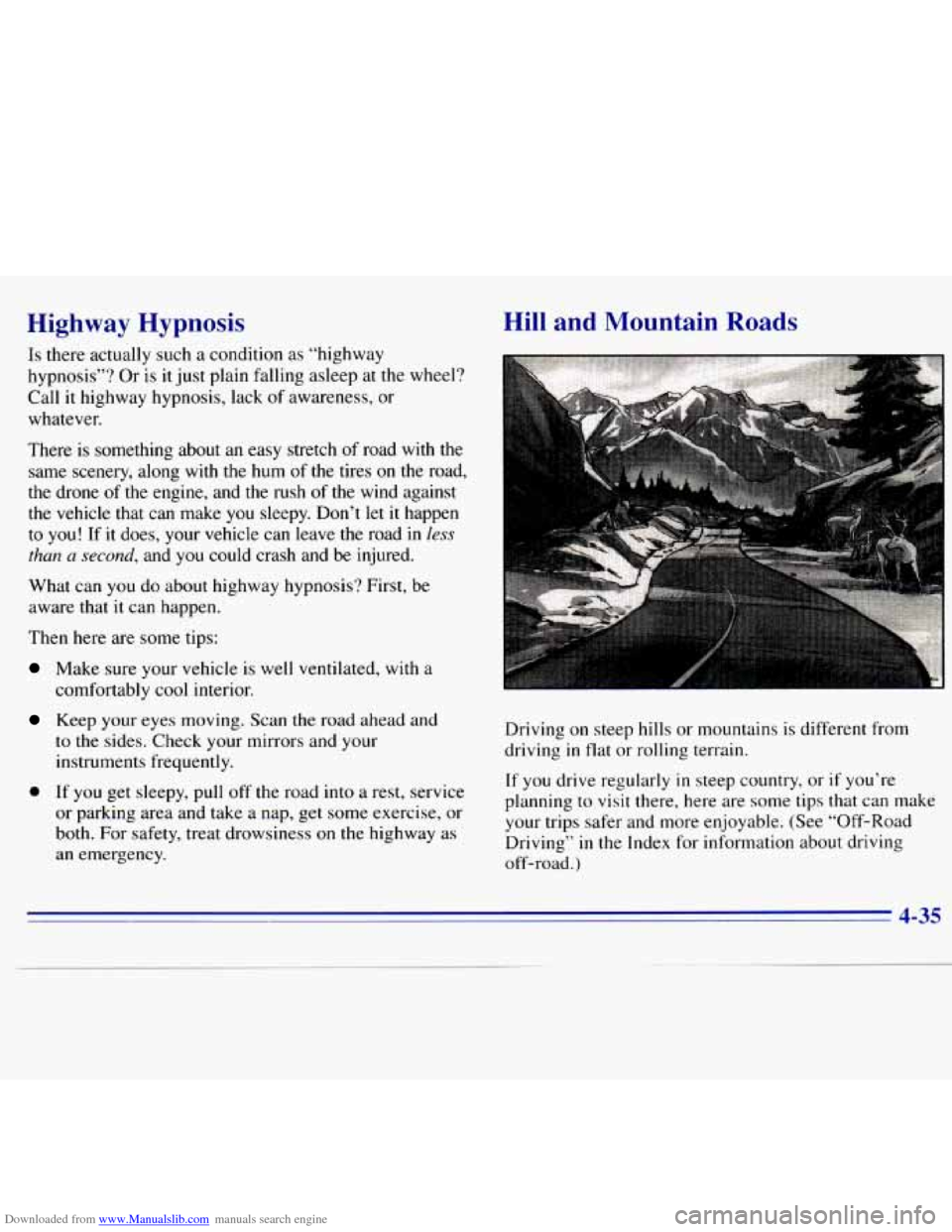
Hill and Mountain Roads
Driving on steep hills or mountains is different from
driving
in flat or rolling terrain.
If you drive regularly in steep country, or if you’re
planning to visit there, here are some tips that can make
your trips safer and more enjoyable. (See “Off-Road
Driving” in the Index for information about driving
off-road.)
4-35
Page 183 of 375
Downloaded from www.Manualslib.com manuals search engine Trailer Brakes
If your trailer weighs more than 1,000 lbs. (450 kg)
loaded, then it needs its own brakes
-- and they must be
adequate. Be sure to read and follow
the instructions for
the trailer brakes
so you’ll be able to install, adjust and
maintain them properly.
Your trailer’s brake system can tap into the vehicle’s
hydraulic brake system only if
a
a
The trailer parts can withstand 3,000 psi
(20 650 kPa) of pressure.
The trailer’s brake system will use less than
0.02 cubic inch (0.3 cc) of fluid from your vehicle’s
master cylinder. Otherwise, both braking systems
won’t work well. You could even lose your brakes.
If everything checks
out this far, then make the brake
fluid tap at the port on the master cylinder that sends
fluid
to the rear brakes. But don’t use copper tubing for
this. If
you do, it will bend and finally break off. Use
steel brake tubing.
Driving with a Trailer
Towing a trailer requires a certain amount of experience.
Before setting
out for the open road, you’ll want to get
to know your rig. Acquaint yourself with the feel of
handling and braking with the added weight of the
trailer. And always keep
in mind that the vehicle you are
driving is now a good deal longer and not nearly
as
responsive as your vehicle is by itself.
Before
you start, check the trailer hitch and platform
(and attachments), safety chains, electrical connector,
lamps, tires and mirror adjustment. If the trailer has
electric brakes, start your vehicle and trailer moving and
then apply the trailer brake controller
by hand to be sure
the brakes are working. This lets
you check your
electrical connection at the same time.
During your trip, check occasionally
to be sure that the
load is secure, and that the lamps and any trailer brakes
are still working.
Page 267 of 375
Downloaded from www.Manualslib.com manuals search engine Underhood Lamp
1. Disconnect the electrical connector from the
underhood lamp assembly.
2. Remove the screws.
3. Disconnect the ground wire.
4. Remove the lamp assembly from the hood.
5. Install the new bulb.
6. Replace the assembly. Install and tighten the screws.
7. Connect the ground wire.
8. Connect the electrical connector to the lamp assembly.
Vanity Mirror Lamps
1.
2.
3.
4.
5.
6.
7.
Insert the blade of a small screwdriver into the center
slot at the bottom of the lens.
Gently pry the screwdriver down in order to lift out
the lens.
Pry out the bulb.
Press the new bulb into place.
Slide the side tabs
of the lens under the side of the
vanity assembly frame.
Rotate the lens downward. Snap the lens into the frame.
6-41
Page 290 of 375

Downloaded from www.Manualslib.com manuals search engine FuseKircuit Usage Breaker
A
B
1
Power Door Locks, Power Seat, Power
Seat Lumbar, Remote Keyless Entry
Power Windows
Stoplamps, Hazard Lamps, Chime,
Center High-Mounted Stoplamp Relay,
Center High-Mounted Stoplamp
3
4
5
6
FuseKircuit Usage
Breaker
2 Dome Lamps, Visor Vanity Mirror,
Cigarette Lighter, Inside Rearview
Mirror Lamp, Overhead Console
Lamps, Glove
Box Lamp, Horns, Horn
Relay, IP Courtesy Lamps, Power
Outside Rearview Mirror, Illuminated
Entry Module
Parking Lamps, License Plate Lamps,
Electric Shift Transfer Case Module,
Underhood Lamp, Ashtray Lamp,
Door Switch Lamp
Alternator Field, A/C Compressor
Relay, Cluster Chime Module, DRL
Relay Coil, Four-Wheel-Drive
Indicator Lamp, DRL Module,
Transfer Case Control Module Ignition, SIR Redundant Ignition,
RKE Ignition
Oxygen Sensor Heater, Exhaust Gas
Recirculation, Cam Sensor, CANN.
Purge, MAS
Blower Motor, Temperature Door
Motor,
HI Blower Relay Coil
6-64
Page 291 of 375

Downloaded from www.Manualslib.com manuals search engine Fuse/Circuit Usage Breaker
7 Power Auxiliary Outlets, Assembly
Line Diagnostic Link
8
9
10
11
12
13
14
15
Not Used
PCMNCM Battery,
ABS Battery, Fuel
Pump (LN2)
PCM/VCM Ignition, Injectors, Crank
Sensor, Coil Driver Module
Radio, Inside Rearview Mirror
Map Lamp
DRAC, Anti-Lock Braking System,
Clock, Radio, Battery,
CD Player
VCM
IGN-3
A/C Compressor Battery Feed
Daytime Running Lamps,
Fog Lamps,
Fog Lamp Relay
Fuse/Circuit Usage Breaker
16
17
19
20 21
22
24 Turn
Signals and Back-up
Lamps, Brake-Transmission
Shift Interlock Solenoid
Windshield Washer, Windshield Wiper Motor
Electric Shift Transfer Case
Crank Signal, Air Bag System
Cluster Illumination,
Radio Illumination, Heater
Lamp, Four- Wheel-Drive
Illumination, Chime Module,
Fog Lamp Illumination
Air Bag System
PRNDL Power, 4L60E Automatic
Transmission
6-65
Page 292 of 375
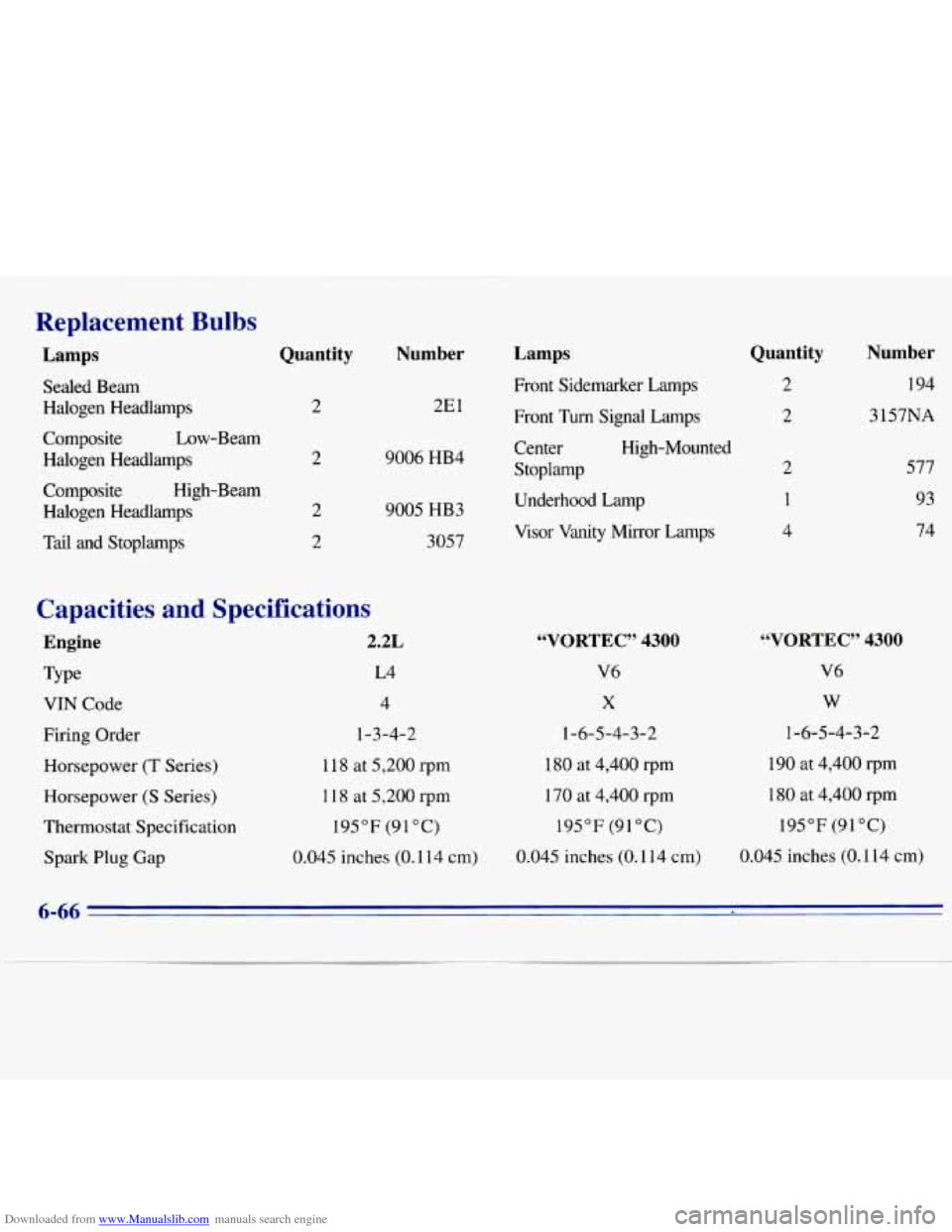
Downloaded from www.Manualslib.com manuals search engine Replacement Bulbs
Lamps
Sealed Beam Halogen Headlamps
Composite Low-Beam
Halogen Headlamps Composite High-Beam
Halogen Headlamps
Tail and Stoplamps
Quantity
2
2
2
2
Number
2El
9006 HB4
9005 HB3 3057
Capacities and Specifications
Type L4
Engine 2.2L
VIN Code 4
Firing Order 1-3-4-2
Horsepower
(T Series) 1 18 at 5,200 rpm
Horsepower
(S Series) 1 18 at 5,200 rpm
Thermostat Specification 195°F (91°C)
Spark
Plug Gap 0.045 inches
(0.1 14 cm)
Lamps
Front Sidemarker Lamps
Front Turn Signal Lamps
Center High-Mounted
Stoplamp
Underhood Lamp
Visor Vanity Mirror Lamps
“VORTEC” 4300
V6
X
1-6-5-4-3-2
180 at 4,400 rpm
170
at 4,400 rpm
195°F (91°C)
0.045 inches (0.114 cm)
Quantity
2
2
Number
194
3 157NA
577 93
74
“VORTEC” 4300
V6
W
1-6-5-4-3-2
190 at 4,400 rpm
180 at 4,400 rpm
195°F (91 “C)
0.045 inches (0.1 14 cm)
6-66
Page 367 of 375
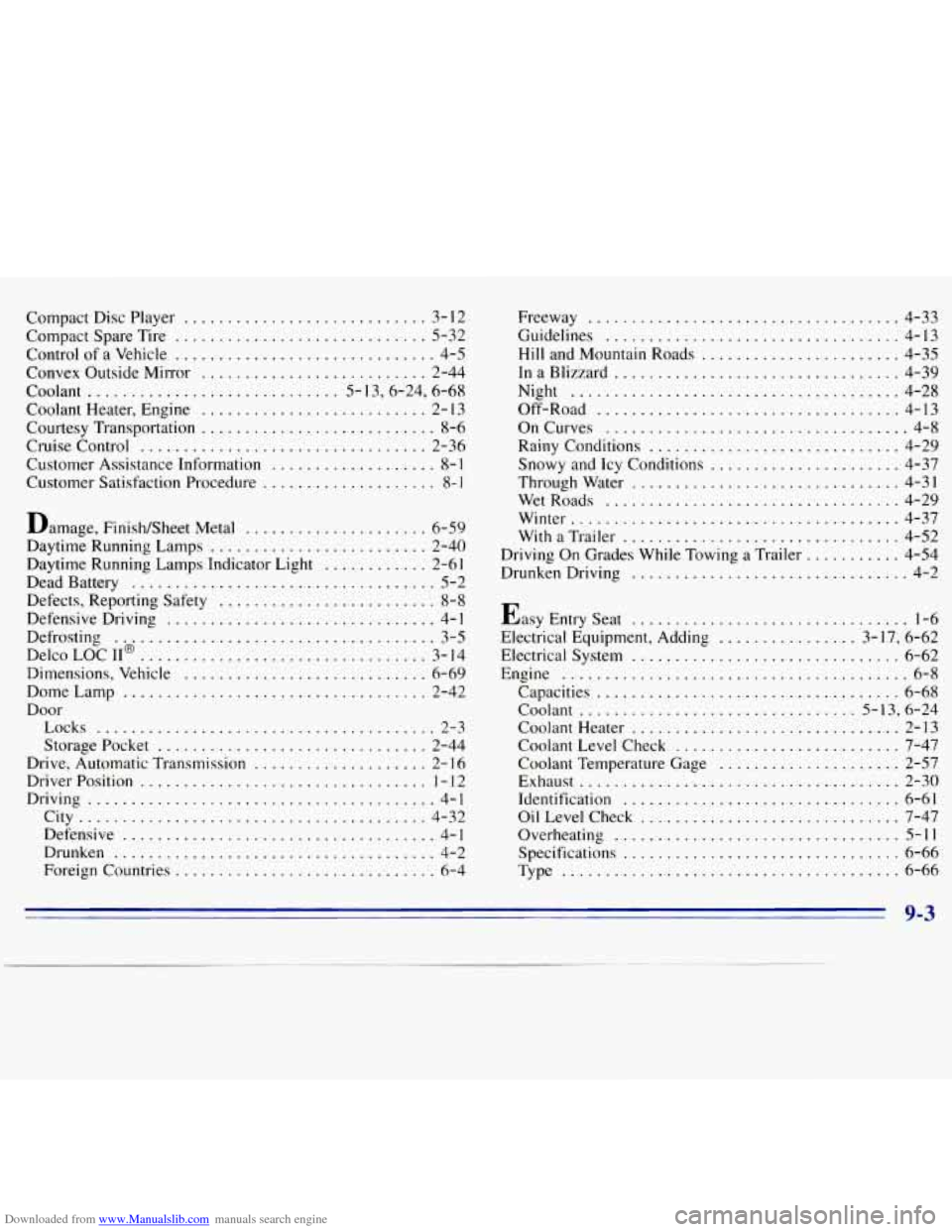
Downloaded from www.Manualslib.com manuals search engine Compact Disc Player ............................ 3- I2
Compact Spare Tire ............................. 5-32
Control of
a Vehicle .............................. 4-5
Convex Outside Mirror
.......................... 2-44
Coolant
............................. 5- 13.6.24. 6.68
Coolant Heater. Engine .......................... 2- I3
Courtesy Transportation ........................... 8-6
Cruise Control ................................. 2-36
Customer Assistance Information
................... 8-1
Customer Satisfaction Procedure .................... 8- 1
Damage. Finish/Sheet Metal ..................... 6-59
Daytime Running Lamps ......................... 2-40
Daytime Running Lamps Indicator Light
............ 2-61
Dead Battery
................................... 5-2
Defects. Reporting Safety ......................... 8-8
Defensive Driving ............................... 4- I
Defrosting .................................... 3-5
Delco LOC 11' ................................. 3- 14
Dimensions. Vehicle
............................ 6-69
DomeLamp ................................... 2-42
Door Locks
....................................... 2-3
StoragePocket
............................... 2-44
Drive. Automatic Transmission
.................... 2- 16
DriverPosition ................................. 1-12
Driving
........................................ 4-1
City ........................................ 4-32
Defensive
.................................... 4-1
Drunken ..................................... 4-2
Foreign Countries
.............................. 6-4 Freeway
.................................... 4-33
Guidelines
.................................. 4-13
Hill and Mountain Roads
....................... 4-35
InaBlizzard
................................. 4-39
Night
...................................... 4-28
Off-Road
................................... 4-13
OnCurves
................................... 4-8
Rainy Conditions
............................. 4-29
Snowy and Icy Conditions
...................... 4-37
Throughwater
............................... 4-31
WetRoads
.................................. 4-29
Winter
...................................... 4-37
With
a Trailer ................................ 4-52
DrunkenDriving
................................ 4-2
Driving
On Grades While Towing
a Trailer ........... 4-54
Easy Entry Seat
................................ 1-6
Electrical Equipment. Adding ................ 3-1.7, 6-62
Electrical System
............................... 6-62
Capacities
................................... 6-68
Coolant ................................ 5- 13. 6-24
Coolant Heater ............................... 2-13
Coolant Level Check
.......................... 7-47
Coolant Temperature Gage
..................... 2-57
Exhaust
..................................... 2-30
Identification ................................ 6-61
OilLevelCheck
.............................. 7-47
Overheating
................................. 5-11
Specifications ................................ 6-66
Type ........................................ 6-66
Engine
........................................ 6-8
9-3